POP display options: temporary, semi-permanent, or permanent
The new lipstick line hits the DC on a Tuesday. By Friday, you need it on the cosmetics counter, the impulse endcap near checkout, and a standee by the entrance — or the launch window closes and the SKU is dead on arrival.
We've all been there: staring at three different display quotes and trying to figure out which one fits a six-week promo without blowing the budget or leaving the brand team disappointed. The answer isn't “buy the cheapest” or “buy the prettiest.” It's matching the display lifecycle to the campaign lifecycle, and that's the part most retail teams get wrong.
Compare car rental deals in United Kingdom
See available offersPartner link — DiscoverCars comparisonThe good news? You have three real categories to work with, and each one has earned its place in the merchandising toolkit. The trick is knowing which one you're actually holding when a vendor slides a quote across your desk, what assumptions are buried in the price, and what happens when the campaign window shifts.
A display is not just a container for product. It is a temporary piece of retail infrastructure, a brand signal, a logistics decision, and sometimes a capital asset. The right point of purchase display options make those four jobs reinforce each other. The wrong one can leave you with a fixture that looks impressive in a rendering but arrives too late, occupies the wrong footprint, or outlives the product it was built to sell.
Temporary POP Displays: Short-Term Impact and Corrugated Logistics
When we say “temporary” in the point of purchase display options conversation, we mean a two-to-eight-week run — sometimes stretching to three months if the product keeps moving and the marketing team gets a reprieve. These are your seasonal heroes: the Halloween candy tower, the back-to-school pencil dump bin, the cardboard shipper that doubles as a display. Construction runs to lightweight, recyclable stock — corrugated cardboard, paperboard, foam core, styrene — which is exactly why the economics work for short bursts. The unit cost is low, freight is cheap, and when the campaign ends, the whole thing can flatten and move into the recycling stream.
But here's the floor-level truth: low cost per unit doesn't always mean low cost per campaign. If you're ordering under 100 units, setup charges, die-cut tooling, color proofs, and plate fees can balloon the per-unit number fast. A quote that looks attractive on the production line can become less attractive once custom tooling, packing, freight, and retailer-specific labeling are added. Ask for the full landed cost, not just the cost of the printed shell.
Lead time is another pressure point. Corrugated builds can move quickly compared with metal or wood fixtures, but “quickly” still depends on artwork approval, structural testing, sampling, production slots, and delivery appointments. Miss the planning window by even a week and you may miss the floor, not just the internal deadline. A temporary display that arrives after the promotional reset is not a cheaper display. It is late inventory.
The best temporary POP programs begin with the shipping plan, not the graphic design. Decide whether the unit will arrive flat-packed, partially assembled, or pre-filled. Determine whether store teams can place it without tools. Confirm how the shipper behaves when cartons are stacked, how the display is protected from moisture, and whether the retailer has a standard receiving path for a unit that is technically both packaging and fixture.
The other thing nobody tells you about temporary POP displays: most ship pre-filled. That's a feature, not a bug, and it changes the labor math completely. Your receiving team isn't spending hours stocking a tower; they're sliding a pallet off the truck, breaking it down, and placing it on the floor. That is especially valuable in stores with limited backroom space or during a reset when staff are already handling several categories at once.
Pre-filled shipping also reduces the gap between delivery and selling. The display is not waiting for a store associate to find the right product, interpret the planogram, and assemble a structure from loose parts. The product arrives with its intended presentation already built into the logistics. That does not eliminate execution risk — cartons can still be damaged, product counts can be wrong, and a store can still place the unit in the wrong location — but it removes several opportunities for the program to drift.
Corrugate is not automatically the right answer just because the campaign is short. It can struggle in damp receiving areas, high-touch environments, and stores where the display will be exposed to carts, cleaning equipment, or repeated restocking. A floor-standing unit designed for a quiet beauty boutique may not survive a busy mass retailer. The material choice has to follow the environment as closely as it follows the calendar.
Temporary displays win when speed-to-shelf, freight efficiency, and clean end-of-life matter more than a long service life.
There is also a sustainability question that deserves more precision than a recycled-content claim on a sell sheet. A lightweight display may use fewer materials and be easier to recycle, but the total result depends on print coverage, coatings, adhesives, packaging, transport distance, and what the retailer can actually process. If the display is likely to be used for only one short promotion, avoid adding permanent-style components that create complexity without adding useful selling time.
Temporary formats are strongest in four situations:
- A seasonal campaign has a defined start and end date.
- The product is being tested in a new channel or store group.
- The retailer wants a visible interruption to the normal shelf set.
- The brand needs a fast, scalable unit that can be shipped with product.
They are less convincing when the fixture must carry heavy inventory, support a tester program, communicate technical information over several months, or maintain a premium finish under constant customer contact.
Semi-Permanent Fixtures: Bridging the Gap for High-Ticket Retail
Now we move up the durability ladder. Semi-permanent store fixtures run from roughly three months to about a year, and they're built from sturdier stock: acrylic, PVC, wood composite, glass, and lighter-gauge metal. This is the category that lives on the cosmetics counter, the pharmacy tester unit, the sunglass wall by the entrance, and the electronics demo pad. When the SKU price point rises, the display has to feel like it belongs to the product — and that's where semi-permanent earns its keep.
The use case is specific. If you're merchandising higher-ticket items — serums, fragrance, electronics accessories, premium beverages — a cardboard tower can send the wrong message. The customer picks up the package, and the materials under their hand may read “clearance” even when the product is positioned as premium. A well-built acrylic counter unit, finished wood-composite riser, or metal-and-acrylic tester station creates a different tactile signal. The display tells the customer that the brand expects to stay in the space and has designed the interaction deliberately.
That does not mean a heavier fixture automatically converts better. A premium material can still fail if the product is difficult to reach, the messaging is too small, or the unit takes up more counter space than the retailer can justify. Semi-permanent fixtures need to earn their footprint every day. They should organize the product, clarify the range, support trial, and make replenishment straightforward. Finish quality matters, but usability is what keeps the fixture on the floor.
The other place we deploy semi permanent store fixtures is in the tester zone. Pharmacy counters, beauty sampling stations, and electronics demo pads all need a fixture that survives daily customer contact without showing wear immediately. Cardboard can work for a short sampling event, but it is a poor default for a station that will be wiped, touched, restocked, and inspected throughout the day. Acrylic, PVC, coated wood composite, and light-gauge metal offer more reliable surfaces for that operating environment.
The design brief should account for cleaning from the beginning. A tester unit with narrow seams, deep recesses, or untreated porous surfaces can become difficult to maintain, no matter how attractive it looks at launch. Include replaceable trays, removable tester holders, wipeable graphics, and accessible product compartments where the program requires them. If the fixture cannot be cleaned without taking it apart, it is likely to look tired long before its planned end date.
Semi-permanent formats also make sense when the campaign itself is flexible. A beauty brand may want one counter unit that can carry a launch message now, a shade story next season, and a gift-set presentation later. In that case, the base needs to be durable while the communication layer remains replaceable. Swappable header cards, magnetic panels, slide-in graphics, and modular product trays can extend the useful life without forcing the brand to keep the original creative forever.
This is where the category earns its “bridge” label. You get more presence and resilience than temporary corrugate without committing to a fully integrated permanent installation. But the bridge still has a toll. Freight costs are higher, packaging is more involved, and reverse logistics can become complicated. If the campaign pivots, you are not simply crushing and recycling the units. You may be warehousing them, shipping them to another market, modifying them, or paying to dispose of materials that no longer fit the brand system.
That inventory risk needs to be discussed before production, not after the marketing plan changes. A semi-permanent fixture can be a smart middle ground, but it can also become stranded inventory when the SKU is discontinued, the retailer changes its planogram, or a reorganization cancels the original program. The more customized the unit, the fewer second-use options it will have. Build a realistic redeployment path into the brief: can the fixture serve another product, another retailer, or another region without looking improvised?
A semi-permanent buy is easier to defend when:
- The product needs a more premium or durable presentation than corrugate can provide.
- The store environment involves regular sampling, demonstration, or handling.
- The brand expects the campaign to last across several merchandising cycles.
- The base can be refreshed with new graphics or product trays.
- The fixture can be redeployed if the original campaign changes.
It is harder to defend when the design is highly specific to one short promotion, the retailer has not committed to a stable location, or the brand has no storage and reverse-logistics plan.
Permanent Retail Displays: Capital Expenditure and Long-Term Brand Presence
Permanent retail displays are the fixtures that don't leave when the campaign does. Lifespan runs one to three years on the conservative side, with refresh cycles that can stretch the useful life further when the structure is sound and the brand system remains relevant. Materials are heavy: metal frames, hardwood shelving, tempered glass, technical plastics. Construction tolerances are tighter, finishes are richer, and the unit price reflects all of it.
This is where the accounting changes. A permanent display may be treated as a capital expenditure rather than a short-term marketing expense, depending on the buyer, the installation, and the organization’s accounting policy. That distinction matters because it changes who approves the buy, how it is depreciated, and how it shows up on the P&L. A branded beverage cooler, a built-in electronics demo table, and a freestanding flagship fixture are not the same conversation as a cardboard shipper. They require a longer commitment from the brand and, usually, a stronger commitment from the retailer.
The strategic play here is control. If you need guaranteed placement for an extended period — say you're launching a new electronics category and want the demo table in the front of every big-box location — permanent is the only category that can realistically support that ambition. Retailers don't give up prime sightlines for short-term commitments, and they shouldn't. A permanent fixture can secure a recognizable location, a consistent customer journey, and a stable place for replenishment and service.
But “permanent” does not mean immovable or immortal. Retail floors change. Categories shrink, expand, merge, and migrate. A fixture designed around one product family may become awkward when the assortment changes. A cooler may need new temperature controls or branding. A demo table may need updated power management, security hardware, and content. A shelf system may need to accommodate packaging that did not exist when the original drawings were approved.
The design should therefore separate the long-life structure from the short-life brand layer wherever possible. Metal frames, shelving standards, power routing, and protective surfaces can last for years. Vinyl graphics, header panels, printed inserts, digital content, and product trays may need to change much sooner. The more of those elements that can be replaced without removing the entire fixture, the less likely the brand is to write off a useful asset because the campaign message changed.
Permanent displays also create operational obligations. They need restocking discipline, cosmetic refreshes, occasional parts swaps, and a clear owner. The LED in the header card burns out, the vinyl graphics fade, the powder coat gets scuffed by a stocking cart, and the shelf hardware disappears during a store move. Plan for those issues in the program budget from day one, or the display degrades faster than the depreciation schedule and you're explaining to finance why the “asset” looks rough after a relatively short time on the floor.
Installation is another line that gets underestimated. A permanent fixture may require site surveys, retailer approval, electrical work, anchoring, delivery appointments, assembly, and sign-off. It may need to fit through a particular door, meet accessibility requirements, avoid fire equipment, or coordinate with overnight labor. The display is not finished when the factory releases it. It is finished when it is safely installed, merchandised, powered if necessary, and accepted by the store.
Permanent displays are a long-term operating commitment, not simply a more expensive version of a temporary unit.
The strongest permanent retail displays are built around a durable retail job:
- They secure a location the brand intends to defend.
- They support an assortment that will remain relevant.
- They make replenishment and maintenance easier rather than harder.
- They can accept updated graphics, hardware, or digital content.
- They have a documented plan for relocation, refurbishment, and end of life.
Permanent is the wrong choice when the product, retailer, or campaign is still being tested. A polished fixture can create false confidence. It may make an unproven category look established, but it cannot fix weak demand, poor pricing, an inconvenient location, or a product that does not fit the shopper mission.
Strategic Selection: Balancing Campaign Duration and Material Durability
Now we get to the part that actually saves money. The decision is not complicated, but it requires discipline, and it requires you to be honest about the campaign window before you fall in love with a finish sample. A display should be selected against the complete program, including freight, store labor, maintenance, replacement graphics, storage, and end-of-life handling.
| Decision factor | Temporary | Semi-permanent | Permanent |
|---|---|---|---|
| Campaign window | Two to eight weeks, sometimes up to three months | Three to twelve months | One to three years, with longer life when refreshed |
| Typical materials | Corrugated cardboard, paperboard, foam core, styrene | Acrylic, PVC, wood composite, glass, light-gauge metal | Metal, hardwood, tempered glass, technical plastics |
| Cost profile | Lowest for suitable volumes; tooling can penalize small orders | Mid-tier, with higher freight and handling | Highest initial commitment, potentially spread across a longer useful life |
| Best-fit use case | Seasonal promotions, product tests, impulse endcaps | Cosmetics, pharmacy counters, tester units, mid-tier electronics | Branded coolers, demo tables, flagship brand zones |
| Accounting treatment | Usually treated as a marketing expense | Depends on construction, ownership, and program structure | May be treated as a capital asset, subject to company policy |
| Lead time | Fastest, but still dependent on artwork and production approval | Longer sampling, production, and freight cycle | Longest, often including site surveys and installation scheduling |
| End of life | Crush, recycle, or retire with the campaign | Return, warehouse, modify, redeploy, or dispose | Refresh, relocate, refurbish, or retire as an asset |
Start with the campaign, not the material:
1. Define the selling window. Is the display tied to a fixed event, a seasonal reset, a launch test, or an ongoing category presence? A vague campaign brief produces an overbuilt fixture because the vendor has to assume the longest possible life.
2. Separate the base from the message. If the structure can remain while the graphics and trays change, semi-permanent or permanent becomes more flexible. If every element is tied to one SKU or one promotion, temporary may be the more honest choice.
3. Map the store environment. A counter unit, a floor-standing shipper, an endcap, and a wall-mounted system have different exposure to traffic, cleaning, replenishment, and customer handling. Material durability should follow the environment rather than the brand team’s preferred finish.
4. Calculate the landed program cost. Include tooling, sampling, packaging, freight, installation, store labor, repairs, graphics refreshes, storage, returns, and disposal. A unit that is cheap at the factory can be expensive across its full lifecycle.
5. Test the redeployment story. Ask what happens if the product underperforms, the retailer changes the planogram, or the campaign ends early. If the answer is “we will find a use for it,” the program does not yet have an answer.
6. Confirm ownership and maintenance. Someone needs to own replenishment, cleaning, service calls, damaged components, and approvals for changes. A permanent fixture without an operational owner is just a slow-moving repair ticket.
If the campaign window is shorter than your quarterly review cycle, temporary is usually the rational starting point. If the SKU needs a premium feel for a single season or two, semi-permanent can provide the right balance. If you're locking in a long period of prime real estate and have the capital approval, permanent may be justified. The mistake we see most often is defaulting to permanent because it “looks more serious” on the rendering — and then sitting on a fixture that is wrong for the product, wrong for the season, and too expensive to pivot out of.
Another useful heuristic is SKU velocity, but it has to be read in context. A fast-moving product can earn a large footprint, while a slow-moving product may need a better location or clearer messaging rather than a more elaborate fixture. The fixture is a multiplier on existing demand; it does not create demand from nothing. If the product is not available, priced correctly, or easy to understand, adding metal and lighting will not solve the underlying problem.
The same applies to measurement. Display-to-conversion rate is useful, but it should sit beside availability, replenishment, dwell, engagement, attachment, and sell-through. A display may appear weak because it is empty by midday. Another may look active because it attracts attention but does not make the purchase path clear. The measurement plan should be agreed before installation, with a baseline store group or comparable shelf position where possible.
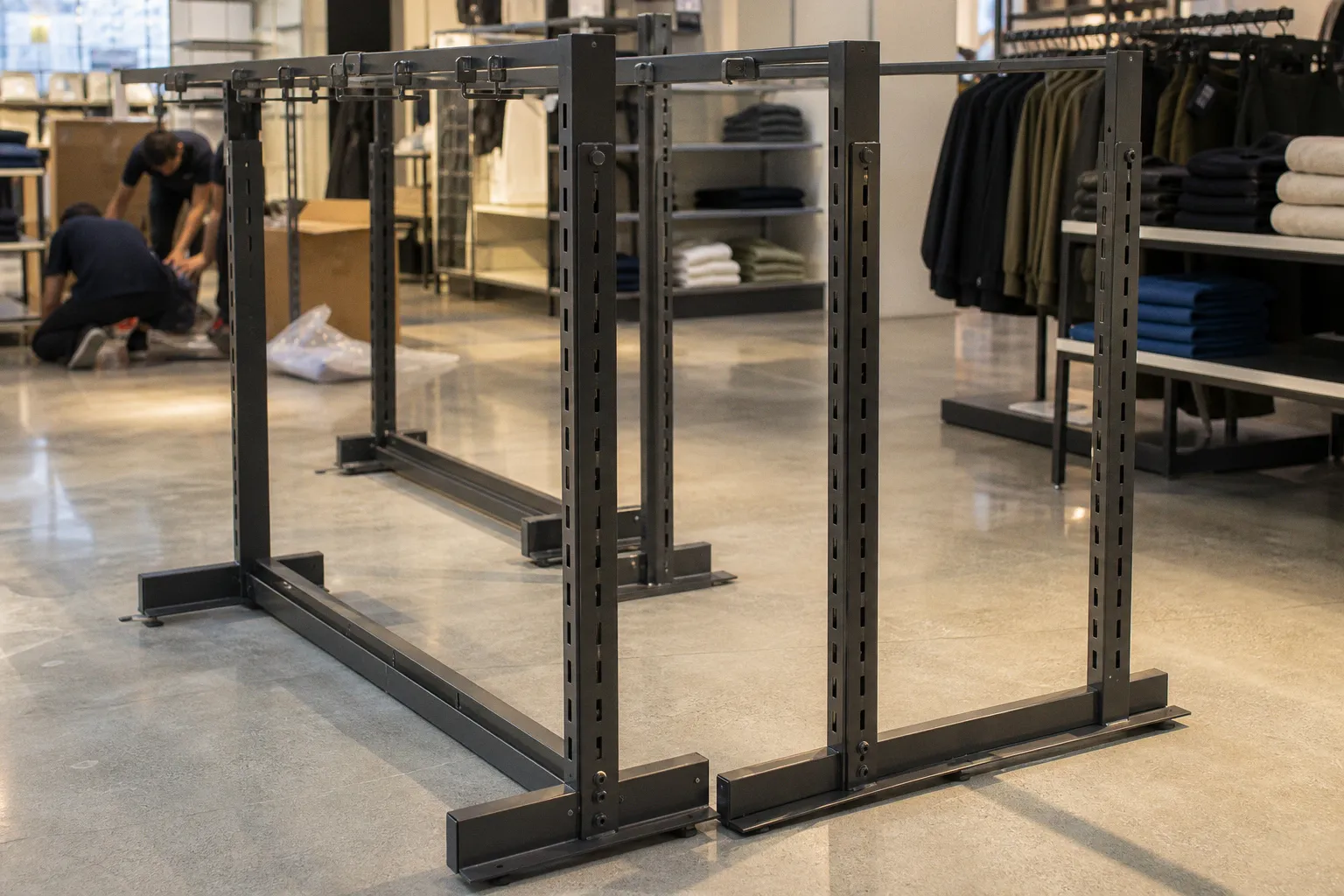
Material selection should also reflect the product’s physical behavior. Heavy bottles need structural support and stable shelves. Small accessories need containment so they do not disappear into the fixture. Testers need wipeable surfaces and replaceable components. Products with security concerns need tethering that does not make the interaction feel hostile. Garment-related displays have their own requirements: hanging rails, folded-product shelves, size communication, garment recovery, and enough clearance for shoppers to browse without dragging one item across another. “Display” is not a single operating condition.
The Future of Point of Purchase: Digital and Robotic Integration
The next generation of point of purchase display options will not eliminate the temporary, semi-permanent, and permanent categories. It will blur the line between the physical fixture and the content running on it.
Digital point of purchase displays use LED screens, electronic shelf labels, projection, and interactive kiosks to rotate content dynamically. The hardware is permanent or semi-permanent; the messaging is temporary. A screen at the cosmetics counter can run a serum campaign in the morning, a fragrance push in the afternoon, and a gift-set pitch during the holidays — all on the same fixture, without replacing the printed header each time.
That flexibility is valuable, but it is not free. Digital hardware requires power, network access, content production, device management, security, and a plan for failure. A screen that goes dark during a launch is not just a technical issue; it changes the quality of the entire brand presentation. The store needs to know who to call, how quickly the unit can be reset, and what the fallback message is when the network is unavailable.
The creative workflow changes as well. Printed graphics are approved as finished objects. Digital content behaves more like a schedule. It can be localized, updated, tested, and retired, but every change introduces another approval path. The strongest programs establish content rules early: screen brightness, loop length, sound policy, accessibility, language versions, product claims, and what happens when inventory is unavailable. Dynamic content should not become a faster way to distribute outdated information.
For brands with multiple product lines and short campaign cycles, digital can collapse several semi-permanent refreshes into a single installed footprint. It is most persuasive when the location is valuable, the assortment changes frequently, and the retailer can support the operating requirements. It is less persuasive when the store environment has unreliable power, limited connectivity, low dwell time, or no clear owner for the equipment.
Robotic POP displays are newer, more theatrical, and a little harder to source. Think motion-activated robotic arms that demonstrate a product, dispense a sample, or draw the eye with movement. These systems are more common in flagship environments, high-traffic specialty retail, and brand activations than in routine store programs. The effect can be powerful because movement creates a reason to look, but the novelty is not a strategy by itself.
Robotic displays bring a different maintenance profile. Moving parts wear, sensors need calibration, software may require updates, and safety rules become part of the retail brief. The system must be designed so that a store associate can identify a fault and make the area safe without waiting for a specialist. If the display requires a technician for every minor issue, the operational burden can overwhelm the engagement benefit.
Neither digital nor robotic systems replaces the three core categories. They sit on top of them. A digital kiosk is still a permanent fixture with a marketing content layer; the lifecycle math does not disappear, although the communication layer becomes more flexible. A robotic demo arm is usually mounted to a semi-permanent or permanent base. The point of purchase display materials under the screen or around the mechanism still have to match the campaign duration and the store environment.
The practical question is not whether the display looks futuristic. It is whether the added layer solves a real merchandising problem. Digital can help when the brand needs frequent message changes. Motion can help when the location suffers from low visibility or weak stopping power. Neither is a substitute for product availability, clear pricing, good placement, or a fixture that shoppers can understand in a few seconds.
Closing the Loop on Point of Purchase Display Options
There is no universally best entry in the point of purchase display options lineup. There is only the right match between campaign window, material durability, store environment, operational ownership, and financial treatment.
Temporary corrugated earns its place on seasonal launches and new-product tests where speed to shelf, pre-filled shipping, and clean end-of-life matter more than a long service life. Semi-permanent acrylic, wood composite, and light-gauge metal earn theirs on cosmetics counters, pharmacy testers, and other high-touch zones where the product price and customer interaction demand a more durable signal. Permanent metal, glass, and integrated systems earn theirs on flagship brand zones, coolers, and long-term placements where the retailer relationship and capital commitment justify the installation.
The most expensive mistake is not always choosing the highest-cost fixture. It is choosing a fixture whose lifecycle does not match the work it is supposed to do. A permanent display can become stranded inventory when the category changes. A temporary shipper can look tired before the promotion ends. A semi-permanent counter unit can sit in storage because nobody decided who would move it when the original program finished.
Treat the display as part of the campaign’s operating model. Price the whole lifecycle. Build in refresh and redeployment where they are realistic. Measure what the fixture is meant to influence, not just how impressive it looked on opening day. When the tool matches the job, material choice becomes a commercial decision rather than a finishing preference — and the floor has a much better chance of doing what the campaign promised.