Display Rack Finish Checklist: What to Know Before Ordering
I’ve racked up—pun absolutely intended—enough time on retail floors and back-of-house stockrooms to know that the finish on your display rack can matter almost as much as the rack itself.
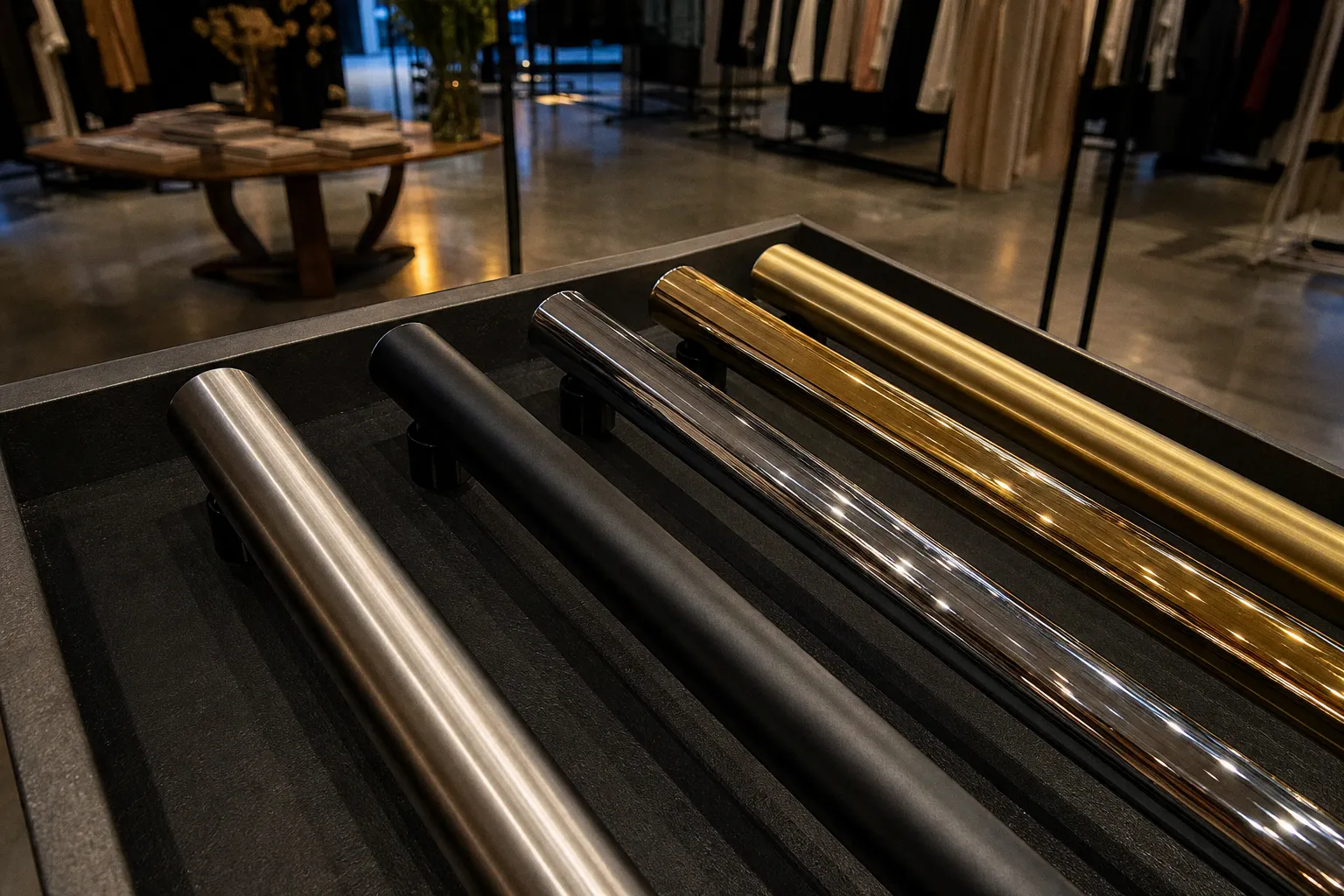
Buy the wrong combination of metal, preparation, and finish, and you’ll be looking at chipped coating on a $400 frame while the floor manager asks why the “brass” wall has started looking tired before the season is over.
That is not a cosmetic issue. It is a specification failure.
Finish language is also a convenient fog machine. PVD, powder coat, electroplate, #8 mirror: one supplier uses the terms precisely, another uses them as catalog wallpaper, and a third assumes nobody will ask what sits beneath the pretty sample chip. A useful commercial display rack metal finish checklist begins by separating appearance from protection, and protection from the strength of the frame underneath.
Molecular vs. Polymer Barriers: PVD and Powder Coating Mechanics
PVD and powder coating are often presented as competing versions of the same thing. They are not. Both are finishes in the broad, practical sense—each changes the surface of a rack—but they are created in very different ways and solve different problems.
Physical Vapor Deposition, or PVD, is a vacuum-deposition process. Material is vaporized in a controlled chamber and deposited as an exceptionally thin metallic or ceramic film on the prepared substrate. Depending on the system and the desired color, that film may involve materials such as titanium, zirconium, chromium, or related compounds. It is measured in microns, not in the thick, paint-like film build associated with powder coating.
That distinction matters, but it needs to be described honestly. PVD is not metal “absorbed into the lattice” of a rack tube, and it is not invincible because it is thin. It is a vacuum-deposited surface film with adhesion that depends on substrate preparation, polishing, cleaning, deposition parameters, and whatever layers sit below it. A well-executed PVD finish can be hard, uniform, and remarkably handsome. It can also scratch, wear through under severe abrasion, or fail where adhesion is poor.
Powder coating takes the opposite route. Dry polymer powder is electrostatically applied to metal and heat-cured into a continuous protective film. On a rack, it is visibly and physically more substantial than PVD: a polymer barrier over the frame rather than a very thin deposited film. It is available in a huge range of colors and textures, from fine matte black to heavy wrinkle finishes that make a budget fixture look more intentional than it has any right to.
The advantage is practical coverage. Powder can soften the visual impact of minor surface irregularities and provides a reasonably forgiving barrier when the metal has been properly cleaned and pretreated. The weakness is equally practical: strike the edge of a powder-coated tube hard enough, or bend a poorly made frame, and the film can chip or crack. Once the substrate is exposed, corrosion can begin underneath the coating, especially on mild steel.
PVD is not magic and powder coat is not “just paint.” The useful question is whether the finish suits the contact, cleaning, humidity, and abuse the rack will actually see.
For garment rack powder coating specifications, ask more than “what color?” Ask what the substrate is, how it was pretreated, whether welds were cleaned before coating, and whether the quoted finish is intended for indoor retail, a stockroom, or an exposed loading area.
For PVD, ask whether the supplier can identify the base metal and the surface preparation beneath the film. A polished PVD gold finish on stainless can look superb in a boutique. The same visual treatment over inconsistent weld grinding or a poorly prepared base will make every defect look expensive.
| Practical question | PVD finish | Powder-coated finish |
|---|---|---|
| What is it? | A very thin vacuum-deposited metallic or ceramic film | A heat-cured polymer film |
| Typical visual character | Crisp, metallic, often deep and reflective | Broad color range, from matte to textured |
| Where it excels | Premium decorative surfaces, controlled interiors, refined metallic tones | General-purpose retail fixtures, broad color matching, economical coverage |
| Common failure mode | Scratching, abrasion wear, or adhesion failure in a poorly prepared system | Chips, cracks, edge damage, and corrosion beneath damaged film |
| What matters most | Substrate quality, polishing, deposition quality, cleaning method | Pretreatment, film coverage, cure quality, and impact exposure |
The point is not that one finish wins every time. A black powder-coated steel stockroom rail may be exactly right. A brushed gold PVD display bar may be exactly right. Trouble starts when a buyer specifies the look without specifying the working environment.
Corrosion Resistance Benchmarks: Interpreting Salt Spray Test Data
Every finish conversation eventually lands on salt spray hours. ASTM B117 testing exposes samples to a salt-laden fog and records the onset of corrosion or visible failure. It is useful, widely recognized, and easy to misuse.
Salt spray is not a prophecy. A retail floor is not a laboratory cabinet filled with salt fog. The test does not tell you how a rack will respond to hanger abrasion, shoe scuffs, fingerprints, strong cleaning chemicals, a hard impact from a rolling fixture, or years of sunlight through a storefront window. What it does provide is a comparable corrosion-resistance benchmark when the test method, substrate, pretreatment, and failure criteria are clearly stated.
Here is the broad hierarchy buyers tend to encounter, with one major caveat: these ranges can vary sharply based on the full coating system, not merely the finish name in a catalog.
| Finish type | Broad ASTM B117 range often quoted | What to interrogate |
|---|---|---|
| Decorative zinc plating | 24 to 96 hours | Conversion coating, clear topcoat, and intended indoor use |
| Nickel-chrome plating | 48 to 240 hours | Underlayers, total plating quality, edge coverage, and substrate |
| E-coating | 240 to 1,000+ hours | Pretreatment, topcoat system, and damage resistance |
| Powder coating, properly prepared | 240 to 1,000+ hours | Pretreatment, cure process, film coverage, and test criteria |
The table is not a shopping list. It is a prompt to ask better questions.
A “chrome garment rack” can mean several very different things. It might be a decorative finish designed for clean, dry interiors. It might be a more robust nickel-chrome system over a properly prepared steel substrate. Those two racks can look indistinguishable in a product photograph and behave very differently near a humid entryway or loading dock.
PVD also deserves a cleaner explanation here. PVD on stainless steel is often chosen for decorative color, hardness, and a high-end surface character. The stainless substrate carries much of the corrosion story. The PVD film can contribute to the overall surface system, but it should not be treated as a standalone corrosion guarantee—especially if the rack has scratches, exposed welds, poorly finished edges, or a damaged base material beneath it.
A salt-spray number without a substrate, test report, and definition of failure is not a specification. It is a sales adjective wearing a lab coat.
A 96-hour rating may be perfectly workable for an indoor fixture in a dry, climate-controlled store. It is a different conversation for a coastal storefront, a semi-open mall corridor, or a rack parked near a receiving door that stays open through wet weather. The right finish is always local.
Salt spray also says little about ultraviolet exposure. A rack positioned in a sunlit window can fade, chalk, or shift in appearance even when it has respectable corrosion performance. That matters most for outdoor or semi-exposed installations, but bright storefront glazing can create its own quiet punishment.
Achieving High-End Aesthetics: Mirror Finishes and Brushed Brass
Now leave the test cabinet and step onto the sales floor, because finish selection is also visual engineering. A rack has to survive, yes. It also has to know when to stop talking.
Mirror stainless is the loudest example. #4 is the familiar brushed satin finish common on commercial equipment. #6 is more refined. #8 is the high-gloss mirror finish used where the rack itself is expected to read as an architectural object rather than background hardware.
Getting to a convincing mirror finish means progressively polishing the underlying steel until surface marks are minimized and reflection becomes clear. It is beautiful. It is also unforgiving. Fingerprints, hanger rub, poor lighting, and even slightly uneven weld finishing become part of the presentation.
A mirror black PVD rack can look extraordinary because the reflective substrate and dark deposited film create depth that ordinary black paint cannot quite reproduce. But this is exactly where marketing language gets reckless. The PVD layer is still a thin deposited film. It may resist ordinary handling very well when the system is properly made, but repeated metal-on-metal hanger contact, rough hooks, abrasive cleaning pads, and grit caught in moving parts can mark it over time.
If a supplier is offering mirror black, ask for a real sample long enough to use, not a postcard-sized swatch that has never met a steel hanger. Slide the actual hangers you plan to use across it. Wipe it with the approved cleaning cloth. Look at it under the store’s lighting. The finish needs to survive your behavior, not the supplier’s showroom shelf.
Brushed brass creates a different problem. Everybody asks for it because it carries warmth that chrome does not. It can make a rail of plain knitwear look more deliberate; it can make an otherwise generic wall system feel like it belongs in the room. But “brushed brass” is an appearance, not a complete material description.
It may mean solid brass components, brass plating, a brass-toned PVD film over stainless, or a brass-colored powder coat over steel. Those are not interchangeable systems.
- Solid brass and brass plating can tarnish, especially in humid or salt-laden environments. The familiar darkening or greenish corrosion products are part of the material’s chemistry, not a surprise defect.
- Brass-toned PVD may provide the visual effect without exposing actual brass at the surface in the same way. Its performance depends on the deposited film, base material, and integrity of the whole system.
- Brass-colored powder coat is usually the most economical route to the color, but it reads differently at close range and can lose credibility quickly if chips expose dark steel underneath.
For dry, climate-controlled interiors, brushed brass is a strong visual choice. For a coastal doorway, an unconditioned stockroom, or a site where staff will clean fixtures aggressively with whatever happens to be in the janitor’s closet, it requires a more skeptical conversation.
Do not ask for “tarnish-proof brass.” Ask what the surface actually is, how it should be cleaned, what the warranty covers, and what happens at damaged edges.
Structural Integrity and Material Selection for Heavy-Duty Racks
Finish talk has a habit of floating above the real issue: the frame. A beautiful gold PVD finish on a thin, flexible tube is still a thin, flexible tube. A mirror-polished upright with a weak weld is a liability with excellent lighting.
For heavy garments—winter coats, tailoring, layered wool, dense denim—the underlying material and tube construction matter more than the color chip. Stainless steel is a familiar workhorse for commercial garment racks because it offers corrosion resistance, a refined appearance, and reliable performance when the tube wall, joints, and load design are appropriate. Grade 304 stainless is common for indoor commercial applications, particularly where the rack will be touched constantly or displayed as part of the store architecture.
Mild steel is not automatically cheap junk. Properly designed mild steel can make an excellent commercial rack, especially with a well-applied powder-coated or plated finish. It is often the sensible choice for large fixture programs where the rack is expected to blend into the merchandising system rather than become the visual centerpiece.
Aluminum brings low weight and natural corrosion resistance, but it has its own design limits. It needs proper section sizing and construction to avoid deflection under heavy loads. A rack that bends is not merely unattractive; bending stresses the finish at corners, joints, and attachment points. The resulting crack may look like a finish problem when it began as a frame problem.
This is why “stainless versus powder-coated steel” is not the actual comparison. Stainless can be powder coated. Steel can be plated. PVD can sit over a suitable metal substrate. The real comparison is between complete systems: material, wall thickness, welds, reinforcement, finish, and expected load.
Finish follows frame. Choose the substrate and construction for the work first; then choose a finish that can live with that decision.
If a rack will carry dense merchandise, ask for documented load guidance for the actual configuration—not simply a proud claim that it is “heavy duty.” A long unsupported bar, a mobile rack on casters, and a fixed wall-mounted rail all distribute stress differently. The finish cannot correct an underbuilt span.
For powder-coated steel, pay particular attention to bends, welds, end caps, and feet. These are the places where damage begins. A thick-looking coating on the straight run of a tube means very little if edges are thinly covered, weld spatter remains beneath the film, or the feet invite moisture to sit against exposed metal.
High-Touch Surface Durability: Chrome and Electroplating Standards
Chrome has survived generations of commercial garment racks because it is smooth, familiar, reflective, and relatively easy to keep looking presentable. But “chrome” is another word that can conceal more than it reveals.
Commercial chrome plating is generally a layered electroplated system. Copper may be used for leveling and adhesion, nickel provides much of the brightness and corrosion resistance, and the chromium top layer supplies the familiar color and surface hardness. The details of that stack—the preparation, layer quality, thickness, and coverage—make the difference between a rack that stays handsome and one that blisters at the first hard season.
Chrome plating is still a finish layer, not a structural rescue operation. It cannot stabilize poorly prepared steel. It cannot protect a sharp edge that received inadequate coverage. And once damage reaches the substrate, corrosion may travel beneath the plated layers in ways that look far worse than the original scratch.
When choosing metal plating for display racks, distinguish decorative use from the actual abuse level of the fixture. A small display stand in a climate-controlled boutique and a rolling garment rack in a receiving area should not be specified as though they have the same life.
There is also no reliable “thumb test” that can certify plating quality. A chrome surface may feel cool and smooth for many reasons, including the temperature of the room and the mass of the metal beneath it. Use your hands to judge obvious roughness, sharp edges, poor polishing, or visible waviness—but do not mistake a tactile impression for proof of a robust plating stack.
A better buyer’s approach is less romantic and more useful:
1. Request a physical sample in the exact finish. Not a digitally corrected catalog image and not a generic chrome chip from another product line.
2. Inspect welded areas and tight corners. These are common weak points for cleaning, coverage, and corrosion resistance.
3. Ask what lies beneath the chrome. A supplier should be able to describe the substrate and plating sequence without changing the subject.
4. Test it with the actual operating conditions. Use the store’s hangers, cleaning products, garment hooks, and handling routine.
5. Read the warranty language carefully. “Wear and tear” can be a reasonable exclusion, but it should not become a catch-all escape hatch for premature peeling, blistering, or obvious adhesion failure.
Heavy-use chrome can remain an excellent choice for garment rails because it gives hangers a slick, low-friction surface and looks neutral beside almost any merchandising palette. It is especially useful when the rack needs to disappear behind the product rather than announce a design statement. But like every finish on this list, chrome is only as credible as the process behind it.
The Purchase Order Is Where the Finish Becomes Real
Before you commit, make the supplier put the finish into plain language. The right questions do not need to sound like a chemistry exam. They need to make ambiguity uncomfortable.
- What is the substrate, and how is the frame built? Get the material, tube dimensions, wall thickness, joint method, and load guidance for the actual rack configuration.
- What precisely is the finish? “Gold,” “brass,” “black,” and “chrome” are visual descriptions. Ask whether the system is powder coat, plating, PVD, polished stainless, or a combination.
- What surface preparation happens before finishing? Cleaning, pretreatment, weld cleanup, polishing, and edge preparation determine whether a finish has something stable to adhere to.
- What testing supports the corrosion claim? If ASTM B117 is cited, ask for the test basis and what counted as failure. A number alone does not tell the whole story.
- What will touch this rack every day? Steel hangers, plastic hangers, hooks, folded denim, rolling carts, cleaning products, salty air, and direct sun all change the answer.
- What is the maintenance instruction? A finish that needs a gentle microfiber cloth and mild cleaner should not be installed where the nightly cleaning routine involves abrasive pads and harsh degreasers.
- What does the warranty actually cover? Structural defects, finish adhesion, corrosion, discoloration, and normal abrasion are different categories. Make the supplier define them.
The commercial rack finish durability checklist is not really about finding the toughest word in a brochure. It is about aligning a surface with its job. Powder coat is often the practical workhorse. Chrome remains a credible high-touch standard when plating quality is real. PVD can deliver exceptional metallic color and refinement, provided everyone understands it is a thin vacuum-deposited film—not an indestructible miracle layer. Stainless earns its reputation when the frame itself is designed to carry the load.
Spend the extra week on the specification. The catalog photo will not be there six months after opening. The rack will.