Gravity flow racks vs static shelves for retail
You've walked a grocery aisle at 2 PM on a Saturday and seen the carnage: a vitamin shelf where the front row is empty by 10 AM and the back row sits untouched until next week's reset.
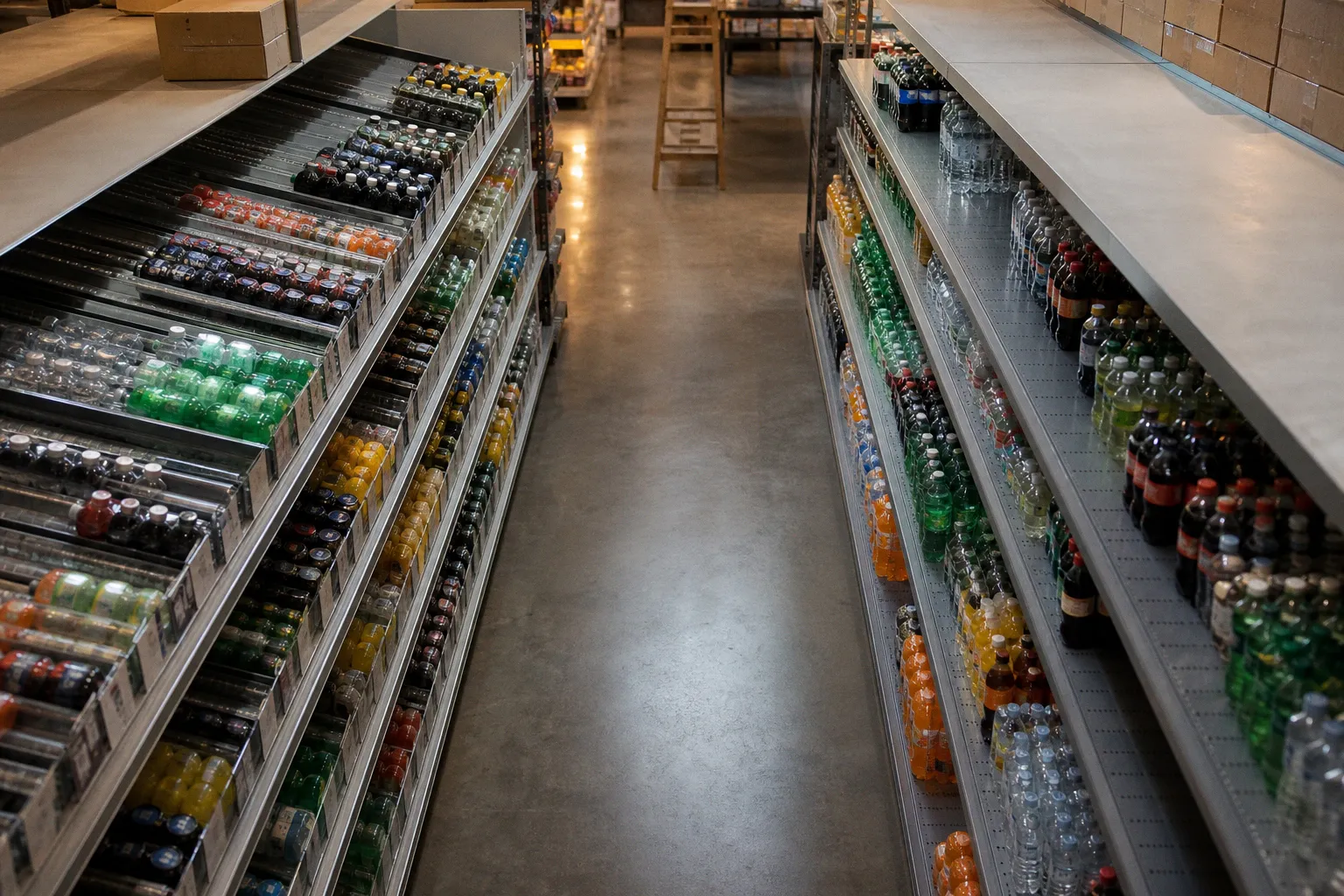
Multiply that across fifty facings, four aisles, and three endcaps, and you have a labor problem that no planogram can fix by itself. The question every retail space strategist eventually lands on is whether gravity feed shelving or flat retail racks — gondolas, static wire decks, the workhorses of the supermarket — actually pay you back at the shelf edge. We have spent enough floor hours resetting, remerchandising, and watching dwell time evaporate behind a stack of slowly migrating cans to have a real opinion. Here is the comparison, drawn from how the systems actually behave under SKU pressure, not from the brochure.
Compare car rental deals in United Kingdom
See available offersPartner link — DiscoverCars comparisonThe Mechanics of Self-Fronting: What Gravity Flow Does That Flat Racks Cannot
A gravity feed shelf is, at its core, an inclined surface paired with roller tracks that let merchandise slide forward as the front unit is removed. Think of a vending machine tray in horizontal form: you take one, the next one rolls to the lip. Madix's @Front system, for instance, is described by the manufacturer as a gravity-feed roller shelf designed to convert a standard Madix shelf into a self-fronting display, with the explicit purpose of reducing manual facing and keeping product at the front edge where shoppers actually look. UNEX makes a similar pitch for its gravity-fed Roller Rack, positioning it as a tool for strict FIFO rotation in backroom and picking environments.
Flat retail racks — gondola shelving, wire decks, pegboard back panels — do none of that on their own. They are static platforms. Product stays exactly where your last merchandiser put it, and if your customer pulls the front three SKUs, you have a three-SKU void until somebody walks the aisle again. That is the central mechanical difference: a gravity shelf moves product; a flat shelf holds product. Everything downstream — labor, planogram discipline, SKU density, even sightlines — flows from that one distinction.
| Parameter | Gravity feed shelving | Flat retail racks (gondola / wire) |
|---|---|---|
| Movement | Inclined roller or track feeds product to the front | Static; product stays where placed |
| Manual fronting required | Minimal if lane and slope are tuned | Required after every few customer picks |
| Reconfiguration speed | Limited — roller widths, dividers, slope are tuned per lane | Fast — Lozier's standard gondola island offers 1-inch vertical shelf adjustability across standard- and heavy-duty versions |
| Best product fit | Flat-based, uniform packaged goods (bottled drinks, cans, vitamins, pharmacy) | Anything you can stage — heavy case packs, irregular sizes, promotional drops |
| Loading discipline | Operator must load from rear to realize FIFO | FIFO only if staff enforces it |
| Capital complexity | Higher — rollers, dividers, tuning per lane | Lower — shelf, bracket, label holder |
A small but important caveat: "self-fronting" is shorthand, not a guarantee. A gravity shelf only self-fronts when the lane width, product width, and downslope are matched to the merchandise. A retail-shelving patent actually documents the failure mode: when fixed roller-unit widths do not match product widths, you get gaps in the lane and poor flow, and if you mix multiple product lines on one roller unit, the rollers can impede each other. The shelf is not magic. It is a tuned system, and tuned systems demand setup time you cannot skip.
FIFO Rotation: Where Gravity Earns Its Keep and Where the Discipline Still Lives
The cleanest argument for gravity feed shelving is FIFO — first-in, first-out. When stock is loaded at the rear of an inclined lane and picked from the front, older inventory naturally rotates forward and gets sold before newer inventory piles up behind it. For dated merchandise, pharmacy, supplements, dairy-adjacent packaged goods, and any category where shrink is driven by expiry, that rotation is worth real money. UNEX explicitly markets its gravity-fed Roller Rack around strict FIFO rotation, and that positioning is honest when the operating process actually loads from the back.
Here is the part the brochure glosses over: gravity does not enforce FIFO. Loading discipline does. If your overnight crew stages new pallets at the front of a gravity shelf because the back is harder to reach, you have a flat rack with extra hardware. The shelf enforces FIFO only when the SOP enforces FIFO. So when we evaluate gravity flow for FIFO-sensitive categories, the question we ask first is not "what is the angle?" — it is "will our team load from the rear, every time, without exception?" If the answer is an honest yes, gravity pays. If the answer is maybe, a flat gondola with a disciplined reset cadence is more reliable than a gravity shelf with a lazy SOP.
The shelf does not push product forward. Process does — and gravity just makes the process harder to fudge.
The same logic applies to labor. Yes, gravity flow reduces manual facing, and on a high-velocity canned-beverage aisle that translates to fewer associate hours per week per aisle. But there is no published, store-independent figure we can point to as a universal labor saving, and anyone selling you a fixed percentage reduction is guessing. What we can say from floor experience is that the labor moves: instead of facing three times a day, you stage from the back once or twice a day, and you spend the saved minutes on planogram accuracy, signage, or the next aisle over. That is a real gain, but it is a redirection of labor, not always a net reduction.
Slope, Load, and the Numbers That Vary by Manufacturer
This is where a lot of retail layout decisions go sideways, because the temptation is to treat "gravity shelf" and "flat shelf" as categories with one set of numbers each. They are not.
Take slope. Lozier lists a gravity-feed shelf with a fixed 8° downslant, offered in 3-foot and 4-foot widths and depths of 19, 22, 25, 28, or 31 inches. Madix, on its @Front G5 roller system, specifies a 6°–7° downtilt — and the same catalog states that a standard 15° downtilt is too steep for that roller design. So if a fixture installer walks in and assumes every gravity shelf wants the same angle, the lane will either run product too fast (heavy items launching off the front lip) or too slow (product stalling and bridging in the middle). Slope is matched to the specific gravity-feed design, not assumed.
Load capacity follows the same logic, with a sharper edge. For one Madix static shelf family, published maximum load capacities run from 300 to 600 lb under evenly distributed static loading, depending on shelf type and depth. The same catalog shows lower figures for front-loaded conditions and for 15° or 30° angled configurations. That means we cannot — and we should not — quote a single "static shelf capacity" number to a store planning a heavy case-pack program. The rating depends on the exact shelf model, depth, mounting, load distribution, and shelf angle. If your merchandiser is loading 80 lb cases of bottled water on a 22-inch flat shelf, you need the manufacturer's specification for that exact SKU, not a category average.
A few practical numbers worth keeping at your desk:
- Lozier gondola island: 1-inch vertical adjustability, standard- and heavy-duty versions.
- Lozier gravity-feed shelf: 8° fixed downslant, 3 ft or 4 ft widths, 19–31 in depths.
- Lozier beverage dividers: sized for most two-liter bottles or 2.62-inch-diameter spray-paint cans — read: not every container.
- Madix @Front G5: 6°–7° downtilt required; 15° is too steep for that system.
- Madix static shelf examples: 300–600 lb max under evenly distributed static load, lower for front-loaded or angled conditions.
If a vendor hands you a one-line "load rating" or "shelf angle," ask for the SKU, the depth, and the load condition. If they cannot produce all three, the number is decoration.
Adaptability and Product Compatibility: When a Roller Lane Helps and When It Costs You
The most expensive mistake we see on gravity retrofits is treating the shelf as a universal upgrade. It is not. Gravity flow is matched, lane by lane, to packaged goods with flat bases and consistent dimensions — bottled drinks, canned goods, vitamins, pharmacy items, certain bagged snacks. UNEX and Madix both design around that envelope, and the accessories reinforce it: dividers, front risers, and adjustable angled supports are used to form lanes, prevent forward slip, and tune the slope for product weight and size. Lozier's beverage dividers are explicitly sized for two-liter bottles or 2.62-inch-diameter spray-paint cans, which tells you everything about the intended product universe.
Where gravity flow struggles — and where flat gondola shelving earns its keep — is anywhere SKU dimensions swing wildly from facing to facing. A grocery endcap running a wine promo one week and a 12-pack of paper towels the next cannot live on a tuned roller lane. A hardware aisle mixing 1 lb blister packs with 30 lb tool cases cannot live on a tuned roller lane. A seasonal candy drop with mixed bag sizes cannot live on a tuned roller lane. The patent literature we referenced earlier says this in plainer language: fixed roller-unit widths create gaps and impede flow when product widths do not match the layout. A flat gondola shelf, by contrast, takes whatever you put on it. Lozier's standard gondola with 1-inch vertical adjustability and standard- or heavy-duty versions is built for layouts that need frequent vertical reconfiguration, which is most of the working supermarket.
So the layout question is not "gravity or flat" in the abstract. It is "which aisles move uniform, flat-based, dated, fast-velocity SKUs all day, every day?" Those are your gravity candidates. Everything else stays on flat gondola. Many of the best-performing stores we have walked run a hybrid: gravity feed shelving in beverages, vitamins, and pharmacy; flat gondola everywhere else. The hybrid is not a compromise. It is the actual best practice.
Sanitation, Certification, and the NSF/ANSI 2 Question
When shelves hold packaged goods only, sanitation certification is rarely the deciding factor. When shelves hold unpackaged food, are part of a refrigerated case, or sit in a prep or serving zone, the question changes. NSF/ANSI 2 is the standard that establishes minimum food-protection and sanitation requirements for the materials, design, fabrication, construction, and performance of food-handling equipment, and NSF published an update article on the standard as recently as October 14, 2022.
The point that matters for store planning: NSF/ANSI 2 is not a universal requirement for every supermarket display rack. Its applicability depends on what the fixture actually touches — unpackaged food, prep surfaces, refrigeration, or just packaged retail goods — and on the local jurisdiction's inspection regime. Gravity flow shelving used in a cold vault for packaged dairy is a different conversation than gravity flow shelving used in a produce prep back room. The same flat gondola in a dry-goods aisle is a different conversation than the same gondola in a bakery zone. Before you specify a fixture for a food-adjacent role, confirm whether NSF/ANSI 2 applies to that specific use case, and confirm with your local authority having jurisdiction. The certification is a tool, not a marketing checkbox.
Closing the Loop: A Working Decision Framework
If you are staring at a refresh budget and trying to decide where gravity feed shelving earns its place, walk this in order. First, isolate the aisles where SKU dimensions are uniform, velocity is high, and dated merchandise drives shrink — those are the gravity candidates, full stop. Second, in those aisles, confirm that your loading SOP actually loads from the rear, because gravity without rear loading is decoration. Third, demand manufacturer-specific numbers from your vendor: slope in degrees, lane width in inches, divider compatibility, load rating for your exact shelf model and depth under your exact load condition. If the vendor cannot produce all of that, the proposal is not ready. Fourth, leave the mixed-SKU aisles on flat gondola shelving — the 1-inch adjustability and standard / heavy-duty range of a Lozier-style island is exactly what those aisles need. Fifth, for any fixture touching unpackaged food, refrigeration, or prep, verify whether NSF/ANSI 2 applies in your jurisdiction before the order is cut.
Self-fronting is not a magic trick. It is a tuned angle, a tuned lane, a tuned workflow — and a willingness to leave the rest of the store on the gondola it already knows how to run.
Run that pass and you will end up with a hybrid layout, not a one-system-fits-all store. That is the configuration that actually moves dwell time, protects margin on dated goods, and keeps the reset labor where you can see it on the schedule. The retailers winning the shelf-edge game right now are not the ones who picked a side. They are the ones who matched the system to the SKU and refused to let a brochure do their merchandising for them.