Optimizing Small Retail Spaces with Strategic Gondola Shelving Layouts
Fermos just dropped an updated layout planning guide built around modular gondola shelving, and for anyone running a small footprint, it's the kind of read that pays for itself before the fixtures even ship.
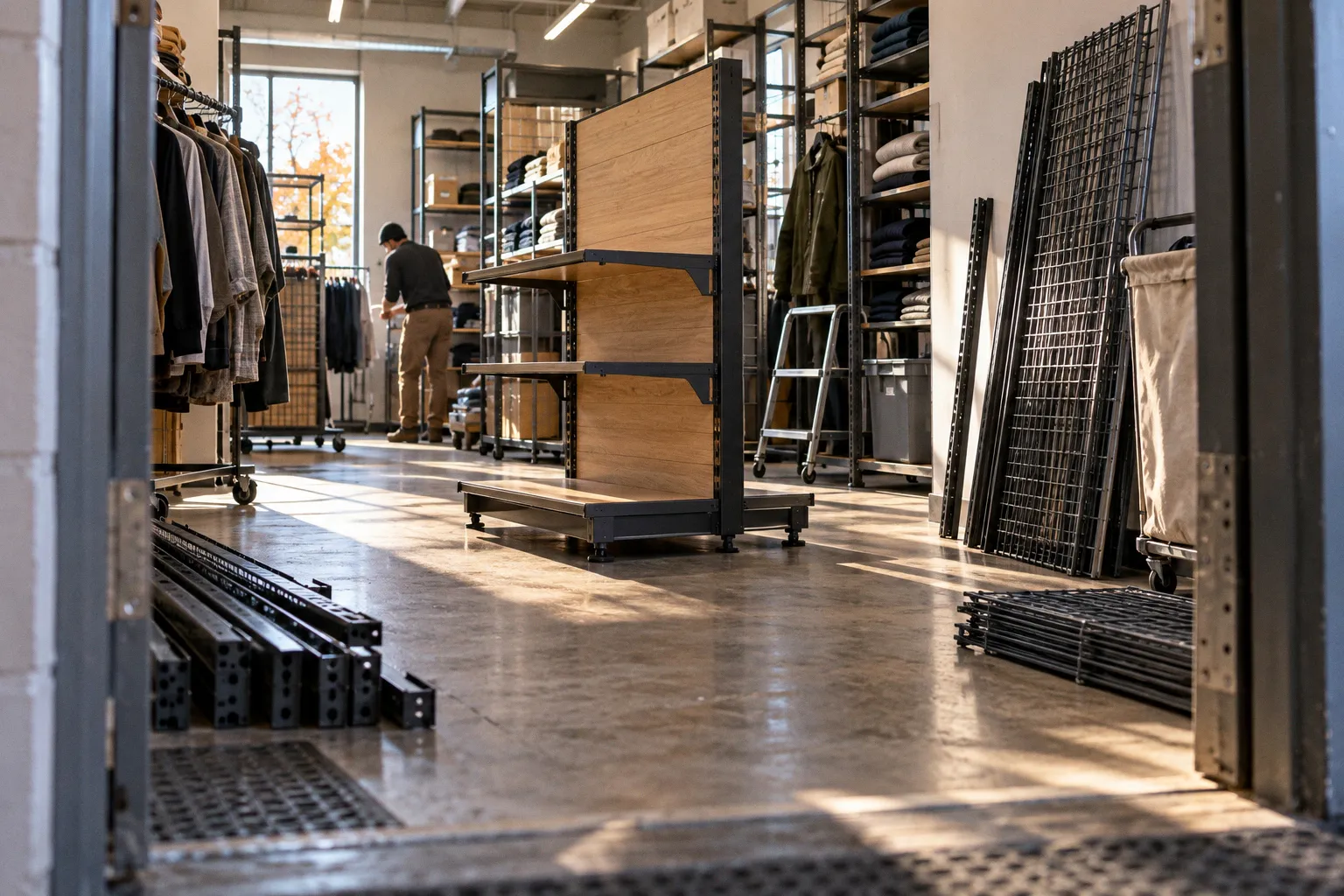
Walk into any compact store that feels cramped and you'll spot the problem in seconds — gondolas shoved wherever a square foot was empty, endcaps doing nothing for margin, and sightlines that turn shoppers around before they hit the back wall. Fermos just dropped an updated layout planning guide built around modular gondola shelving, and for anyone running a small footprint, it's the kind of read that pays for itself before the fixtures even ship. It lands right alongside a fresh round of fit-out analysis — slatwall-versus-gondola tradeoffs from ADP Retail Systems, new checkout-zone design guidance from Dina Group — all of it pointing at the same truth: when floor space is tight, the shelving system is your real store.
Run the Walls, Free the Center
Here's the spatial rule we lean on with every small-box retailer we walk through: single-sided gondolas belong against the perimeter, not the middle of the floor. You pull display space off the edges, you open up the core for actual customer movement, and suddenly the store breathes instead of bottlenecks. Drop one or two short double-sided runs down the center to create your cross-aisles — short enough that shoppers can switch categories without committing to a runway that feels like a bowling lane. If your entrance feels boxed in, that's usually a height problem, not a square-footage problem. Keep your lower gondolas near the front door so first-time customers get an unobstructed view the second they cross the threshold, and let the taller fixtures earn their keep toward the back and side walls where vertical real estate stops feeling like overhead.
Endcaps, Sightlines, and the Checkout Pull
This is where I see small stores bleed conversion every single week — endcaps get treated like overflow shelves instead of campaign real estate. One category per cap, one message, one clear visual. Seasonal push, new arrival, promotional price, high-margin line — pick the lane and own it. A clean, single-focus endcap pulls eyes from twenty feet away; a cluttered one reads as more shelf space customers have already ignored. Pair that with category-grouped gondola runs so complementary SKUs sit shoulder to shoulder, and you give basket-building a running start without adding a single square foot. And while you're tightening those sightlines, don't forget the impulse zone at checkout — Dina Group's checkout design framework is a useful reminder that fixture positioning near the queue is where secondary sales actually live.
Go Modular — Or Plan to Get Reworked
The guide's biggest practical takeaway is also the most underrated: if your product mix or promotion calendar shifts more than twice a year, you don't want a fixed shelving system, you want a modular one. Heights, depths, sections, extensions — when you can reconfigure a run in an afternoon instead of calling a contractor, your planogram becomes a living document rather than a graveyard you dread updating. Fermos's Standard and T-Line gondola systems are built around that kind of flexibility, with different finishes and configurations you can match to the actual store rather than forcing the store to match the shelf. That kind of decision gets easier once you've weighed the alternatives, which is exactly what ADP Retail Systems laid out — slatwall versus gondola, cost factors, weight-bearing tradeoffs, and the floor layouts each one actually serves.
Before you sign the floor plan, run this against your layout: are perimeter walls carrying the single-sided gondolas? Are center runs short and double-sided only where you actually need cross-traffic? Are endcaps each owning one category or campaign? Are lower units staged near the entrance and taller units staged deep? And can your team reconfigure any run without a drill? If you answered yes to all five, your small store just stopped feeling like a storage closet with a register.