Heavy-duty garment racks: a seasonal storage roadmap
A single winter coat weighs approximately 4–6 lb, or 1.8–2.7 kg. That figure is not significant in isolation. It becomes structural load when multiplied across a full hanging rail.
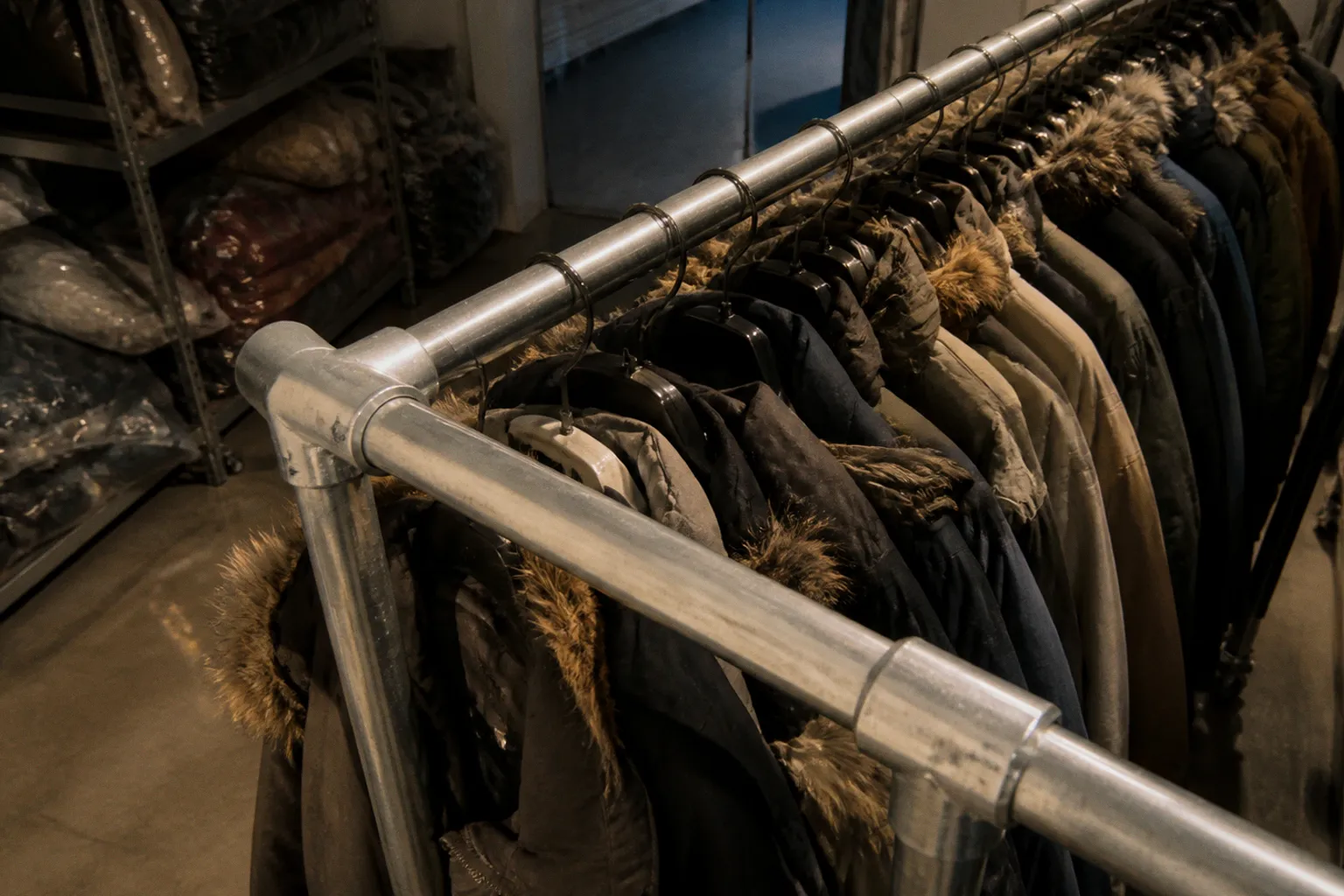
Fifty coats represent roughly 200–300 lb before hangers, garment bags, uneven distribution, or movement are included.
That is the first error in seasonal wardrobe storage: treating winter clothing as a volume problem. It is a load problem. The rack must carry the accumulated mass, resist bending across the rail span, remain stable when loaded, and tolerate lateral forces when moved. A domestic clothes rack rated for 20–40 kg is not equivalent to a commercial system rated for 100 kg, 635 lb, or more. The numbers describe different structural classes.
For heavy duty clothes racks for winter coat storage, the correct selection sequence is therefore mechanical:
1. Calculate the suspended load.
2. Separate static capacity from mobile capacity.
3. Check rail span and unsupported length.
4. Identify the steel section and protective finish.
5. Verify caster geometry, brakes, and floor conditions.
6. Keep the working load below the published limit rather than treating the limit as an operating target.
The physics of winter coat storage: calculating load accumulation
Winter coats create concentrated load. Unlike shirts, dresses, or lightweight jackets, they are thick, dense garments that occupy substantial rail length while adding several pounds each. This produces two simultaneous constraints:
- total rack load;
- load per unit length of the hanging bar.
The first determines whether the frame, posts, joints, and base can carry the assembly. The second determines whether the bar will deflect or buckle between supports.
A rack may advertise a high overall capacity while using a relatively long unsupported rail. That rating does not automatically apply to every individual hanging bar. The frame and the bar are separate structural elements. Their capacities must be assessed separately.
A practical calculation begins with garment count:
Total coat mass = number of coats × average coat mass
Using the documented range:
- 20 coats: approximately 80–120 lb, or 36–54 kg;
- 40 coats: approximately 160–240 lb, or 73–109 kg;
- 50 coats: approximately 200–300 lb, or 91–136 kg;
- 100 coats: approximately 400–600 lb, or 181–272 kg.
These values exclude hangers. They also exclude any lower shelf, side hooks, cartons, or accessory rails. The resulting load is not necessarily uniform. Heavy parkas may be clustered at one end. Wet garments may remain in one section. A dense group near the centre of a long rail produces higher bending demand than the same mass distributed across several supported sections.
Rail loading is not the same as frame loading
A coat rack has multiple load paths:
- garment weight enters the hanger and hanging bar;
- the bar transfers load into vertical posts or end frames;
- the posts transfer force into the base;
- the base transfers force through casters or feet into the floor.
Failure can occur at any part of this path. A bar can deflect while the base remains intact. A caster can deform while the rail still has adequate tensile strength. A bolted joint can loosen under repeated movement without any visible fracture in the tubing.
This is why an industrial garment rack for heavy coats should be evaluated as an assembly, not by one capacity number printed on a product page.
The working load should include the full seasonal inventory, not merely the garments expected to be on the rack during normal display. Storage operations create temporary peaks. Staff may load all coats before rotation, add protective covers, or move the rack while it is at maximum density. Those conditions govern the design decision.
Winter coat storage is governed by accumulated mass and unsupported rail length. The garment count is only the first variable.
Use capacity as a reserve, not as a target
Published static ratings are commonly stated under controlled conditions: level floor, correctly assembled frame, evenly distributed load, and no impact. A rack loaded to its stated static maximum may remain upright in position but have insufficient reserve for rolling, turning, threshold crossings, or uneven floor joints.
A better approach is to distinguish three values:
| Load value | Meaning | Use in planning |
|---|---|---|
| Garment load | Weight of coats, hangers, and attached covers | Calculate before selecting the rack |
| Static rack capacity | Maximum supported load while stationary under stated conditions | Must exceed the complete stored load |
| Mobile working capacity | Reduced capacity while the rack is being moved | Must exceed the complete moving load with reserve |
The research basis for heavy-duty garment racks indicates that mobile dynamic capacity is approximately 30–40% lower than static capacity. The reduction results from lateral forces, garment swing, wheel impacts, and changes in load distribution during movement.
For example, a rack rated at 600 lb static should not automatically be treated as a 600 lb transport platform. A reduction of 30–40% places the approximate moving range at 360–420 lb before considering floor quality, acceleration, or obstacles. This is not a universal certification rule. It is a practical engineering distinction where the manufacturer does not provide a separate dynamic rating.
A domestic rack rated for 44–88 lb is immediately unsuitable for a large winter-coat inventory. Even the upper end of that range can be consumed by fewer than twenty heavy coats. The issue is not whether the rack looks stable when empty. The issue is whether its tubes, joints, base, and wheels remain stable after the load has been multiplied.
Static versus dynamic load ratings: why movement matters
A stationary rack carries primarily vertical force. A rolling rack carries vertical force plus horizontal and rotational forces. The difference is structural.
When a loaded rack starts moving, the garments do not remain perfectly fixed relative to the frame. Coats swing. The centre of mass shifts. The casters encounter floor joints and small changes in elevation. The operator applies force at the frame, often above the centre of gravity. This creates an overturning moment.
The rack does not need to be travelling quickly for this to matter. A slow turn in a narrow aisle can produce more lateral stress than straight-line movement on a level floor. A threshold can impose a short impact through one or two casters. That impact is transferred to the base, uprights, wheel plates, and fasteners.
Static capacity
Static capacity applies while the rack is stationary and correctly loaded. It is most relevant to:
- fixed wardrobe storage;
- back-room garment inventory;
- seasonal clothing held in one position;
- display racks that are not moved during loading.
Static capacity still depends on load distribution. A rating based on evenly distributed weight does not necessarily support the same weight concentrated at the middle of one span or at one end of the frame.
Dynamic capacity
Dynamic capacity applies while the rack is being pushed, pulled, turned, or repositioned. It is affected by:
- caster diameter and swivel action;
- wheel material;
- floor joints and thresholds;
- number of locked casters;
- frame height relative to base width;
- position of the centre of mass;
- rail occupancy and garment swing;
- speed and direction of movement.
A mobile rack with a narrow base and a high coat load has a higher overturning risk than a lower rack with the same total mass. The vertical load may be identical. The moment generated by that load is not.
At least two casters should have locking brakes. The locks are necessary during loading, unloading, steaming, and garment selection. A brake prevents unwanted rolling, but it does not convert a mobile rack into a fixed structural system. The frame still needs an adequate base footprint and correctly tightened joints.
Loading and movement procedure
For a rolling rack for winter clothing, the operational sequence should be controlled:
1. Park the rack on a level surface.
2. Engage at least two caster brakes before loading.
3. Distribute the heaviest coats across the central portion only if the frame and rail are designed for that loading pattern; do not create an end-heavy condition.
4. Keep garments below any specified maximum hanging height.
5. Release the brakes only after verifying that covers, hangers, and loose items cannot catch on nearby fixtures.
6. Move at walking speed.
7. Approach thresholds squarely rather than diagonally.
8. Do not transport the rack at its maximum static load unless the manufacturer provides a compatible dynamic rating.
9. Reapply caster brakes before steaming or sorting.
This is not procedural decoration. Each step controls a specific mechanical variable. Braking controls unintended motion. Balanced loading controls the centre of mass. Slow movement reduces impact. Square threshold approach prevents one caster from receiving the full vertical impulse.
Why “heavy duty” is not a technical specification
The phrase heavy duty has no fixed meaning across all garment rack suppliers. One product may use it to describe a thicker hanging bar. Another may refer to a larger caster. A third may use the term for a multi-tier frame with a high combined capacity.
The relevant data is more specific:
- tubing outside diameter and wall thickness;
- steel gauge where gauge is provided;
- published static and dynamic capacities;
- unsupported rail span;
- number and type of casters;
- base width and depth;
- joint design;
- finish and corrosion protection.
If those values are absent, the label provides little structural information.
Structural integrity and the impact of rail span length
Rail span is one of the most consequential variables in garment rack design. As the unsupported length increases, bending stress increases and deflection becomes more pronounced. The load capacity of a steel pipe does not scale linearly with length.
The documented comparison is direct: a steel pipe hanging bar may support up to approximately 689 lb over a 2 ft span, while the same general bar configuration may support approximately 229 lb over a 6 ft unsupported span. The longer span reduces capacity because the bending moment increases between supports.
This is why a long single-rail rack can be structurally inferior to a shorter rack with intermediate supports, even if both use steel tubing and have similar overall dimensions.
The rail is a beam
A hanging bar behaves as a beam. Coats apply downward forces along its length. The supports apply upward reactions at the ends or at intermediate points. The bar bends between those supports.
Three conditions increase stress:
- greater coat mass;
- greater unsupported span;
- concentrated loading near the centre of the span.
Deflection may appear before a visible failure. A rail that sags under load has already lost structural reserve. Repeated loading can also place additional stress on welds, sockets, bolts, and end plates. If the frame is mobile, the bar experiences those vertical forces while the entire assembly is also exposed to lateral movement.
The correct question is not simply whether the rail can hold the total number of coats. The question is whether each span can hold the local load without excessive deflection.
Multi-tier systems and load separation
Multi-tier garment racks can increase storage density, but their capacity must be read by level. A published total capacity for a multi-tier system does not mean that every tier can carry the same load independently. Upper rails also raise the centre of mass and can increase lateral instability during movement.
Use separate calculations for:
- each hanging rail;
- each shelf or platform;
- the combined frame;
- the caster and base assembly.
If a rack has two rails, divide the inventory according to the rail limits rather than simply dividing the total number of coats by two. The rails may have different spans, support conditions, or heights. A lower rail with shorter support spacing may have a different practical limit from an upper rail with a longer unsupported section.
Joint behaviour under repeated seasonal use
Seasonal storage creates repeated assembly and loading cycles. A rack may be dismantled after winter, reassembled before the next season, and moved between storage and sales areas. Every cycle introduces opportunities for:
- under-tightened fasteners;
- damaged threads;
- distorted socket joints;
- local coating damage;
- misaligned uprights;
- caster plate looseness.
A frame that is structurally adequate when correctly assembled can become unstable if joints are not seated fully. The inspection should be mechanical rather than visual alone. Check that uprights are vertical, rails are fully engaged, fasteners are tight, and the base does not rock under hand-applied lateral force.
Do not compensate for a long span by adding arbitrary clamps or improvised supports. An unverified modification can transfer stress into a joint that was not designed for it. If intermediate support is required, it should be part of the rack’s engineered configuration.
Selecting industrial-grade materials for long-term stability
Material selection affects both strength and degradation. For commercial garment storage, the relevant choices usually include carbon steel with a protective finish, chrome-plated steel, and stainless steel in environments where corrosion resistance is the dominant requirement. The rack’s section geometry and wall thickness remain decisive. A corrosion-resistant surface cannot compensate for an undersized tube.
Carbon steel and zinc-plated finishes
Carbon steel provides the structural basis for many industrial garment racks. Its performance depends on tube geometry, wall thickness, weld quality, and joint design. Zinc plating provides a sacrificial corrosion-protection layer on exposed steel. It is useful where the rack may encounter moderate humidity or intermittent handling abrasion.
The protective layer is not invulnerable. Scratches, cut edges, damaged weld areas, and trapped moisture can expose the underlying steel. In unheated storage, condensation may form on cold metal when warmer humid air enters the room. The long-term rate of degradation depends on conditions not established by the available data, so a universal service-life claim is not justified.
For ordinary commercial interiors and dry back-room storage, zinc-plated carbon steel is often structurally adequate when the section is correctly sized. The finish should be selected according to the environment, not used as a substitute for load analysis.
Chrome-plated steel
Chrome plating is commonly used where the rack is exposed to customer contact and frequent handling. It creates a hard surface layer and supports cleanability. Its structural performance still comes from the underlying steel tube.
Inspect chrome-plated members for damage at:
- welds;
- caster mounting plates;
- rail ends;
- threaded adjustment points;
- areas where hangers or metal fixtures repeatedly contact the surface.
A damaged plated surface can become a corrosion initiation point. The concern is not visual degradation alone. Corrosion reduces the effective section and may concentrate stress at a loaded joint or thin wall.
Epoxy-polyester coatings
An epoxy-polyester powder coating provides a continuous polymer finish over the steel surface. It can protect against ordinary abrasion and environmental exposure when correctly applied. Coating thickness, adhesion, edge coverage, and surface preparation determine the result.
The coating is not a structural layer. It contributes no meaningful tensile strength to the rack assembly. It should therefore be treated as a corrosion-control system, while the frame’s capacity is determined by steel section, geometry, and connections.
For garments, coating damage can also create contamination concerns. Flaking or sharp corrosion at a rail may catch fabric. That is a maintenance defect even when the rack remains capable of carrying its rated load.
Material comparison
| Material or finish | Structural basis | Corrosion behaviour | Suitable use | Main limitation |
|---|---|---|---|---|
| Zinc-plated carbon steel | Carbon-steel tube and frame geometry | Sacrificial zinc protection on exposed surfaces | Commercial storage and dry back rooms | Damaged plating exposes steel; moisture control remains necessary |
| Chrome-plated steel | Steel tube beneath plated surface | Hard plated exterior; vulnerable at damaged areas | Customer-facing garment display and frequent handling | Plating does not increase the tube’s fundamental load capacity |
| Epoxy-polyester coated steel | Steel section beneath polymer coating | Barrier protection when coating is continuous | Retail and warehouse environments requiring a consistent finish | Chips and poorly covered edges can become corrosion points |
| Stainless steel | Stainless structural section and connection design | Higher inherent corrosion resistance than ordinary carbon steel | More corrosive or frequently cleaned environments | Material choice does not remove the need to verify span and load ratings |
The choice should follow the environment and maintenance regime. A high-capacity carbon-steel rack with a damaged finish is not protected by its original specification. Conversely, a stainless or plated rack with a long unsupported rail remains vulnerable to bending if the load is excessive.
Finish controls material degradation. It does not increase the load rating of an undersized rail.
Caster engineering and floor safety for heavy-duty rolling racks
Casters are load-bearing components. They are not accessories added after the frame is designed. A rack with a high static capacity requires a caster set capable of carrying the transferred load under both vertical and lateral forces.
The total rack load is not always divided evenly among the wheels. Floor irregularities, frame distortion, uneven loading, and turning can shift force toward individual casters. A four-caster rack should not be evaluated on the assumption that each wheel permanently carries exactly one quarter of the load.
For rolling garment racks, use 360-degree swivel casters with at least two locking brakes. Swivel action allows directional changes, while brakes stabilise the rack during loading and garment handling. Wheel diameter, tread material, mounting plate, and rated capacity should match the floor and the expected load.
Floor conditions change the risk profile
A rack may perform adequately on a smooth level floor and become unstable on:
- raised thresholds;
- broken concrete;
- expansion joints;
- thick floor mats;
- loading-dock transitions;
- sloped surfaces;
- loose debris;
- damaged tile edges.
Uneven floors produce impact and transient load. They can also cause one caster to lose contact, forcing the remaining wheels to carry more of the rack mass. A heavy-duty clothes rack for winter coat storage should therefore be routed on the smoothest available path. Moving across a threshold at an angle increases the probability that the casters will encounter the obstacle sequentially rather than together.
Do not move a fully loaded rack over an uneven floor simply because the wheels rotate. Wheel rotation addresses rolling resistance. It does not guarantee frame stability or prevent buckling.
Brake placement and operational stability
At least two locking brakes are required for stable loading operations. Brake placement matters. Brakes on adjacent casters may provide less resistance to rotation than brakes positioned to control opposite sides of the base. Follow the caster manufacturer’s configuration rather than assuming that any two locked wheels provide identical stability.
The rack should be parked with its longest base dimension aligned to resist the expected handling direction. If staff pull garments from one side, the base must resist that lateral force without rocking. A tall rack with a narrow footprint is more sensitive to side loading than a lower rack with a broader base.
The following inspection points are suitable before each seasonal deployment:
- caster wheels rotate without binding;
- swivel plates turn without excessive play;
- at least two brakes engage fully;
- mounting fasteners remain tight;
- wheel treads are not split or flattened;
- the base does not rock on a level floor;
- uprights remain vertical under an unloaded visual check;
- the rack does not twist when pushed lightly from opposing sides.
These checks do not replace a manufacturer’s rating. They identify conditions that can invalidate the rating in service.
Building a seasonal wardrobe storage system around the rack
The rack should be selected as part of a storage system, not as an isolated metal object. Winter coats require adequate clearance, controlled grouping, and a movement plan. Compressing too many garments into a single span increases local loading and reduces access. It also encourages operators to pull several garments at once, applying unintended lateral force to the rail.
A seasonal wardrobe storage system should separate garments by operational function:
- active stock for daily access;
- reserve stock held in fixed storage;
- incoming or returned garments awaiting processing;
- garments requiring steaming or inspection;
- damaged or wet garments requiring temporary isolation.
The separation reduces unnecessary rack movement. It also prevents the entire seasonal inventory from being placed on one rolling unit when only part of it is needed.
Rail length and coat density
The available rail length should be calculated from garment thickness and handling clearance, not only from the number of hooks. Winter coats occupy more horizontal space than lightweight apparel. Excessive compression creates three problems:
1. the rail receives a concentrated load rather than a distributed load;
2. hangers are dragged laterally across the bar;
3. operators apply force to the frame while attempting to separate garments.
If the rail is long, use the manufacturer’s support configuration and capacity by span. If the rack provides intermediate supports, keep the dense portion of the coat inventory within the supported sections. Do not assume that a rail rated for a short span retains that capacity after the support spacing is increased.
Fixed racks versus rolling racks
The correct format depends on the movement requirement.
| Requirement | Fixed garment rack | Rolling garment rack |
|---|---|---|
| Primary load condition | Stationary vertical load | Stationary and moving load |
| Main structural concern | Rail bending and frame capacity | Rail bending, lateral force, caster load, and overturning |
| Floor requirement | Level mounting or stable feet | Smooth route with controlled thresholds |
| Best use | Long-term back-room or wardrobe storage | Rotation between sales floor, stockroom, and processing areas |
| Operational control | Anchoring or stable placement | Locking brakes and controlled movement |
| Capacity interpretation | Static rating is central | Dynamic rating is mandatory or must be conservatively reduced |
A fixed rack is not automatically safer. If it is freestanding and repeatedly pulled sideways, it is exposed to many of the same lateral forces as a mobile unit, without the benefit of purpose-designed casters. Conversely, a rolling rack is not automatically more flexible in practice. Its usable capacity depends on the floor, route, brake performance, and operator control.
Anchoring and high-density storage
Where the rack is intended to remain in one location, anchoring may be appropriate if permitted by the design and building conditions. Anchoring transfers lateral force into the floor or wall structure. It does not increase the safe capacity of the rail. It only reduces movement of the frame.
High-density arrangements also require aisle clearance. The rack must be loadable and inspectable without forcing workers to lean against the frame or push adjacent units apart. A layout that maximises floor occupancy but prevents direct access to the casters and joints creates a maintenance problem.
The physical footprint should be treated as a structural parameter. Base width, rack height, rail span, aisle width, and turning radius interact. A system that fits on paper may not provide enough space for safe loading or controlled movement.
A rule-based selection method for heavy winter coats
Selection can be reduced to a sequence of engineering decisions.
1. Establish the maximum inventory
Use the highest number of coats that may occupy the rack during seasonal rotation, not the average daily quantity. Multiply the count by the documented coat-weight range of 4–6 lb per item. Add hangers and any fixed accessories.
If the result approaches the rack’s static rating, the rack is underspecified. If the result approaches the estimated mobile rating, it is not suitable for regular transport at that load.
2. Identify the load type
Classify the rack as:
- stationary storage;
- occasional repositioning;
- regular rolling transport;
- frequent movement over thresholds or uneven floors.
The third and fourth categories require a dedicated dynamic rating or a substantial reduction from the static rating. A static rating alone is incomplete for a mobile operation.
3. Check the rail span
Obtain the unsupported rail length. Do not rely on the overall rack width. A 6 ft bar behaves differently from a 2 ft supported section. The available comparison—approximately 689 lb over 2 ft versus 229 lb over 6 ft—demonstrates the effect of span on bending capacity.
Where the manufacturer provides separate rail ratings, use the lowest applicable rating for each section.
4. Verify the frame and connection system
Confirm:
- steel construction;
- tube dimensions or gauge;
- welded or mechanically locked joints;
- base geometry;
- adjustment mechanism;
- rail-end connection;
- stated load distribution conditions.
A thick hanging bar joined to a weak socket is not a high-capacity assembly. The weakest load path controls.
5. Match the finish to the environment
For dry retail or stockroom conditions, zinc-plated or epoxy-polyester coated carbon steel may provide an appropriate balance of structural capacity and corrosion control. For more corrosive conditions, the material and finish require closer review. No finish eliminates the need to inspect scratches, cut edges, weld zones, and fasteners.
6. Verify casters and brakes
For a mobile industrial garment rack, require 360-degree swivel casters and at least two locking brakes. Confirm that the caster rating is compatible with the complete assembly and that the route does not contain obstacles beyond the rack’s practical operating conditions.
7. Establish a working limit
Set an internal limit below the published maximum when:
- the manufacturer provides only a static rating;
- the rack is moved while loaded;
- the floor contains thresholds or joints;
- coats are concentrated in one section;
- the rack is tall relative to its base;
- the unit has a history of loose joints or damaged finish.
The exact reduction depends on the rack design and operating environment. The documented 30–40% dynamic reduction is a useful conservative reference, not a substitute for a manufacturer-tested mobile rating.
The definitive recommendation
For heavy duty clothes racks for winter coat storage, specify a steel commercial rack with a documented static capacity above the calculated seasonal load, a separate mobile rating where movement is required, a rail span suitable for the local coat density, and 360-degree swivel casters with at least two locking brakes.
Use 4–6 lb per winter coat as the starting load range. Treat a 30–40% reduction from static capacity as a practical warning when the rack is moved and no dynamic rating is provided. Read rail capacity separately from frame capacity. Inspect joints, plating, coating, casters, and brakes before each seasonal cycle.
The rule is direct: if the coat load exceeds the rail’s span-specific capacity, the rack is unsuitable regardless of its advertised total rating. If the rack can hold the load while stationary but cannot move it with structural reserve, it is a storage rack, not a transport rack. If the environment attacks the steel finish, material protection becomes part of the load-path maintenance program because corrosion reduces the section that carries the force.
Choose by mass, span, movement, and environment. Aesthetic configuration is secondary. Structural failure is not.