Bringing Retail Efficiency Home: Adapting Clip Strip Displays for Residential Storage
According to PR Newswire, Clip Strip Corp.
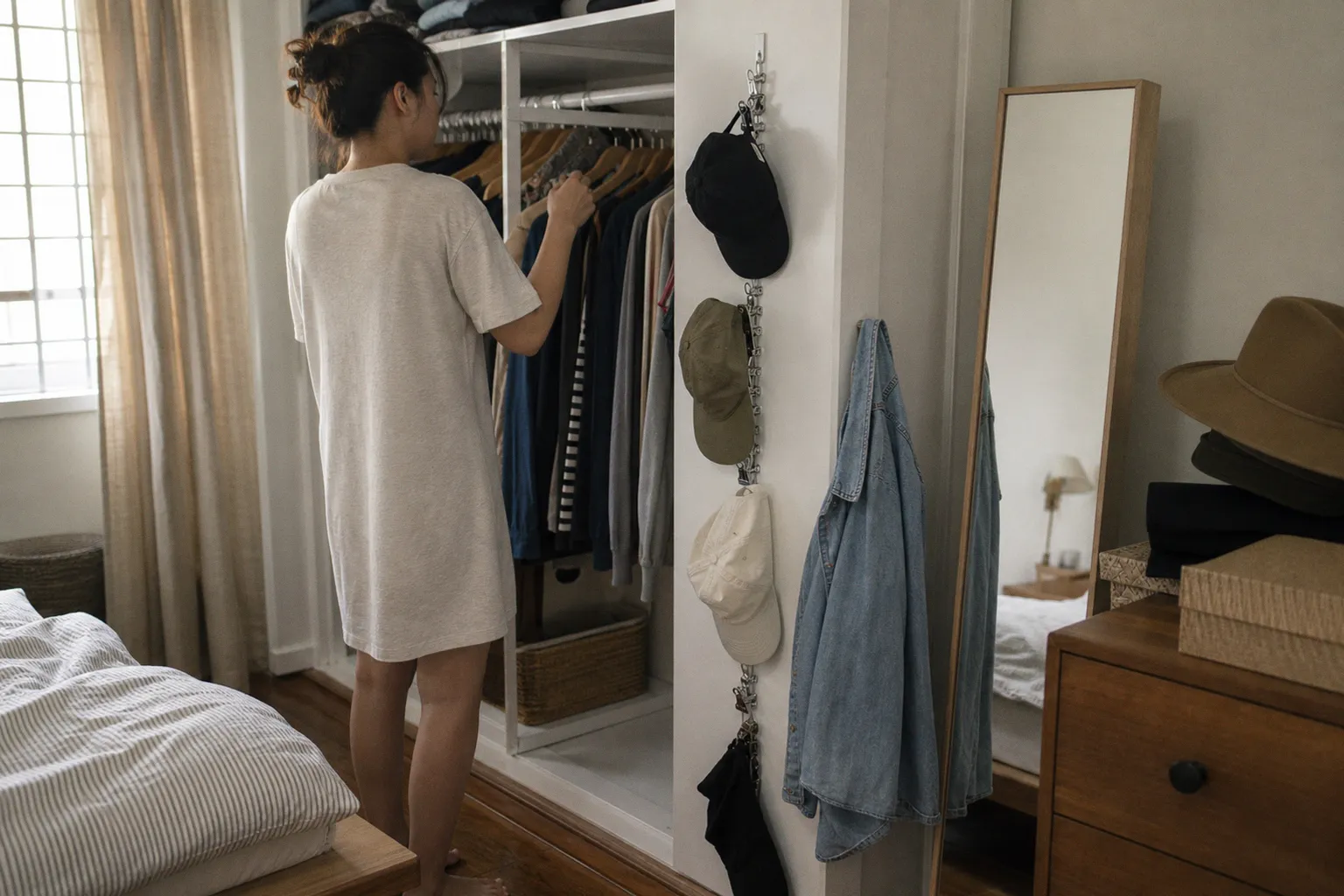
and Lola Products have launched Clip Strip® @ Home, taking a patented retail display-rack system into kitchens, pantries and closets. The pitch is vertical storage and instant visibility—two things retail has treated seriously for decades and homes routinely squander behind cabinet doors. For anyone planning garment or utility storage, the interesting part is not the branding. It is the attempt to turn a point-of-purchase fixture into a daily-access tool.
Retail logic, transplanted—not magically improved
Clip Strip Corp. says its merchandising system has been used in retail for 46 years, where the job is simple: put small products in sight and within reach without consuming shelf frontage. Clip Strip® @ Home applies that idea to household goods, with Lola Products as the exclusive launch partner.
That principle does travel well. Verticality is often the only spare real estate left in a crowded pantry, narrow closet or laundry area. A hanging display can keep frequently used items from disappearing behind bulky packaging, bins and drawers. It may also make replenishment easier because the empty space is visible rather than buried.
But “retail-tested” is not a free pass for a residential installation. A store fixture works within a planned display environment; a home has door swings, shallow clearances, mixed packaging and people reaching around each other. The rack needs to fit the access path, not merely occupy an unused vertical patch. Otherwise it is just clutter standing upright—an old retail trick with a new postcode.
The garment-storage angle: visibility has limits
For clothing and accessory storage, the concept is most relevant for lightweight, frequently grabbed items that benefit from being seen individually rather than stacked. Think of the logic, not necessarily the exact product: making use of vertical space can reduce the footprint claimed by small packaged goods or accessories.
Still, I would not confuse display capacity with storage capacity. A clip-based merchandising format is designed around visibility and access; a garment system also needs orderly separation, repeatable loading and enough clearance to avoid a tangled retrieval routine. If the item must be unhooked, shifted or fought with every morning, the supposed space saving evaporates in daily friction.
The announcement describes uses in kitchens, pantries, garages, laundry rooms, utility closets, workshops, craft rooms, dorm rooms and RVs. It does not provide, in the supplied information, dimensions, mounting requirements, load capacity, clip configuration or compatibility with particular garment types. Those are not small omissions. They are the entire installation conversation.
A useful signal for fixture planners
The launch matters less as a breakthrough product than as a familiar retail idea crossing into residential organization. Retail display has always valued product discovery: see it, reach it, use it. Home storage usually defaults to concealment: put it away, then spend time finding it again.
For commercial rack planners, the broader signal is clear. Visibility-led, low-footprint display is being framed as an everyday organizational benefit, not only a selling tool. That can be useful where the stock is small, fast-moving and easy to handle. It is less convincing for anything that requires deeper storage, controlled spacing or robust load management.
Before treating a Clip Strip® @ Home setup as a closet cure-all, my reality check is short:
- Confirm the available vertical clearance and the reach zone—not just the empty wall.
- Check how the rack affects door movement, aisle access and nearby hanging garments.
- Ask for mounting and load details before assigning it anything weighty.
- Use it for visible, regularly accessed items; do not expect a display strip to replace structured storage.
- Judge the system after repeated retrievals. If access is awkward, the saved footprint is mostly theatre.