Garment rack wheels for hardwood floors: caster guide
Hardwood floors and rolling garment racks have a combative relationship. You push a fully loaded Z-rack across maple once, twice, maybe twenty times without incident — and then you spot it.
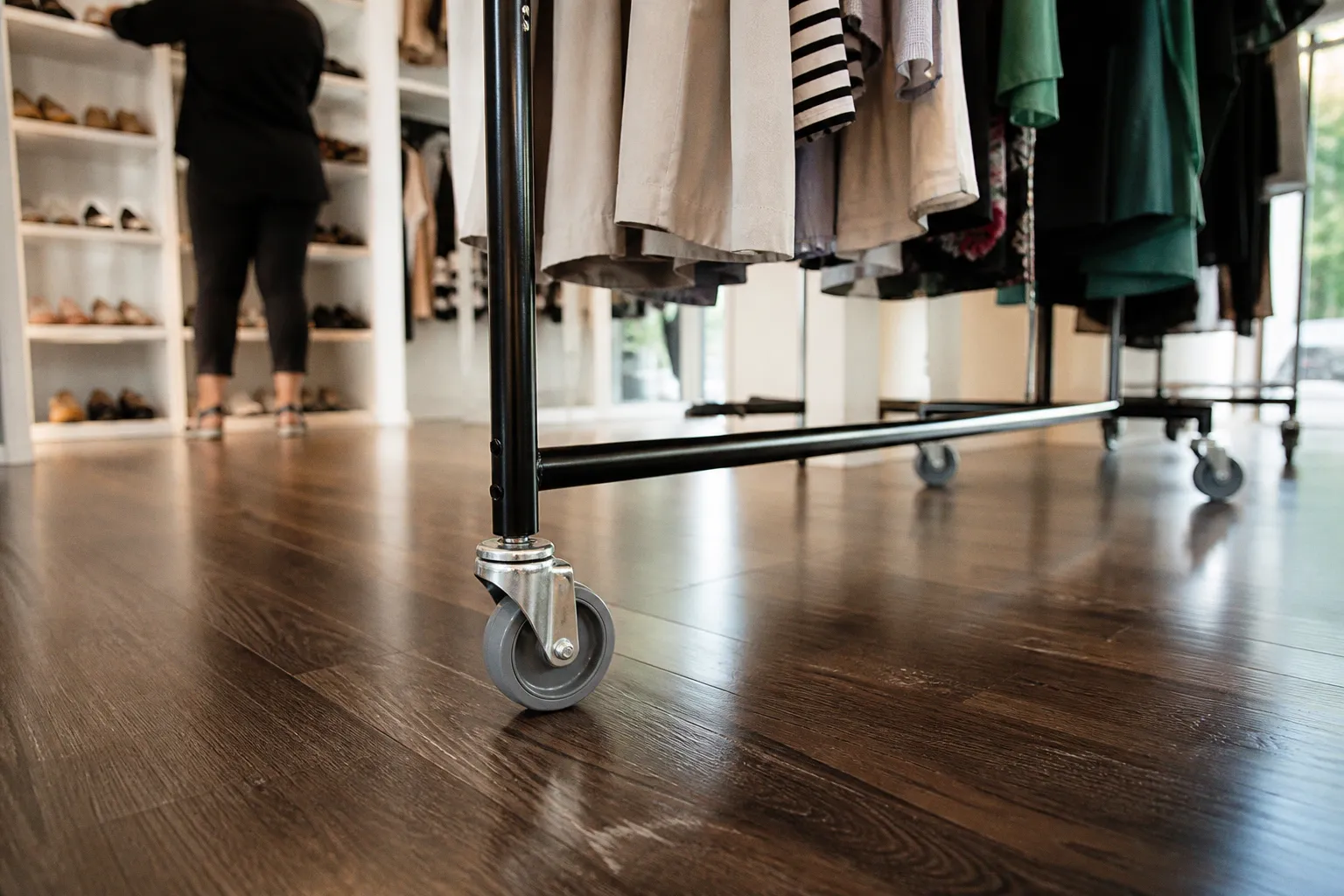
A half-moon gouge the width of a caster tread where the rack was parked. Or a constellation of fine scratches that only appears when afternoon light cuts across the grain.
I’ve installed enough racks to know the damage almost never starts with the frame. It starts with four small wheels — usually the wrong ones — doing exactly what physics predicts when a hard contact surface, concentrated load, and a bit of grit meet a finished wood floor. Manufacturers routinely ship garment racks with hard nylon or steel casters because they are inexpensive and perfectly at home on concrete. That does not make them suitable for stained oak in a boutique, a residential dressing room, or any sales floor where the wood is part of the presentation.
The fix is not complicated, but it is specific. For garment rack wheels for hardwood floors, material matters first. Then come stem fit, wheel size, braking, and the unglamorous work of keeping the tread clean.
The Mechanics of Floor Damage: Why Hard Casters Fail on Wood
Hardwood is durable, but it loses fights against point loading and abrasion. A hard nylon caster has a stiff, glossy tread that barely yields under load. Nylon is generally described on the harder Shore D scale rather than Shore A; in practical terms, it behaves much more like hard plastic than a rubber tire.
That stiffness is useful in a warehouse. On smooth concrete, a hard wheel rolls efficiently, resists wear, and shrugs off loose debris. On hardwood, it concentrates the rack’s weight into a very small contact patch. Add a loaded rail of coats, denim, or garment bags, and the wheel can press into a softer floor finish or exploit a weak spot in the wood beneath it.
Then you start rolling. Unlike a soft-tread wheel, hard nylon does not conform around a grain of sand, a staple, a pebble carried in from the street, or a slight unevenness at a floor transition. It pushes that obstacle into the finish. Stationary pressure can leave a dent; movement turns the same event into a scratch or gouge. Steel and cast-iron wheels are even less forgiving. They have a place in industrial environments, but that place is not a polished hardwood retail floor.
The selection rule is simple, and it is worth stating correctly: use soft-tread wheels on hard floors. Hardwood, tile, polished concrete, laminate, and finished stone all benefit from a wheel that gives slightly at the contact point. Hard wheels belong on robust, rougher industrial surfaces where floor protection is not the first concern.
Soft tread protects the floor not because it is delicate, but because it spreads the load and absorbs the small shocks that hard wheels transmit.
That does not mean any soft wheel is automatically safe. A soft wheel with embedded grit can become a very efficient sanding tool. But material is still the first decision, because it sets the ceiling on how forgiving the rack can be.
Selecting Soft-Tread Materials: PU vs. TPR vs. Rubber
Caster catalogs love the phrase “floor-safe.” It sounds reassuring and reveals almost nothing. Polyurethane, thermoplastic rubber, and rubber all appear under that label, yet they behave differently once a rack is loaded, parked, and pushed across a working sales floor.
| Parameter | Polyurethane (PU) | Thermoplastic Rubber (TPR) | Rubber |
|---|---|---|---|
| General feel | Firm, resilient soft tread | Softer, more cushioned tread | Soft and grippy, depending on compound |
| Load handling | Strong choice for commercial rolling racks | Better for lighter or moderate loads | Often best for light-duty use |
| Rolling noise | Quiet | Usually the quietest | Quiet, though it can drag more |
| Resistance to wear | High | Moderate under frequent heavy use | Varies widely by compound |
| Floor protection | Excellent with a clean, non-marking tread | Excellent on delicate finishes | Good when the wheel is non-marking and clean |
| Best fit | Busy boutiques, stockrooms, loaded Z-racks | Closets, showrooms, lighter display racks | Occasional-use racks and lower-load setups |
Polyurethane is the workhorse. A properly made PU caster gives you a soft contact surface without feeling mushy under a commercial rack. It is usually the most sensible choice for heavy-duty rack floor protection: the tread holds up to repeated movement, rolls with less effort than soft rubber, and does not flatten as readily when a loaded rack stays parked for long stretches.
The trade-off is that polyurethane is not as plush as TPR. That is not necessarily a problem. On a busy shop floor, a slightly firmer PU wheel can be the better long-term answer because it keeps its shape and rolls predictably. Look for a non-marking tread intended for finished floors, not simply a wheel described as “poly.”
TPR is the boutique favorite. It is quiet, compliant, and especially good on sensitive finishes where the rack is moved gently and often. A TPR wheel takes the edge off vibration. If a rack crosses a narrow seam, a minor threshold, or a small imperfection in the floor, the wheel absorbs more of that event before it reaches the wood.
The limitation is load and duty cycle. TPR can be excellent on a rolling display rack holding a modest edit of clothing. It becomes less convincing when the rack is treated like warehouse equipment: overloaded, dragged through back rooms, or rolled all day over rough transitions. The softer tread may wear, flatten, or pick up debris more readily.
Rubber is the broadest category and the least predictable one. Good non-marking rubber can be gentle on hardwood and pleasantly quiet. Cheap black rubber can leave marks, age poorly, or feel sticky when a heavily loaded rack is forced into a turn. For a rack moved occasionally in a closet or a small display area, rubber wheels for clothing racks can work well. For an industrial Z-rack that sees daily movement, PU is usually the safer bet.
The useful question is not, “Which material is best?” It is, “How will this rack actually live?” A rack that stays in one place most of the week needs stable brakes and clean treads. A rack that crosses the showroom every morning needs rolling efficiency, tread durability, and enough wheel diameter to avoid being shoved over every minor obstacle.
The problem with generic “soft rubber” claims
A product description that says “rubber caster” is not a full specification. Ask whether the wheel is non-marking, whether the tread is bonded securely to the core, and whether the stated load rating applies to one caster or the full set. More importantly, judge the wheel in the context of the rack.
A light chrome garment rack with a few dresses is not a loaded commercial rack, even if both happen to use four casters. The frame may look similar. The forces at the floor are not.
Matching Stem Sizes and Mounting Types for Secure Installation
Material gets the attention, but the stem decides whether the new wheel stays on the rack. A loose caster is not merely annoying. It lets the rack wobble, changes how the load sits over the wheel, and raises the odds of a tip or sideways skid. That is when a harmless-looking caster upgrade turns into a floor repair.
Garment racks use several common mounting arrangements, and they are not interchangeable:
- Threaded stems screw into a receiving nut or threaded socket in the rack leg. Light and medium-duty racks often use smaller threaded stems, while commercial frames may use more substantial threads.
- Expanding stems fit into hollow tubular legs. Tightening the bolt expands a rubber or metal sleeve inside the tube, holding the caster in place.
- Grip-ring stems are pressed into a socket and retained by a ring rather than threads. They are common in some lighter furniture-style applications and should not be substituted casually.
- Plate-mounted casters bolt beneath a frame or base. These are less common on standard garment racks but appear on custom rolling fixtures and heavy display units.
- Pipe-thread arrangements show up on heavier industrial racks, including some Z-rack designs. They are robust, but they require the correct thread type rather than a caster that merely looks close.
The trap is assuming that a wheel with the right diameter will fit because its stem “looks about right.” It will not. Thread diameter, pitch, stem length, socket depth, and the shape of the rack leg all matter. A threaded stem that is too small can wobble in the receiver. One that is too large can damage the fitting. An expanding stem used in the wrong tube may never tighten correctly.
Before ordering, remove one existing caster and inspect it in good light. Measure the threaded portion if there is one. Measure the inside diameter of a hollow leg if the caster uses an expanding or grip-ring stem. Check whether the old wheel had a spacer, washer, or bushing that kept the caster shoulder from rubbing against the frame.
If the rack is older, imported, or has been repaired before, bring the removed caster to a caster specialist. That is faster than ordering by guesswork and discovering that the new wheels either do not seat or sit at different heights. A rack on mismatched caster heights may still roll, but it will not distribute weight evenly — exactly the opposite of what you want on hardwood.
The best caster in the wrong socket is still the wrong caster. Secure mounting is part of floor protection.
The Hidden Threat: How Grit and Debris Compromise Floor Safety
Here is the part no caster box emphasizes enough: even the best soft-tread wheel can scratch hardwood if the tread is dirty.
Soft PU, TPR, and rubber are forgiving partly because they deform around small particles. That is also their weakness. Fine grit gets pressed into the tread, where it stays. The next time the rack moves, that embedded debris is dragged across the finish under load. The wheel may look perfectly clean from a few feet away while carrying enough dust, salt, or tiny stones to leave a pale trail behind it.
This is especially common in stores that move racks between a loading area and a finished sales floor. The rack crosses concrete, an entry mat, a threshold, and then hardwood. Every zone adds something: dust from stockroom floors, grit from sidewalks, fragments from cardboard, metal shavings from fixture assembly, or construction residue after a renovation.
The solution is not glamorous, but it works:
1. Wipe the tread before the rack enters the finished-floor area. A damp cloth catches surface dust. Do not soak the wheel; the goal is to lift debris, not leave moisture on the floor.
2. Brush out embedded particles. A stiff nylon brush is useful for tread grooves and soft rubber surfaces where grit has pressed in.
3. Vacuum or sweep the travel path before moving loaded racks. A clean wheel cannot compensate for a visible line of sand on the floor.
4. Use entry mats as a buffer, not as decoration. Mats reduce the dirt that reaches both shoes and caster treads, particularly near exterior doors and loading routes.
5. Inspect wheels after construction, deliveries, or weather events. Those are the moments when a floor-safe setup quietly becomes a scratch risk.
Do not underestimate static parking, either. If a loaded rack sits for weeks in the same spot, check the wheels before moving it. A small piece of debris trapped beneath a stationary caster has had plenty of time to press into the finish. Moving the rack later can turn that compressed point into a long scrape.
Optimizing Stability with Braking Systems and Wheel Diameter
Hardwood is smooth, which is good for rolling and bad for racks that have no interest in staying put. A garment rack on unlocked casters can drift when someone brushes past it, leans on it while sorting hangers, or opens a nearby door. The resulting collision may damage more than the floor.
For a standard four-caster rack, two locking casters are the bare minimum. On long rolling racks, heavily loaded Z-racks, or displays placed near customer traffic, four locking casters are worth the modest added cost. A rack should stay where you park it without relying on a wall, another fixture, or a stack of folded cardboard under one wheel.
Not all brakes do the same job. Some lock wheel rotation but allow the caster to swivel. Others lock both the wheel and the swivel action. For garment racks on hardwood, a total-lock brake is the better arrangement. It reduces creeping and keeps the rack from gradually changing its angle while it is loaded.
Wheel diameter matters as much as the brake type. Small wheels encounter every flaw in the floor as an obstacle. They need more push force to cross shallow seams, floorboard transitions, low thresholds, and stray debris. When the rack finally lurches over, that force can become a skid, a sudden pivot, or a scraped tread.
A larger wheel rolls over the same conditions more calmly. For commercial garment racks that move with real weight on them, a wheel in the three- to four-inch range is generally more practical than a tiny furniture-style caster. It reduces the effort needed to start and steer the rack, which reduces the temptation to yank the frame sideways.
There is a balance to keep. Oversized casters raise the rack, alter hanging height, and can interfere with lower shelves or storage beneath the rail. The goal is not the biggest wheel available. It is a wheel large enough to roll smoothly through the rack’s actual route without changing the fixture into something awkward to use.
Stability is a floor-protection feature
This point gets missed because brakes are usually discussed as a safety accessory. They are also a protection measure. A rack that does not drift is less likely to bump a wall, scrape along a display, or be stopped by someone’s shoe at an angle. A rack that moves smoothly when unlocked is less likely to be dragged sideways when it resists motion.
That is the quiet connection between wheel diameter, brake coverage, and preventing floor scratches from garment racks: smooth, controlled movement creates fewer moments where force goes somewhere it should not.
Build the Rack Around the Floor It Has
A garment rack does not need luxury casters to coexist with hardwood. It needs appropriate ones. Start with a non-marking soft tread: polyurethane for the heavier commercial job, TPR for the quieter and lighter-duty one, and good rubber where occasional movement is the reality. Match the stem precisely instead of improvising. Choose a wheel diameter that does not turn every floor transition into a wrestling match. Give the rack brakes that actually hold it in place.
Then keep the wheels clean.
That last part is easy to dismiss because it is not a product upgrade. But floor protection is not a label printed on a caster box. It is the combined result of a compliant tread, a stable rack, sensible loading, and a wheel that is not carrying last week’s loading-dock grit into the showroom. Get those details right, and the rack can do its job without leaving a record of every trip across the floor.