Garment Rack Casters vs Leveling Feet: Mobility or Stability
A heavy-duty garment rack rated for 1,050 pounds on leveling feet may have a mobile load capacity of only 300 to 350 pounds when fitted with casters. That gap is one of the most underestimated details in garment rack procurement.
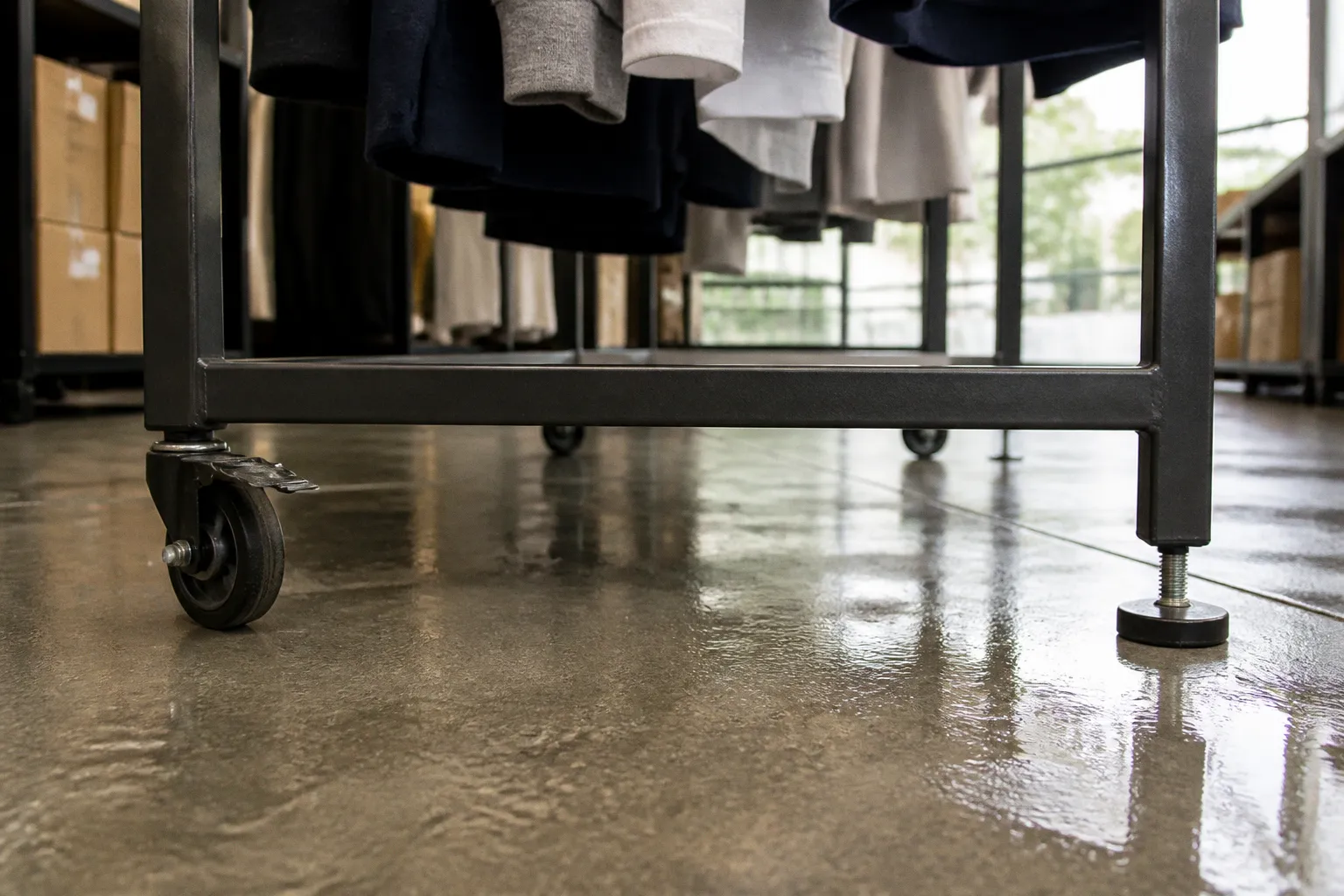
It appears whenever a retailer confuses the stationary rating printed on a spec sheet with what the rack can actually carry once it is rolling, and it appears again when someone bolts aftermarket wheels onto a frame that was never designed to move under load.
Compare car rental deals in United Kingdom
See available offersPartner link — DiscoverCars comparisonIf you're specifying base hardware for a boutique floor, a back-of-house staging zone, or a flagship display, the casters-versus-leveling-feet decision isn't an accessory choice. It's a structural call that affects merchandise density, fixture stability, floor protection, and the labor cost of every reset. The numbers behind the choice can be stark, and they're worth understanding before you write the purchase order.
The Physics of Load Capacity: Why Wheels Change Everything
When a manufacturer specs a garment rack, the rated capacity reflects a specific base configuration. A rack shipped with leveling feet is rated for stationary use on those feet. The load distributes through four rigid contact points that transfer weight directly into the floor. The frame stays square, the cross-braces stay true, and the welded joints at the upright-to-beam connections remain within the stress range intended by the design because the contact points do not move.
When the same manufacturer offers the frame with casters instead of leveling feet — or when a retailer adds aftermarket wheels to a stationary rack — the rated capacity changes because the load path changes. A wheel is a dynamic contact point. It has a wheel, a bearing or bushing, a swivel head, and a stem or mounting plate that connects the assembly to the rack frame. Each interface can flex under static load, and each is exposed to additional force when the rack crosses a threshold, turns sharply, or stops suddenly.
That is why a mobile rating is not simply the stationary rating with a convenient wheel attached. When a loaded rack moves, the casters absorb vibration from the floor. The swivel heads experience lateral force. The mounting hardware sees loads that do not exist when the rack is resting on fixed feet. The manufacturer’s mobile capacity is intended to account for those conditions.
A common mistake is to load the rack to its stationary rating after converting it to casters. That can substantially exceed the caster-rated mobile capacity, even when the frame itself appears robust enough to support the weight. The fact that the rack has carried the load without an immediate failure does not make the configuration safe. Repeated movement can fatigue the caster mounts, loosen fasteners, deform wheels, and transfer more stress into the frame than the original stationary design anticipated.
For a typical commercial rolling clothes rack, the number that matters is the manufacturer’s stated capacity for the complete caster configuration — not the rating for the same frame on stationary garment rack feet. If the caster option is not given its own rating, that is a specification gap to resolve before purchase, not permission to assume the higher number applies.
A wheel doesn't fail the way a foot fails — it rolls past the warning signs until it doesn't.
What “Mobile Capacity” Actually Means in Practice
Manufacturers publish separate numbers for a reason, and conflating them is one of the most expensive mistakes we see in store planning. Each rating is tied to the base configuration the rack ships with:
- The stationary rating applies when the rack is supported by leveling feet and remains in place.
- The mobile rating applies when the rack is supported by casters and moved under the conditions defined by the manufacturer.
- The working load should reflect the actual garments, boxes, shelves, and accessories placed on the rack, not just the empty frame or the weight of the clothing rail.
- The moving condition matters. A rack pushed occasionally across a smooth floor is not experiencing the same forces as one moved daily over thresholds, dock plates, carpet transitions, or uneven tile.
If your rack lives in one spot and only moves during quarterly floor resets, the stationary rating may be the relevant figure — provided the rack is actually resting on leveling feet at that point. If your team relocates it every day, pulls it from back stock to a promotional endcap, rotates it through a clearance zone, or rolls it onto a freight elevator, you are operating in mobile territory. The safe planning number is the capacity published for that caster configuration.
Plan the garment count against the mobile number, not the stationary one, and the storage plan will be much more likely to hold up in daily use. Loading a converted rolling rack to its original stationary specification can place the base hardware and frame under a load well beyond the capacity intended for movement. The rack may hold for weeks or months, but fatigue does not announce itself with a useful warning label. A caster stem loosens, a swivel head begins to bind, a corner drops, and the rack pivots into merchandise or a customer.
The distribution of the load matters as much as the total. A rack carrying evenly spaced shirts along a rail is not configured in the same way as one carrying dense winter coats at one end, boxed inventory on a lower shelf, or a single heavy garment bag hanging from the outer corner. Uneven loading shifts the center of gravity and increases the lateral force on the casters during a turn. In practice, a lower total weight can be more difficult for a rolling rack to manage if that weight is concentrated on one side.
The Frame Is Only One Part of the System
Retailers often evaluate the steel gauge, tube size, and welds first because those components are visible and easy to compare. They matter, but they do not tell the whole story. A rack’s base hardware creates the connection between the frame and the floor, and that connection controls how the load enters the structure.
A stationary foot transfers force into a relatively broad, fixed contact area. A caster concentrates the load through a smaller assembly and adds moving components between the frame and the floor. The mounting plate or stem must be compatible with the rack upright, the wheel must be appropriate for the surface, and the swivel mechanism must be able to handle both the intended load and the forces created while turning.
That is also why two racks with similar frames can have very different real-world performance once wheels are installed. The base is not an afterthought. It is part of the load-bearing system.
Stability on Uneven Surfaces: The Role of Adjustable Leveling Feet
A slightly sloped floor is enough to expose the difference between wheels and feet. In an older retail space, the tile may vary across the rack footprint. A platform may not be perfectly true. A stockroom floor may have a shallow dip near a doorway. A rack on adjustable leveling feet lets you compensate at each post, remove the wobble, and establish a firm relationship between the frame and the floor.
That adjustment is not cosmetic. It allows the four corners of the rack to share the load instead of leaving one foot lightly engaged while another carries disproportionate force. Once the frame is properly leveled, it behaves more like a single rigid structure than a four-legged table searching for equilibrium under load.
The effect becomes more noticeable as the rack gets taller or more heavily loaded. A small amount of rocking at the base can become visible movement at the top rail. Customers feel it when they browse. Staff feel it when they pull a garment from the middle of a dense run. Over time, the repeated movement can loosen fasteners and make the rack appear less substantial than it actually is.
Adjustable leveling feet also help protect finished floors. The pad at the base of a quality foot spreads the load across a defined contact area, which matters on hardwood, laminate, tile, and low-pile commercial carpet. A hard caster can dent, scratch, or crush a surface, particularly when a loaded rack is turned in place or pushed across a seam. A small wheel may look harmless in the showroom, but repeated point loading and lateral movement can leave a visible track.
For boutiques that merchandise on hardwood or specialty tile, this is not a finishing detail. Repairing a damaged retail floor can cost more than the price difference between casters and stationary feet, and the damage may appear long after the original fixture decision has been forgotten. Floor protection should be evaluated alongside mobility, not treated as a separate maintenance issue.
The trade-off is permanent placement. Once you have leveled a rack, moving it means releveling it. That labor cost is why many retailers default to casters in spaces where the layout changes every week. But in flagship displays, fitting-room staging, and storage areas where a rack stays in place for extended periods, stationary garment rack feet are usually the more controlled solution. They deliver the full stationary-rated capacity specified for that configuration, reduce wobble, and prevent the slow drift that pulls display sightlines out of alignment.
There is another subtle benefit: fixed feet reduce vibration transfer. A rack that rolls or rocks under the pressure of a customer browsing can transmit vibration through the wheels and into the floor. On raised platforms, mezzanines, or quiet retail floors, that movement can be surprisingly noticeable. Leveling feet create a firmer contact and reduce the sense that the fixture is floating on its base.
Locking Casters Are Not Leveling Feet
A locking caster helps keep a rack from rolling, but it does not automatically turn a mobile base into a stationary base. Most wheel locks prevent the wheel from rotating, and some also prevent the swivel from turning. Neither function necessarily removes the wheel from the load path or gives the rack the broad, rigid support of an adjustable foot.
That distinction matters when the rack is loaded heavily or placed on an uneven surface. A locked wheel can still sit at an angle. It can still transmit a concentrated point load into the floor. It can still allow small movements at the swivel head. If the specification calls for leveling feet, a caster lock is not a substitute for the manufacturer’s intended support.
The Hybrid Compromise: Understanding Leveling Casters
Leveling casters combine a wheel with an adjustable pad or stabilizing mechanism. In mobile mode, the pad is raised and the rack rolls. In stationary mode, the pad is lowered until it bears the load, reducing the amount of weight carried by the wheel and making the rack more stable.
This sounds like the answer to everything, and in some environments it is. A boutique that re-merchandises monthly, a pop-up that resets its floor plan every few weeks, or a warehouse staging zone that needs mobility for receiving and rigidity for picking can all justify the added cost. The hybrid base is especially useful when a rack must move through a doorway but needs to remain stable for long periods afterward.
The catch is that leveling casters have their own operating limits. Their rating may depend on whether the rack is rolling, stationary on the pads, or being adjusted while loaded. The mechanism must be able to engage consistently at all four corners, and the user must have enough clearance and access to operate it. A rating for the caster assembly is not automatically the same as a recommended working load for a garment rack in daily retail use.
The adjustment process is where many installations go wrong. If one pad is raised slightly higher than the others, the frame can continue to rack even though the rack appears to be supported. The load migrates toward the lowest point, and the fixture gives you the illusion of stability without delivering it. A premium component cannot compensate for inconsistent setup.
A leveling caster that isn't level is just a caster that costs more.
Leveling casters also add height to the rack assembly. The extra height may be modest, but it raises the center of gravity and can change the tipping behavior of a tall garment rack. That becomes relevant when a fully loaded rack is pushed across a threshold or stopped abruptly. The higher the rail and the more unevenly the garments are distributed, the more important the base geometry becomes.
Before selecting leveling casters, confirm four things:
- The rack frame is designed to accept the caster type and mounting method.
- The caster rating is stated for the intended use, not only for an ideal static test.
- The stabilizing pads can be engaged without unloading the rack.
- The additional base height does not create a clearance, sightline, or tipping problem.
A hybrid base is a useful compromise when the operating pattern genuinely requires both functions. It is a poor compromise when it is selected simply because the buyer wants the rack to do everything without paying attention to the limits of either mode.
Operational Risks: When Low-Quality Casters Compromise Structural Integrity
The cost-cutting we see most often in garment rack procurement happens at the base, specifically with the casters. A premium rack frame built on budget wheels can fail in ways that have nothing to do with the steel gauge or weld quality. The failure modes are predictable: the swivel head binds under load, the wheel deforms and tracks unevenly, the stem pulls against the mounting plate, or the whole assembly begins to list toward one corner after repeated moves.
A light-duty rolling rack may be perfectly adequate for a bedroom closet and completely unsuitable for a retail floor. The issue is not only the frame. Consumer-grade wheels often have smaller contact areas, less robust bearings, lighter mounting hardware, and no meaningful allowance for thresholds or uneven commercial floors. A box may describe the rack as “heavy duty” because the frame carries more than a household model, while the caster specification tells a different story.
The structural risks compound once the rack is in service. A rack that tips under load is a liability event waiting to happen: damaged merchandise, injured staff, blocked access, or a customer experience that reads as careless even if the customer cannot articulate why. The cheapest wheels also tend to be the loudest. A rattling rack in a quiet boutique is a dwell-time killer. Customers do not linger comfortably beside a fixture that sounds unstable, and staff begin to avoid moving it when they should be resetting the floor.
There is a maintenance-cycle issue as well. Budget casters may use simple bushings or light-duty bearings that deteriorate quickly under repetitive point loads. The first symptom is increased rolling resistance. Staff push harder to move the rack, which increases lateral force on the mounting stem and swivel race. That accelerates wear, which makes the rack harder to steer, which creates even more force during the next move. A small increase in resistance can become a structural problem when the rack is routinely moved while full.
Watch for these early signs:
1. The rack no longer tracks straight. One wheel may be dragging, the swivel may be binding, or the frame may have shifted out of square.
2. A wheel develops a flat spot. This creates vibration and encourages staff to push harder over every floor transition.
3. The mounting hardware loosens repeatedly. Re-tightening is not a permanent repair if the hole, plate, stem, or frame connection is deforming.
4. The rack rocks after the wheels are locked. A lock that stops rotation does not correct a bent wheel, uneven floor, or loose swivel.
5. The caster turns hot, noisy, or unevenly. Friction and bearing wear are warnings that the assembly is no longer operating as intended.
6. The frame leans under an ordinary load. Stop treating this as a leveling problem until the base and mounting points have been inspected.
The rack frame is a long-term investment; the casters are a wear item — spec them like one.
Caster maintenance should be assigned to someone, not left to chance. Inspect the wheels, swivel heads, fasteners, and mounting plates on a schedule that matches how often the rack moves. Remove thread, plastic tags, and dust from the wheel path. Check whether the locks engage fully. Replace damaged casters as a matched set when the manufacturer requires it, rather than mixing a new heavy-duty wheel with older components of a different height or rating.
Strategic Selection: Matching Base Hardware to Your Storage Needs
The right base depends less on whether mobility sounds convenient and more on how the rack actually behaves during a normal week. We walk clients through the decision on the floor, tied directly to the operating pattern and the merchandise involved.
- Choose leveling feet when the rack is a permanent or semi-permanent fixture, such as a flagship display, fitting-room staging area, or warehouse picking station. They are also the stronger choice when the floor is uneven, the finish needs protection, or the rack will carry loads close to the stationary rating specified by the manufacturer.
- Choose standard casters when the rack moves daily or several times per week, the load remains within the manufacturer’s mobile rating, and the floor can tolerate repeated movement. At least two casters should typically be lockable, with the locking mechanism engaged whenever the rack is stationary.
- Choose leveling casters when the rack must move occasionally but remain rigid between moves, and the budget supports a properly rated hybrid system. Confirm the working-load limits and the adjustment procedure before treating them as an equivalent to stationary feet.
- Choose a heavier-duty base when garments are dense, loads are uneven, the rack crosses thresholds, or staff must move it while fully merchandised. A higher frame rating does not compensate for an underspecified wheel assembly.
Capacity Comparison at a Glance
The figures below illustrate why base configuration must be treated as part of the rack specification. Stationary and mobile numbers are independently specified; mobile capacity is not derived by applying a universal discount to the stationary rating.
| Rack Model | Stationary Rating on Leveling Feet | Mobile Rating on Casters | What the Comparison Shows |
|---|---|---|---|
| Huluwat 3-Tier Heavy-Duty | 1,050 lbs | 300–350 lbs | A substantial reduction when the base changes |
| IRIS Heavy-Duty Steel | 750 lbs | 300–350 lbs | The same frame category can have a much lower mobile rating |
| VEVOR 7-Tier | 850 lbs / 385.5 kg | Lower with casters | The caster specification must be checked separately |
| 4-Way Clothing Rack | 120 lbs with floor levelers | Lower with casters | A light rack still needs a distinct mobile rating |
| Generic Light-Duty Rolling Rack | 100–150 lbs static | Around 22 lbs in a demanding daily-use example | Consumer-grade mobility is not commercial capacity |
The table is not a substitute for the specification of the exact rack and caster combination being purchased. It is a warning against treating “heavy duty” as a complete load rating. If a product lists a stationary capacity but does not state the capacity with casters installed, ask for the mobile specification. If the seller cannot provide it, treat that uncertainty as a procurement risk.
A Quick Floor Check Before You Buy
Before committing to a base configuration, walk the actual placement zone with a tape measure and a level. Do not evaluate the rack only on the showroom floor or from a product photograph. Confirm the following:
- Whether the floor is flat across the full rack footprint.
- Which thresholds, seams, ramps, or dock plates the rack will cross.
- Whether the surface is hardwood, tile, laminate, concrete, carpet, or a specialty finish.
- How often the rack will move while loaded.
- Whether staff will push it from one end, from the side, or by pulling it through a doorway.
- Whether the rack must pass through elevators, narrow aisles, or doors with limited clearance.
- Whether the loaded rack can be parked without blocking an egress route or service path.
If the floor is flat, the finish is durable, and the rack moves frequently, a caster base may be the right answer. If the floor is uneven, the finish is vulnerable, and the rack stays put, leveling feet provide better control. If the rack needs both occasional mobility and dependable stability between moves, leveling casters may justify their premium — but only when their rating and operating procedure are clear.
One more detail deserves attention: the caster stem or plate must match the rack’s mounting specification. Aftermarket casters with the wrong stem diameter, bolt pattern, offset, or mounting depth can introduce stress concentrations at the connection point. A wheel may carry its advertised load in isolation while the rack connection cannot. That load rating does not account for an incompatible mounting geometry.
If the rack manufacturer sells a caster kit for the frame, use it unless there is a documented reason not to. If there is no approved kit, confirm the mounting specification before sourcing third-party wheels. Do not assume that a larger wheel or a higher advertised caster capacity automatically makes the rack safer. The connection between the wheel and the frame is part of the system.
The Operating Pattern Decides the Base
The frequency of movement is often more useful than the word “mobile” in a product description. A rack that moves once every few months is operationally different from one that travels across the store several times each day. The first may benefit from the rigidity and floor protection of leveling feet. The second needs a caster system designed for repeated movement, steering, stopping, and loading.
The merchandise changes the decision too. Lightweight shirts distributed evenly along a rail create one type of demand. Winter coats, denim, boxed stock, or concentrated promotional displays create another. If the merchandise is expensive, delicate, or difficult to replace, the cost of a tip-over is not limited to the price of the wheel. It includes damaged product, labor, lost selling time, and the customer’s perception of the fixture.
Buy the base hardware that matches the longest interval the rack will sit in one place, not the shortest stretch of motion.
The bottom line is straightforward: casters buy operational flexibility, while leveling feet buy structural control. Neither is universally better. The mistake is choosing one based on the empty rack, the frame alone, or the highest number on the spec sheet.
Use stationary garment rack feet when the rack is meant to stay stable, level, and heavily loaded. Use heavy duty clothes rack wheels when the rack genuinely has to move and the complete mobile configuration is rated for that work. Use leveling casters only when the hybrid function solves a real operational problem and the team is prepared to use the adjustment mechanism correctly.
Mobility is valuable, but it is never free. It changes the load path, the center of gravity, the floor contact, and the maintenance cycle. Treat the base as part of the structure, and the decision between garment rack casters vs leveling feet becomes much less about convenience and much more about designing a rack that can do its job safely.