Z-Racks vs Collapsible Racks: Mobile Storage Compared
A garment rack can either make your stockroom faster or quietly turn every replenishment run into a negotiation with space, weight, and bad casters.
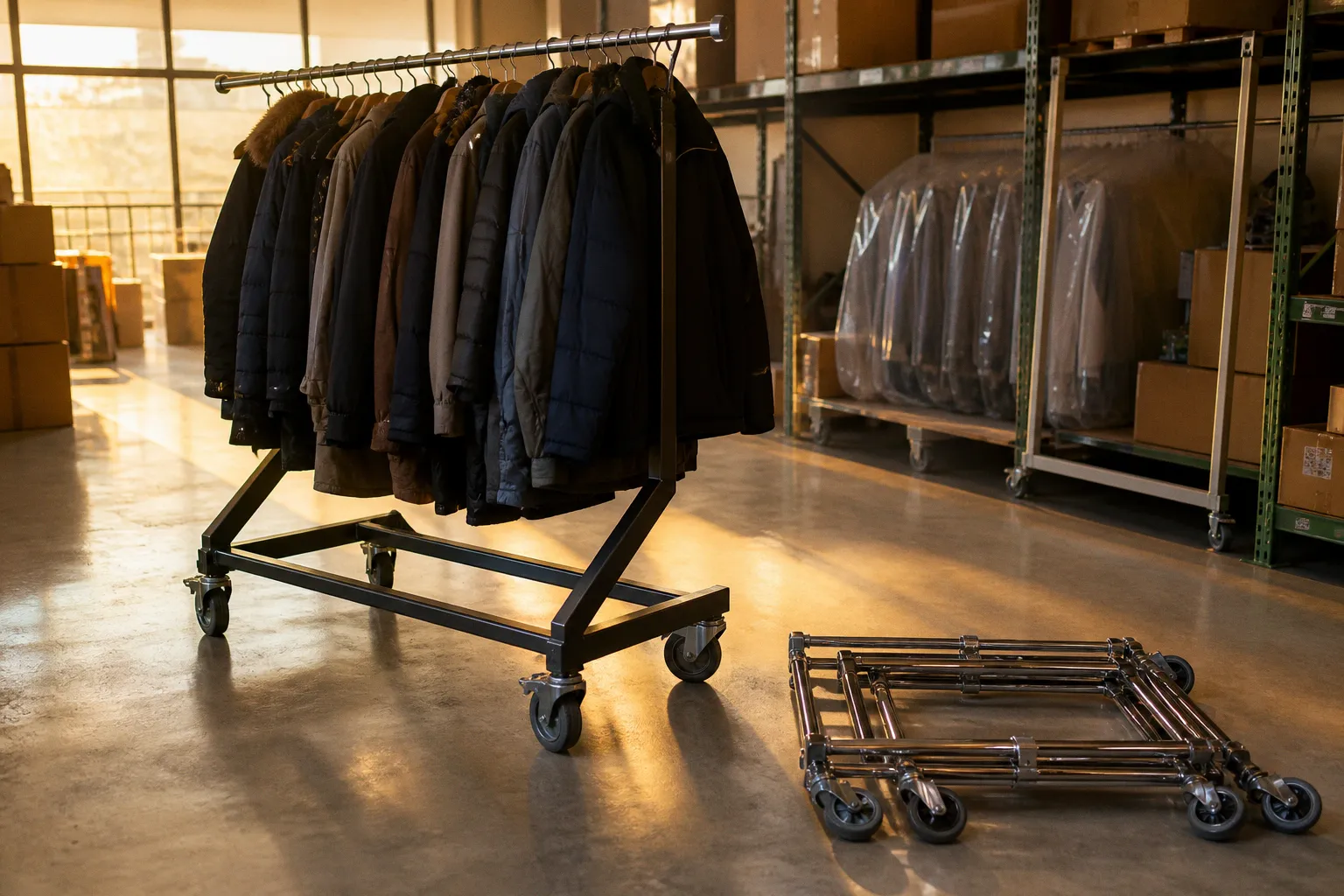
That difference shows up on the sales floor: slow restocking, damaged apparel, crowded sightlines, and staff leaving high-value seasonal inventory in the wrong place because the rack is too awkward to move.
Compare car rental deals in United Kingdom
See available offersPartner link — DiscoverCars comparisonThe practical question behind Z-racks vs collapsible garment racks is not which frame looks more commercial. It is where the rack works in your operating rhythm. Z-racks are built around capacity, stability, and nesting efficiency. Collapsible salesman's racks are built around portability, quick deployment, and compact transport. Put the wrong type into the wrong workflow and the rack becomes a bottleneck; match the rack to the movement pattern and it can improve SKU access, stockroom density, and floor conversion at the same time.
The short version: capacity versus portability
A Z-rack is the stronger choice when clothing moves from receiving to stockroom to sales floor in large, heavy batches. Its rigid Z-shaped base allows units to nest together when empty, while the frame and larger casters are designed for commercial handling. Typical commercial Z-racks are rated for roughly 300 to 500 pounds, making them suitable for packed apparel, winter coats, uniforms, and other dense garment loads.
A collapsible rack, often called a salesman’s rack, solves a different problem. It folds flat, often to a height of approximately 4 to 5 inches, so a sales representative can load several racks into a vehicle, carry them into a temporary venue, and deploy them without assembling a permanent fixture. Standard models commonly use a 48-inch hangrail with two 12-inch pull-out extensions, creating up to 72 inches of hanging space.
That sounds like a simple distinction, but the operational consequences are wide:
| Operating requirement | Z-rack | Collapsible salesman’s rack |
|---|---|---|
| Primary job | High-capacity stock movement and storage | Portable displays, events, and mobile selling |
| Storage footprint when empty | Nests into other Z-racks | Folds nearly flat |
| Typical commercial capacity | Approximately 300–500 lb | Approximately 130–250 lb |
| Common rail configuration | Fixed heavy-duty rail | 48-inch rail extending to about 72 inches |
| Typical frame construction | Often 1.5–2-inch square steel tubing in the base | Commonly 1-inch round chrome-plated steel tubing |
| Caster profile | Often 4–5-inch industrial casters | Commonly 3–4-inch ball-bearing casters |
| Best environment | Stockrooms, back-of-house, replenishment routes | Pop-ups, sales calls, temporary displays, transport |
| Main trade-off | More robust but less vehicle-friendly | More portable but generally lower capacity |
The decision becomes clearer once we stop treating both products as generic rolling garment racks and map them to the way your inventory actually moves.
Choose the rack by workflow, not by the fact that both products happen to have wheels.
The Z-rack: a stockroom tool disguised as a simple garment rack
The Z-rack was designed and patented by Archie Solomon in 1976. Its defining feature is the Z-shaped base, which creates a nesting geometry: when one rack is empty, another can slide into its footprint. That is the feature that matters most in a busy apparel operation, because an empty rack still occupies valuable square footage.
A conventional straight-base garment rack may leave you with a row of separate frames that must be parked, turned, or pushed aside. Z-racks reduce that parking problem. You can keep several units together in a stockroom lane, pull out only the rack needed for replenishment, then return it to the nest after the apparel has moved to the floor.
This works particularly well in businesses where garment volume fluctuates during the day:
- Department stores receiving multiple cartons of apparel.
- Uniform suppliers staging orders by customer or delivery route.
- Retailers handling seasonal coats, schoolwear, or promotional merchandise.
- E-commerce operations using hanging storage for pick-and-pack.
- Dry cleaning and alteration businesses moving finished garments between processing and collection.
- Costume, theater, and event operations storing bulky garments on mobile rails.
The Z-rack’s base is usually built from heavier square steel tubing, commonly in the 1.5- to 2-inch range. That additional structure is not decorative. It helps the rack resist twisting when a long load of garments is pushed over uneven flooring or when operators turn a fully loaded unit through a stockroom aisle.
The rail height and width vary by model, so you should not assume that every Z-rack offers the same hanging capacity simply because the silhouette is familiar. Rail length, usable clearance beneath the garments, base width, and caster placement all affect how the unit behaves when loaded. A rack that holds a large number of lightweight shirts may behave very differently from one carrying dense wool coats.
Why nesting improves stockroom density
Nesting is most valuable when the rack fleet is managed as a group. If you have two or three racks, the space saving may feel minor. If you have ten, twenty, or more, the parking footprint becomes part of your stockroom planogram.
A useful way to evaluate nesting is to measure three states rather than one:
1. Loaded operating footprint: how much aisle and turning clearance the rack needs while carrying product.
2. Empty parking footprint: how much space is consumed when the rack is waiting for its next assignment.
3. Access footprint: how much open space staff need to pull one rack out without disturbing every other unit.
The third measurement is where many stockrooms fail. A rack may technically nest, but if the nest is parked against a wall, beside a receiving door, or inside a narrow turning pocket, the first unit may be accessible while the units behind it become dead inventory infrastructure. We want nesting to reduce congestion, not create a new retrieval ritual.
For a high-volume stockroom, the best arrangement usually keeps the Z-rack nest parallel to the main replenishment route, with enough clearance to extract one unit and roll it directly toward the sales floor. Avoid parking the nest across a fire exit, in front of electrical panels, or in the turning zone of pallet and cart traffic. The rack is mobile; the stockroom still needs a disciplined circulation pattern.
Where Z-racks earn their floor space
The commercial value of a Z-rack is not just its weight rating. It is the combination of load capacity, repeatable movement, and reduced idle footprint.
Suppose your team handles winter apparel. A rack loaded with coats occupies fewer individual handling steps than a series of smaller rolling garment racks, and the larger frame is better suited to the load. Staff can move the assortment from receiving to a back-stock zone, then from back stock to the floor, without splitting the product into multiple unstable loads.
That can reduce:
- Rehandling time during replenishment.
- Garment compression and wrinkling caused by overpacked temporary storage.
- Aisle congestion during delivery windows.
- The number of racks left on the sales floor after a floor set.
- Lost staff time searching for a particular size or color group.
However, we should not turn the Z-rack into a universal answer. Its rigid construction makes it less convenient for transport in a car or van, and its nesting base does not fold flat. If your operation requires a rack to travel to a client, a hotel ballroom, or a weekend market, the strength of the Z-rack may be irrelevant compared with the ability to load the rack into the vehicle.
The collapsible salesman’s rack: built for the road and the temporary floor
Collapsible racks are designed around a salesperson’s reality: transport the display, open it quickly, hang a working assortment, and pack it away without dedicating a truck or storage room to permanent fixtures.
Most standard commercial models use a 48-inch hangrail with two 12-inch pull-out rods, extending the total hanging span to approximately 72 inches. Height settings commonly include 55, 60, and 65 inches, allowing the rack to adapt to the garments being presented and the sightlines of the venue.
That adjustability has a direct merchandising effect. A lower setting can keep a compact assortment visually accessible in a crowded showroom or allow the rack to sit below a window line. A higher setting can give longer garments more clearance and prevent hems from dragging near the floor. If you are presenting a curated sample range rather than storing a full department, the ability to tune the rack height can matter more than maximum load.
The standard frame is often made from 1-inch round chrome-plated steel tubing. That construction keeps the rack comparatively light and allows the joints to fold. It also means that commercial quality varies sharply between models. Some racks use robust metal joints and reinforced connection points; others rely on plastic components or thin-walled tubing that may be adequate for occasional home use but frustrating in a retail schedule.
This category includes several very different products under the same name:
- Economy portable apparel racks rated around 130–150 pounds.
- Heavy-duty commercial collapsible racks rated around 220–250 pounds.
- Domestic or specialty models advertised at 525–600 pounds, with ratings that should not automatically be compared with commercial rolling use.
The last category deserves caution. A high advertised number may describe a static load under controlled conditions rather than a rack being pushed across a floor, turned through a doorway, or repeatedly folded and unfolded. The exact dynamic load rating is often not specified. We should never assume that a collapsible rack carrying a large static load will behave like a heavy-duty Z-rack during repeated movement.
The extension rail is useful, but it is not free capacity
The pull-out extensions increase hanging length from 48 to roughly 72 inches, which is valuable when you need to display more product without bringing a second rack. But extension length changes the load distribution.
A balanced load across the main rail is generally easier to control than a heavy cluster placed at the end of an extended rod. If the product is dense—denim, jackets, leather, uniforms, or bundled garments—loading the extension aggressively can affect stability and caster tracking. The rack may still stand, but it can become harder to push and more likely to catch on door thresholds or uneven flooring.
Use the extension rods strategically:
- Place the core assortment on the central 48-inch rail.
- Use the extensions for lighter garments, size runs, or overflow.
- Keep the load balanced from left to right.
- Avoid creating a heavy endcap effect on one side of the rack.
- Test the rack fully loaded before assigning it to a narrow aisle or customer-facing route.
This is retail mechanics, but it also affects customer psychology. A rack that leans, rattles, or requires a staff member to wrestle it into position does not signal an organized assortment. Portable apparel racks should be quick to deploy without looking temporary once they are in front of the customer.
Load bearing, casters, and the difference between holding and moving
Load capacity is one of the easiest specifications to misuse. A rack can hold a stated weight in a static position and still be a poor choice for that load if the staff must move it frequently.
For commercial Z-racks, a typical published capacity falls between 300 and 500 pounds. That range makes them appropriate for heavier garments and larger stockroom loads, but we still need to distribute the weight evenly and respect the manufacturer’s rating. A 500-pound rating does not mean that one corner, one rail extension, or one side of the frame can carry 500 pounds safely.
Commercial collapsible racks more commonly fall in the 130- to 250-pound range. The lower end can suit a sales representative carrying a selected sample collection. The upper end can support a serious temporary display or moderate back-stock assignment, but it should not be treated as equivalent to a heavy-duty Z-rack simply because both are described as commercial.
Casters determine whether the rack behaves like equipment
The frame gets the attention, but the casters determine whether the rack earns its place on the floor.
Heavy-duty Z-racks commonly use 4- to 5-inch industrial casters, often with non-marking rubber and locking mechanisms. Larger casters roll more predictably over small floor transitions, dock plates, seams, and carpet edges. They also provide a more stable base when the rack is heavily loaded.
Collapsible racks commonly use 3- to 4-inch ball-bearing casters. These can be smooth and effective for showroom floors, event spaces, and vehicle loading, but they have less rolling authority over rough surfaces. A smaller caster can become a daily irritation if your route includes thresholds, warehouse joints, or thick commercial carpet.
When you test a rack, do not push it only on an empty showroom floor. Test it in the conditions where it will actually work:
- Fully loaded with the heaviest planned garment category.
- With the rack pushed from both ends.
- Through the narrowest doorway on the route.
- Across the floor transition between stockroom and sales floor.
- With one person stopping and locking the casters.
- During a turn, not only in a straight line.
A caster lock is also more than a safety detail. On a sales floor, the rack must remain in its intended position while customers browse. On a stockroom route, the lock must engage quickly enough that staff do not leave a loaded unit rolling while reaching for cartons or hangers.
A rack’s real capacity is the load your team can move, stop, turn, and park without slowing the operation.
Steel construction and joint fatigue
Z-racks generally gain their durability from a more rigid frame. Collapsible racks trade some of that rigidity for folding convenience. Neither approach is automatically superior; they are optimized for different duty cycles.
If the rack will be folded several times a day, inspect the folding points as carefully as the rail and base. Look for:
- Metal-to-metal joints rather than thin plastic pivots in high-stress locations.
- Positive locking mechanisms that remain engaged while the rack is moving.
- Reinforced points where the extension rods meet the main rail.
- Fasteners that can be tightened or replaced.
- Minimal lateral play when the rack is opened and loaded.
- A frame that remains square instead of rocking on a flat surface.
A collapsible rack that becomes loose at its joints may remain usable for a light sample assortment but become unsuitable for a dense retail load. That is why purchase decisions should follow the intended workflow, not an optimistic maximum capacity printed on a product page.
Nesting versus flat-fold storage: two different space strategies
The storage advantage of a Z-rack is horizontal nesting. The advantage of a collapsible rack is vertical compression into a flat package. These solutions save space in different parts of the business.
Nesting works inside a repeat-use operation
Z-racks are efficient when they remain in the facility and move repeatedly between fixed zones. Their empty frames can be nested in a compact group, then separated as inventory arrives or replenishment begins.
This is a good fit for:
- A stockroom with predictable garment flows.
- A distribution or fulfillment area with daily rack movement.
- A retailer with dedicated receiving and back-stock zones.
- A uniform or workwear operation where orders are staged before delivery.
- A store that performs frequent floor resets and seasonal transitions.
The rack does not need to disappear; it needs to be ready. Nesting keeps the fleet organized and visible, which is useful when the next floor set requires ten empty racks in the same hour.
Flat-fold storage works when the rack must leave the building
Collapsible racks are strongest when the storage problem is transport. Folded to approximately 4–5 inches high, they can fit into a vehicle or be stacked with event materials far more easily than a rigid Z-rack.
This supports workflows such as:
- Traveling sales appointments.
- Pop-up shops and trunk shows.
- Temporary retail in hotels, convention centers, and galleries.
- Off-site uniform fittings.
- Seasonal markets and event merchandising.
- Temporary overflow displays during a store remodel.
- On-location wardrobe, costume, or production use.
The key question is not “Which rack takes less space?” It is “Where is the space expensive?” If your stockroom is crowded but your racks rarely travel, nesting is likely the better operational answer. If vehicle cargo space and setup time are the constraints, folding wins even if the rack carries less.
Sightlines and customer movement
The same rack that works beautifully in the back room can damage the sales floor if it blocks sightlines or creates a visual wall between departments. Rack height, garment length, and placement all influence dwell time and navigation.
For customer-facing use, consider:
- Whether the rack blocks the view of an endcap or promotional sign.
- Whether customers can approach both sides without creating a pinch point.
- Whether long garments hang low enough to make the aisle feel crowded.
- Whether the rack’s wheels protrude into the customer path.
- Whether the selected height preserves sightlines across the department.
- Whether the display creates a natural pause or a dead zone.
A collapsible rack’s height adjustment can help when the merchandise is part of a temporary display. A Z-rack may be more stable, but if it is too tall, too deep, or too heavily loaded for the selling zone, the operational advantage can become a conversion problem.
The floor is not just a place to park inventory. It is a sequence of decisions. Customers read the first visible garment, scan the density of the assortment, decide whether the rack looks shoppable, and then determine whether to enter the space. Keep the rail too crowded and SKU density rises while discoverability falls. Keep it too sparse and the display looks picked over. The rack must support the planogram rather than dictate it.
Matching the rack to garment type and SKU density
Garment weight and garment behavior should shape the choice.
Lightweight tops, fashion samples, and small seasonal assortments are generally easier to support on a collapsible rack, especially when the rack is being transported. The extensions can expand the assortment without requiring another unit, and the adjustable height can help align the rack with the display environment.
Dense apparel is a different calculation. Coats, tailored jackets, uniforms, heavy denim, and packed size runs place greater demand on the rail, frame, and casters. A heavy-duty Z-rack is usually the safer fit for repeated stock movement, especially when the load will remain on the rack for long periods.
The planning issue is SKU density. More garments per linear foot can improve stockroom efficiency, but too much density slows selection and increases handling. A rack packed for storage is not automatically a rack configured for selling.
Use separate operating standards:
- Back-stock density: prioritize capacity and efficient use of the storage footprint.
- Replenishment density: leave enough room for staff to identify sizes and pull product quickly.
- Sales-floor density: protect garment separation, customer access, and visual hierarchy.
- Transport density: balance the desire to carry more product against stability and setup time.
This is where a retailer’s planogram and rack fleet should work together. If the sales floor requires a clean six-foot presentation, the 72-inch extended rail on a collapsible rack may be useful. If the stockroom needs to hold a full run of winter merchandise, the same rail length tells you less than the rack’s frame rigidity and verified weight rating.
A practical selection matrix
Rather than choosing by product category alone, map the rack against the job:
| If your primary workflow is… | Start with… | Why |
|---|---|---|
| Moving heavy apparel from receiving to back stock | Heavy-duty Z-rack | Higher typical capacity and more robust rolling hardware |
| Nesting multiple empty racks in a stockroom | Z-rack | The Z-shaped base is designed for compact group storage |
| Carrying samples to appointments | Collapsible rack | Folds flat and fits vehicle-based workflows |
| Running a pop-up or temporary display | Collapsible rack | Fast setup, adjustable height, and extendable hanging space |
| Staging uniforms or coats for repeated delivery | Z-rack | Better suited to dense loads and repeated facility movement |
| Displaying a light curated assortment on a flexible schedule | Collapsible rack | Portability matters more than maximum load |
| Crossing rough thresholds with heavy merchandise | Z-rack | Larger industrial casters generally handle transitions better |
| Storing equipment in a very limited vehicle cargo area | Collapsible rack | Flat-fold design reduces transport volume |
This matrix is a starting point, not a substitute for testing the actual route. A store with smooth polished concrete and frequent pop-ups may get excellent results from collapsible racks. A retailer with a narrow stockroom, heavy outerwear, and daily replenishment will usually benefit more from Z-racks.
Common buying mistakes that create expensive friction
The most expensive rack mistakes are rarely dramatic failures. They are small mismatches repeated every day.
Buying by advertised weight alone
A high weight figure does not explain how the rack behaves while moving. Confirm whether the rating is static, how the manufacturer defines the load, and whether the frame is intended for commercial rolling use. Treat unusually high ratings on domestic models with caution if your team will move the rack frequently.
Ignoring the empty-rack parking plan
A rack that fits the stockroom loaded may still create a dead zone when empty. Measure the nest or folded storage area, but also map extraction. If an employee must move five other units to reach the one needed for replenishment, the theoretical space saving is not producing operational speed.
Underestimating doorway and turning clearance
Measure the narrowest doorway, the tightest turn, and the point where the rack meets the sales floor. Include garment overhang, not only the frame. A rail may pass through the door while long garments catch on the frame, wall fixtures, or neighboring displays.
Using portable racks as permanent heavy-duty storage
Folding commercial clothes racks are convenient, but convenience does not make them equivalent to industrial storage equipment. If a rack is carrying dense apparel all day, every day, use a model rated for that duty and do not rely on its folded portability as proof of structural strength.
Filling extension rods unevenly
The extra 24 inches of rail are useful, but loading one side with heavy garments can compromise handling. Use extensions to expand a balanced presentation, not to create a one-sided hanging wall.
Treating a stockroom rack as a customer fixture
A back-room rack may be perfectly functional while looking cluttered and visually heavy on the sales floor. Customer-facing apparel needs appropriate spacing, controlled sightlines, and a clear shopping path. If the rack is always overfilled, the problem may be the assortment plan rather than the hardware.
Forgetting maintenance access
Wheels, locks, joints, and fasteners need inspection. A rack fleet should have a simple routine: remove lint and hanger debris from casters, test each lock, tighten loose hardware, and isolate any frame that rocks under load. One unstable rack can damage garments and slow a team that assumes every unit is safe to move.
Building the right rack fleet instead of choosing one universal model
Many retailers do not need an either-or fleet. They need a division of labor.
Use Z-racks as the operational backbone for receiving, back stock, replenishment, and dense seasonal inventory. Use collapsible racks for the mobile layer: events, appointments, temporary selling, and light assortments that need to travel.
That hybrid approach gives each rack a defined home and reduces misuse. Staff know which units can carry winter coats, which are approved for vehicle transport, which belong on the sales floor, and which should be folded immediately after an event. The result is less improvisation, fewer overloaded frames, and a more predictable replenishment route.
A simple allocation might look like this:
- Z-racks assigned to receiving and stockroom zones.
- Z-racks reserved for heavy or long-dwell inventory.
- Collapsible racks stored with event and field-sales equipment.
- Collapsible racks assigned to temporary floor sets and pop-up kits.
- Separate inspection standards for folding joints and heavy-duty caster assemblies.
- A clear maximum load by garment category, not just by rack model.
You can also assign racks by sales-floor role. A collapsible rack with extensions may support a short-term promotional endcap, while a Z-rack remains in the back room staging replenishment. That keeps the floor presentation nimble without sacrificing the capacity needed behind the scenes.
How to test the decision before you buy a fleet
Before committing to a large order, run a live trial with one unit of each type. Do not evaluate them only as empty fixtures in a showroom.
Load the racks with the garments that create the hardest case for your operation. If the business sells outerwear, test coats. If it handles uniforms, test full size runs. If the rack will travel, load the same quantity used for an appointment or pop-up.
Then record:
1. Load time: how long it takes to hang and organize the planned assortment.
2. Movement time: how long it takes to travel from receiving or storage to the sales floor.
3. Turning performance: whether staff can turn the rack without repeated corrections.
4. Doorway performance: whether garments or casters catch on thresholds.
5. Parking time: how quickly the rack can be nested, folded, or stored.
6. Retrieval time: how long it takes to access one specific SKU or size.
7. Customer impact: whether the rack blocks sightlines or narrows the shopping path.
8. Staff fatigue: whether the rack requires excessive force to push or reposition.
The right rack will usually reveal itself through labor data before it reveals itself through specifications. If a Z-rack saves several minutes on every replenishment trip, that value compounds quickly. If a collapsible rack cuts event setup from an hour to fifteen minutes, its lower capacity may be irrelevant because it solves the constraint that actually costs money.
Final decision: let the movement pattern lead
Choose a Z-rack when your priority is high-capacity, repeatable movement inside a commercial operation. Its nesting base, heavier frame, and larger industrial casters make it a strong choice for stockrooms, replenishment routes, dense apparel, and seasonal inventory.
Choose a collapsible rack when your priority is transport, fast deployment, and compact storage between uses. Its folding frame, adjustable height, and extendable rail suit sales calls, pop-ups, temporary displays, and curated assortments.
If your operation does both, build a mixed fleet rather than forcing one rack to do every job. Use the Z-rack where load and throughput matter; use the folding rack where the vehicle, event schedule, and setup time control the economics.
The KPI to watch after installation is simple: minutes from stock assignment to customer-ready presentation. Track it by rack type, garment category, and route. If the new system reduces retrieval time, protects sightlines, and keeps heavy apparel moving without staff workarounds, it is doing more than storing clothes—it is supporting conversion.