Garment storage setups: which system suits your space
A standard MDF wardrobe rail bowing under a run of wool coats is not merely a storage problem. It is a merchandising problem in slow motion.
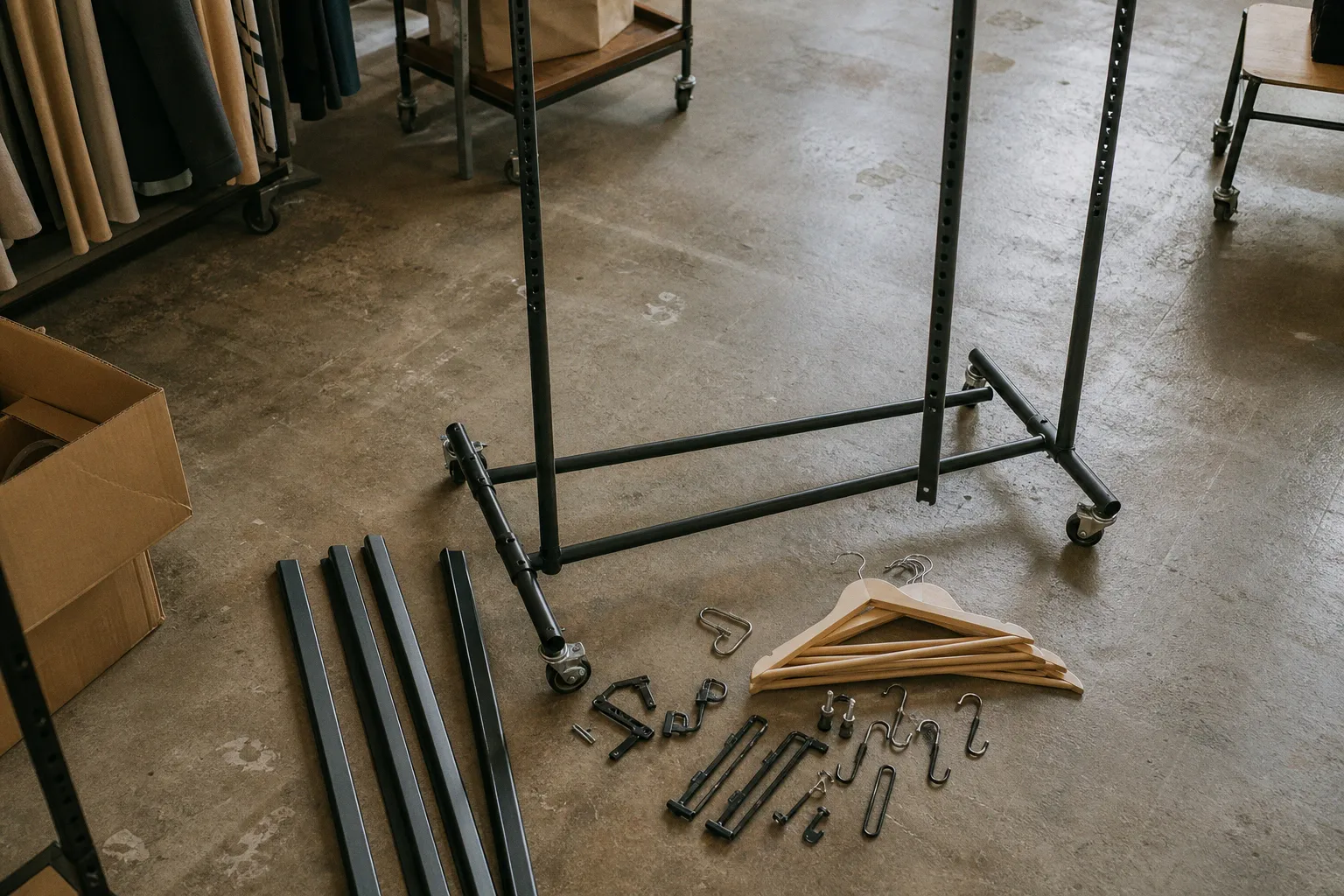
Once a rail starts dipping, access gets awkward, garments crowd together, and the whole setup begins to look like it was assembled for a spare bedroom rather than a working stockroom.
Compare car rental deals in United Kingdom
See available offersPartner link — DiscoverCars comparisonThe heavy duty garment rack vs wardrobe system decision is really a question of control. Who controls the layout: the renter, the storeowner, the floor manager—or the cabinetry that was installed years ago and cannot move without a drill, a wall repair, and a long afternoon?
On retail floors, in backrooms, and inside temporary selling spaces, the wrong framework shows up quickly. It slows replenishment, blocks sightlines, puts too much weight on lightweight components, and makes a simple merchandising reset feel like a renovation. The useful comparison is not “rack versus closet” in the abstract. It is what each system does when the inventory gets heavy, the lease is short, the room is damp, or the collection changes next month.
Load Capacity and Structural Integrity: Steel vs. MDF
The first number worth respecting is the load specification. Heavy-duty steel garment racks are commonly rated for static loads from 70 kg up to 200 kg, depending on tube diameter, cross-bracing, weld quality, and the design of the base. Commercial laundry rooms, theatre costume departments, warehouse stockrooms, and busy resale operations tend to rely on the same basic logic: sturdy steel tube, broad support points, and enough structural confidence to hang dense outerwear without treating every rail like a gamble.
A standard MDF wardrobe rail belongs to a different category of use. Many are intended for light everyday clothing, not bulk apparel, wet outerwear, uniforms, or tightly packed seasonal stock. The weak point is rarely dramatic at first. The rail sags gradually, the side panels take stress they were never meant to carry, and the middle of the span becomes the place where heavy jackets quietly collect. Eventually, someone introduces the traditional emergency repair: a makeshift support underneath the rail, usually involving a dowel, a box, or whatever happened to be in the room.
Premium wall-mounted systems can raise the ceiling considerably. Elfa Classic, for example, is designed for far more demanding loads than a basic flat-pack wardrobe, while the Décor+ range is built around substantial wall anchoring and modular components. Their capacity depends on sound installation, proper anchors, and a wall that can actually bear the load. That last part matters. A strong shelf system attached to a weak wall is not a strong system; it is simply a better-looking future problem.
| Parameter | Heavy-Duty Steel Garment Rack | Standard MDF Wardrobe Rail | Wall-Mounted Modular System |
|---|---|---|---|
| Typical use | Bulk apparel, mobile stock, garment handling | Light daily wear | Fixed, planned storage |
| Structural basis | Steel tube, bracing, broad base | MDF panels and rail fittings | Anchored vertical standards and brackets |
| Mobility | High, especially with locking casters | None | None once installed |
| Main overload risk | Bent frame or stressed welds | Sagging rail, cracked panels, pulled fittings | Anchor failure or wall damage |
| Best environment | Retail floors, backrooms, rentals, pop-ups | Dry, low-load residential use | Permanent installations with sound walls |
The practical distinction is simple. Steel is built to carry a working load. MDF is often built to create the appearance of a finished room.
A wardrobe rail is not decorative trim. Once it carries coats, uniforms, samples, or sale stock, it becomes load-bearing infrastructure.
If you are hanging a full seasonal wardrobe, a uniform archive, a dense vintage collection, or a sample sale’s worth of branded apparel, the load calculation should happen before the purchase—not after the rail begins to lean.
Mobility and Installation: The Landlord-Friendly Advantage
Most spaces are not blank canvases. They come with lease clauses, old plaster, imperfect walls, awkward corridors, shared storage rooms, and security deposits that make “just drill into it” an expensive suggestion.
This is where rolling racks earn their keep. A commercial rack on 360° swivel, lockable casters can move from stockroom to floor, from fitting-room overflow to delivery staging, or from a quiet weekday layout to a weekend sale configuration without changing the room itself. Lock the wheels when the rack is in use; release them when the collection needs to move. It is a small mechanical feature with a large operational effect.
The width adjustability found on many commercial rolling racks is useful for the same reason. A rack that can compress to clear a narrow doorway and expand when it reaches the selling floor is more than storage. It is part of the store’s handling equipment. For a vintage seller taking denim outdoors for a trunk show, a pop-up retailer moving stock between short-term locations, or a rental operation turning garments around quickly, that matters more than a neat row of fixed cabinet doors.
Wardrobe systems trade this mobility for permanence. Once panels are leveled, rails are mounted, and baskets are set into place, the plan becomes physical. That can be excellent in a well-established showroom or a dressing room where the layout is unlikely to change. It is less forgiving when the inventory changes shape, the floor needs a reset, or the business moves.
IKEA’s KOMPLEMENT mesh baskets, for instance, are rated for a maximum load of 15 kg. That is entirely reasonable for folded T-shirts, knitwear, accessories, or light domestic storage. It is not an invitation to pile heavy blankets, dense denim, printed catalogues, or visual merchandising supplies into one drawer and hope the runners are feeling optimistic.
The question is not whether fixed storage is “better.” It is whether fixed storage reflects the way the operation actually works.
- Choose rolling racks when the collection moves, the floor changes often, or the premises are leased.
- Choose built-in closets when the room has a stable purpose, a stable wall, and a stable layout.
- Choose wall-mounted modular systems when you need adjustability but can accept that the installation itself is permanent.
- Avoid treating a lightweight wardrobe as an industrial clothing rack. The materials are telling you what they are for.
That is the real divide in rolling racks vs built in closets. One follows the inventory. The other asks the inventory to behave around it.
Airflow, Dust Control, and Garment Preservation
Open racks have one obvious advantage: air moves around the clothes. Moisture has somewhere to go, garments dry more evenly after handling, and tightly packed wool, cotton, denim, and uniforms are less likely to sit in a stale enclosed pocket for weeks.
This matters in stockrooms with inconsistent HVAC, coastal retail spaces, basement storage, laundry-adjacent uniform rooms, and any location where the air changes noticeably between opening and closing. An open rail does not solve a damp room, but it does not create another sealed cavity inside it.
The trade-off is exposure. Open apparel storage systems for retail leave garments vulnerable to dust, airborne particles, pollen, building debris, and whatever enters through an open shopfront or loading door. A full-rail dust cover is not a fussy add-on in those settings. It is basic garment protection. Cover the rack after closing, uncover it before the floor opens, and treat the cover as part of the storage system rather than an accessory that lives folded in a drawer.
Wardrobes reverse the equation. Doors and panels create a cleaner visual boundary and provide a degree of shielding from room dust. They can be useful for formalwear, visual clutter control, customer-facing fitting areas, or collections that need to disappear between appointments. But an enclosed cabinet is not a climate-controlled archive. If the room is humid, stale air can remain inside. If the cabinet is crowded, garments rub together and receive less airflow. If the back panel sits against a cold or damp wall, the enclosure can conceal the very conditions that should be corrected.
MDF also deserves a realistic assessment. It is a practical, economical material in dry interiors, but it does not enjoy repeated moisture exposure. Swollen edges, lifting laminate, and softened fittings are not rare mysteries; they are predictable consequences of putting moisture-sensitive board material in the wrong environment.
An enclosed wardrobe controls the view, not the climate. A closed door is not the same thing as garment preservation.
Neither choice is dust-proof by default. Steel racks need covers and routine cleaning. Wardrobes need space around garments, periodic airing, and attention to the room’s humidity. The best commercial garment storage solutions acknowledge the room they occupy instead of pretending every stockroom has the atmosphere of a showroom photograph.
Maximizing Vertical Space and Modular Organization
Floor footprint is where storage planning gets expensive without announcing itself. Every deep wardrobe carcass takes space away from circulation, selling area, staging, or fitting-room access. In a compact boutique, that loss is felt daily. In a stockroom, it turns receiving into a game of sideways walking.
Heavy-duty racks work well because they use vertical space with relatively little built-in bulk. A single-rail unit keeps the profile clean. A double-tier rack makes use of ceiling height where the garments and access pattern allow it. Add a lower shelf for boxed shoes, folded stock, or packed returns, and the rack starts doing the work of several separate storage pieces without becoming a permanent obstacle.
There is a caveat: double-tier storage only works when the upper rail remains usable. If staff need a step stool every time they reach for core sizes, the system has become a vertical attic. The lower rail should hold high-turnover or customer-facing merchandise; the upper position is better for reserve stock, lighter seasonal pieces, or garments with a slower handling cycle.
Open-rack browsing also reduces physical friction. Customers can scan colour, texture, silhouette, and size range at a glance. Staff can spot gaps in a size run before a customer asks. Replenishment can happen from the side rather than through a door opening. Enclosed storage has its place, particularly for curated appointments and visually quiet interiors, but it asks a shopper or staff member to take an extra action before the merchandise becomes visible.
That difference is not a universal law of retail. Some premium environments deliberately use drawers, cabinets, and concealed stock to make the sales interaction more personal. But for self-directed browsing, fast turnover, and straightforward visual merchandising, an open rail is usually the more convenient format.
Wall-mounted modular systems occupy a useful middle ground. They can be reconfigured with shelves, hanging sections, drawers, dividers, and accessory components as the stock profile changes. Their flexibility is real, but it remains attached to a fixed wall and depends on competent installation. A steel rack is modular in another way: add a rail, remove an arm, group several units together, roll them apart, or move the entire arrangement during a floor reset.
A sensible rack layout usually separates inventory by handling speed:
1. Keep high-turnover garments accessible. Core sizes, replenishment stock, and frequent try-on items belong where staff and customers can reach them without rearranging the rack.
2. Use upper storage for reserve rather than daily handling. This keeps the selling rail readable and prevents staff from constantly reaching over active merchandise.
3. Leave breathing room between garment groups. Crowding hides product, creases fabric, and makes a rack look understocked and overloaded at the same time.
4. Assign one purpose per rack where possible. Receiving, returns, steaming, selling stock, and long-term storage all have different rhythms. Mixing them creates confusion quickly.
5. Build in a reset path. If a fixture cannot be moved when the floor changes, it is not flexible—it is merely present.
Environmental Suitability: Managing Moisture and Static
A storage system should be matched to the room’s climate, not the mood board.
In a damp basement, a poorly ventilated stockroom, or a room built against a cold exterior wall, MDF is usually the first component that asks for mercy. The panels can absorb moisture, edges can swell, finishes can lift, and fasteners may lose their secure hold as the board changes shape. A wardrobe can still work in these conditions only if the room itself is managed: ventilation, humidity control, clearance from damp walls, and routine inspection all become part of the job.
Steel holds up more calmly in difficult rooms. Chrome-plated or powder-coated steel will not swell or delaminate, and its open construction avoids trapping damp air against a back panel. That does not mean steel is invulnerable. Damaged coating, constant condensation, and neglected wet garments can still lead to corrosion. But the maintenance is straightforward: keep the rack dry, wipe it down, inspect casters and weld points, and avoid leaving wet textiles bunched together on the rail.
Static is the quieter issue. It becomes especially noticeable in dry heated interiors, where synthetic fabrics, knitwear, plastic hangers, packaging, and particleboard surfaces can all contribute to the familiar cling-and-crackle effect. An MDF wardrobe is not automatically a static generator, but enclosed, crowded storage can make the problem more apparent because garments have less room to settle and separate.
Steel racks do not eliminate static either. They simply make garments easier to air, space, and handle. Use appropriate hangers, avoid overpacking, and keep delicate synthetics out of tightly compressed storage if presentation matters. A sweater that comes off the rail twisted into itself is not ready for a sales floor, even if it was technically stored indoors.
Match the storage to the room’s climate, not the brochure’s lifestyle photo. The basement does not care about Scandinavian design.
The Retail-Ready Decision
The best answer is rarely a pure choice between one system and the other. Many strong operations use both.
A heavy-duty rolling rack is the workhorse: receiving, steaming, backstock, pop-up selling, overflow, seasonal shifts, and any situation where the rack may need to move tomorrow. It is the backbone for businesses that value speed, visibility, and landlord-friendly setup.
A wall-mounted modular system is the fixed organiser: polished showroom storage, dressing rooms, stable stock areas, and long-term layouts where the wall structure is reliable and the configuration has been properly planned.
A standard MDF wardrobe is the light-duty domestic option: it can be neat, familiar, and visually contained, but it should not be mistaken for commercial equipment just because it has a hanging rail inside.
For apparel storage systems for retail, the useful test is plain: can the team see the inventory, reach it quickly, protect it from the room, and reconfigure the setup without turning a merchandising change into a construction project?
Steel racks win on mobility, airflow, and working-load confidence. Wardrobes win on concealment, permanence, and a finished visual line. The right setup is the one that lets inventory move through the space instead of sitting in it, waiting for the furniture to catch up.