Heavy coat storage systems: which setup fits your space?
A winter coat rack can look perfectly stable when it is half full and fail the moment the seasonal assortment arrives.
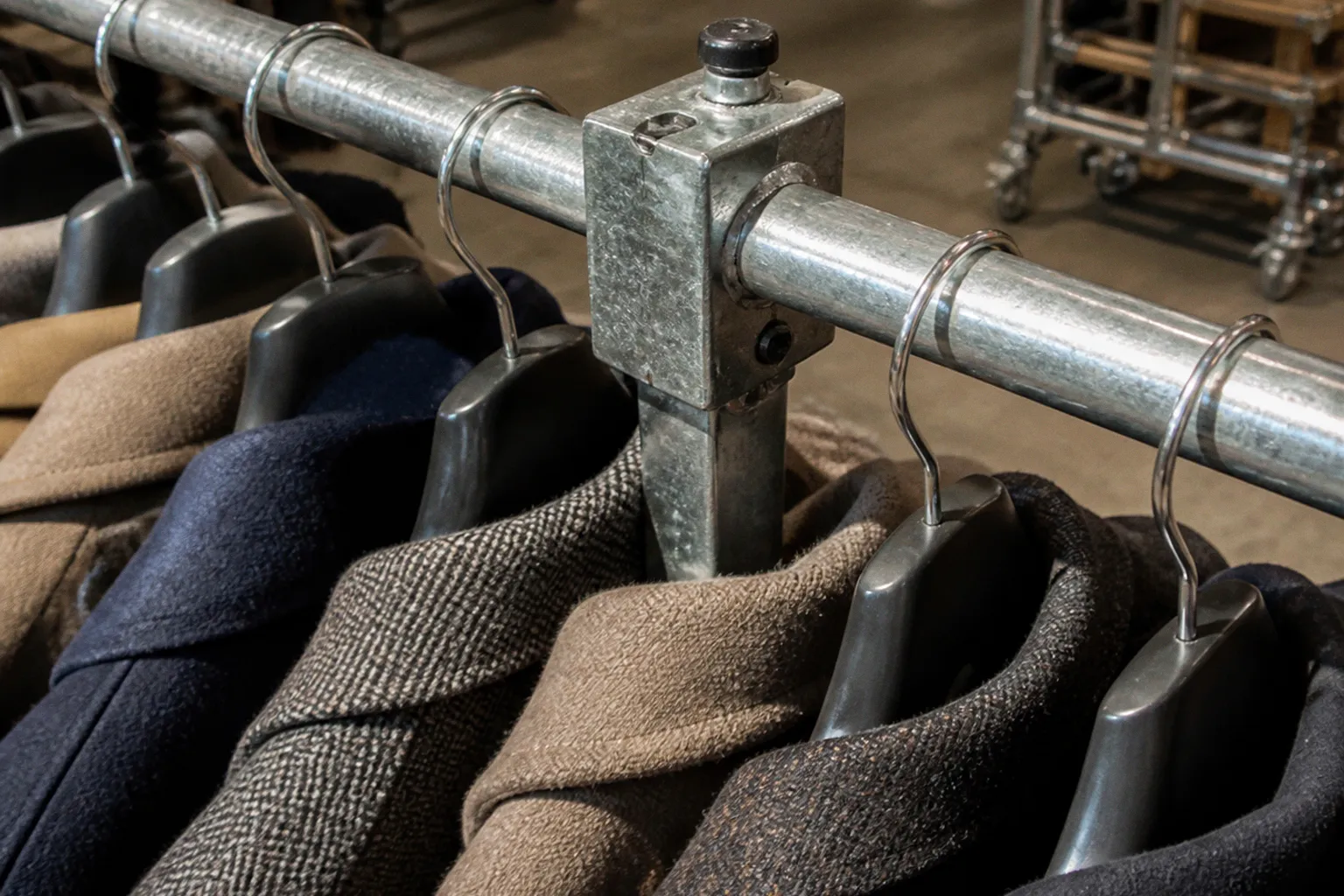
Heavy overcoats typically weigh between 2.0 and 3.5 kg each, so a rail carrying 40 garments may be supporting 80–140 kg before you add hangers, packaging, customer handling, or the uneven loading that happens when one side of the rack fills first.
That changes the buying decision. A light-duty garment rail may be adequate for shirts and summer dresses, yet completely wrong as a heavy duty clothes rack for winter coats. In a retail floor, stockroom, alteration area, or wardrobe room, you are not choosing a pipe and four wheels. You are choosing how much concentrated weight the system can hold, how safely it can move, and whether the layout keeps customers and staff moving without creating a dead zone.
The right setup depends on three things: the weight of the garments, the length of the hanging span, and whether the rack will remain stationary or move while loaded. Miss any one of those, and a rack that looks commercial on paper can become a bottleneck—or a structural problem—during the busiest part of the season.
Start with the coat count, not the rack
The first mistake we see in winter storage planning is choosing a rack by visual size. Retailers look at a six-foot rail and think in terms of how many coats will fit shoulder to shoulder. The better starting point is the load.
Use the heaviest realistic garment, not the average light jacket. A winter assortment can include insulated parkas, wool overcoats, leather outerwear, and long padded coats, and these do not distribute weight evenly. A rough planning calculation looks like this:
Number of coats × garment weight = hanging load
For example:
- 30 coats at 2.0 kg each create about 60 kg of garment load.
- 40 coats at 2.5 kg each create about 100 kg.
- 40 coats at 3.5 kg each create about 140 kg.
- 50 coats at 3.5 kg each create about 175 kg, before hangers and accessories.
That last figure is already beyond the range of many domestic or light-duty garment racks, which are often rated around 20–40 kg. A commercial rail rated for 80–160 kg or more gives you a much more credible starting point, but even that rating needs interpretation. It may apply to a stationary rack on a level floor, with the load distributed as intended. It does not automatically describe what happens when the same rack is pushed across carpet, over a threshold, or around a tight corner.
A winter rack should be sized for the heaviest moment of the season, not for the quiet afternoon when the rail is half empty.
There is also a practical merchandising issue. If coats are packed too tightly, the nominal capacity of the rack becomes irrelevant to the customer. Shoppers cannot slide hangers, inspect lining, compare sizes, or remove a garment without pulling several others forward. The result is lower product interaction even when the structure remains within its load rating.
For apparel display, we need to balance SKU density with access. A dense rail may store more units per linear foot, but it can reduce dwell time at the product because the customer gives up before finding the right size or color. In a stockroom, density may be the priority. On the sales floor, the rack must carry the load while preserving a usable browsing rhythm.
A practical load scenario
Suppose a boutique places 36 heavy coats on a rolling rack. If the assortment averages 3 kg per coat, the garments alone weigh approximately 108 kg. Add hangers and allow for uneven distribution, then ask four separate questions:
1. Is the rack rated above that stationary load?
2. Does the rating apply to the full rack or only the hanging bar?
3. Can the casters roll that load without jamming or twisting the base?
4. Will the rack remain stable when a customer pulls a coat from one end?
That last question matters because a rack rarely carries weight in a perfectly balanced arrangement. One side may hold long wool coats while the other carries lighter quilted jackets. A customer may remove three garments from one section. Staff may push the rack while the load is concentrated toward the front. Static capacity does not answer all of those situations.
Static capacity and dynamic capacity are different decisions
Manufacturers generally describe load capacity as a static rating: the weight the system can hold while stationary on a flat, stable surface. That is useful, but it is only one part of the operating picture.
A rolling rack experiences dynamic stress whenever it moves. The force is not limited to the weight hanging from the rail. The base, joints, caster plates, wheels, and vertical uprights all react to acceleration, stopping, turning, floor transitions, and uneven loading.
This is why a rolling rack for heavy jackets should not be selected by matching the garment load exactly to the published maximum. If a rack is rated for 300 lb in a static position, that does not mean it can be pushed safely at 300 lb across carpet or over a doorway threshold. Movement creates additional stress, and poor casters can make the rack harder to control even when the frame itself is strong.
Commercial Z-racks and industrial-grade rolling garment racks commonly sit in the 300–500 lb static capacity range, approximately 136–227 kg. Those figures make them suitable candidates for serious winter storage, but the rating still needs to be matched to the way your team uses the equipment.
Consider the difference between these two floor plans:
| Operating condition | What the rack must handle | Best evaluation focus |
|---|---|---|
| Stationary stockroom storage | Concentrated garment weight over time | Rail capacity, frame rigidity, base strength |
| Daily movement between stockroom and floor | Weight plus rolling and stopping forces | Caster quality, wheel diameter, frame rigidity |
| Customer-facing display | Load, browsing, partial unloading, and accidental contact | Stability, access, braked casters, footprint |
| Back-of-house transfers | Uneven loads and repeated handling | Welded joints, caster plates, push control |
| Long-term seasonal storage | Sustained static load over weeks or months | Rail deflection, connection points, corrosion resistance |
If your team moves the rack every day, treat mobility as a structural requirement rather than a convenience feature. A rack with small, low-quality casters may be difficult to steer under a heavy load, so staff compensate by pulling from the side or forcing the frame around corners. That is when joints and caster mounts take abuse.
For a fixed rail, the calculation is simpler, but span length becomes critical. A steel pipe hanging bar can support approximately 229 lb across a six-foot span, compared with about 689 lb across a shorter two-foot span. The important lesson is not to memorize those figures as a universal specification; it is to understand why one long uninterrupted rail behaves differently from several shorter supported spans.
The longer the span, the more the bar is exposed to bending and deflection. A rail may not collapse, yet it can bow visibly in the center, making hangers slide toward the middle and concentrating even more weight in one area. That creates a merchandising problem before it becomes a safety problem.
Z-racks, steel pipe systems, and wood: choosing the structure
The main industrial coat rack options are not interchangeable. Each configuration solves a different spatial and operational problem.
Commercial Z-racks for flexible floor plans
A Z-rack is useful when the store or stockroom needs mobility, nesting, and quick reconfiguration. The lower frame commonly creates a stable base, while the shape allows multiple racks to be nested when empty or partially loaded. This can preserve aisle width during opening hours and improve back-of-house capacity after closing.
For winter apparel, the advantages are straightforward:
- Rolling access between stockroom and sales floor.
- A footprint that works well in temporary seasonal zones.
- Easy grouping by department, size, or delivery batch.
- Commercial static capacities commonly ranging from 300 to 500 lb.
- Better flexibility than a fixed wall-mounted rail.
The trade-off is that a Z-rack is only as useful as its wheels and base. If the casters are undersized or the floor contains thresholds, the nominal load rating will not describe the real operating experience. Also, a heavily loaded rack needs enough turning clearance; otherwise the team will repeatedly strike gondolas, fixtures, or door frames.
A Z-rack works especially well when the assortment changes throughout the day. If staff replenish the floor from a stockroom, look for a configuration that can be pushed in a straight line without excessive side-to-side movement. If the rack is mainly a permanent display, the mobility may add cost and footprint without adding meaningful value.
Structural pipe systems for fixed capacity
A steel pipe hanging system is usually the stronger route when the rack will remain in one location and the priority is high load capacity across a planned bay. These systems can be designed with vertical supports, wall anchors, intermediate brackets, and shorter rail spans.
The key advantage is control. We can decide where the load is carried instead of asking one long bar to support the entire assortment. Adding an intermediate support reduces the unsupported span and can materially improve resistance to deflection. It also makes it easier to separate departments or maintain a clear planogram.
A fixed pipe system suits:
- Stockrooms with predictable wall or floor positions.
- Alteration and wardrobe areas where garments stay in place.
- High-volume winterwear bays.
- Heavy coats that remain on the rail for extended periods.
- Spaces where maximum hanging capacity matters more than rapid relocation.
The limitation is flexibility. Once the system is anchored, changing the footprint may require dismantling sections or adjusting the surrounding layout. That is acceptable when the space is stable; it is inconvenient when a retailer changes the seasonal floor plan every few weeks.
Freestanding wood and carbon-steel racks
Freestanding wooden racks can perform well in customer-facing environments where the fixture needs to look like part of the store rather than warehouse equipment. In testing of standing coat racks, solid wood models handled approximately 40–60 lb before instability, while thin metal tube models handled roughly 15–25 lb. That comparison is useful for understanding frame behavior, but it should not be treated as a universal rating for every wood or metal design.
A solid wood coat rack may offer a broader, heavier base and greater resistance to tipping than a thin tubular model. It can also support a warmer visual presentation for premium apparel. However, appearance does not replace a load specification. A decorative rack designed for a few customer coats is not automatically a heavy duty clothing rack for heavy coats.
Carbon-steel garment racks generally offer better structural potential than thin hollow tubing, particularly when the frame is welded or uses robust mechanical connections. Still, the wall thickness, joint design, base geometry, and caster hardware determine the result. Two racks can both be described as steel while behaving very differently under a concentrated winter load.
Our rule is simple: use wood where the presentation benefit is real and the load is controlled; use commercial steel or structural pipe where the business depends on high capacity, frequent movement, or long-term storage.
The weakest component decides the outcome
A heavy-duty garment system fails at its weakest link, not at the part that looks most impressive in the product photograph. Retailers often focus on the hanging bar and overlook the connectors, wheels, or base.
The common failure points are predictable:
1. Thin hollow tubing
A tube may look substantial from a distance but have limited resistance to bending when the span is long and the load is concentrated in the center. Deflection is often the first visible warning.
2. Plastic connector joints
Plastic fittings can be acceptable for light garments and temporary home storage, but they are a poor choice for full seasonal storage of heavy winter coats. Repeated loading, twisting, and movement can loosen or deform the connection.
3. Low-quality casters
A caster that rolls smoothly under an empty rack may jam under a loaded one. Small wheels also transmit more impact when crossing uneven surfaces, increasing stress on the frame and making the rack harder to steer.
4. Weak caster plates or mounting points
The wheel itself may be adequate while the plate, bolt pattern, or welded mount is not. When a loaded rack turns, force transfers through this connection into the base.
5. Long unsupported rails
Even a strong steel bar can bow when the span is too long. The problem becomes worse when garments bunch at the center instead of remaining evenly distributed.
6. A narrow or top-heavy base
Long coats place visual and physical mass high above the floor. If the base is narrow, the rack can become unstable when a garment is pulled from the end or when the unit is pushed at an angle.
7. Poor load distribution
A rack may be within its total capacity but still unstable if all the heaviest coats are grouped on one side. This is common when staff organize by size or color without considering weight.
The inspection should therefore follow the load path: garment, hanger, rail, upright, connector, base, caster mount, and floor. If any one of those components is designed for a lighter application, the advertised capacity becomes less meaningful.
What to look for in a commercial specification
A useful specification should distinguish the total rack capacity from the capacity of the hanging bar. It should also make clear whether the number is static and whether the rack is intended for use on a level indoor floor.
Look for details such as:
- Total static capacity in pounds or kilograms.
- Capacity per rail if the system has multiple levels.
- Maximum recommended span between supports.
- Frame material and whether joints are welded, bolted, or connector-based.
- Caster diameter, wheel material, and brake configuration.
- Base width and overall footprint.
- Whether the rack is intended for stationary storage, mobile use, or both.
- Any restrictions on carpet, thresholds, ramps, or uneven flooring.
If the listing only says “heavy duty” and gives no load figure, that is not a specification; it is a marketing description. For a retail operation carrying winterwear, we need a number, a use case, and a clear understanding of what the number represents.
Rail span is a merchandising variable, not just an engineering detail
Span length affects both structural performance and product presentation. A long rail gives us more linear hanging space, but it can create a soft center, uneven garment distribution, and a visually flat presentation that customers ignore.
Shorter bays with intermediate supports offer more control. They reduce the load carried by each unsupported section and allow the planogram to create recognizable product groups. One bay can hold short insulated jackets, another long wool coats, and another larger sizes or premium pieces. That segmentation improves findability while helping the structure carry the assortment more evenly.
The calculation is not simply “more rail equals more coats.” We need to consider:
- How many garments fit without compressing the hangers.
- Whether long coats require additional vertical clearance.
- How much empty space is needed for customers to browse.
- Where the heaviest garments will sit along the rail.
- Whether the rail is supported at the ends only or at intermediate points.
- Whether the rack must pass through doors and aisles when fully loaded.
For a fixed wardrobe storage system, a series of shorter spans may outperform one continuous rail even if the total linear footage is identical. For a mobile rack, the base and wheel arrangement may impose a practical limit before the rail itself reaches its theoretical capacity.
This is where customer eye-tracking and structural planning meet. A fixture that places the strongest visual story at the customer’s natural sightline is useful only if shoppers can approach it, stop, and remove a garment without fighting the density. We want a clear endcap or entry-facing display for the seasonal message, while the deeper assortment can move to secondary rails or back-of-house storage.
The best winter storage system does two jobs at once: it protects the garment load and makes the next purchase easier to find.
Match the rack to the room
The same heavy-duty rack can be right for one space and wrong for another. Start with the movement pattern, then decide whether you need a mobile or fixed solution.
In the sales floor
A customer-facing rack must balance load capacity with approachability. A very deep rolling unit can hold more coats but reduce the usable aisle and create a visual barrier. If the rack sits near an entrance, allow enough clearance for customers carrying bags or wearing bulky outerwear. The fixture should not force traffic into a narrow pinch point.
Use a mobile Z-rack when seasonal flexibility matters, but control the number of units in the zone. Too many racks create high SKU density without improving conversion. Customers see a wall of similar garments and may not know where to begin.
For a premium department, a freestanding wood or substantial carbon-steel rack may create a better presentation, provided the load is moderate and the base is stable. For a high-volume promotional area, commercial steel offers better tolerance for repeated handling and replenishment.
In the stockroom
The stockroom rewards capacity and organization. Fixed steel pipe systems or heavy-duty industrial racks can create predictable bays with clear size and category divisions. The goal is not merely to hang more coats; it is to reduce the time staff spend searching and reshuffling.
A practical stockroom layout separates:
- New deliveries awaiting processing.
- Sellable reserve stock.
- Returns or quality-control garments.
- Alteration or repair items.
- Seasonal overflow.
Use consistent bay labels and keep the heaviest garments on the most structurally supported sections. If staff must move racks, leave a clear route and avoid placing a fully loaded unit where it has to make repeated tight turns.
In a wardrobe or event storage area
Wardrobe systems often face a different demand: many garments may arrive at once, and staff may need to move them quickly. Here, dynamic capacity and caster performance become more important than a high static number.
A rack that is excellent for stationary storage may be awkward when pushed through a crowded backstage area. Check the turning radius, brake access, handle height, and wheel behavior under load. If garments are covered, verify that covers do not snag on uprights or make the unit harder to control.
Build capacity into the layout, not just the equipment
A heavy coat storage system should be planned as part of the floor strategy. The rack needs a home, a replenishment path, and a product logic.
For each rack or bay, define:
- The garment category it carries.
- The maximum intended number of units.
- The heaviest garment type in that group.
- Whether the rack is fixed or mobile.
- The replenishment route.
- The customer-facing side.
- The clearance needed to browse and remove garments.
This prevents a common operational failure: buying a rack with adequate capacity, then overloading it because the surrounding storage is insufficient. When reserve space disappears, staff push more coats onto the same rail. Hangers become compressed, garments migrate toward the center, and the rack becomes harder to move.
A good planogram can also distribute the load. For example, place the heaviest long coats across supported sections rather than grouping them all at one end. Keep dense size runs from turning into a single concentrated block. If the rack has two rails, do not assume the upper and lower levels can each carry the same weight unless the specification says so.
The objective is a stable relationship between product, fixture, and customer movement. If a rack is overloaded, customers notice the consequences as poor access, crowded sightlines, and messy presentation before they notice the technical cause.
Which setup should you choose?
The decision becomes clearer when we connect each configuration to the operating problem.
| Your operating priority | Strongest fit | Why |
|---|---|---|
| Move winter coats between stockroom and sales floor | Commercial Z-rack | Combines mobility, seasonal flexibility, and high static capacity |
| Store heavy coats in one permanent stockroom location | Fixed steel pipe system | Supports planned spans and can use intermediate brackets |
| Create a premium customer-facing display | Solid wood or substantial carbon-steel rack | Offers a more finished presentation, provided capacity is verified |
| Maximize reserve storage in a back room | Industrial garment rail system | Prioritizes load capacity and organized bay planning |
| Reconfigure the floor frequently | Rolling industrial clothing rack | Allows seasonal zones and promotional endcaps to change quickly |
| Carry very heavy coats over long periods | Shorter supported spans | Reduces rail deflection and controls weight distribution |
For most retailers, the best answer is not one universal rack across the entire business. Use fixed high-capacity rails where the assortment stays put, mobile Z-racks where replenishment and seasonal movement are constant, and presentation-focused fixtures where the customer experience justifies them.
A domestic or light-duty rack may still have a role for a small number of lightweight garments. It should not be treated as a substitute for a commercial heavy duty clothes rack for winter coats when the system will hold a full seasonal assortment.
Before opening: make the load and the route visible
Walk the space with the rack fully planned, not empty. Mark the rail span, the heaviest garment group, the caster route, and the customer approach. Then ask whether the fixture still works when all intended stock is present.
A fast pre-opening review should confirm:
- The planned coat count multiplied by the heaviest expected garment weight stays below the stationary rating.
- The rack is not being treated as mobile at its full static capacity.
- The longest rail span has adequate support and shows no obvious bowing.
- The casters roll and brake under a realistic load.
- Heavy garments are distributed rather than stacked at one end.
- Customers can reach, slide, and remove coats without compressing the rail.
- The rack does not block a sightline to the main seasonal display or create an aisle pinch point.
- Staff have a clear replenishment route that does not require forcing a loaded unit around fixtures.
Then measure the operational result. Track replenishment time, garment interaction, fitting-room requests, and sales by rack or zone. If a denser rail holds more units but produces fewer customer touches and slower replenishment, it is not improving the business. If a shorter supported bay makes the assortment easier to browse and staff can restock it faster, the lower visual density may be producing better conversion.
The right heavy winter storage system is therefore a capacity decision, a mobility decision, and a merchandising decision at the same time. Start with the real coat load, separate static from dynamic use, control the rail span, and inspect every connection between the garment and the floor. Once those fundamentals are right, the rack stops being a storage afterthought and becomes what it should have been from the beginning: a reliable part of the selling system.