Clothing racks vs built-in closets for modern bedrooms
Here's the merchandising question we put to every homeowner who walks into our showroom: are you building a vault or a boutique?
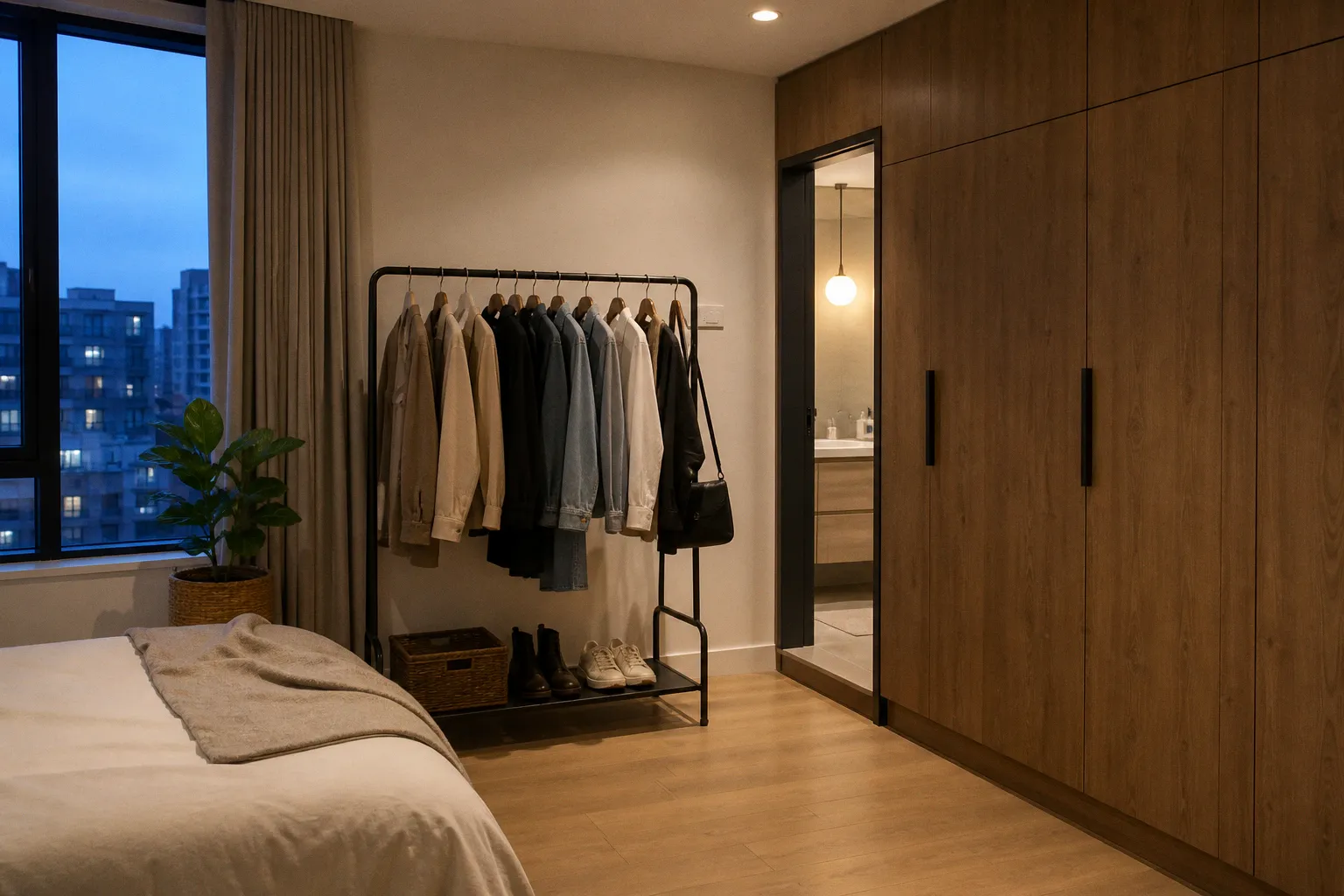
That single decision — built-in closet versus open clothing rack — cascades into everything from your daily getting-ready experience to your eventual resale appraisal. We've watched clients sink ten grand into millwork only to underuse half the hanging space, and we've seen others drop a few hundred dollars on a commercial-grade steel rack that became the visual centerpiece of their bedroom. The right answer depends on how your wardrobe actually behaves, not how a Pinterest board says it should.
Compare car rental deals in United Kingdom
See available offersPartner link — DiscoverCars comparisonThe Financial Reality: Custom Installations vs Modular Racks
Let's talk dollars first, because in retail — and in your bedroom — the P&L drives everything. Custom built-in closets run between $1,000 and $10,000 depending on the level of customization, materials, and whether you're tearing out drywall to expand the footprint. Built-in wardrobes — the freestanding cabinet kind that still mounts to the wall — average $1,500 to $6,000. That's a wide range, and we see homeowners routinely underestimate the upper end once they start adding soft-close drawers, integrated lighting, and glass-front doors.
A serious open clothing rack — the kind built on a commercial steel frame — runs a fraction of that. You're looking at a piece of retail hardware that handles the same weight as the millwork but costs less than a single drawer pull on a high-end custom install. The math gets even more interesting when you factor in lifespan: a powder-coated steel rack can be disassembled, moved to a new apartment, and reassembled without a contractor. The built-in stays with the house, which is a feature if you're staying and a sunk cost if you're not.
A built-in closet is a sunk asset tied to the property. A steel clothing rack is portable inventory you take with you.
If your lease is up in eighteen months, or your job-transfer window is unpredictable, the rack wins on financial flexibility every time. If you're putting down roots and plan to sell in five-plus years, the millwork starts to pencil out — but only if you actually use the full volume.
Structural Efficiency: Maximizing Vertical Space and Depth Requirements
Here's where we drop our floor-manager hat and start measuring sightlines. A standard built-in closet designed to hang clothes front-to-back requires a minimum depth of 24 inches — that's the non-negotiable number for hangers to rotate freely without crushing the garment behind it. Most built-ins then extend floor-to-ceiling, which means you're capturing roughly 8 feet of vertical real estate per linear foot of wall.
An open clothing rack typically tops out around 5 to 6 feet of hanging height — your shoulders are the ceiling, not the joists. That leaves a dead zone above the unit, and we'll be honest: in small bedrooms, that dead zone becomes visual clutter unless you stack something purposeful on top. The built-in wins the vertical battle outright. Where the rack fights back is footprint. A 4-foot open rack occupies roughly 4 square feet of floor and breathes on all sides; a 4-foot built-in section eats into the room the same way but adds wall mass that can make a 10-by-10 bedroom feel like a storage unit.
| Dimension | Built-In Closet | Open Clothing Rack |
|---|---|---|
| Minimum depth (front-to-back hang) | 24 in | 18–22 in (bar-to-wall) |
| Typical vertical reach | Floor to ceiling (~8 ft) | 5–6 ft (bar height) |
| Floor footprint per linear foot | Same as wall footprint | Same, but visually lighter |
| Mobility | Permanent | Fully portable |
| Best for | Full wardrobes, odd corners, vaulted ceilings | Capsule wardrobes, rotating displays, rentals |
That table is your spatial SKU comparison. If your closet-to-wall ratio favors hiding things, go built-in. If it favors seeing and rotating things, go rack.
Environmental Impact on Garments: Airflow and Dust Protection
Now we get into the merchandising trade-off that nobody puts on the spec sheet but everyone notices within six months: air and dust.
Open racks keep your clothes breathing. Continuous airflow around hanging garments is the single best defense against mildew, mustiness, and that distinctive "closed closet" smell that hits you when you open the door in a humid climate. We've installed racks in coastal properties where the homeowners had been losing sweaters to mold inside built-ins for years — the moment they switched to an open rail, the problem evaporated. Literally.
But — and this is the but — open racks expose your wardrobe to dust accumulation and direct sunlight. In a south-facing bedroom with afternoon UV, color fading on a prized silk blouse is a real, measurable risk over a single season. Dust shows up faster on a horizontal bar than you'd think, especially on darker fabrics where the film is visible.
Closed closets trap moisture. Open racks trap dust. The right pick depends on your humidity, your sun exposure, and how often you actually launder.
If you live somewhere humid — Gulf Coast, Southeast US, tropical climates — the airflow argument is decisive. Go open. If you live in a dry, sunny market like the high desert or inland California and you own anything you care about fading, go closed or be ready to rotate seasonally.
Load Capacity and Durability: Commercial Steel vs Consumer Grade
This is where our retail DNA becomes your bedroom advantage. A heavy-duty commercial-grade steel clothing rail — the same hardware you'd see anchoring a department store's outerwear run — supports a uniformly distributed load of 100 to 200 kg (roughly 220 to 440 lbs). That's enough to hang a full winter wardrobe for two adults on a single 4-foot bar without flexing.
Compare that to a basic consumer-grade clothes rack, which typically maxes out around 20 kg (about 44 lbs). The difference isn't aesthetic — it's structural. The consumer rack is built for a weekend's worth of clothes. The commercial rack is built for a season's worth, and it shows in the tube gauge, the weld quality, and the foot design.
When we recommend an open rack for a primary bedroom, we're always pointing clients toward the commercial-grade option. Yes, it costs more upfront than the $40 chrome thing from the big-box store, but the failure mode on the cheap rack — a mid-week collapse that takes your good blazers with it — is the kind of merchandising disaster we don't recover from easily. If you're going open, go commercial. If you're going closed, the structural question shifts to the cabinet maker, not the hanging hardware.
Real Estate Value and the Perception of Bedroom Storage
Last layer, and it's the one buyers and appraisers care about: does a built-in closet actually move the needle on home value?
Here's the honest answer. According to the International Residential Code (IRC) and most state building codes, a built-in closet is not legally required to classify a room as a bedroom. You can list a four-wall room with a window and proper egress as a bedroom without a closet, and the law won't blink. What blinks is the buyer. Local real estate markets and appraisers almost universally expect a closet — it's baked into the listing photos, the comparable sales, and the buyer's mental walkthrough.
Think of it like anchor tenants in a strip mall. Nobody legally requires a grocery store to anchor a shopping center, but the moment you remove one, foot traffic patterns shift and tenants start asking about co-tenancy clauses. Same psychology in residential real estate: no closet, and buyers start mentally discounting the room or wondering what else was skipped.
So the rule of thumb — if you're in a competitive seller's market and the comps all have closets, a built-in returns a meaningful percentage of its cost. If you're in a buyer's market or a neighborhood where walk-in conversions are trending, the open-rack-as-staging-prop strategy can actually work in your favor; boutique hotels have trained buyers to associate open wardrobes with lifestyle luxury, and a curated steel rack staged with your best pieces reads as a design choice rather than a missing amenity.
Your Bedroom Storage Decision: The Floor-Manager Checklist
Before you sign the contractor's deposit or hit "add to cart" on a steel rack, run this quick floor check:
- Volume check. Do you actually have enough hanging clothes to fill 8 feet of vertical space? If the answer is no, a built-in will be half-empty and you'll feel it every morning.
- Mobility horizon. Are you in this home for three-plus years, or could a job or life change move you in eighteen months? Portable wins short-term; permanent wins long-term.
- Humidity and sun audit. Which side of the house is the bedroom on? How's the indoor humidity in summer? Airflow beats hiding in damp rooms; closed beats open in sunny rooms.
- Load reality. Are you hanging a season's worth of wool and denim, or a capsule of thirty pieces? Capsule — a consumer rack is fine. Full wardrobe — commercial steel, no exceptions.
- Resale comp check. Pull three comparable sales on your street. How many have closets? That's your answer on whether the built-in is an amenity buyers expect or a bonus they notice.
Pick the option that wins four out of five. That's your store-floor KPI for the bedroom. Anything less, and you're merchandising for someone else's lifestyle, not your own.