Floor racks vs ceiling hung rails for apparel storage
A clothing storage system can either earn its footprint or quietly consume it. That is the real decision behind floor standing garment racks vs ceiling hung rails: do you need flexible capacity that…
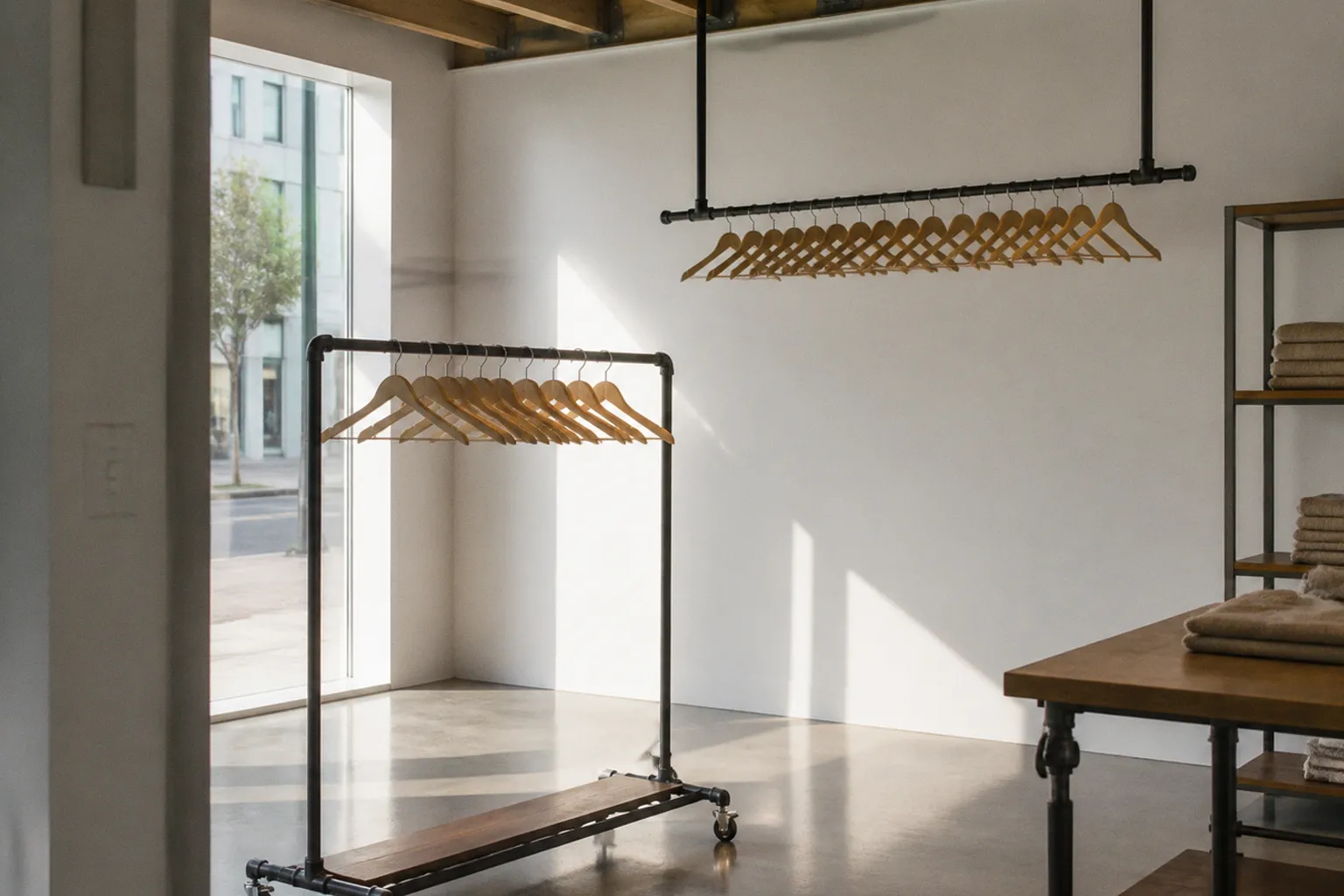
A clothing storage system can either earn its footprint or quietly consume it. That is the real decision behind floor standing garment racks vs ceiling hung rails: do you need flexible capacity that can move with the merchandise, or are you ready to anchor apparel storage permanently above the selling floor?
The wrong choice shows up quickly. A lightweight rolling rack starts bowing when a delivery is fully loaded, casters jam during a floor reset, and the aisle turns into a metal obstacle course. A ceiling rail can solve the footprint problem beautifully, but only if the ceiling structure, bracket positions, access requirements, and daily operating habits support it. One system is mobile and forgiving; the other is space-efficient and committed.
For retailers, the comparison is not simply about where clothes hang. It affects SKU density, sightlines, replenishment speed, customer dwell time, visual merchandising, and the amount of floor you can actually sell from.
The basic trade-off: flexibility against permanent capacity
Floor-standing garment racks are the faster operational answer. They arrive as independent fixtures, require no drilling or structural modification, and can be repositioned when the assortment changes. That makes them particularly useful for pop-up stores, rented premises, seasonal departments, outlet environments, and retailers whose planograms are still evolving.
You can move a rack from a wall run to an endcap, split one dense presentation into two lighter groups, or clear the floor entirely for an event. If the store changes its product mix every few weeks, that flexibility is not a minor convenience; it is part of the merchandising system.
Ceiling-hung rails take the opposite position. They use overhead space, remove the rack footprint from the floor, and can create a cleaner selling area below. For back-of-house garment storage, this may increase usable capacity without adding another bulky fixture. In a retail environment, suspended garment rails can also keep replenishment stock close to the sales floor without blocking circulation.
But the ceiling system is not a rack with the legs removed. It becomes part of the building. Safe installation requires brackets to be mounted directly into wood ceiling joists or another solid structural substrate, not simply into hollow drywall. Standard framing often places ceiling joists 16 or 24 inches on center, so the available structure determines where the rail can run and where the brackets can be fixed.
That difference sets the operating tone:
- Choose floor racks when the layout must change easily, the premises are rented, or the apparel program is temporary or seasonal.
- Choose ceiling rails when floor area is expensive, the storage position is stable, and you can verify the ceiling structure before installation.
- Use both when the store needs visible flexibility on the floor and dense reserve storage overhead.
The best garment storage system is not the one with the highest theoretical capacity; it is the one that keeps merchandise accessible without stealing the space where customers need to shop.
Floor-standing garment racks: the case for mobility
A floor rack gives the merchandising team immediate control over the selling surface. That matters when product turnover depends on quick reactions: moving a slow category into a stronger sightline, creating a new promotional zone, or separating new arrivals from clearance without rebuilding the entire floor.
For a boutique, a rolling rack can function as a flexible fixture rather than simple storage. It may hold a tightly edited capsule collection near the entrance, support a weekend promotion, or become an endcap that interrupts a long aisle and gives the customer a reason to slow down. In each case, the rack’s value comes from mobility and visual control.
The strongest floor systems are built around a solid frame, sensible base geometry, and casters that match the floor surface. If the rack is expected to carry dense apparel, look for a 1-inch-diameter solid steel pipe rail or a comparable heavy-duty construction. A solid steel rail of that size can support more than 150 pounds without sagging, while hollow aluminum alloy or thin chrome-plated bars may begin to bow under loads in the range of 60–80 pounds.
Those figures should not be treated as a universal rating for every rack. The overall capacity still depends on the frame, joints, welds, base, caster assembly, and how evenly the garments are distributed. A strong horizontal bar does not rescue a narrow, unstable base.
What makes a floor rack commercially useful
A good heavy-duty floor clothing rack should support the way your staff actually works, not just look substantial in a product photograph.
Pay attention to:
- Rail construction. Solid steel is better suited to dense apparel loads than thin tubing that flexes when the rack is full.
- Base stability. A tall rack with a narrow base can become a hazard when customers pull several garments forward at once.
- Caster quality. Low-quality plastic casters may jam, mark, or scratch floors, turning every reset into a maintenance problem.
- Locking movement. For rolling racks, 360-degree swivel lockable casters make it easier to reposition the fixture and then keep it fixed during shopping.
- Static versus working capacity. A quoted static load may assume an evenly distributed, motionless load. Retail racks experience pulling, pushing, turning, and uneven loading.
- Garment clearance. Dresses, coats, and longer pieces need enough drop to avoid dragging on the floor or folding over the lower frame.
- Access from both sides. A double-sided rack can increase SKU density, but it can also become visually heavy if it sits in a narrow aisle.
The common operational failure is buying a rack that is technically a clothing rack but functionally a light-duty display prop. Thin metal tubing, weak joints, and poor casters often remain invisible until the fixture is loaded with a full category. By then, the rack is already part of the selling floor, and replacing it means moving stock, disrupting the planogram, and explaining why the fixture did not survive normal use.
Where floor racks win
Floor-mounted racks are particularly strong in environments with:
1. Frequent layout changes. If your visual merchandising team tests different adjacencies, mobility lets you change the customer path without construction work.
2. Short-term occupancy. Pop-ups and rented retail spaces benefit from zero-drilling assembly and fixtures that can leave with the inventory.
3. Seasonal peaks. Outerwear, holiday dressing, school uniforms, and promotional assortments may need temporary capacity that does not justify permanent mounting.
4. Flexible back rooms. A rolling rack can move between receiving, steaming, fitting-room support, and the sales floor.
5. Fast replenishment. Staff can bring a loaded rack to the floor, exchange it for an empty one, and reduce repeated garment handling.
There is a commercial cost to that flexibility: every rack occupies floor area, and every occupied square foot competes with circulation, fixtures, product presentation, and customer comfort. A floor rack can raise SKU density while simultaneously lowering the quality of the shopping path if it is placed without regard to sightlines.
Ceiling-hung rails: using the volume above the floor
Ceiling-mounted clothes hanging systems solve a different problem. They make use of vertical volume that conventional floor fixtures leave untouched, potentially freeing the full floor footprint beneath the rail. This is especially valuable in compact stockrooms, wardrobe rooms, alteration areas, fitting-room support spaces, and retail floors where clear circulation is part of the brand experience.
A suspended garment rail can keep reserve apparel off the floor while leaving the wall and aisle available for other functions. In a stockroom, that may make picking and replenishment more orderly. In a sales environment, it can preserve a clean sightline and reduce the visual weight of a continuous row of floor fixtures.
However, the installation is structural, not decorative. The rail must be fixed into wood ceiling joists or another solid substrate capable of supporting the intended load. Hollow drywall alone is not a safe anchor for a heavily loaded rail merely because the bracket appears secure at first.
The joist layout matters from the beginning. With common framing intervals of 16 or 24 inches on center, bracket positions may be constrained by the ceiling rather than by the preferred merchandising line. Before ordering a system, map the available joists with a stud finder and determine whether the intended rail length, suspension points, and garment clearance can work together.
Allow at least 60 minutes for a basic installation process involving structural locating and measurement, and expect more time if the rail requires multiple brackets, awkward access, or adjustments to the surrounding storage. The key point is not the clock; it is the sequence. Find the structure first, then finalize the rail position. Do not choose a location visually and assume the ceiling will cooperate.
Where ceiling rails earn their keep
Ceiling rails are most compelling when:
- Floor space has a high sales value. Removing a rack footprint can improve circulation and make adjacent displays more visible.
- The storage position is stable. Permanent mounting is sensible when the same stock zone will remain in place through repeated seasons.
- The ceiling volume is underused. High areas above a stockroom or wardrobe zone can support overhead apparel storage solutions without adding another floor obstacle.
- Access can be planned. If staff need a ladder or step platform for the highest garments, that operating requirement must be part of the layout.
- The building structure is suitable. Joists or a solid structural substrate must be available where the brackets need to go.
The most common mistake is to treat a ceiling rail as a universal capacity upgrade. It is not. A rail suspended from inadequate anchors, overloaded beyond the rating of its rod or cable system, or installed where staff cannot safely reach the garments will create a different kind of bottleneck.
Capacity is more than the number on the specification sheet
Comparing floor standing garment racks with ceiling hung rails by weight alone leads to bad decisions. A rack may advertise a strong static capacity but perform poorly when garments are concentrated at one end. A ceiling rail may be structurally secure but operationally inefficient if the team cannot reach the rear section without moving a ladder or half the stockroom.
We should evaluate capacity in three layers:
Structural capacity
This is the load the rail, frame, brackets, fasteners, and substrate can safely support. For floor racks, the relevant chain includes the horizontal bar, vertical supports, joints, base, and casters. For ceiling rails, it includes the rail itself, suspension hardware, mounting brackets, and the ceiling structure.
A 1-inch solid steel pipe rail can handle 150+ pounds without sagging, while thinner hollow aluminum or chrome-plated tubing may bow around 60–80 pounds. That contrast is useful when screening products, but it does not eliminate the need to review the complete assembly.
Operational capacity
This is how much merchandise the team can load and still move, replenish, count, and retrieve efficiently. A rack that can physically hold more garments than staff can comfortably browse may reduce conversion rather than improve it. Hangers overlap, size runs disappear, and the customer has to work too hard to find the right item.
For a ceiling system, operational capacity includes reach height and access frequency. Reserve stock that is needed every ten minutes should not be stored in the least accessible overhead position simply because the rail fits there.
Merchandising capacity
This is the amount of product the customer can understand. Dense SKU presentation is useful only when the assortment remains legible. If a rail or rack creates a continuous wall of garments, it may reduce sightlines into the next zone and shorten the customer’s willingness to explore.
A useful comparison looks like this:
| Merchandising and operating factor | Floor-standing garment racks | Ceiling-hung rails |
|---|---|---|
| Installation | Usually zero-drilling assembly; no structural modification | Requires secure anchorage into joists or solid substrate |
| Mobility | Can be repositioned for planogram and seasonal changes | Fixed after installation unless remounted |
| Floor footprint | Occupies selling or storage floor area | Frees the rack footprint beneath the rail |
| Best use | Pop-ups, changing assortments, sales-floor presentation, mobile replenishment | Stable stock zones, compact rooms, overhead reserve storage |
| Load behavior | Depends on tubing gauge, frame, base, joints, and casters | Depends on rail, brackets, suspension hardware, and ceiling structure |
| Customer presentation | Directly supports displays, endcaps, and edited collections | Better for preserving sightlines and reducing floor clutter |
| Replenishment | Easy to bring a loaded rack to the floor | Efficient only when access and reach are planned |
| Main failure risk | Bowing bars, unstable frames, jammed or floor-damaging casters | Inadequate anchorage, inaccessible stock, unverified substrate |
This is why a retailer should avoid asking which system is universally stronger. The productive question is: where does the load need to live, how often does it move, and who needs to reach it?
A ceiling rail saves floor space only when the overhead stock remains safe, reachable, and operationally useful; otherwise, it has merely moved the problem out of the aisle and above your head.
Customer psychology: sightlines, dwell time, and visual friction
Garment storage is often discussed as a capacity decision, but on the sales floor it is also an eye-tracking decision. Customers scan for categories, color blocks, newness, and easy entry points. Every rack changes that scan.
A floor rack placed across a natural sightline can slow the customer down in a productive way if it presents a clear, edited offer. The same rack can become visual friction if it is overfilled, angled into the path, or placed so close to another fixture that shoppers cannot step in and browse both sides.
Use floor racks when you want to create a deliberate pause:
- New arrivals at the threshold of a department
- A small collection beside complementary accessories
- A promotional endcap with a clear price or offer architecture
- A transition point between categories
- A flexible fitting-room or service-area assortment
Avoid using them as automatic fillers for dead zones. A dead zone is not always solved by adding more metal and more inventory. If customers do not see the category, cannot enter the rack comfortably, or cannot understand the product grouping, higher SKU density will not produce better turnover.
Ceiling rails are stronger when the visual objective is openness. They can protect sightlines across a compact room, keep reserve inventory out of the main customer scan, and allow wall displays or freestanding presentations to carry the selling message. In a boutique, the distinction between selling stock and reserve stock is particularly important: customers should encounter an edited assortment, while staff still have enough nearby inventory to replenish sizes quickly.
This gives us a practical rule:
- If the garments themselves are the visual message, use a floor rack where the customer can browse them comfortably.
- If the room needs to feel open and the garments are primarily reserve stock, move capacity overhead.
- If a rack blocks a strong view toward a high-margin category, relocate it even if the fixture is otherwise useful.
- If a ceiling rail forces staff to leave the floor repeatedly for routine size retrieval, the space saving may be costing more in service speed than it returns in footprint.
Installation and daily operations: the details that decide the winner
The installation burden is the clearest dividing line. Floor racks are portable because they do not need to become part of the premises. Ceiling rails require a building check before they become a storage solution.
For a ceiling installation, work through the practical sequence:
1. Locate the joists or solid structural substrate. Common joist spacing is 16 or 24 inches on center, but the actual ceiling must be verified rather than assumed.
2. Mark the usable mounting line. The best merchandising position may not align with the strongest anchorage points.
3. Confirm the load path. Review the rail, brackets, suspension pieces, and substrate as one assembly.
4. Check garment clearance. Long apparel needs enough drop to avoid floor contact, nearby fixtures, or customer circulation.
5. Plan retrieval. Decide how staff will reach the highest garments and where a step platform or ladder can be used without creating a hazard.
6. Load gradually. Begin with a controlled distribution rather than concentrating the entire stock load at one point.
7. Inspect after use. Look for sagging, loose brackets, shifting hardware, or changes in the ceiling around the mounting points.
For floor racks, the sequence is shorter but not casual:
1. Assemble the frame and inspect every joint before loading.
2. Test the casters on the actual floor surface, especially if the store has polished concrete, tile, or delicate finished flooring.
3. Lock the casters once the rack reaches its selling position.
4. Distribute garments across the rail instead of creating a heavy cluster at one end.
5. Push and pull the loaded rack slowly; do not use the fixture as a substitute for a stock cart unless it is designed for that role.
6. Recheck the frame after repeated moves, because mobility introduces impact that a stationary rack never experiences.
If your floor plan changes often, the maintenance cost of a fixed rail may be greater than its installation cost because every assortment change becomes a negotiation with the building. If your store has remained in the same configuration for years, repeatedly buying and moving floor racks may be the more expensive form of indecision.
A practical selection route for different retail environments
The right answer becomes clearer when we match the system to the operating model rather than to the room alone.
Pop-up stores and rented premises
Start with floor-mounted racks. Zero-drilling assembly, portability, and quick resets are more valuable than permanent vertical capacity. Choose a frame that can tolerate repeated transport and a caster system that will not damage the host floor.
Boutique sales floors
Use floor racks selectively for edited presentations, endcaps, and newness. Consider ceiling rails for reserve garments in fitting-room support or back-of-house zones, provided the structure and access are appropriate. The boutique usually benefits from a clear distinction between what customers browse and what staff retrieve.
High-volume apparel stockrooms
Ceiling-hung rails can be effective when they create a defined reserve-storage pattern and the retrieval path is safe. Floor racks remain useful for active replenishment, steaming, receiving, and temporary sorting. In practice, a hybrid layout often beats a single-system approach because not all inventory has the same access frequency.
Seasonal departments
Favor floor racks when the department must appear, expand, and disappear on a predictable cycle. A permanent ceiling system may be justified only when overhead storage will remain useful after the season ends.
Long garments and outerwear
Measure the drop before choosing the system. A compact rail may look efficient until coats, dresses, or gowns fold over the lower frame or brush the floor. The system must accommodate the garment length, not merely the hanger width.
The hybrid layout is often the most commercial answer
Retailers sometimes frame this as an either-or decision because the two systems look fundamentally different. On an operating floor, they can complement one another.
Use ceiling-mounted rails for reserve apparel that must be close but does not need to dominate the customer’s sightline. Use floor racks for the active assortment, promotional presentations, and categories where customer browsing creates the sale. This arrangement separates storage density from visual density.
The hybrid approach also gives staff a better replenishment rhythm. A ceiling rail can hold depth by size or color, while the floor rack carries a smaller, more legible selection. When a size sells through, staff replenish the floor without expanding the customer-facing fixture until the presentation genuinely needs more product.
The limitation is discipline. Overhead capacity should not become an excuse to keep every possible SKU in the room. Reserve stock still needs an inventory logic, and floor fixtures still need a clear planogram. Otherwise, the store gains physical capacity but loses decision speed.
The final decision: measure the space you sell and the work you repeat
When comparing floor standing garment racks vs ceiling hung rails, begin with the question that ties every design choice to the bottom line: which constraint is currently limiting performance?
If the problem is constant layout change, choose floor racks. If the problem is a crowded stockroom or a valuable floor footprint, investigate ceiling-mounted clothes hanging systems. If the store has both problems, divide the job between mobile floor fixtures and anchored overhead storage.
Before committing, run this quick layout check:
- Mark every proposed rack or rail on the planogram and look at the remaining sightlines.
- Identify whether the garments are customer-facing stock, reserve stock, or a temporary working load.
- Match the rail and frame construction to the real load, not the marketing category.
- Verify joist locations before planning any suspended garment rails.
- Check caster quality and floor compatibility on every rolling unit.
- Test whether staff can replenish without blocking an aisle or interrupting customer browsing.
- Review the layout against a measurable result: faster replenishment, clearer category navigation, higher sell-through, or fewer fixture moves.
The strongest system is the one that improves that result without creating a new operational drag. Floor racks give us speed and flexibility; ceiling rails give us vertical efficiency and a cleaner footprint. Choose based on how your merchandise moves, how your customers scan the floor, and how often the building needs to change around the business.