Garment rack floor protection: preventing damage on hardwood
A freestanding garment rack loaded with winter coats weighs more than most people assume.
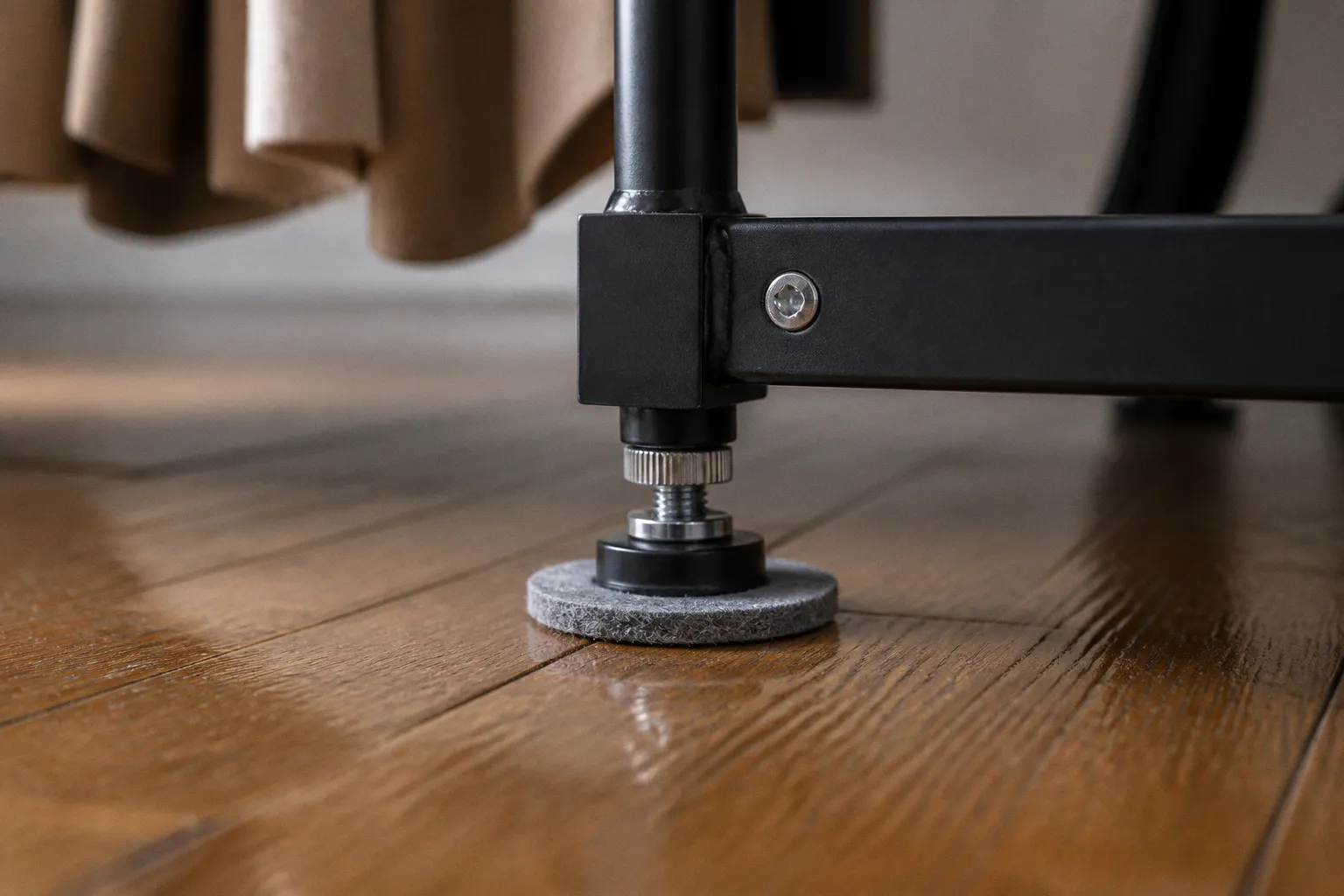
Add a row of denim, a few hanging organizers, and the steel frame suddenly behaves like a small car parked on casters that were arguably never designed to roll across a living room. I learned this the hard way, on a freshly refinished oak floor, six months into my own place. The rack had been sold as "residential-friendly." The floor told a different story: a constellation of grey scuffs where the wheels had been pivoting, two dark pressure points under the load-bearing casters, and a haze of fine scratches radiating outward from every direction I'd rolled the thing. The retailer called it "wear." I called it a $1,400 lesson in caster chemistry.
This is the part nobody prints on the box. A garment rack is not a passive piece of furniture. It's a rolling load, and on hardwood it concentrates weight into a footprint so small that the floor underneath effectively becomes a punching bag. If you're trying to figure out how to keep your rolling rack from ruining your wood, the answer is less about which product is "premium" and more about understanding three things: how much pressure is actually under each wheel, what those wheels are made of, and how to keep abrasive grit from turning the whole rig into sandpaper.
The physics of floor damage: why heavy racks leave marks
Every claim about "floor-safe" casters is a deflection from a number nobody wants to print on the spec sheet. A loaded rolling garment rack can generate concentrated pressure points exceeding 120 psi at the caster contact zone. To put that in perspective, a women's stiletto heel — the long-standing villain of hardwood floors — typically exerts somewhere around 80 to 100 psi. Your rolling closet is, per square inch, in the same league or worse.
The reason comes down to two variables working against you: total load and contact area. Steel garment racks don't carry 5 pounds of T-shirts. They carry the kind of wardrobe weight that surprises people — 60, 80, sometimes over 100 pounds once you load hangers, organizers, and the heavy coat season. That weight is then funneled through four small wheels. The smaller the wheel, the higher the psi. The softer the wheel, the larger the contact patch — and the lower the psi. This is the entire game.
A loaded garment rack exerts more pressure per square inch than a stiletto heel. The wheel material decides whether that pressure becomes a scratch or a non-event.
There are also two kinds of damage people miss. The obvious one is the abrasion line — the curved scuff a caster leaves as it rolls. The less obvious one is point loading: a stationary caster sitting under a static load for weeks, slowly compressing the polyurethane finish and displacing wood fibers beneath it. That's the dark, dull spot you sometimes find exactly where the rack "lives." It didn't happen because the rack rolled. It happened because the rack sat there. Either way, the fix starts with the caster itself.
Selecting the right caster material: polyurethane vs. thermoplastic rubber
The rack industry loves to put a small rubber-looking wheel on a steel stem and call it "non-marking." That's a marketing sentence, not an engineering fact. Wheel material matters more than any other decision in this whole category, and there are really only three materials you should care about.
Hard nylon and steel casters — the kind that ship on the cheapest rolling racks — are designed for concrete warehouse floors, not your living room. They are abrasive by definition. On finished hardwood, they cut. They also create point loading because they barely deform under load, so the contact patch stays tiny and the psi stays high. Skip these entirely. If your rack came with hard black or grey wheels that look like industrial hardware, replace them before you ever roll the rack across wood.
Thermoplastic rubber (TPR) is the softer cousin in the wheel family. It's quiet, it grips well, and it's appropriate for lighter display loads — think a few hanging shirts, a curated outfit rack, seasonal rotation pieces. TPR wheels deform slightly under load, spreading the contact patch and dropping the effective psi. They are excellent for noise and for racks that get moved daily. They are not the right choice for a heavy coat-and-denim wardrobe.
Polyurethane (PU) is the workhorse. A quality PU caster deforms just enough to enlarge the contact patch without compressing into mush, which means it carries heavy loads while keeping the psi under the threshold where hardwood finishes start to fail. For a fully loaded garment rack — the kind that actually justifies owning a garment rack in the first place — PU is the only honest answer. It costs more than the nylon wheel the manufacturer bolted on, but it is the difference between a floor and a refurbish.
| Parameter | Hard nylon / steel | Thermoplastic rubber (TPR) | Polyurethane (PU) |
|---|---|---|---|
| Contact patch under load | Tiny, point-loads | Moderate | Largest, well-distributed |
| Approx. effective psi on hardwood | Highest | Medium | Lowest |
| Quietness | Loud, rattles | Very quiet | Quiet |
| Best use | Concrete, warehouses | Light display racks | Heavy residential rolling racks |
| Risk to wood finish | High — abrasive and gouging | Low for light loads | Low across typical residential loads |
One warning the spec sheets won't tell you: cheap black rubber wheels can leave marks, age into a sticky mess under heavy load, or transfer pigment onto light finishes. PU and quality TPR are color-stable. If a wheel is suspiciously cheap and matte black, treat it as suspect.
Strategic use of protective mats and felt underlayment
Casters are the first line of defense, but they're not the whole story. Even the best PU wheel can sand the floor if it's carrying grit — and any rack on a hardwood floor is rolling across dust, pet hair, and microscopic debris that is functionally indistinguishable from sandpaper. The mat is what keeps that grit from ever meeting either the wheel or the wood.
The trick is picking a mat that does not compress. A foam-backed rubberized underlay sounds luxurious and behaves terribly. It compresses unevenly under a static load, which means the rack ends up slightly tilted, which means the weight shifts to two casters instead of four, which means the psi on those two casters doubles. Worse, foam rubber traps debris underneath and holds it against the finish, where it slowly abrades the wood under every roll. The lifespan of a foam-backed rubber underlay on a high-traffic rack is roughly 8 to 12 months before visible compression sets in. The lifespan of a rigid PVC/nitrile mat in the same spot is 22 to 26 months. That's not a small difference.
A rigid 3mm PVC mat, cut to extend four inches past every edge of the rack, outperforms every cushioned "premium" underlay I've tested.
What works is a 3mm non-slip PVC closet floor mat, cut so it extends roughly 4 inches beyond the rack's footprint on every side. The 3mm thickness is enough to stay flat under load without compressing; the non-slip texture keeps the rack from drifting when you don't want it to; and the 4-inch overhang means the casters roll onto and off of the mat cleanly instead of catching the edge and tripping — which is the moment most floor damage actually happens. A mat that's exactly the size of the rack is a tripping hazard and an edge-lifter. A mat that's slightly oversized is a runway.
If you want to push the protection further, add a small felt pad under each caster in addition to the mat. This combination reduces initial impact shock by roughly 40% — the moment when a heavy rack first rolls onto the floor and the casters slam into the wood with full weight. Felt alone, diligently used on furniture legs, has been shown to reduce hardwood floor scratches by up to 90% in active households. It's not load-rated for the heaviest commercial racks, but for a residential garment rack it's a meaningful upgrade.
Stationary solutions: managing pressure with ABS leg caps
Not every garment rack rolls. Drying racks, valet stands, and many of the heavier boutique-style display racks sit in one spot for months. The damage here is different — it's not abrasion, it's point loading and leg drift — and the fix is different too. You want a leg protector that absorbs shock, prevents the metal foot from sliding on the wood, and spreads the load across a slightly larger surface area.
The honest answer for most residential racks is a non-slip plastic or ABS leg cap, sized for the rack's tubing. 19mm replacement caps are the common size for standard residential and light commercial garment racks, and they're the right starting point. ABS is rigid enough not to compress under static load, grippy enough to keep the rack from drifting when you hang a heavy coat, and cheap enough that replacing a missing one is not a moral event. Rubber feet feel softer and look friendlier in product photos, but under a heavy static load they slowly squish, and once they squish they slide — which is exactly the failure mode you were trying to prevent.
If you do choose rubber feet on a stationary rack, plan to inspect them every six months. The compression is invisible until the rack has drifted six inches across the floor and left a faint grey trail behind it.
Maintenance protocols to prevent abrasive grit accumulation
This is the unglamorous half of floor protection that nobody wants to hear: even soft casters will scratch hardwood if they pick up grit. The wheel is not the failure point. The grit the wheel is carrying is the failure point.
The maintenance loop is short and not optional.
- Vacuum the caster tread weekly. A handheld crevice tool takes thirty seconds. The grit you remove is the grit that doesn't end up dragged across the finish at the next roll.
- Sweep the mat, don't just look at it. A mat full of dust is a sandbox the casters roll through. Lift the mat monthly, vacuum underneath, and check the wood for early wear.
- Inspect felt pads and leg caps quarterly. Anything that has compressed, shifted, or picked up debris gets replaced. Felt pads are consumables, not permanent fixtures.
- Wipe the wheel hubs, not just the treads. Spindle bearings can wick fine grit into the contact patch without you seeing it on the tread surface.
- Rotate the rack's position seasonally. Even on a mat, the same square inch of floor absorbs months of static load. A two-foot shift every season distributes the wear across a wider area.
None of this is complicated. All of it is the difference between a floor that ages gracefully and a floor that needs refinishing in year three.
The reality check before you buy (or keep) a garment rack
If you've read this far, you're either shopping for a rack or trying to save a floor from the one you've got. Either way, here's the short version of what actually matters.
- The wheels that ship on most residential racks are wrong for hardwood. Plan to replace them. Budget for it.
- Polyurethane casters are the correct default for any loaded residential rack. TPR is fine for light display use. Anything hard or metal-on-metal is a no.
- A 3mm rigid PVC mat, oversized by 4 inches, outperforms every cushioned underlay. Foam rubber compresses, traps grit, and shortens its own life.
- Felt pads under each caster cut impact shock by ~40%. They're cheap, replaceable, and worth it.
- Stationary racks need rigid ABS leg caps, not squishy rubber feet. Soft feet compress and drift; rigid caps don't.
- Grit is the silent killer. A perfect caster on a dirty floor is still going to sand the finish.
- The 120 psi number is real. A loaded rack is, per square inch, harder on the floor than a stiletto. Take it seriously.
A garment rack is one of the most useful pieces of residential storage hardware you can own — when its wheels, feet, and floor interface are actually chosen for the floor you have. The industry sells you a steel frame and a pair of warehouse casters and calls it residential. It isn't. Protect the floor before you protect the wardrobe.