Freestanding garment racks: stability on carpet
Last winter I hung a wool overcoat on a budget garment rack, turned around to grab a hanger, and watched the entire assembly tip sideways onto my shag rug. The coat survived. My toe didn't.
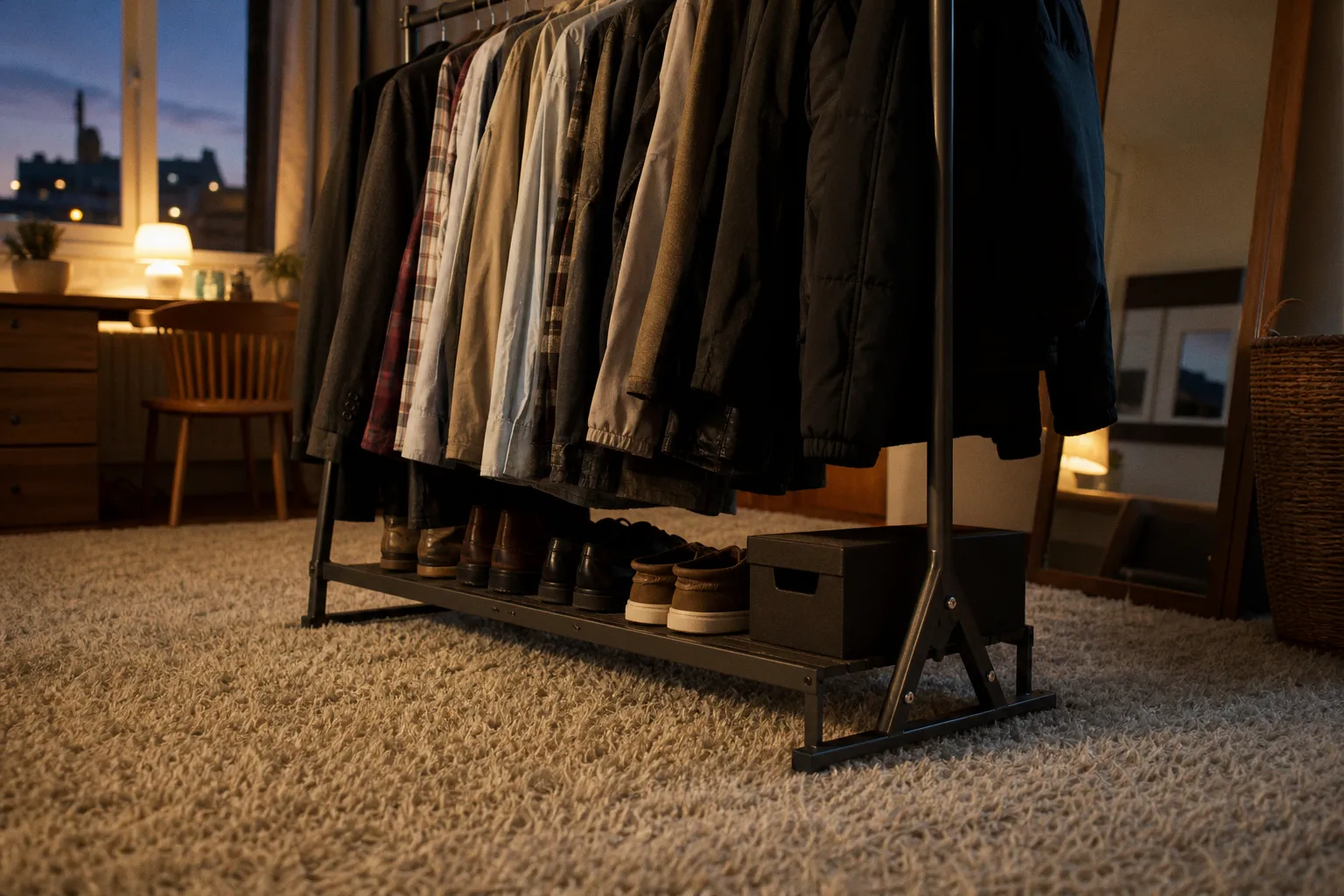
That little disaster taught me more about freestanding garment rack carpet stability than any spec sheet ever could, and the uncomfortable truth is this: most racks sold online are engineered for tile, hardwood, or polished concrete—not the soft, uneven surface you actually live on.
The bad news is that carpet compresses under a rack in ways a hard floor does not. The good news is that the pattern is usually understandable. Pile height, underlay density, base geometry, caster size, and the position of the clothing all affect how much the rack settles and how easily it tips. Once you know which part is causing the movement, you can often fix the problem without replacing the entire unit.
I've spent enough evenings leveling furniture, tightening cheap brackets, and swearing at swivel casters to walk you through the physics, the hardware, and the load-balancing tricks that actually work.
The Mechanics of Carpet Instability: Why Standard Racks Wobble
Carpet isn't a floor. It's a springy, fibrous layer that yields under load. Pile fibers crush downward, the pad beneath compresses, and any object with a narrow footprint can slowly sink, tilt, and migrate. A garment rack usually has only a few contact zones—four small wheels, four narrow feet, or two slim base rails. All of them run into the same basic problem: a small contact area creates concentrated pressure.
Over time, the legs or casters form separate compressed patches in the carpet. The rack is no longer resting on one level plane. It is balancing on the edges of several shallow depressions, with softer carpet between those points acting like a flexible pivot. That is why a rack may feel steady immediately after you place it down and start to rock later, after the pile and pad have had time to settle.
The surface matters as much as the rack. A low-pile carpet over firm padding may offer only a little more resistance than a hard floor. A deep shag or plush carpet over thick underlay gives the base much more room to sink. Berber and tightly woven carpets can behave differently again: they may resist penetration while allowing a narrow foot to slide or catch between loops. There is no single “carpet effect” that applies equally to every room.
Add a tall vertical column of clothing above that small base, and you have a classic tipping problem. The taller and heavier the load, the higher the center of gravity climbs. The farther the load sits from the centerline of the base, the more leverage it has when the rack begins to lean. A rack that feels perfectly steady on tile can become a swaying nuisance on a plush rug because the hard floor keeps the base flat while the carpet allows each contact point to settle differently.
A garment rack doesn't tip simply because it is poorly built. It tips when a flexible surface, a narrow base, and a high or uneven load start working in the same direction.
There is also the issue of caster behavior. The small hard-plastic wheels supplied with many budget racks—often around 1 to 1.5 inches across—can sink into pile fibers almost immediately. Once part of the wheel is buried, the swivel joint may bind and the caster may stop tracking in the direction you expect. You push, the rack pivots, and one wheel stays put while the others turn. That uneven movement can shift the clothing load before you have time to correct it.
A caster that rolls well on wood may be almost useless on a plush carpet. The wheel needs enough diameter to climb over the pile rather than wedge into it, and the housing needs enough clearance that carpet fibers do not interfere with the swivel. Even then, a rolling rack is inherently harder to stabilize than a stationary one. The ability to move is convenient, but it also means the base can respond to a sideways pull instead of resisting it.
How to tell what kind of instability you have
The movement itself offers useful information:
- The whole rack rocks when you press the top: the contact points are settling unevenly, or the base lacks torsional rigidity.
- One corner sinks noticeably: the foot or caster is concentrating too much pressure in one spot, or the carpet has a soft area beneath it.
- The rack drifts when clothing is pulled from one side: the wheels or feet are sliding across the pile rather than gripping it.
- It tips only after one end is loaded: the issue is primarily load distribution and lateral leverage.
- The rack twists as you push it: the casters may be too small, the frame may be loose, or the base is flexing under the load.
That diagnosis matters. Ballast will not fully solve a frame that twists, and larger wheels will not correct a rack whose heavy coats are all hanging beyond one upright.
Selecting the Right Base: Z-Frame vs. A-Frame Geometry
If you're shopping for a new rack, the single most important decision is not color, finish, or brand. It is the shape and contact pattern of the base. Two designs dominate the residential market, and they behave very differently on carpet.
The Z-base, also called a Z-frame or Z-bar, uses long, parallel steel rails connected by crossbars. Seen from above, the footprint is long and shallow. The rails spread the load over a greater length than four isolated feet, while the crossbars can lift much of the frame slightly above the carpet pile. A well-made Z-frame also keeps the load low and resists front-to-back movement.
The A-frame uses two triangular side supports, one at each end of the horizontal rod. Each side creates a broad stance, often with two feet or a short rail touching the floor. This gives the rack a more symmetrical footprint and can make it feel secure when someone brushes past it from the side. The trade-off is that the feet may press deeply into plush carpet, especially when the load is concentrated near the ends.
Here is how the two designs compare in ordinary residential use:
| Parameter | Z-Base Rack | A-Frame Rack |
|---|---|---|
| Footprint | Long, narrow, low-profile | Wide, symmetrical, often four-point contact |
| Carpet contact | Long rails or crossbars can spread pressure | Individual feet may create deeper depressions |
| Center of gravity | Often lower because of the low-slung frame | Can be stable, but depends heavily on side-support width |
| Lateral resistance | Strong when the rails are long and the load is centered | Good against some sideways bumps, weaker if one side is heavily loaded |
| Rolling option | Common on commercial-style models | Less common; many are stationary |
| Best location | Open floor or a room where the long base can lie flat | Against a wall, in a corner, or where a broad stance is useful |
| Main carpet concern | A narrow rail can still sink if the pile is very deep | Small feet can punch into plush carpet and settle unevenly |
The Z-base often wins on raw hanging capacity because its long rails and crossbars can distribute weight more effectively. Its low-slung geometry also helps keep the center of gravity closer to the floor. But a Z-frame is not automatically stable: a lightweight frame with loose joints and tiny casters can still wobble badly.
The A-frame trades some load capacity for a broader stance. It can be a sensible choice in a narrow hallway or bedroom corner, particularly when the rack will remain stationary. However, the shape alone does not guarantee carpet stability. Check how much of each foot actually contacts the floor, whether the feet can be leveled, and whether the side supports flex when you press the top rail.
The base should match the room, not just the load rating
A rack placed in the center of a room needs resistance in every direction. A rack positioned against a wall has a little more practical support, but the wall should not become a substitute for a proper anti-tip arrangement. If the rack can touch the wall, a discreet anchor may reduce the consequences of a sideways shove, but it will not stop the carpet beneath the base from compressing.
Measure the footprint on the floor, not only the width of the hanging bar. A rack can fit between two pieces of furniture while its feet sit partly on a rug edge or on a transition between carpet and hard flooring. That uneven support is a recipe for rocking. The entire base should rest on the same surface, with enough clearance for garments to hang without pushing against a wall or door.
Upgrading Hardware: Swivel Casters and Leveling Feet Solutions
Most freestanding racks ship with hardware that prioritizes manufacturing and shipping cost, not the carpet in your bedroom. The fix is often a hardware swap, but the replacement has to suit the frame. A larger caster or leveling foot is useful only if the stem, socket, and frame can support it.
Swivel casters for a clothes rack on plush carpet
If your rack needs to roll, the factory wheels are probably the first place to look. On plush carpet, swivel casters in the 3-inch to 4-inch diameter range generally handle pile better than very small wheels. They have more room to roll over the surface instead of burying themselves in it. Going much larger can raise the rack and make the upper load less forgiving, so the largest available wheel is not automatically the right one.
A polyurethane or rubber tread usually behaves better than hard nylon. The softer tread can grip the carpet instead of skating across it, although excessive grip can make a loaded rack harder to steer. The goal is controlled rolling, not a wheel that locks into the pile.
Before ordering, check:
- the stem type—threaded, bolt-hole, or plate-mounted;
- the stem diameter and length;
- the clearance around the swivel housing;
- the wheel diameter and width;
- the total load carried by each caster;
- whether the frame socket is metal or thin plastic.
Threaded-stem casters with a 5/16-inch or M8 shank are common on residential racks, but “common” does not mean universal. Remove one existing wheel and compare it with the replacement specification. A caster that almost fits can loosen under movement or damage the socket.
Four swivel casters also create a handling problem: when all four can turn freely, the rack can crab sideways instead of tracking straight. Two locking swivel casters, placed on the same end, may make parking easier. Remember what the locks actually do, though. They stop a wheel from rotating or swiveling; they do not widen the base, lower the center of gravity, or stop a frame from tipping.
Leveling feet for a wardrobe rack carpet base
If the rack does not need to move, adjustable leveling feet are usually the cleaner solution. These are threaded posts with a flat rubber or plastic pad at the bottom. Each corner can be raised or lowered to compensate for uneven compression in the carpet and underlay.
The common thread sizes for residential racks include M6, M8, and 1/4-inch, but the correct fit depends on the rack. Bring the old wheel or foot to a hardware store, or measure the socket with a caliper before ordering. The thread must engage securely; a foot that is held by only a few turns can bend or pull out when the rack is loaded.
Install the feet, place the rack on the carpet, and let it settle before making final adjustments. Put a small bubble level on the horizontal rod, then adjust each foot in small increments. Check the rack from both directions. A level rod is useful, but the more important test is whether the base still rocks when you apply moderate pressure to opposite corners.
A wide foot pad is preferable to a narrow threaded tip on plush surfaces. The pad spreads pressure over more carpet and is less likely to punch a deep hole. If the supplied foot has a small hard end, add a properly fitted rubber pad beneath it rather than stacking loose objects that can shift.
Leveling feet are not glamorous, but they address the actual problem: four contact points that are no longer sitting at the same height after the carpet has compressed.
Do not mistake a level rack for a stable rack. Leveling corrects uneven height; it does not repair a weak frame, overloaded bar, or base that is too narrow for the clothing above it. Stability comes from the combination of a rigid frame, a suitable footprint, secure hardware, and a load that stays within that footprint.
Strategic Weight Distribution for a Lower Center of Gravity
Even with the right base and hardware, a garment rack is still vulnerable to a high, uneven load. The clothing you put on it determines whether the rack stays upright when someone removes a coat, pulls a hanger, or bumps the side.
The simplest rule is also the most frequently ignored: put the heaviest items near the center of the rod and as close to the vertical uprights as practical. A winter parka at the far end of the rod creates more leverage than the same parka near the support. The increase is not a fixed multiplier; it depends on the distance from the rack's centerline, the width of the base, the height of the garment, and how much the carpet has already allowed that side to sink.
That distinction matters in real use. On a wide A-frame with firm, low-pile carpet, a single coat at the end may be harmless. On a narrow rack standing on deep plush carpet, the same coat can be enough to start a lean—especially if several lighter items are already pulling in the same direction. Think in terms of leverage: the farther the weight sits from the support, the more strongly it tries to rotate the rack around the opposite edge of the base.
If you have several heavy items—winter coats, jeans, wool blankets, or bags—cluster them between the uprights or across the middle section of the rod. Leave the ends for shirts, scarves, and other lighter pieces. Avoid loading one complete category on one side simply because it is convenient. A rack can be within its stated total capacity and still be unstable because the distribution is wrong.
Use the lower shelf or bar as ballast
The second rule is even more effective on carpet: use the bottom of the rack as ballast. Many Z-base and A-frame designs include a lower bar or shelf near the floor. If yours does, use it for dense items that will not shift during ordinary movement.
Stacked shoe boxes, a row of hard-shell suitcases, folded linens, or a few hardcover books can all lower the center of gravity. The exact amount of ballast is less important than its position and security. A heavy object placed low and centered helps more than the same object hanging high from the rod. A loose suitcase that can roll off the shelf, however, introduces a new hazard.
A rack with shoes or storage boxes on the lower level and a moderate number of shirts on the rod is usually steadier than the same rack carrying all that weight overhead. The total mass may be similar, but the center of gravity is lower and the upper load has less leverage.
I keep a small basket of ankle weights on the bottom bar of my own rack. It's not elegant, but it works, and nobody sees it because there's a bed skirt in the way. The important detail is that the weights are contained so they cannot slide toward one edge when the rack is nudged.
Leave room for movement
Overloading is not only a question of pounds or kilograms. Clothing needs space to move without becoming a lever. If the garments are packed tightly against a wall, door, or neighboring furniture, pulling one hanger can drag several others. Long coats can catch on a lower shelf. A garment bag can act like a sail when someone walks past.
Leave enough clearance for the load to hang naturally. Keep bags and heavy accessories on a lower shelf where possible. If children or pets use the room, treat sudden side impacts as part of the design problem rather than an unlikely event.
Temporary Stabilization Techniques for High-Pile Surfaces
Sometimes the rack you have is the rack you're stuck with, and the budget for a new base is not there. A few cheap, unattractive, effective workarounds can improve a marginal setup. They are useful for a guest room, a temporary wardrobe, or a seasonal storage solution, but they should not disguise a rack that is structurally undersized.
Sandbags and ankle weights
A sandbag draped over each base leg adds mass at a low point. If the rack has a bottom shelf, the bags can sit there instead, provided they do not slide. Sandbags are useful because they conform to the available space and do not roll away. Keep them dry and inspect the fabric periodically; a leaking bag is a carpet problem of a different kind.
Ankle weights wrapped around a lower crossbar perform a similar job with cleaner lines. Fasten them so they cannot migrate to one side. Ballast works best when it is centered and low. A weight hanging from the upper rod may add total mass while raising the center of gravity, which is the opposite of what you want.
Rubber mats and grippers
A cut piece of dense anti-slip rubber beneath each foot or caster can increase the effective contact area and reduce lateral drift. On plush carpet, a large, thin mat under the whole base is often more useful than several tiny pads because it gives the rack a more consistent surface to settle into. The mat must lie flat and remain fully beneath the base; a curled edge creates another trip and tilt point.
Furniture grippers can help a stationary rack resist sliding. Cork and rubber pads sold for table legs may work on carpet, but test them before leaving the rack loaded. Some pads compress quickly, while others grip the pile without providing much support. They are a supplement, not a replacement for leveling feet.
A rigid board under the base can be more effective when the carpet is extremely deep. It spreads the load across a larger area and reduces the independent sinking of each foot. The board should be wide enough for the entire base, have smooth protected edges, and sit flat without rocking. A narrow scrap placed under only one side will make the rack less stable, not more.
Positioning is part of the fix
Place the rack where the carpet is most consistent. Avoid the edge of an area rug, a seam, a damaged patch, or a place where a heavy bed or cabinet has already compressed the pile unevenly. If the rack must sit near a wall, leave enough room to prevent garments from rubbing against it, but use the wall as a secondary safeguard only if the rack is properly anchored and the wall surface can accept that arrangement.
These measures are stopgaps, not solutions. If your rack is a lightweight, roughly 22-pound-rated assembly, no amount of ballast will turn it into a safe substitute for a heavy-duty wardrobe rack. That category is suited to guest linens, a small amount of dry cleaning, or short-term use—not a family's collection of winter coats. Respect the rating, and remember that a manufacturer's rating assumes a particular load arrangement and a reasonably supportive floor.
Reading the Load Rating Without Being Misled
A stated capacity describes what the frame can carry under the manufacturer's test conditions. It does not automatically describe how the rack behaves on a high-pile carpet with the load concentrated at one end. A “holds 500 pounds” claim may refer to a distributed load on a rigid, flat surface. Your setup may involve a plush rug, small casters, loose joints, and a row of heavy garments all hanging from the same section of the rod.
Instead of applying a universal reduction, assess the conditions that make the rating less useful:
- Base geometry: a long, rigid base generally tolerates distributed weight better than four small feet.
- Contact area: broad rails and wide pads sink less aggressively than narrow tips.
- Carpet depth and underlay: deeper, softer surfaces allow more settlement and tilt.
- Load height: weight on the upper rod raises the center of gravity.
- Load position: weight near an end or outside a support creates more leverage.
- Movement: rolling, pulling, and side impacts require more stability than stationary storage.
- Frame condition: loose bolts, flexing joints, and bent tubing reduce confidence regardless of the advertised capacity.
A conservative approach is to treat the manufacturer's number as a starting point, not a target. Load the rack gradually, keep the heaviest items centered and low, and test it after the carpet has settled. If the frame bows, a caster lifts, a foot sinks sharply, or the rack rocks under a light push, stop adding weight. The warning signs are more valuable than an arbitrary percentage.
A carpet-friendly garment rack is not defined by one impressive capacity number. It is defined by how the base, surface, hardware, and real-world load behave together.
The Pre-Purchase Reality Check
Before you spend a dime, run through the details that product photos tend to hide. The most useful specifications are often the least glamorous ones.
- Measure the footprint, not just the height. Confirm that every rail or foot fits on the same section of carpet. Add clearance for garments to hang without bunching against a wall or door.
- Look for a rigid base. If the frame twists when you press one upper corner, it will not become rigid after you add clothing.
- Check the contact area. Broad feet, long rails, and replaceable pads are more useful on carpet than tiny plastic caps.
- Inspect the hardware. Steel or stamped-metal caster housings generally offer more confidence than thin plastic sockets, especially on a loaded rolling rack.
- Confirm replacement options. A rack becomes easier to live with when its wheels can be replaced with larger casters or its feet can be swapped for adjustable levelers.
- Check the lower storage zone. A usable shelf or bar gives you a place to keep ballast and lowers the center of gravity without adding clutter to the rod.
- Read how capacity is measured. Look for whether the rating refers to a distributed load, a stationary frame, or a specific configuration of shelves and casters.
- Examine the support spacing. A long rod supported only at its ends can flex or encourage end-loading. Additional uprights may improve both capacity and balance.
- Consider the room's traffic. A rack in a quiet corner can be stationary. One beside a closet door or walkway needs more resistance to sudden sideways contact.
I used to treat wobble as a binary verdict: either the rack was defective or it was fine. Carpet taught me to read it as information. If the rack rocks side-to-side, the base may be too narrow, the feet may be uneven, or the carpet may be compressing independently beneath each corner. If it tips only when one side is loaded, the load distribution is the first suspect. If the wheels lock up, the casters are too small or poorly matched to the pile. If the frame twists, hardware or geometry is the real problem.
Every failure mode has a remedy, and many of them do not require replacing the rack. Larger carpet-suitable casters can improve a rolling model. Leveling feet can tame a stationary one. A wide mat, centered ballast, and better clothing distribution can make a temporary setup perfectly serviceable. But there is a limit. A lightweight rack has no business holding a family's winter wardrobe simply because the product photo shows a full rail of coats. The photo doesn't have carpet.