Folding garment racks: locking joint and hinge failures
A folding garment rack rarely fails because the horizontal hanging rod lacks nominal capacity.
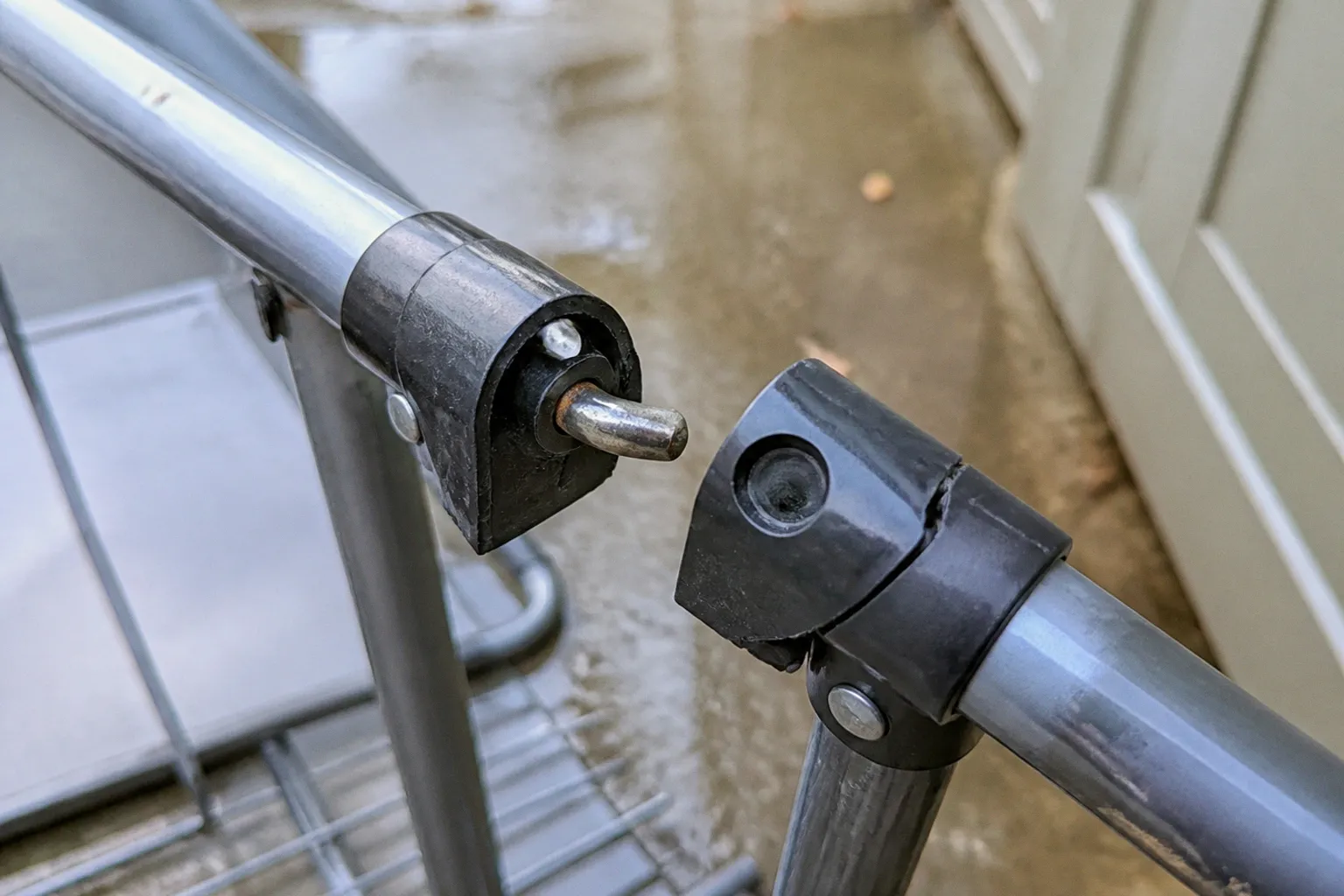
Folding garment rack locking mechanism failure: why joints and hinges collapse
The failure usually begins lower in the load path: a worn plastic retention clip, a pivot bolt with excessive friction, a locking strut that does not reach its designed position, or a bracket displaced by uneven loading. Once the joint loses alignment, the frame no longer behaves as a rigid rectangle. It becomes a mechanism.
This is the central problem in folding garment rack locking mechanism failure. The rack may still appear serviceable when empty. Under load, however, the hanging force creates bending at the top rail and lateral force at the folding joints. A connector that has lost only a small amount of engagement can then release, rotate, or buckle.
Capacity ratings do not correct a defective joint. They describe a rack in its intended configuration, with the frame fully open and the weight perfectly distributed along the horizontal rods. A folding rack with localised load, damaged retention hardware, or incomplete locking is a different structure.
Anatomy of a collapse: why folding joints give way
A folding clothing rack transfers load through several components:
- The horizontal hanging rod carries the garment load and develops bending stress between supports.
- The vertical tubes transfer that force toward the base.
- Folding hinges and locking struts resist rotation of the frame.
- Pivot bolts or rivets allow controlled movement during folding but must remain stable during use.
- Plastic clips, snap-release joints, or friction-fit connectors maintain engagement between adjoining members.
- The feet and casters transfer vertical and lateral reactions into the floor.
The hanging rod is therefore only one element in the system. A rod can remain below its rated load while the joint supporting it fails first.
Basic light-duty garment racks commonly fall in the 10–15 kg range. Mid-range systems intended for mixed wardrobes generally occupy the 20–40 kg range. Heavy-duty steel racks for commercial use, heavy coats, or stockroom handling may be rated at 50 kg or more. One heavy-duty rolling rack specification lists an 80-pound hanging-rod capacity. These figures are not interchangeable. They also do not describe the strength of every component equally.
A thin steel tube may have adequate tensile strength in a straight vertical position and still deform at a drilled hinge connection. The local wall section around a bolt hole is weaker than the uninterrupted tube. Repeated folding increases this effect because the connection experiences alternating bearing stress, not only static compression.
A typical folding frame has two operating conditions:
1. Transport condition. Members rotate around hinges or pivots. The joint is allowed to move.
2. Loaded condition. The frame must restrict rotation and carry a sustained vertical and lateral force.
Failure occurs when the hardware remains in transport behaviour after the rack has been opened. A locking strut that is only partially extended, a snap connector that has not fully seated, or a bracket held by friction rather than positive engagement can permit rotation under load.
The visible symptom is often a rack that leans, folds inward, or drops one side of the hanging rod. The initiating defect may be hidden inside the joint.
A folding rack is not stable because it is open. It is stable only when every locking element has reached full mechanical engagement.
Plastic clips and friction-fit connectors
Budget folding racks frequently use plastic retention clips, friction-fit sockets, or snap-release top joints. These parts reduce manufacturing cost and simplify assembly. They also concentrate the locking function in a material that is sensitive to wear, impact, creep, and alignment.
A plastic clip can fail in several ways:
- Edge wear. Repeated opening and closing removes material from the contact surface. The clip still appears intact but no longer captures the mating tube deeply enough.
- Cracking. Local stress around a retaining lip or screw hole produces a crack. The crack may remain closed without load and open when the rack is loaded.
- Creep. Sustained force can cause gradual deformation. The clip loses its original geometry and no longer holds the joint with the designed interference.
- Brittleness. Some plastics become less tolerant of impact and cold conditions. A force applied during folding can fracture a retention feature instead of allowing controlled movement.
- Misalignment. A tube or bracket enters the connector at an angle. The locking lip then carries a concentrated load rather than a distributed bearing load.
Friction-fit connectors are particularly dependent on tolerance. Their resistance comes from contact pressure and geometric interference. That resistance falls when the tube diameter is undersized, the socket is worn, or the joint is loaded laterally. A connector may hold a vertical load while the rack is empty and release when garments create side-to-side movement.
Snap-release top joints have a related weakness. They depend on precise alignment between a pin, recess, bracket, or spring-loaded retention feature. Folding force applied before the joint is released can bend the mating parts. Opening force applied while the frame is twisted can prevent full seating. The joint then looks closed but has insufficient engagement depth.
Adhesive is not a structural repair for a worn or cracked locking clip. The joint continues to move under service load. The cyclic force acts directly at the adhesive interface, while the original part was designed for mechanical retention. A temporary reduction in movement does not restore the load path.
What to inspect on a plastic or snap-fit joint
Inspection should be performed with the rack empty, fully opened, and positioned on a level floor. Examine each joint rather than inspecting only the visibly damaged side.
Look for:
- A retaining lip that is rounded, polished, or visibly thinner than the unused section.
- White stress marks in dark plastic, indicating local deformation or cracking.
- A pin that enters only partway into its hole or recess.
- A top rail that can be lifted, rotated, or shifted independently of the side frame.
- A gap between the connector and tube that changes when the frame is loaded.
- Unequal spacing between the left and right folding assemblies.
- Plastic fragments, fine cracks, or powder around the pivot area.
- A joint that requires excessive force to open or close.
The rack should not be evaluated by appearance alone. A connector can have no visible fracture and still have lost the engagement needed to resist rotation.
Pivot bolts, hinges, and locking struts
Portable garment rack hinge problems often originate in the pivot hardware rather than the hinge plate itself. The pivot bolt must permit folding but limit unwanted looseness. If it is too tight, the operator applies excessive force to the frame. If it is too loose, the joint develops play and the frame moves under load.
A pivot assembly can deteriorate through:
- Corrosion on the bolt, nut, washer, or hinge plate.
- Deformation of the tube wall around the pivot hole.
- Loss of clamping force.
- Wear between the bolt and the hole.
- Bent brackets caused by folding the rack while overloaded.
- Contamination that increases friction or prevents full movement.
- Incorrect hardware replacement that changes the joint geometry.
A tight pivot is not automatically a secure pivot. Rust or bracket distortion can make the joint difficult to move while leaving it structurally unstable. The resistance felt by the operator may come from corrosion, not from a functioning lock.
Locking struts carry a different responsibility. They prevent the folding frame from rotating once deployed. A strut may use a telescoping member, a hinged bar, a spring-loaded pin, or a cord-and-bar arrangement. In each case, the strut must reach its designed end position and remain there during loading.
Common strut defects include:
- A pin that does not pass fully through the aligned holes.
- A bar that stops short because the bracket is bent.
- A hinge that has seized and prevents the strut from extending.
- A support cord or bar placed under excessive tension.
- A bracket that has shifted so the locking points no longer align.
- A strut loaded sideways because the frame is not square.
If the locking strut is not straight in the loaded configuration, it is not carrying the intended force efficiently. It may be forced into bending instead of compression. Slender steel members have much lower resistance to buckling than to direct compression. The distinction matters in a garment rack because a small lateral offset can generate a significant bending moment at the hinge.
Friction, corrosion, and false security
Metal components in folding racks are often zinc-plated steel or painted carbon steel. Zinc plating provides a sacrificial corrosion layer, but it does not prevent all corrosion. Scratches, exposed cut edges, trapped moisture, and contact with damp floors can initiate oxidation at the most highly stressed locations.
Corrosion affects a folding joint in three ways:
1. It reduces cross-sectional area at the bolt or bracket.
2. It increases friction and prevents normal movement.
3. It changes the dimensions of the contact surfaces, producing misalignment.
An epoxy-polyester powder coating can protect exposed steel surfaces when intact. It does not repair a loose pivot or compensate for a cracked connector. Coating failure around drilled holes and fasteners deserves closer attention than broad, undamaged surfaces because the joint load is concentrated there.
A hinge that binds should not be forced through its range of motion while the rack carries garments. The operator may bend the bracket or transfer the force into the tube wall. The correct sequence is to unload the rack, inspect the pivot, restore alignment if possible, and replace mechanically damaged components when the joint no longer retains its geometry.
Weight distribution and the limit of capacity ratings
The phrase maximum capacity is often treated as a property of the entire rack. In practice, it is a condition-dependent rating. Manufacturers state these capacities for weight distributed across the horizontal hanging rods. A concentrated load changes the force pattern.
A garment rack loaded with evenly spaced shirts does not behave like the same rack carrying a dense group of coats at one end. The second arrangement produces:
- Higher bending moment in the rod near the loaded side.
- Greater reaction force at one vertical support.
- Torsion in the top frame.
- Unequal force at the folding hinges.
- Increased tendency for casters or feet to shift.
- Additional lateral movement when the garments are moved.
The same applies to rolling garment racks. Casters reduce floor friction and allow repositioning, but they also make the base more sensitive to lateral force. If one caster is not aligned or one wheel carries a different share of the load, the frame can twist during movement. That twist is transferred directly to the folding joints.
A capacity rating should therefore be read alongside the rack geometry and operating environment.
| Load condition | Structural consequence | Typical risk |
|---|---|---|
| Evenly distributed garments | Vertical load is shared by both sides and the rod remains closer to symmetrical bending | Lowest joint stress, assuming the frame is fully locked |
| Heavy garments concentrated at one end | One support and one folding joint receive a larger reaction force | Local deformation, lean, or partial joint release |
| Load near the centre of a long rod | Rod bending increases between supports | Permanent sag or overstress at the rod sockets |
| Garments placed above the intended hanging level | Centre of gravity rises | Greater overturning moment and lateral instability |
| Loaded rack moved across an uneven floor | Dynamic force enters through casters and base | Hinge shock, bracket bending, or strut displacement |
| Rack opened only partially | Locking geometry is incomplete | Collapse even below the nominal capacity |
For commercial apparel displays, the operating load also includes handling forces. Garments are pulled from the middle of a dense row. The rod is pushed sideways. The rack is repositioned with wheels loaded. These actions produce transient forces that are absent from a static capacity test.
A heavy duty folding rack failure is therefore not limited to a load that exceeds the advertised number. Repeated side loading below the nominal vertical capacity can fatigue a joint. The rack may survive one heavy placement and fail later after the hinge has developed play.
Rated capacity belongs to a configuration: open frame, engaged locks, sound hardware, level support, and distributed load. Remove one condition and the number loses meaning.
The main failure points in a heavy-duty folding rack
Heavy-duty construction normally means thicker steel, stronger tubes, larger fasteners, or a more stable base. It does not guarantee that every folding mechanism has the same margin of safety. The highest-capacity component may be connected to the weakest hinge.
Forensic inspection should follow the force path from the hanging rod to the floor.
1. Hanging rod sockets
Check whether the rod is fully inserted into its sockets. Partial insertion reduces bearing length and increases local stress at the tube end. A socket can also loosen if the rod repeatedly rotates during garment handling.
Look for crushed tube ends, oval holes, polished contact areas, and movement between the rod and vertical support.
2. Upper folding joints
Top joints frequently carry a combination of vertical force and frame rotation. In snap-release designs, verify that the locking pin or clip is fully seated on both sides. A joint that closes with a click is not necessarily locked; the retaining element must be visibly and mechanically engaged.
3. Pivot bolts
Measure looseness by observing relative movement between the bracket and tube while applying only light hand force to the empty frame. Excessive play indicates wear, hole deformation, or loss of clamping force. Do not use a loaded rack as a test instrument.
4. Locking struts
The strut should be straight, aligned, and at its mechanical stop. Bent struts, incomplete pins, or displaced brackets indicate that the frame has been loaded or folded outside its intended geometry.
5. Tube sections near drilled holes
The area around a pivot hole is a stress concentration. Inspect for ovalisation, tearing, local buckling, and paint cracking that follows the edge of the hole. A straight tube elsewhere does not confirm the integrity of this section.
6. Base joints and casters
The lower frame controls overturning resistance. Loose caster plates, bent legs, or unequal wheel contact can introduce torsion into the vertical members. If the rack rocks on a level floor, the issue is structural or geometric, not cosmetic.
7. Fastener retention
Nuts, washers, cotter pins, and retaining rings must remain present and correctly positioned. A missing washer can change bearing pressure and allow a bracket to cut into a tube wall. A replacement bolt of the wrong diameter can create clearance that becomes hinge play.
Portable racks versus fixed wardrobe systems
Folding garment racks are useful when storage must be moved, collapsed, or deployed temporarily. Their mechanical advantage is also their structural limitation. Every folding interface introduces clearance, moving surfaces, and a potential lock.
A fixed wardrobe storage system eliminates most of these joints. Vertical uprights and horizontal rails can be fastened directly to a wall, frame, or structural support. The load path is simpler, but the installation substrate becomes the critical variable. A fixed system attached to weak wall material can fail at the anchorage even if the steel rail is adequate.
The comparison is not between portable and fixed systems in the abstract. It depends on the operating load and the frequency of movement.
| Parameter | Folding garment rack | Fixed wardrobe storage system |
|---|---|---|
| Primary load path | Tubes, hinges, struts, sockets, and base | Rails, uprights, brackets, and anchors |
| Frequent failure mechanism | Joint wear, incomplete locking, pivot looseness | Anchor pull-out, bracket deformation, rail bending |
| Mobility | High; often supported by casters | Low unless integrated into a movable fixture |
| Inspection requirement | Every folding joint and locking element | Anchors, fasteners, rail connections, and wall substrate |
| Suitability for repeated relocation | Strong | Limited |
| Tolerance for uneven garment distribution | Lower when the frame is narrow or lightly braced | Higher when the system is properly anchored |
| Main design priority | Positive mechanical locking and torsional control | Anchor capacity and continuous support |
A portable rack is appropriate where deployment time and mobility outweigh the additional joint risk. A fixed system is preferable for sustained heavy storage, high garment density, or environments where the rack will be handled continuously while loaded.
Rolling industrial clothes racks occupy the middle ground. They can use larger tubes and stronger casters than domestic models, but the rolling base still introduces dynamic loading. A rack rated for 50 kg or more must be examined as a complete assembly. The rod, hinge, strut, base, and wheels must all support the intended use.
A practical integrity assessment
The assessment should be mechanical and repeatable. It does not require destructive testing, but it does require the rack to be unloaded before any joint is manipulated.
Use this sequence:
1. Record the rack configuration. Note the number of rods, the folding positions, the caster arrangement, and any adjustable sections. A rack should be assessed in the configuration in which it will operate, not in a partially collapsed state.
2. Open the frame on a level surface. Confirm that both sides reach the same position and that the base does not rock.
3. Engage every lock without garments. Observe pins, clips, struts, and snap joints directly. If one side requires more force than the other, investigate the alignment.
4. Check joint play. Move the unloaded frame with controlled hand force. Distinguish designed folding movement from unintended movement after the locks are engaged.
5. Inspect the metal around fasteners. Look for oval holes, cracks in the coating, rust at exposed edges, and deformation in the tube wall.
6. Inspect plastic components under light. Stress whitening, fractures, and worn retaining lips are failure indicators even if the joint remains assembled.
7. Load gradually and symmetrically. Add garments across the rod rather than placing a dense mass at one end. Stop if the frame changes geometry, leans, or produces a new sound.
8. Recheck after movement. If the rack is rolled while loaded, inspect the locking hardware again. Dynamic forces can move a pin or bracket without producing immediate visible damage.
9. Remove the rack from service when the lock no longer retains. A cracked clip, bent strut, distorted pivot hole, or joint that opens under light force is a structural defect.
The inspection should also account for the environment. Damp stockrooms, loading areas, laundries, and unheated spaces accelerate corrosion. Textile dust and packaging debris can enter moving joints. Frequent folding increases wear even when the rack is never overloaded.
Repair and replacement decisions
Some defects are serviceable. A loose fastener may be restored if the bolt, hole, bracket, and tube remain within their original geometry. A missing washer or retaining pin can be replaced with the correct part. A pivot may be cleaned and returned to controlled movement if corrosion has not reduced the section or changed the fit.
Other conditions indicate replacement of the joint or the rack:
- A plastic locking clip is cracked, split, or permanently deformed.
- A snap-release connector no longer reaches full engagement.
- A pivot hole has become visibly oval.
- A locking strut is bent or cannot reach its stop.
- A bracket has torn, buckled, or shifted relative to the tube.
- The frame collapses or folds when a moderate load is applied.
- The rack remains unstable after the fasteners are correctly tightened.
- Corrosion has reduced the section of a bolt, bracket, or tube.
Replacing only the visible clip may not be sufficient. If the clip failed because the tube was bent or the hinge was misaligned, the replacement part will receive the same abnormal force. The cause must be corrected before the component is returned to service.
The same rule applies to salesman rack locking pins and other small retaining elements. A pin is not a minor accessory when it prevents the frame from folding. Its diameter, engagement length, material, and retention method determine whether the load is transferred through a positive mechanical stop or through friction at the joint.
Definitive selection rules for commercial use
The correct garment storage solution follows from load, movement, and environment.
Select a light-duty folding rack only for light, evenly distributed garments and low handling intensity. A 10–15 kg class rack is not a substitute for a commercial steel frame simply because the rod fits the required number of hangers.
Use a mid-range 20–40 kg rack for mixed wardrobes when the frame is fully locked, the garments are distributed, and the rack is not repeatedly moved under load.
Use a heavy-duty steel rack rated at 50 kg or more for dense apparel, heavy coats, and commercial handling, but inspect the folding mechanism as rigorously as the tube diameter and rod capacity. An 80-pound rod specification does not validate a worn hinge, loose pivot, or damaged base.
For sustained storage, high garment density, or frequent lateral handling, choose a fixed wardrobe storage system or a non-folding industrial rack when the installation allows it. Reduce the number of moving joints before increasing the nominal load.
The rule is direct: if the operating load is high, the environment is corrosive, or the rack is moved while loaded, positive mechanical locks and rigid load paths take priority over collapsibility. A rack that folds compactly but depends on worn plastic clips or friction-fit joints is not a heavy-duty storage solution. It is a temporary frame with a finite wear limit.