Double rail vs single rail racks: retail storage paths
The Real Question Behind the Rail…
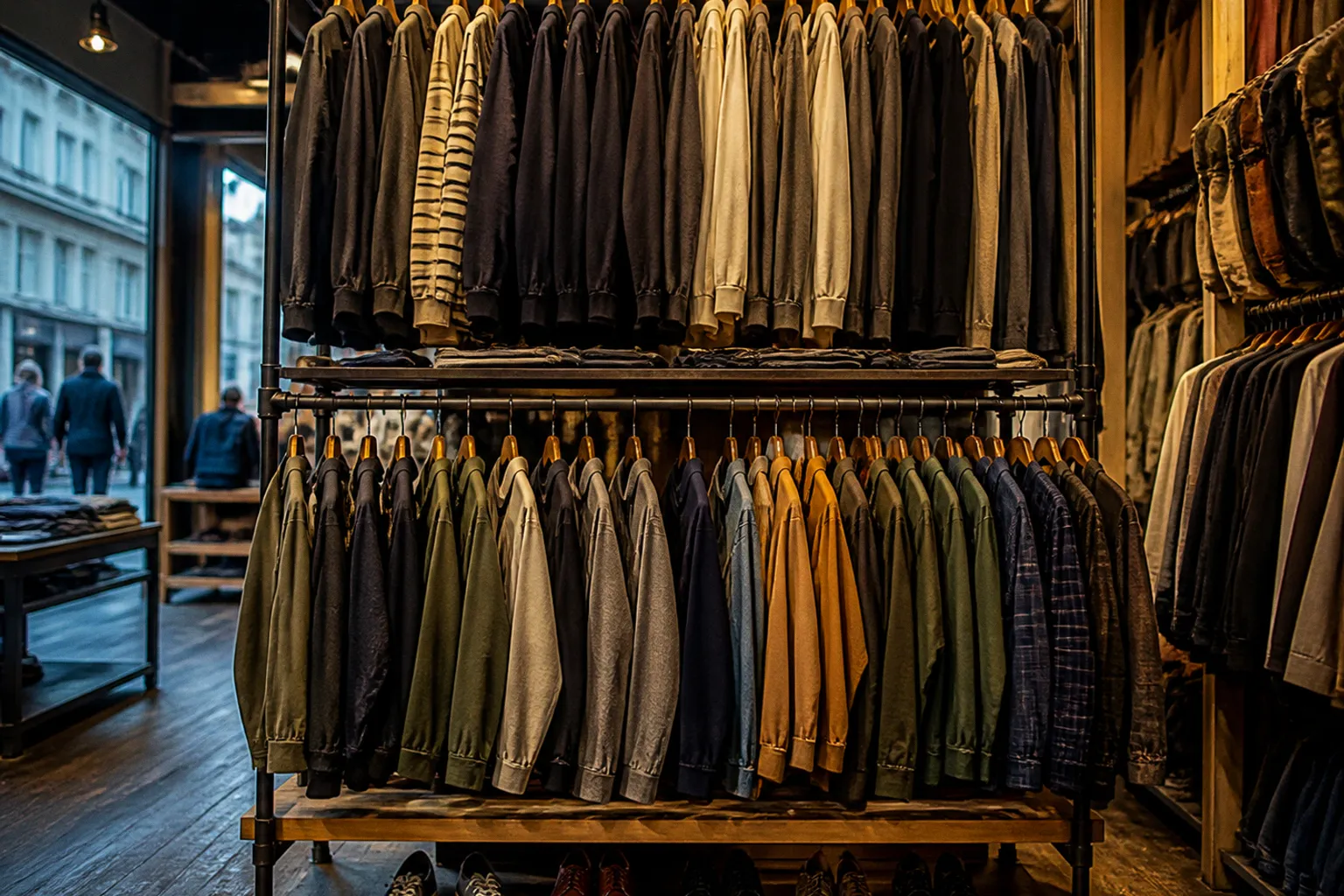
Every retail floor has one of those moments — usually between seasons — when the rail you bought "just for now" turns into a permanent fixture. You've got a 200-square-foot corner that needs to hold 800 pieces, or a 600-square-foot section that holds 200, and the difference between those two scenarios is almost always a single decision: did you go with a single rail system or a double rail setup?
We see this call play out across boutiques, department stores, and warehouse-style outlets all the time. The racks look similar at first glance, but the math underlying them is fundamentally different. Single rail garments hang like a curated edit. Double rail racks stack the inventory vertically and treat your floor like a vertical real estate problem. Pick wrong, and you either hemorrhage square footage to display the same number of SKU units, or you cram so much into a frame that customers can't pull a single piece without shaking the whole structure. So before you order the next batch, let's walk through the actual variables — vertical clearance, weight capacity, SKU density, depth, and merchandising strategy — and get you to a decision you can defend on a P&L.
Vertical Clearance and Garment Length Requirements
The single biggest physical constraint on a hanging rail is the distance from the floor to the bar. If you're displaying coats, maxi dresses, or any long silhouette, that distance has to be 1600mm to 1900mm, and we mean that as a hard floor — anything less and your hemlines drag, customers develop the habit of stepping over your inventory, and your dry-cleaning bill spikes before the end of the month.
When you split that vertical space into two tiers, you lose the ability to hang anything longer than a hip-length top. That's the trade-off the double rail makes on day one. A typical stacked double rail places the upper bar at 1600mm to 1800mm and the lower bar at 900mm to 1000mm, which works fine for a folded-and-hung mix of shirts, blouses, kids' basics, and cropped jackets. It absolutely does not work for floor-length evening wear, full-length winter coats, or anything that needs to drape.
So the first question we ask any retailer evaluating single vs double rail garment rack storage is innocent and decisive: what's the longest piece in your buy? If the answer is "a knee-length skirt," you have flexibility. If it's "trench coats that hit the calf," the single rail is your only honest option. There is no clever bracket or angled display that turns a 1000mm lower tier into a viable home for a wool coat — the geometry simply refuses.
Garment length sets the rail height before anything else — if a single piece in your buy drags on the floor, no doubling of capacity will save you.
Maximizing SKU Density with Stacked and Staggered Systems
If vertical clearance isn't the constraint, the next battleground is SKU density — how many distinct units you can make visible and accessible within a given footprint. This is where double rail systems genuinely earn their rent, and it's where the comparison between single vs double rail garment rack storage gets commercially interesting.
A stacked double rail shelves two tiers of garments in the same vertical column, which roughly doubles the linear capacity of a wall run. A 4ft rail might hold 40 to 60 pieces on a single tier; the same 4ft frame in a stacked configuration can absorb 80 to 120 if you're disciplined about how tightly you compress the merchandise. Staggered double rail systems — where the two bars are offset horizontally or vertically so garments don't hang in the same vertical plane — go a step further. Frames around 15.9 inches deep let you push a dense wall of T-shirts without the front row of hangers smothering the back row.
This is where the merchandising brain lights up. If you run a high-volume basics department, an outlet floor, or a children's section where parents appreciate being able to see a hundred options at a glance, double rail density becomes a conversion lever. We see outlet stores in particular lean heavily on this — the entire store is essentially a comparator wall, and the customer is making a decision based on visible inventory. The more SKUs in their sightline, the higher the dwell time, and the higher the attach rate on that impulse second item.
Single rail, by contrast, is the workhorse of an edited assortment. A capsule collection, a new arrivals wall, a designer spotlight — anywhere the visual story matters more than the volume count — that's where single rail racks earn their place. They give each garment the breathing room to read as a unit, which is critical in a boutique or a higher-end department. Strip that out, and you're competing on price, which is a race to the bottom the rail can't win for you.
Structural Integrity: From Domestic Rails to 100kg Commercial Steel
Now here's where the retail conversation usually surfaces a cash register reality: not all rails are built to handle double-tier loads. A basic domestic single rail is rated around 10kg — fine for ten silk blouses, terrifying when you load it with winter coats. A basic domestic double rail is rated around 15kg for the whole frame, which is barely stronger than a single rail and definitely not enough for a commercial floor.
If you're going to push double rail hard, you need heavy-duty construction. Commercial steel rails built from 30mm steel tubes (or 25mm carbon steel rods) and coated in epoxy resin for protection against rust and scuffing can handle up to 100kg per frame, with some heavy-duty commercial models rated between 400 and 600 lbs. That's the bracket you want if you're loading a denim wall, stocking a full winter coat season, or running a uniform program where each rail holds dozens of identical items.
The mistake we see most often is a retailer buying a "double rail" rack from a domestic-grade supplier and then loading it like a commercial frame. The frame bows, the welds creak, the rail sags in the middle, and within a season you're replacing an entire wall of fixtures. When we plan a renovation, we spec the rails to the worst-case load, not the average. If a 6ft rail is rated for 60 to 80 garments, we plan for the moment a buyer orders an extra 20 units and the rail takes the hit. Always spec for the spike, never for the baseline.
We also pay attention to the finish. Epoxy-coated steel rails tend to outlast chrome-plated ones in high-traffic retail conditions, especially in humid climates or anywhere you're spraying fixtures with cleaning solution several times a week. We're not going to give you a hard lifespan number — the honest answer is that it depends on the environment — but we've seen epoxy frames outlast chrome frames by years in coastal stores and high-traffic outlet centres.
Strategic Merchandising: When to Choose Single vs Double Rails
Let's get specific about merchandising strategy, because the two tier garment rack vs single rail decision is rarely as binary as the supplier catalogues suggest.
We default to single rail in three situations. First, anywhere long garments are dominant — coats, dresses, formal wear, full-length knits. The geometry doesn't lie. Second, on a new arrivals wall or any "edit" presentation where you want each piece to breathe. Third, in a high-ticket zone where the customer is making a considered decision; the visual restraint of a single rail signals quality and signals that the buying team has curated. Single rail reads as slow, considered, premium.
We default to double rail in three opposite situations. First, in a high-volume section where SKU variety beats visual breathing room — basics, kids' wear, outlet apparel, accessories that customers want to compare side by side. Second, anywhere the buy is heavy and uniform — think uniform programs, denim walls, or a full colour story of a single SKU where the customer is choosing between shades. Third, on a tight footprint where vertical real estate is the only way to expose enough inventory to make the floor productive. Commercial double rail clothing rack benefits show up loudest in these three scenarios.
There's also a hybrid play we've seen work well in mid-market retail: a single rail at the front of the section as the "edit" — your new arrivals, your hero pieces, your promo — and a double rail behind or beside it as the stock wall. The customer sees a curated moment, then turns to find the depth. It's the same logic as a planogram with a feature endcap and a deep-fill fixturing behind it. We use the term "two-tier storytelling" on the floor, and it's an effective way to bridge the boutique and the outlet.
For a quick reference, here's the core comparison our floor managers use when they're sketching a section:
| Parameter | Single Rail | Double Rail |
|---|---|---|
| Typical use | New arrivals, capsule edits, long garments | Basics, kids' wear, outlet floors, denim walls |
| Vertical clearance | 1600mm–1900mm per tier | 1600mm–1800mm upper, 900mm–1000mm lower |
| 4ft linear capacity | 40–60 garments | 80–120 garments (stacked or staggered) |
| Domestic frame rating | ~10kg | ~15kg |
| Commercial frame rating | Up to 100kg | Up to 100kg+ (heavy-duty steel) |
| Minimum internal depth | 550mm–600mm | 600mm+ stacked; ~15.9in staggered |
| Sightline role | Edit, whisper, premium moment | Density wall, shout, abundance signal |
Depth and Footprint: Planning for Floor Traffic and Accessibility
The last variable, and the one that decides whether your plan survives contact with the customer, is depth. A standard garment rack needs 550mm to 600mm of internal depth — somewhere between 18 and 24 inches — for the garments to hang freely without brushing against back panels, doors, or the wall behind. If you go shallower, the front of the rack becomes a wrinkled mess as customers push and pull. If you go deeper, you lose the visible inventory because the back row disappears into shadow.
For double rail systems, depth becomes even more critical. A staggered frame at around 15.9 inches works because the offset prevents the front hangers from smothering the back hangers. A stacked frame at the same depth won't — the garments on the upper tier will press against the garments on the lower tier, and the customer ends up fighting the rack to see anything. If you're going stacked, you need at least 18 inches of internal depth, and we prefer 20 to 24 inches for any commercial floor.
Then there's the footprint math. A double rail doesn't double your square footage demand — it roughly doubles your vertical capacity within the same footprint. That's a huge win in a tight store. But you need to plan for the customer movement around the rack. A double rail wall that runs eight feet and holds 200 pieces needs at least four feet of clearance in front of it for the customer to step back, scan, and pull. If your aisle is narrower than that, you're forcing engagement at arm's length, and engagement drops. Sightlines only work if the customer can actually step back and see the wall.
We also think about sightlines from the aisle. A double rail wall, when stocked properly, creates a denser visual block than a single rail wall. That works in your favour on a back wall where you want the inventory to read as a statement of abundance. It works against you near a window or a feature zone where the visual story is supposed to be a single, considered moment. Match the rack density to the sightline plan — denser racks where you want the wall to "shout," lighter racks where you want the rack to "whisper."
Pulling It All Together: A Decision Frame You Can Defend on a P&L
Here's the frame we walk clients through when they're staring at a floor plan and trying to decide. If the buy is dominated by long garments, full-length coats, or anything that needs to drape — single rail, no exceptions. If the buy is dense, uniform, and benefits from a comparator wall — double rail, stacked or staggered depending on depth. If you need both, run a hybrid: single rail for the edit, double rail for the depth.
Spec the rails to the worst-case load with a comfort margin. A 2ft rail will hold approximately 20 to 30 garments (or 15 thick winter coats). A 4ft rail will hold 40 to 60 pieces. A 6ft rail will hold 60 to 80 items (or up to 40 thick winter coats). If your numbers exceed those bandings, you need a heavier frame — not a longer frame. Length adds load, doesn't reinforce it. Plan for 550mm to 600mm of internal depth minimum, and 20 to 24 inches for stacked double rail. Plan for at least four feet of customer clearance in front of any heavy rail. Plan sightlines to match the merchandising story — single rail for the whisper, double rail for the shout.
The cheapest piece of equipment in the store is the one that carries the most decisions — get the rail right, and the rest of the merchandising plan starts to fall into place.
And the KPI we always close on: track your units per square foot before and after the change. If you switch from single to double rail and your units per square foot doesn't move meaningfully, you've added density without adding capacity, and the conversion data will show it. We hold the same-week comparison against dwell time and attach-rate numbers from the prior period — if the rack is denser but the conversion story doesn't shift to match, the fixturing isn't carrying its weight on the floor. When the numbers underwhelm, we walk the floor with the buyer to figure out whether the buy itself was thin or whether the rack simply wasn't doing the work. Either way, you'll have an answer inside a month, and the rail will either earn its place or get swapped out before the next seasonal reset.