Capsule wardrobe rack setup: path to a minimalist bedroom
A garment rack fails for a simple reason: the load is concentrated on a narrow horizontal tube, while the rack is stabilized by two vertical members and a small footprint. A rail carrying 25 kg of clothing does not impose only a 25 kg vertical load.
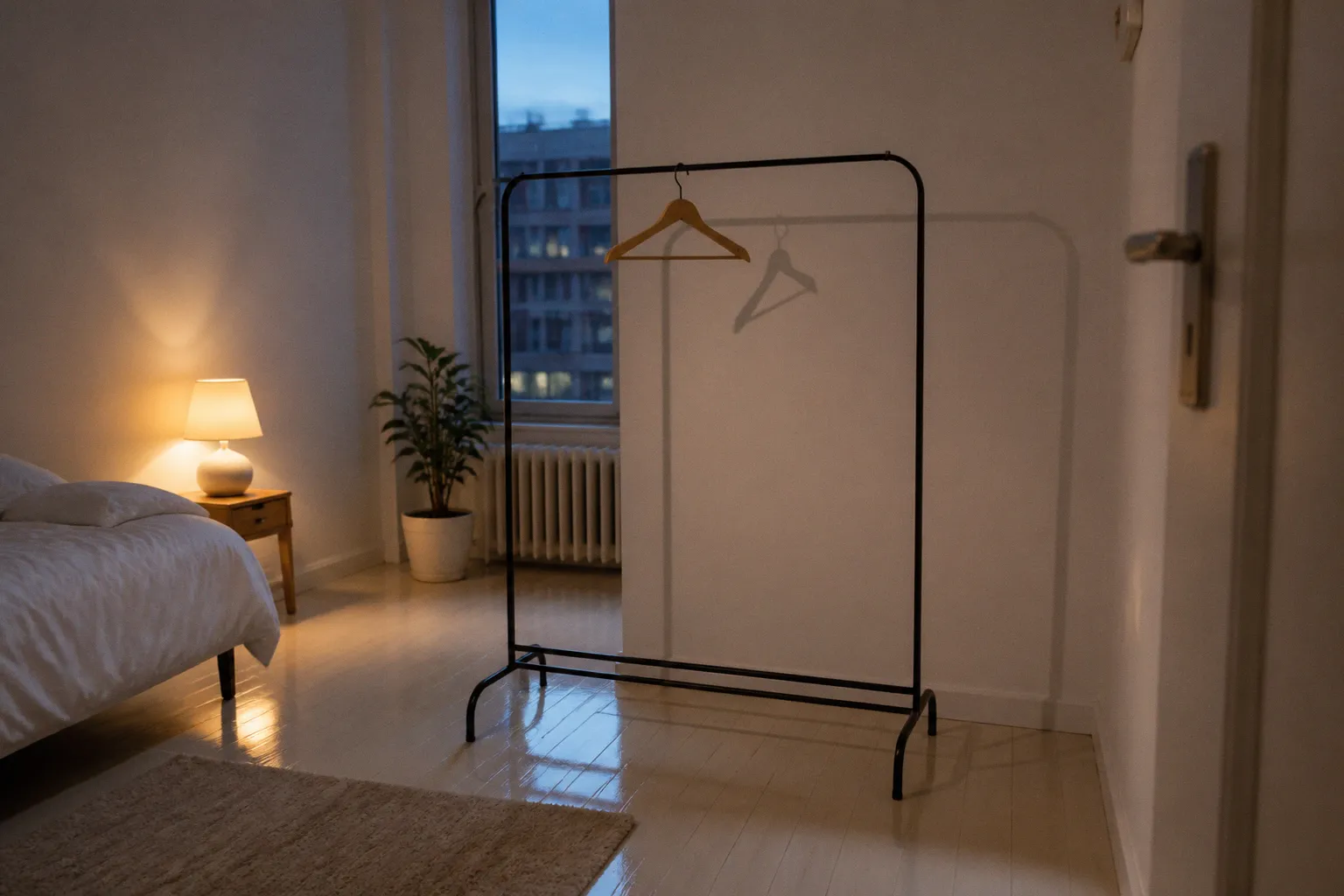
Capsule Wardrobe Rack Setup: A Path to a Minimalist Bedroom
Hangers create eccentric loading, garments are pulled from one side, and wheels or adjustable feet transfer the resulting moment into a limited area of flooring.
The correct minimalist garment rack capsule wardrobe therefore begins with structural capacity, not color or finish. The rack must carry the intended clothing mass, preserve a clear circulation path, resist lateral sway, and tolerate the humidity and abrasion conditions of a bedroom. Open storage reduces visual obstruction. It also exposes every error in quantity, spacing, and material selection.
A capsule wardrobe rack setup works when the system has a defined load limit and the wardrobe has a defined volume. If neither is controlled, the result is not minimalism. It is an overloaded open closet system with visible deformation.
The Architecture of an Open Closet System
An open garment rack is a small frame structure. Its primary components are the horizontal rail, vertical uprights, base supports, joints, and anti-tip elements. Each component has a separate failure mode.
The rail is normally governed by bending. The uprights are governed by buckling, joint rotation, or local deformation at the connection points. The base is governed by overturning and sliding. The wheels, if present, introduce additional compliance and reduce lateral stability unless they lock positively.
Load on the garment rail
Clothing load is not uniform in practice. A row of lightweight shirts may distribute mass across 600–900 mm. Coats, denim, wool garments, and structured jackets create heavier local concentrations. A rail designed around a uniform load can perform poorly when 8–10 dense garments are pushed into one section.
For preliminary sizing, separate the contents into three categories:
- Lightweight garments: shirts, blouses, thin trousers, and synthetic layers.
- Medium garments: denim, knitwear, lined jackets, and multiple-layer outfits.
- High-mass garments: wool coats, leather jackets, heavy outerwear, and garment bags.
The rack should be selected for the upper bound of the intended load, not the current average. A household clothing rail may be loaded at 10–20 kg in normal use, but the relevant capacity is the manufacturer’s rated load for the complete assembly. A rail rated at 30 kg is not automatically suitable for 30 kg if the rating applies only to a centered, static load with the rack fixed to a wall.
The distance between supports also matters. For a simply supported rail, bending moment increases with span under a distributed load. A 1,200 mm rail is not merely 20% more demanding than a 1,000 mm rail. The effect of span is stronger because deflection rises rapidly as span increases. In simplified beam behavior, deflection is proportional to the fourth power of span when material, section, and loading remain constant.
That relationship makes compact rack widths structurally efficient. A 900 mm rail with adequate support can be more stable than a 1,200 mm rail made from the same tube. The larger rack may provide more storage volume, but it also demands better section stiffness and more reliable joints.
Rail section and material
Common garment rails use round or rectangular steel tubing, aluminum tubing, or thin-wall plated steel. The outside diameter is not enough to determine capacity. Wall thickness and section geometry control resistance to bending.
A hollow steel rail with a 25 mm outside diameter and a 1.0 mm wall does not perform like a 25 mm rail with a 1.5 mm wall. Both may appear identical at the surface. Their local buckling resistance and bending stiffness are different.
The principal materials behave differently:
| Material or finish | Structural behavior | Corrosion behavior | Typical limitation |
|---|---|---|---|
| Zinc-plated steel | High stiffness and good resistance to ordinary garment loads | Zinc layer provides sacrificial protection when intact | Cut edges, scratches, and threaded joints can corrode |
| Powder-coated steel | High stiffness with a polymer barrier over steel | Epoxy-polyester coatings resist indoor humidity and abrasion when properly cured | Impact damage can expose the substrate |
| Aluminum | Low mass and adequate corrosion resistance | Forms a stable oxide layer; no red rust | Lower modulus than steel, so equal-size rails deflect more |
| Stainless steel | High corrosion resistance and stable surface | Strong performance in humid interiors | Higher material cost; grade and tube wall still matter |
| Solid wood | Good compressive behavior in supports; variable rail stiffness | Sensitive to moisture cycling and finish damage | Grain direction, joints, and creep affect long-term performance |
For a bedroom, zinc-plated steel and epoxy-polyester coated steel are usually sufficient if the room is dry and the coating is continuous. A bathroom-adjacent bedroom, coastal residence, or poorly ventilated room imposes a different exposure class. In those conditions, inspect fasteners and cut ends first. The visible tube is rarely the first location to show degradation. Threaded inserts, wheel brackets, and unsealed scratches are more vulnerable.
A garment rack is a beam-and-frame assembly. If the rail bends, the system is under-designed even when no joint has separated.
Joints are the weak link
Many residential racks use push-fit connectors, set screws, cam fittings, or threaded collars. The connection must transfer vertical load and resist rotation. A joint that supports a downward force can still fail as a frame connection if the rack sways laterally.
Set screws create a localized contact area. Under repeated loading, the screw can mark or dent thin-wall tubing. The resulting indentation reduces local section strength. Push-fit joints depend on friction and geometric engagement. They may be adequate for light clothing but become unstable when the rack is moved while loaded.
Bolted connections are more predictable when the tube is reinforced at the connection. A bolt passing through a thin tube wall can ovalize the hole under repeated lateral force. The connection then develops play. That play is not cosmetic. It increases deflection and changes the dynamic response when garments are removed from the rail.
For a fixed minimalist open closet system, a rigid back brace or wall anchor is preferable to relying on the rail and base alone. If the rack is mobile, use locking casters with a positive brake and a base footprint proportionate to rack height. A tall frame on four small casters has limited resistance to overturning, especially when garments are pulled toward the front.
Curating the Capsule: Balancing Aesthetics and Utility
A capsule wardrobe is a volume-control method. It reduces the number of garments placed on the rail, but it does not eliminate load concentration. The structural and spatial requirements remain.
The rack should have a defined operating inventory. Do not begin by filling every available 100 mm of rail. Begin with the garments that require hanging storage and assign the remaining items to shelves, drawers, or closed storage.
A practical hanging inventory can be divided by use:
1. Daily rotation. Shirts, trousers, skirts, and work layers that are accessed frequently. Place these in the central zone between approximately 800 and 1,500 mm above the floor.
2. Structured garments. Jackets and coats require more horizontal clearance because their shoulders project beyond the hanger. Do not compress them against soft garments.
3. Low-frequency garments. Seasonal items can occupy the upper rail only if the rack remains stable when the garments are removed. High placement increases handling force.
4. Delicate items. Use low-friction, shaped hangers that prevent local distortion at the shoulder. Avoid wire hangers on thin fabrics.
5. Folded items. Knitwear and heavy denim should not occupy the garment rail by default. A shelf or drawer distributes their weight through vertical supports rather than suspending it from a single beam.
Hanger geometry controls usable rail length. Slim hangers may occupy approximately 10–15 mm each. Structured wooden or padded hangers may require 35–50 mm. A rack holding 30 garments therefore needs a different rail length depending on hanger type. Counting garments without measuring hanger width produces an inaccurate storage plan.
For a capsule wardrobe rack setup, calculate the rail requirement as:
required rail length = number of hanging garments × average hanger width + clearance for grouping
The clearance term prevents the row from becoming a compressed block. A wardrobe may fit physically while becoming difficult to operate. Pulling one garment from a dense rail transfers lateral force into the rack and can loosen joints over time.
A useful arrangement is to keep heavier garments near the supports and lighter garments toward the middle, provided the rail is designed for distributed loading. This reduces local bending near the center. However, the arrangement must not create a dominant load on one side of a mobile rack. The center of gravity should remain inside the base support polygon during normal use.
The visual edit is a load edit
Open storage makes excess inventory visible. That is an operational advantage. It also means the rack must not become a secondary closet for items that should be folded, stored seasonally, or discarded.
Use the rack for garments that benefit from vertical hanging access. Move the following categories elsewhere:
- Heavy knitwear that stretches under its own mass.
- Shoes, which introduce concentrated point loads and dirt.
- Bags with rigid hardware that can strike the frame.
- Vacuum storage bags, which create unstable overhead loads.
- Garment boxes that exceed the shelf rating or obstruct the anti-tip connection.
- Items in long-term storage that are accessed only once or twice per season.
The capsule principle is not a color palette. It is a constraint on inventory, access frequency, and storage volume. A rack with fewer garments has lower operating load, fewer lateral impacts, and better visual separation between categories.
Selecting the Right Rack for Minimalist Living
The correct rack depends on load, span, height, mobility, and environment. Dimensions should be selected before finish. A black or brass-colored frame cannot compensate for inadequate section thickness or poor bracing.
Fixed versus mobile systems
A fixed rack is mechanically superior when the location is known. Wall anchoring limits overturning and reduces lateral movement. It also permits a narrower base in rooms where floor area is restricted.
A mobile rack is useful when the bedroom layout changes or when garments must be moved for cleaning. Mobility introduces a trade-off. Casters add height, joints, rolling resistance, and a second potential failure point. The brakes stop wheel rotation but may not eliminate frame sway.
| Configuration | Strength | Limitation | Appropriate use |
|---|---|---|---|
| Wall-anchored single rail | High resistance to tipping; small floor footprint | Location is fixed; wall substrate matters | Dedicated bedroom or dressing area |
| Freestanding steel rack | Flexible placement; simple installation | Requires a wide and stable base | Dry room with moderate hanging load |
| Mobile rack with locking casters | Can be repositioned; useful for cleaning | Lower lateral stiffness; wheel brakes may allow sway | Light capsule inventory and frequent rearrangement |
| Double-rail rack | High hanging capacity in limited width | Higher center of gravity and more complex access | Separated short garments and low-mass items |
| Rack with integrated shelves | Adds folded storage and base mass | Shelf loads can overload the frame | Mixed hanging and folded capsule storage |
| Modular wall-mounted system | Adjustable height and accessory placement | Anchors must match wall construction | Long-term system with controlled installation |
For a bedroom, a single rail at approximately 1,600–1,800 mm is suitable for full-length hanging garments if the base remains clear. A lower rail can be added for shirts and short jackets, but the upper frame must be braced against lateral movement. Double rails are efficient only when the garments are short enough to avoid interference between rows.
A full-length garment section requires clearance from the floor. Clothing should not contact flooring, baseboards, or heating equipment. Contact introduces abrasion and can create a local moisture path. It also causes users to lift or pull garments unevenly, increasing lateral force at the rail.
Base width and tipping resistance
Rack height and base depth must be evaluated together. A tall, narrow frame has a higher overturning risk than a low frame with the same mass. The relevant variable is the horizontal distance between the center of gravity and the tipping edge.
A rack can tip when the moment generated by an eccentric load exceeds the restoring moment of the frame and its contents. The load may become eccentric when garments are concentrated at one end, when a bag hangs from an outside upright, or when a user pulls a garment forward rather than sliding it along the rail.
The following conditions increase risk:
- Rail height above 1,600 mm with a shallow base.
- A single-sided garment arrangement.
- Locking casters with small wheel contact areas.
- Smooth flooring that permits sliding.
- A rack positioned where the rail can be used as a handle.
- Heavy shelves mounted above the hanging rail.
- No wall anchor in a household with children or pets.
The base must remain stable on the actual floor. Uneven flooring can leave one caster or foot unloaded. Adjustable feet are useful, but the adjustment must be locked after leveling. A rack that rocks under hand pressure is not ready for clothing.
Surface finish and indoor chemistry
Finish selection is a corrosion decision. It is not only a color decision.
Zinc-plated steel relies on the zinc layer for sacrificial protection. The layer is damaged by aggressive cleaning agents, repeated abrasion from metal accessories, and exposed cut edges. Powder-coated steel uses a polymer film. Epoxy-polyester systems are common for indoor applications because they combine adhesion with resistance to household abrasion, but the coating remains vulnerable at sharp edges and impact points.
Avoid placing a steel rack against a persistently damp wall. Condensation can remain trapped between the upright and the wall, limiting evaporation. The resulting corrosion may be hidden until the coating blisters or the fastener begins to seize.
Do not use chlorine-based cleaners on unknown metal finishes. A neutral detergent and a dry cloth are sufficient for ordinary bedroom dust. Cleaning products that leave a conductive residue can accelerate corrosion at joints where coating coverage is incomplete.
Strategic Placement and Visual Flow in the Bedroom
Placement determines how the rack is loaded, approached, and moved. It also determines whether the open system remains an organizing device or becomes an obstruction.
The first control is circulation. Measure the clear path in front of the rack with garments installed, not with the rack empty. Hangers and sleeves may project 250–350 mm from the rail depending on garment type. Door swing, drawers, and wardrobe doors must operate without contacting the hanging load.
The second control is wall condition. A wall anchor must be matched to the substrate:
- Timber studs provide direct structural engagement when the fastener length and diameter are appropriate.
- Masonry requires a compatible plug or anchor and a hole that is not oversized.
- Plasterboard requires a stud connection or a load-rated hollow-wall anchor selected for the actual load.
- Decorative wall panels may not provide structural capacity even when they appear rigid.
The third control is thermal exposure. Keep garments and polymer-coated components away from direct contact with radiators, portable heaters, and high-temperature air outlets. Heat cycling can degrade elastomeric wheel components, dry textile fibers, and reduce the life of some coatings.
The fourth control is daylight. Direct solar exposure can fade textiles and heat dark-coated metal. The rack itself may remain structurally sound while the garments degrade. UV exposure is therefore an inventory-management issue, not only a room-layout issue.
Positioning the rack relative to the bed
A rack beside the bed should not reduce the exit path or create a hard projection at shoulder height. A rack opposite the bed should be assessed for reflection, visual density, and door clearance, but these are secondary to access and stability.
Keep the heaviest garments closest to the uprights. Keep frequently accessed garments between waist and shoulder height. Store low-frequency items high only when a stable step method is available. Do not use the top rail as a general-purpose overhead shelf unless the rack has a shelf rated for that load.
For a narrow bedroom, a wall-mounted rail with a separate low shelf can outperform a freestanding rack. The wall carries the lateral restraint, while the shelf carries folded items. This separates load paths. The rail does not have to support shoes, bags, and folded textiles in addition to hanging garments.
In a small bedroom, the highest-value dimension is not rail length. It is the clear floor area that remains after the rack is loaded.
Aesthetic garment rack organization without structural confusion
Organization should follow the load path. Arrange garments by category, length, and access frequency. Do not attach heavy accessories to the outside of the frame merely to keep them visible.
A controlled sequence is:
1. Place coats and dense jackets near the uprights.
2. Place trousers and skirts where their length does not obstruct the base.
3. Group shirts and light layers in the central rail zone.
4. Keep bags on a shelf or dedicated hook rated for their mass.
5. Leave a defined access gap between categories.
6. Remove empty hangers instead of allowing them to occupy the rail.
7. Keep the rack below its rated capacity even when the rail still has physical space.
The rack should show the operating inventory, not every item owned. This is the mechanical equivalent of reducing unused live load.
Maintaining the Minimalist Edit: Beyond the Initial Setup
A rack does not remain stable because it was assembled correctly once. Fasteners settle. Tubes rotate under cyclic loading. Casters loosen. Coatings receive impact damage. A capsule wardrobe system requires periodic inspection.
Use a short inspection sequence:
- Push the upper rail laterally with moderate hand force. Any clicking, joint movement, or delayed return indicates looseness.
- Inspect set screws and bolts for rotation marks, stripped heads, and ovalized holes.
- Examine the rail at midspan. Permanent sag indicates yielding, joint settlement, or sustained overload.
- Check the uprights for twist and the base for uneven contact.
- Test each caster brake individually. A locked wheel that still rolls or swivels requires replacement.
- Inspect zinc-plated areas and coated edges for white corrosion, red corrosion, blistering, or exposed steel.
- Confirm that wall anchors remain tight and that the substrate has not cracked or pulled away.
- Remove garments before tightening connections. Tightening a loaded frame can trap a misaligned joint and produce false rigidity.
Do not repair a bent rail by forcing it back into alignment. Cold straightening introduces residual stress and may reduce section capacity. Replace the component. Do not drill new holes through a thin-wall upright without confirming that the modification will not weaken the frame or interfere with the original connection.
Controlling long-term load
Clothing mass changes seasonally. A summer rail may carry light textiles. The same rack may later receive coats, boots, and bags. The design load must reflect the maximum seasonal condition.
A simple inventory record is sufficient. List the heavy garments and estimate their combined mass. Weighing is preferable when the rack rating is close to the expected load. The calculation need not be elaborate:
- Count high-mass garments separately.
- Place dense items near the supports.
- Add the mass of shelves, baskets, and accessories.
- Include the force from any item that hangs outside the main rail.
- Compare the result with the complete rack rating, not only the rail rating.
- Reduce the operating load when the rack is mobile or unanchored.
Manufacturer load ratings are often conditional. They may apply to evenly distributed loads, fixed installations, or specific component arrangements. A rating without its test condition is incomplete data.
When a modular system is justified
A modular system is justified when storage requirements change, the wall can accept secure anchoring, and the components use a consistent connection standard. It is not automatically stronger because it has more parts.
Modularity helps when the capsule includes:
- One hanging rail for full-length garments.
- A short-hang rail for shirts and jackets.
- Shelves for folded knitwear and denim.
- A lower shoe shelf with a defined point-load rating.
- Hooks for lightweight bags.
- An anti-tip connection at the upper frame.
The modules should carry their own intended loads. Do not use a shelf bracket as a garment hook or hang a loaded bag from a decorative side panel. Each deviation changes the force path.
For high-end home decoration, the most reliable approach is to make the structure legible and the inventory limited. A rigid steel frame with controlled dimensions will outperform a more elaborate system that relies on thin panels, friction joints, and unbraced height. The finish can be selected after the mechanical specification is fixed.
Final rule for the minimalist garment rack capsule wardrobe
Select the rack by the heaviest seasonal inventory, the longest unsupported rail span, and the actual floor and wall conditions. Use steel when stiffness and load capacity dominate. Use aluminum only when lower mass and corrosion resistance justify greater deflection. Use a wall anchor whenever the frame is tall, narrow, heavily loaded, or positioned in a circulation zone. Keep dense garments near the supports. Keep folded mass on shelves. Keep mobile racks below their nominal limit.
A minimalist garment rack capsule wardrobe is not defined by an empty rail or a neutral finish. It is defined by a controlled load, a restrained inventory, a stable frame, and a clear path through the bedroom. The rule is direct: if the rack moves during normal garment access, reduce the load or increase the restraint. If the rail sags, replace it. If the coating is failing at a joint, correct the corrosion path before the damage reaches the structural substrate.