Z-Racks vs Salesman Racks: Which Rolling Frame Fits Your Store?
Picture this: it's 6:47 a.m. on a Saturday, the doors don't open for another forty-five minutes, and you're standing in your stockroom with two partial pallets of inbound fall coats that won't fit on your existing gondola run.
Your floor team is setting up a sidewalk sale in two hours. You have thirty feet of empty back-of-house floor, a delivery van idling at the loading dock, and a buying decision to make before the first customer walks in. Do you wheel in a Z-rack that can swallow hundreds of pounds of inventory in one footprint, or do you crack open a collapsible salesman's rack that folds into the back of a sedan?
That question — z rack vs salesman rack commercial use — is one of the first fork-in-the-road decisions any growing apparel retailer makes, and it almost never comes with a clean answer. We've watched owners overbuy the wrong frame because it looked right in a catalog, then pay for it in damaged goods, dead stockroom space, and missed pop-up revenue. Let's walk the floor together before you spend a dollar.
The Evolution of the Z-Rack: Stockroom Efficiency and Nesting
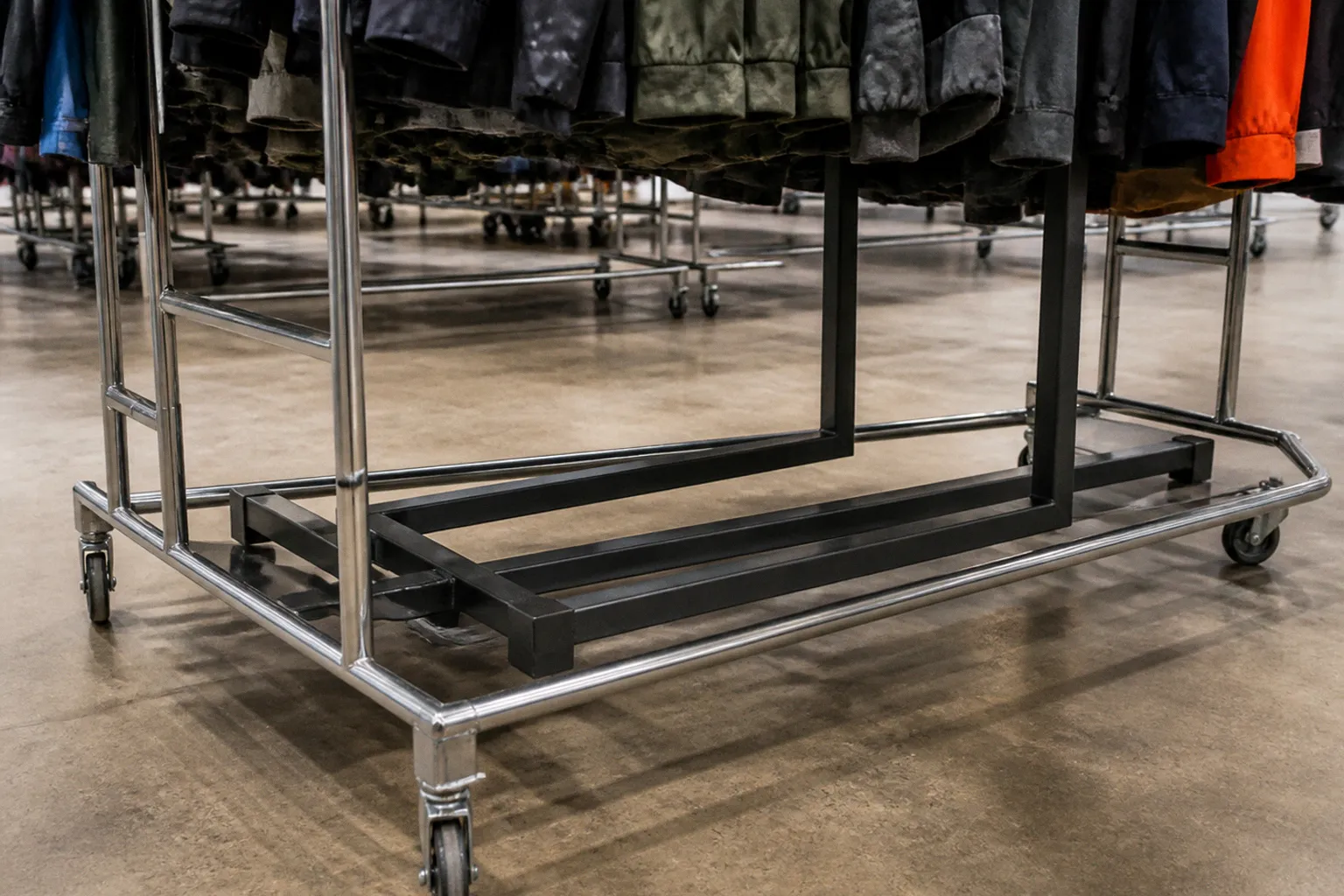
The Z-rack has a real history, and understanding it will save you from buying the wrong knockoff. The frame was designed and patented by Archie Solomon in 1976, and the genius of that Z-shaped base wasn't aesthetic — it was operational. The base angles outward in a way that lets empty units slide into one another and nest flat, which means when your seasonal surge ends, your stockroom doesn't look like a parking lot of metal. If you run a mid-volume boutique doing seven figures a year, a dozen Z-racks nested together take up roughly the footprint of two nested ones.
That nesting math is the entire reason Z-racks exist as a category. We use them for one job: holding dense, heavy, slow-moving inventory that needs to live in the back until it ships to the floor. Think winter outerwear, workwear uniforms, denim stacks, and boxed footwear. The typical commercial Z-rack is rated between 300 and 500 pounds, which means you can load an entire rack with forty to sixty heavy winter coats and roll it across uneven concrete without the frame twisting out of true. The base is built from 1.5-inch to 2-inch square steel tubing for exactly that reason — you want it to track straight even when it's fully loaded and you're pushing it across a transition strip between carpet and tile.
If your operation looks like ours — receiving freight twice a week, staging markdowns in the back, rotating seasonal palettes from a single stockroom — the Z-rack is the workhorse. It doesn't fold flat for a car trunk, and that's fine, because it isn't supposed to. It nests, it rolls, and it holds more pounds per square foot of stockroom than anything else in its price tier.
Portability and Versatility: The Salesman Rack Workflow
The salesman's rack was engineered for a completely different moment in the retail calendar: the moment your inventory needs to leave the building. If you've ever booked a trade show booth, run a sidewalk sale out front, or partnered with another store for a co-branded pop-up, you've already felt the constraint the salesman's rack solves. The frame is designed to fold flat without tools — no hex keys, no pin removal, no YouTube tutorial — and the entire unit collapses down to a profile slim enough to slide into the cargo area of a standard SUV.
That portability opens up a use case the Z-rack simply can't touch. We deploy salesman's racks for flash events where the customer journey starts on the sidewalk: end-of-season clearances, charity sample sales, vendor days, and in-store trunk shows. The frame carries a standard 48-inch to 50-inch hangrail, but here's the trick most buyers miss — each end pulls out an extra 12 inches, which extends the total hanging space up to 72 inches, or six feet of continuous rail. You can stage an entire collection on one rack and still fit it through a standard doorway.
The height also adjusts, typically to 55, 60, and 65 inches, so a single salesman's rack can hold everything from cropped jackets to floor-length eveningwear without crushing the hemlines. That adjustability directly protects your sell-through: garments that arrive at the event looking like they've been stored correctly convert at a noticeably higher rate than the same pieces wrinkled on a fixed-height rack.
The salesman's rack isn't a storage solution that happens to roll — it's a merchandising tool that happens to fold. Treat it like the latter and it will pay for itself in a single busy weekend.
Structural Integrity: Comparing Steel Gauge and Weight Limits
Let's put the two side by side, because the spec sheet is where the trade-off becomes undeniable. The Z-rack is overbuilt on purpose. Its 1.5-inch to 2-inch square steel tubing base resists the kind of twisting you get when a fully loaded rack takes a corner at speed, and the 300 to 500-pound load rating assumes you'll be piling on weight continuously, day after day. It's a piece of back-of-house infrastructure.
The salesman's rack is engineered for a different physics problem. It has to be light enough for one person to fold and lift into a vehicle, which means the tubing is thinner, the joints prioritize quick-release over absolute rigidity, and the load rating reflects that. Most commercial collapsible salesman's racks support between 130 and 250 pounds, though some heavy-duty models can stretch up to 330 pounds. That's a meaningful gap, and it's the gap you should be planning around.
| Parameter | Z-Rack | Salesman's Rack |
|---|---|---|
| Primary Use Case | High-density stockroom storage, heavy inventory | Pop-up events, trade shows, sidewalk sales |
| Typical Weight Capacity | 300–500 lbs | 130–250 lbs (some heavy-duty up to 330 lbs) |
| Base Construction | 1.5"–2" square steel tubing | Lighter-gauge steel, quick-release joints |
| Footprint When Empty | Nests flat with other Z-racks | Folds flat without tools for transport |
| Hangrail Length | Standard 48"–60" | 48"–50" base, extends to 72" with 12" pull-outs |
| Height Adjustment | Typically fixed | Adjustable 55", 60", 65" |
| Best For | Winter coats, uniforms, dense denim stacks | Lightweight apparel, sample sales, mobile displays |
If you're tempted to push a salesman's rack to its upper weight limit and roll it across a stockroom floor twice a day, you're going to see frame fatigue inside a season. Conversely, if you try to fit a Z-rack into a hotel ballroom for a pop-up, you'll spend an hour wrestling it through a loading dock door and your team will never forgive you. Match the tool to the workflow, not the other way around.
Operational Trade-offs: Permanent Storage vs. Temporary Displays
Here's where the conversation turns from spec sheets to dwell time and sightlines, which is where the money actually lives in retail. Z-racks are almost always a back-of-house asset. We position them in the stockroom, near the receiving area, and roll them to the sales floor only when a specific zone needs a refill. They're not meant to live in the customer path. If you park a Z-rack on the sales floor for more than an hour, it starts eating into planogram discipline and your sightlines collapse.
Salesman's racks are the inverse. They're a front-of-house merchandising tool that happens to live in the back when idle. We use them to break up the monotony of a long gondola run — a salesman's rack parked at the endcap, dressed with a coordinated outfit and a clear signage panel, will pull customer attention and increase dwell time at that zone measurably. We've watched customers stop, touch, and engage with endcaps far more often when a portable rack replaces a static fixture, simply because the eye reads the rack as a fresh edit rather than permanent store inventory. That perception shift — "this is new, this is here right now" — is the lever, and it's why the same merchandise dressed on a rolling rack routinely outperforms the same merchandise dressed on a fixed fixture over a Saturday-Sunday weekend cycle.
The decision tree we walk every client through is straightforward. If the rack spends 90 percent of its life in the back, holding weight, and only rolls to the floor for replenishment, it's a Z-rack. If the rack spends 90 percent of its life on the floor or on the road, holding a styled edit, it's a salesman's rack. Most stores we work with end up needing both — a fleet of nested Z-racks in the stockroom and a smaller rotation of salesman's racks near the staging area — but the budget question always comes down to which workflow is dominant in your operation.
Choose based on where the rack spends its working hours, not where it spends its idle hours. A Z-rack on the sales floor is a mistake. A salesman's rack in the stockroom is overkill.
Selecting the Right Frame for Your Retail Footprint
So which one wins? Neither — and both, depending on what you're trying to move. If your bottleneck is stockroom square footage and you need to hold maximum weight in minimum nested floor space, the Z-rack is the only honest answer. Its 300 to 500-pound capacity and purpose-built nesting geometry were designed for exactly that problem in 1976, and no collapsible frame has replicated it since.
If your bottleneck is event revenue, vendor days, or any workflow that requires a frame to leave the building, the salesman's rack is the only honest answer. The fold-flat profile, the 72-inch extended hangrail, and the adjustable heights give you a mobile merchandising unit that protects garment quality and converts browsers into buyers.
Before you place the order, run this quick layout check against your actual operation:
- Measure the heaviest single SKU category you carry — if the rack load routinely tips over 250 pounds, you're in Z-rack territory.
- Count your off-site events per quarter — one or fewer means rent or borrow a salesman's rack; four or more means you need to own one.
- Walk your stockroom during a peak Tuesday morning and look at how many empty racks are taking up floor space — if they aren't nested, you need Z-racks.
- Stand at the entrance during a busy Saturday and count how many endcaps feel static — if you can't remember what was on them last week, you need salesman's racks.
The retailers who get the most out of their rolling frames are the ones who treat the two racks as a system, not a choice. Nest the heavy work in the back, roll the styled edits to the floor and the road, and audit the fleet every quarter against your actual conversion data. That's how you turn a piece of metal tubing into measurable lift — and how you keep your stockroom from becoming the bottleneck that slows down every other smart decision on your floor.