Rolling garment racks on carpet: caster size guide
You've loaded a rolling garment rack with winter coats, grab the upright, and push — but the rack barely moves.
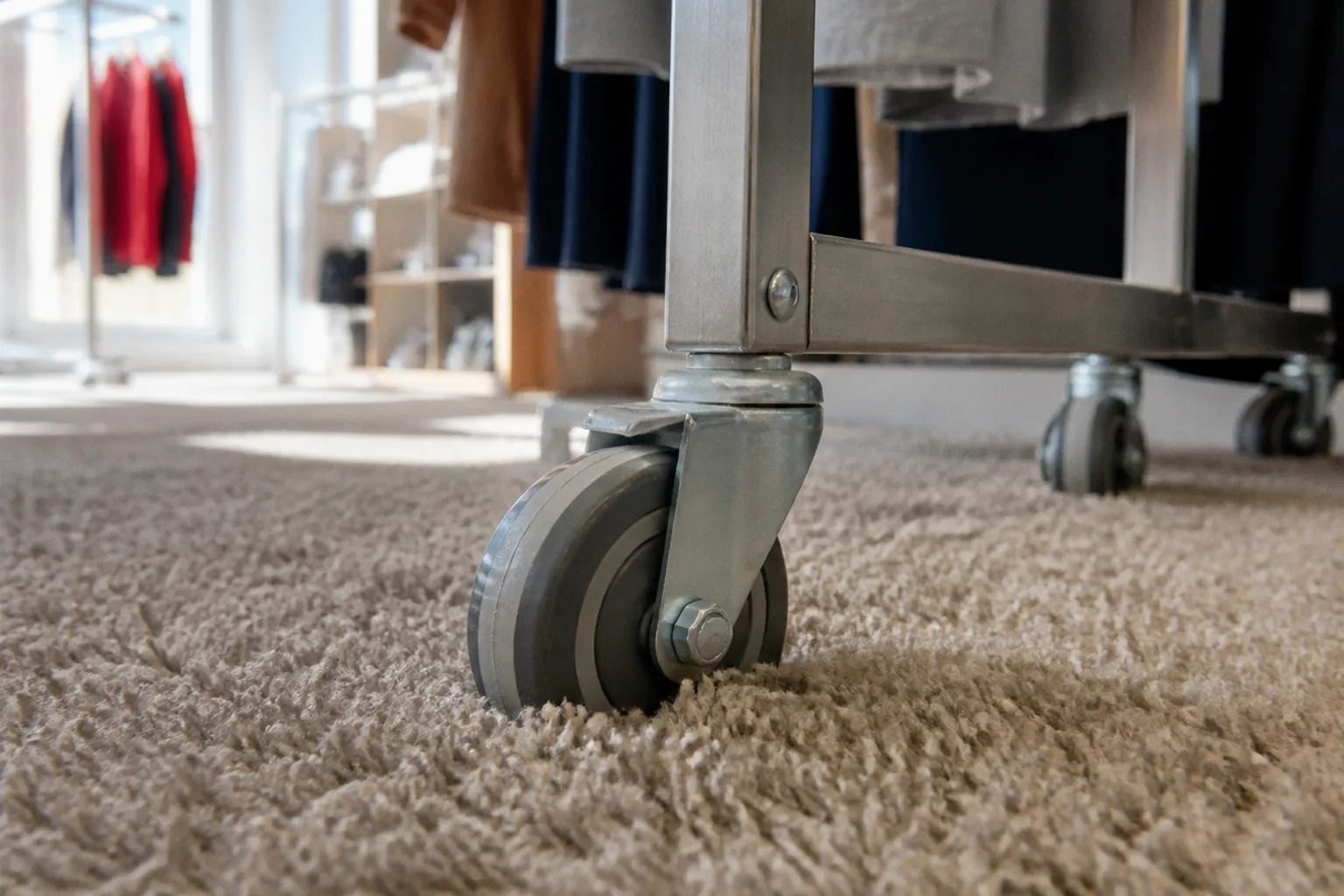
Four small wheels disappear into the carpet pile, the frame rocks instead of rolling, and a piece of equipment sold as “mobile” behaves as if it has been fixed to the floor.
That is usually not a failure of the rack frame. It is a mismatch between the casters and the surface. The wheels supplied with many garment racks are intended for concrete, tile, sealed hardwood, and other hard, level floors. Put the same rack on medium- or high-pile carpet and the conditions underneath it change immediately. Small wheels sink, the carpet deforms around them, and the force required to start and maintain movement rises sharply.
For rolling garment racks for thick carpet, caster diameter matters first. Wheel material, load rating, stem fit, and the arrangement of the rack matter just as much once the rack is carrying a serious apparel load. A rack that moves easily when empty may become nearly immovable when it is holding coats, boxed stock, or several dozen garments.
The Physics of Caster Performance on High-Pile Surfaces
A caster rolling across carpet behaves very differently from one rolling across polished concrete. The difference begins at the contact patch: the small area where the wheel meets the floor.
On a hard floor, the surface remains largely stable beneath the wheel. The caster rolls over it, and the main sources of resistance are axle friction, wheel hardness, bearing condition, and the load pressing the wheel down. Carpet adds another variable because the floor itself gives way. Fibers compress, the pile bends, and the wheel can settle into the surface rather than remaining on top of it.
A small hard wheel may press through the pile until it encounters the carpet backing or, on thinner installations, the pad beneath it. The wheel then has to climb out of the depression it created with every rotation. That may not be noticeable when the rack is empty. Add a full load of clothing, and the same wheel is forced deeper into the carpet. Starting from a standstill becomes difficult, and turning becomes harder still.
The effect is especially obvious when a rack changes direction. A fixed wheel can continue along its existing path, but a swivel caster has to rotate around its mounting point before the wheel is aligned with the new direction. If the wheel is partly buried, the carpet resists that rotation. The rack may lurch forward, drag sideways, or pivot only after the user applies a sharp pull to the upright.
Caster diameter is therefore one of the most important specifications for carpet use. A larger wheel does not eliminate every source of resistance, but it reduces the relative depth of the rut it creates and gives the caster a better chance of riding over the pile. A 3-inch caster can be adequate on low or medium pile when the rack is sensibly loaded. On thicker carpet, 4-inch or 5-inch wheels generally provide a more usable margin.
The carpet itself also matters. A dense, low commercial loop pile is not the same surface as a plush hotel carpet or a thick showroom rug. Neither is the pad below it. Two floors that look similar from standing height can produce very different results under a loaded rack.
Before choosing wheels, pay attention to:
- Pile height: Taller fibers allow a small caster to sink farther and may interfere with swivel movement.
- Pile density: Dense carpet can resist the wheel differently from loose, soft pile; neither should be treated as a generic “carpet” surface.
- Underlay or pad: A soft pad increases deformation beneath the caster and can make a rack feel heavier than it does on carpet installed directly over a firm floor.
- Transitions: Door thresholds, metal strips, and changes between carpet and hard flooring require enough wheel diameter to climb without catching.
- Turning space: A rack that rolls acceptably in a straight line may still be difficult to steer in a narrow stockroom or around display fixtures.
The wheel does not have to be enormous to work. It has to be large enough for the surface, the load, and the way the rack will be moved. A garment rack used for occasional repositioning in a low-pile boutique has different requirements from a loaded Z-rack moved repeatedly across a carpeted exhibition hall.
If your rolling garment rack will not roll, look at the wheels before blaming the frame. The problem is often below the load, not inside it.
Why 2-Inch Casters Fail Under Heavy Apparel Loads
The standard light-duty garment rack — the type sold for home closets, dorm rooms, temporary displays, and occasional pop-up use — often comes with casters in the 2-inch to 2.5-inch range. On hardwood or tile, those wheels may perform perfectly well. They swivel easily, take up little space, and keep the rack close to the floor.
Carpet exposes their limits.
A 2-inch wheel has little clearance above the surface. Once it sinks into the pile, the effective wheel height is even smaller. The wheel is no longer simply rolling across the carpet; it is pushing through a deformable surface while carrying the rack and everything hanging from it. The result is higher starting resistance, poor tracking, and a tendency to stall when the user tries to turn.
Load distribution makes the problem more severe. Four casters do not automatically divide the total rack weight into four equal portions. The floor may be uneven, the frame may flex, and one caster can carry more of the load during a turn or while crossing a transition. Clothing also creates a shifting load. A rack full of lightweight shirts behaves differently from one carrying winter coats, denim, boxed inventory, or garment bags.
This is why a caster’s advertised load capacity needs to be read carefully. A rating may describe a static load on a smooth, hard surface. It does not necessarily describe how easily the rack will move over carpet, how the wheel behaves while turning, or how much safety margin remains when the load is uneven. A wheel can technically support the weight and still be a poor choice for mobile use.
The failure mode is usually quiet rather than dramatic. The caster does not necessarily snap or detach. Instead, the front wheels dig in, the rear wheels resist, and the rack rocks forward a short distance before stopping. The user then starts levering the assembly by the upright bar. That puts sideways force into the frame, the caster stem, and the mounting socket — precisely the kind of force a small wheel was not designed to handle.
The 2-inch caster is not inherently defective. It is simply suited to a narrower job: lighter loads, short movements, and relatively firm floors. On thick carpet, the same caster becomes a bottleneck. The rack may have a strong frame and a generous hanging capacity, but its practical mobility is limited by the four smallest components touching the floor.
For heavy duty racks on carpet, a useful distinction is the difference between supporting a load and moving it. Supporting a stationary rack is a static task. Rolling that rack from one side of a room to another, turning it, stopping it, and starting again is a dynamic task. The casters need capacity for both.
Selecting the Right Caster Material for Carpeted Floors
Diameter addresses how deeply the wheel sinks. Material affects how the wheel interacts with the carpet once it is moving. The best choice depends on whether the priority is low rolling resistance, floor protection, noise control, or the ability to move across several surfaces.
Hard nylon and polypropylene are commonly effective choices for carpeted floors. Their rigid tread resists flattening under load, and they do not grip carpet fibers in the same way as a soft tire. That makes them suitable for commercial garment racks that need to remain mobile while carrying substantial apparel.
Nylon is often selected for demanding commercial applications because it combines a hard rolling surface with good resistance to wear. Polypropylene can be a practical alternative where the loads are moderate and cost or weight matters. The actual performance still depends on wheel construction, bearing quality, tread shape, and the condition of the carpet. “Nylon” alone is not a complete specification.
Soft rubber and polyurethane have legitimate advantages, particularly on smooth floors. They can run more quietly, absorb small impacts, and be gentler on delicate hard-floor finishes. Those benefits do not automatically carry over to thick carpet. A soft tread can deform under the rack, increase the contact area, and catch the carpet pile. That may make the rack feel stable when stationary but difficult to start or steer.
There is no universal rule that one material is best for every building. A retail operation with carpeted sales areas and concrete stockrooms may need a compromise. A rack that spends most of its time on carpet may be optimized for that surface, while a rack moved repeatedly between carpet and hard flooring may need a more balanced wheel specification.
The important question is not whether a caster is advertised as “premium,” “floor-friendly,” or “quiet.” Ask what happens when the wheel is carrying the actual rack load on the actual floor. Marketing language often describes performance on smooth surfaces. It may say little about a loaded rack on high-pile carpet.
A practical comparison looks like this:
| Wheel material | Typical advantage | Behavior on carpet | Best fit |
|---|---|---|---|
| Hard nylon | Low deformation and strong wear resistance | Usually rolls well when sized correctly; can be noisy on hard floors | Commercial racks used mainly on carpet or mixed floors |
| Polypropylene | Light weight and practical cost | Good for moderate loads; performance depends on wheel design | Retail, boutique, and general storage applications |
| Soft rubber | Quiet operation and impact absorption | Can compress and grip thick pile under load | Smooth floors, lighter racks, or environments where noise is the priority |
| Polyurethane | Floor protection and quiet rolling | May create more drag on deep pile, especially when soft | Hard floors and mixed environments requiring a gentler tread |
For a carpet-friendly garment rack wheel, hardness is only part of the decision. A narrow, hard wheel may still cut into soft pile if its diameter is too small. A wide wheel may spread the load but become awkward in a tight turning radius. Material and dimensions have to be chosen together.
Technical Specifications for Upgrading Commercial Rack Wheels
If you already own a rolling rack and the wheels are undersized, replacing the casters can be more economical than replacing the entire frame. The upgrade is straightforward only when the replacement caster matches the rack’s mounting system and physical clearance.
Casters attach to garment racks through several common arrangements. Some use threaded stems; others use grip-ring stems that press into a socket. A grip-neck design may use a shaped section to retain the caster in the leg. Commercial racks can also use plate-mounted casters, although stem-mounted versions are common on tubular uprights and light commercial frames.
Measure the existing caster instead of ordering by appearance. Two stems can look nearly identical while differing enough to fail during installation. Check:
- Stem diameter: Common commercial sizes include 3/8 inch and 7/16 inch, but the correct size is determined by the rack, not by the replacement listing.
- Stem length: A stem that is too short may not engage securely; one that is too long may bottom out inside the leg.
- Thread pitch: A threaded stem must match the socket’s thread. A similar diameter does not guarantee compatibility.
- Grip-ring position: On a grip-ring caster, the ring must sit at the correct point to lock into the socket.
- Mounting height: A larger wheel may raise the rack more than expected and affect stability, shelf clearance, or the height of the hanging rail.
- Swivel clearance: The fork and wheel need room to rotate without striking the base, crossbar, shelf, or adjacent caster.
- Brake configuration: A total-lock or wheel-lock brake can be useful, but it adds hardware and may reduce clearance on some rack designs.
Caster diameter should be measured as the actual wheel diameter, not the overall height of the caster assembly. Product listings sometimes emphasize total caster height, while the performance difference on carpet comes primarily from the wheel itself and its contact with the floor.
Here is a practical way to think about common size categories:
| Caster size | Suitable surface and load pattern | Carpet performance | Main limitation |
|---|---|---|---|
| 2"–2.5" | Hard floors, light loads, occasional movement | Often poor on medium or high pile | Sinks easily and becomes difficult to steer |
| 3" | Low to medium pile, moderate commercial use | Acceptable when the rack is not overloaded | May struggle on plush pile or soft padding |
| 4" | Medium pile, heavier apparel loads, frequent movement | Generally strong for commercial use | Requires checking frame and swivel clearance |
| 5" | High pile, transitions, heavy racks, repeated movement | Offers the greatest practical clearance in this group | Adds height, cost, and sometimes a larger turning radius |
For Z-racks specifically, the familiar Z-shaped base is a common feature, but bar arrangements vary by model. Some have a single hanging bar, some use two bars, and others include shelves or different crossbar layouts. The base shape is designed to let racks nest or align efficiently in storage, but it does not tell you the exact load distribution or caster specification. Check the model’s frame design and rated capacity before treating it as a standard configuration.
A 4-inch or 5-inch industrial swivel caster is often a sensible direction for a commercial Z-rack used on carpet, provided the frame can accept the added height and stem. The wheel needs to be matched to the rack, not simply chosen because it is the largest option on the shelf.
Replace all casters as a set whenever possible. Mixing a new pair of large front wheels with smaller original rear wheels changes the rack’s level, turning behavior, and load distribution. The result may be an uneven base that feels unstable when pushed. Different wheel materials can create a similar problem: one pair may track smoothly while the other pair drags or swivels under a different load.
Balancing Load Capacity and Maneuverability on Soft Flooring
Caster selection is a balance between capacity and control. A wheel that can carry the weight but cannot steer comfortably is not a successful mobile solution. Neither is a large caster that raises the rack so far that the frame becomes top-heavy or the hanging rail becomes awkward to use.
Start with the rack’s real operating load. Do not use the empty rack weight as the basis for selection. Include garments, garment bags, boxes, shelves, accessories, and anything commonly placed on the lower frame. If the rack is used for seasonal stock, calculate for the heavier season rather than the average day.
Then consider how that weight is arranged. A rack filled evenly from end to end puts different demands on the casters than a rack with a dense group of coats at one end. A bottom shelf loaded with boxes lowers the center of gravity but can add substantial weight. A top-heavy arrangement may remain within the nominal capacity and still feel difficult or unsafe to maneuver.
The wheel rating should provide margin above the normal working load. Ratings are not a promise that a rack will remain easy to push in every condition. They are one part of the specification, and the surface, wheel material, bearing, mounting method, and frame all affect the result.
The following sequence is more useful than choosing a wheel by diameter alone:
1. Estimate the working load. Use the heaviest normal configuration, not the empty rack or a typical light load.
2. Identify the floor. Separate low-pile commercial carpet from thick plush carpet, soft padding, and mixed floor routes.
3. Choose a diameter with clearance. If the rack must cross transitions or turn under load, allow more margin than a straight-line movement requires.
4. Select the tread material. Hard nylon or polypropylene is often appropriate for carpet-focused commercial use; softer materials may make more sense when hard-floor protection and quiet operation dominate.
5. Confirm the mounting system. Match stem diameter, thread, length, ring position, and mounting height.
6. Check the frame after installation. Make sure the new caster does not contact the base, shelf, brake pedal, or neighboring wheel.
7. Test with a representative load. An empty rack tells you almost nothing about how it will behave when fully dressed.
Maneuverability also depends on the type of caster. Four swivel casters can turn tightly but may wander when the rack is pushed quickly in a straight line. A combination of fixed and swivel casters can track more predictably, although it may require more room to turn. A rack intended for narrow aisles needs a different balance from one moved across an open showroom.
Brakes deserve attention as well. A brake can keep a rack from drifting on a slight slope or during loading, but a brake is not a substitute for a correctly sized wheel. Some brakes lock the wheel only; others lock both the wheel and swivel. The latter provides more stability but may be harder to engage and can require additional clearance around the caster.
A larger wheel does not guarantee effortless movement. Axle condition, bearing contamination, a bent fork, a damaged stem, and carpet caught around the hub can all create resistance. Before upgrading, spin each wheel off the floor and inspect whether it rotates freely. If one caster binds while unloaded, changing the other three may not solve the problem.
What the Floor Is Telling You
The easiest way to diagnose a carpet problem is to compare the rack’s behavior across surfaces while keeping the load similar. If it moves smoothly on concrete but stalls on carpet, the surface and caster combination is the first place to look. If it drags everywhere, inspect the bearings, stems, frame alignment, and brake mechanisms as well.
A rack that moves forward but resists turning may need larger swivel casters or more clearance around the fork. A rack that leaves deep tracks in the carpet is carrying too much load for the wheel size, the surface may be too soft, or both. A rack that rocks from side to side may have mismatched caster heights or a frame that was not designed for the replacement wheel.
Do not ignore thresholds. A wheel that works on a flat carpeted floor can catch on a transition strip because the leading edge has to climb a vertical obstacle. Larger diameter helps, but the angle of approach and the rigidity of the wheel matter too. If the rack regularly crosses doorways, plan for those transitions rather than testing only in the middle of the room.
There is also a practical limit to how much a caster upgrade can accomplish. A lightweight household rack with thin tubing, loose joints, and a low-rated hanging bar should not be turned into a warehouse cart simply by installing larger wheels. The casters may be able to carry the load, but the frame, welds, sockets, and hanging rail may not. Caster capacity cannot upgrade the structural capacity of the rack.
The reverse is true as well. A heavy commercial rack with a strong frame can be frustrating to use if it is equipped with small furniture-style wheels. In that case, the frame may be perfectly adequate while the mobility hardware is underspecified for the environment.
The right caster does not merely carry the rack. It preserves the reason the rack is mobile in the first place.
The Real Fix for Racks That Stall on Carpet
Most rolling garment rack problems on carpet are not solved by pushing harder. They are solved by matching the casters to the floor and the load.
For a light rack used occasionally on low-pile carpet, 3-inch casters may be enough. For a commercial rack carrying winter apparel or boxed stock across medium-pile carpet, 4-inch wheels are a more dependable starting point. For high-pile surfaces, frequent movement, or difficult thresholds, 5-inch casters may offer the clearance needed to keep the rack usable. The correct choice still depends on the rack’s mounting system and structural limits.
Hard nylon and polypropylene are often strong candidates when the main goal is rolling resistance on carpet. Soft rubber and polyurethane remain useful materials in other settings, especially where quiet movement and hard-floor protection matter, but they should not be selected automatically for thick pile.
Measure before ordering. Confirm the stem, thread, mounting height, wheel clearance, brake style, and actual working load. Replace the full set rather than mixing wheel sizes. Then test the rack under the load it will really carry.
A mobile rack is not defined by the word “rolling” in a product description. It is defined by whether a person can move it safely and predictably across the floor where it is used. On carpet, that depends less on the hanging rail than on the four casters underneath it.