Pipe Racks vs Wire Shelving: Two Heavy-Duty Storage Routes
Seventeen days into a fall rollout, your best-selling shearling parkas start to bow on the racks. The garment bag still reads "new arrival," but the canvas-and-wire unit you've trusted for years is showing a four-inch sag at the hanging rod.
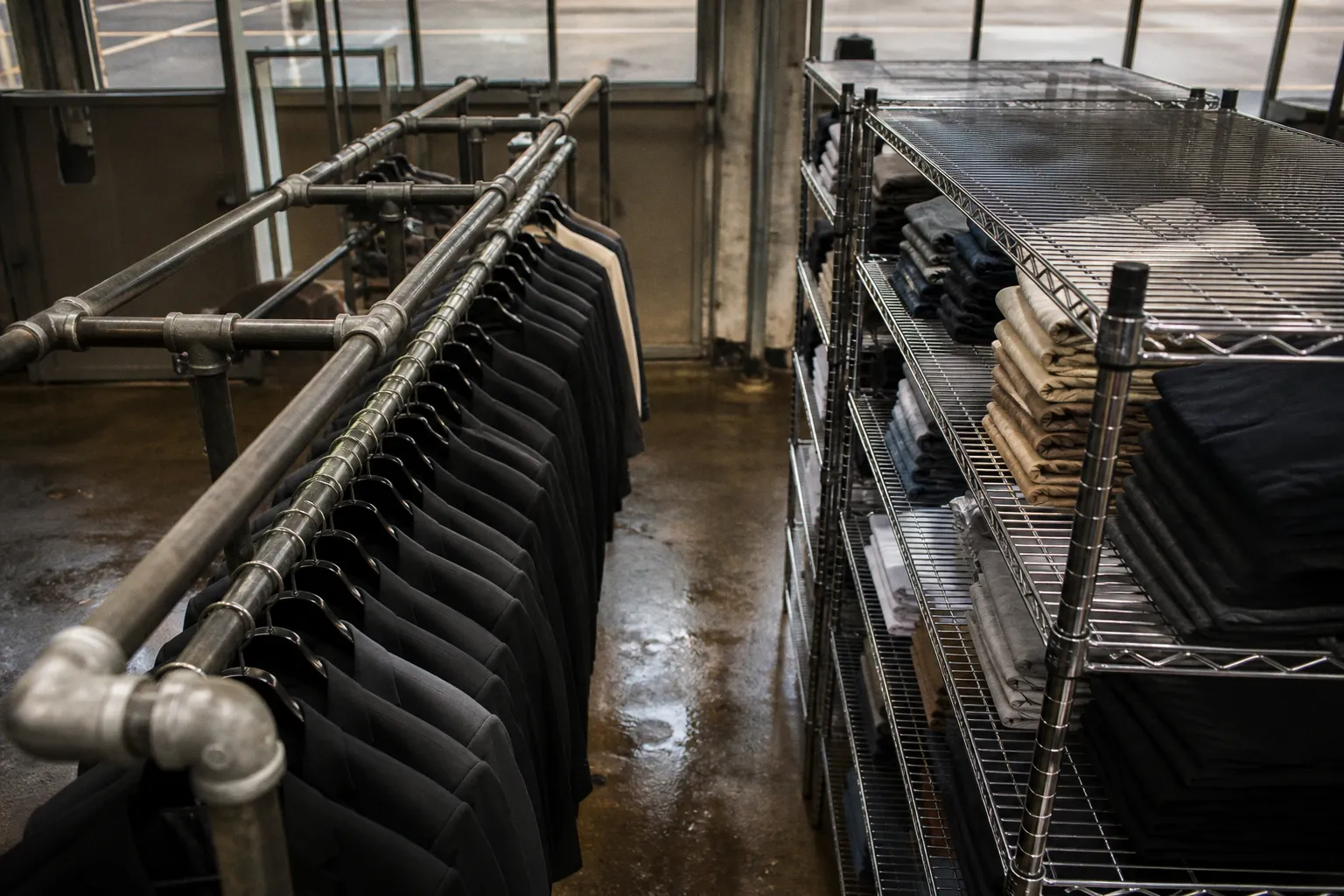
That's not a maintenance problem — that's a merchandising failure. When storage furniture starts to dictate product display, your dwell time drops, your planogram cracks, and customers walk right past inventory they didn't even register as available.
Compare car rental deals in United Kingdom
See available offersPartner link — DiscoverCars comparisonThis is the moment every retail space strategist dreads: the storage system is no longer serving the merchandise. Heavy outerwear, suiting, denim stacks, and bulk-pack wholesale volumes all generate the same question from buyers and merchandisers — should we move to industrial pipe racks, or stay the course with wire shelving? Both routes are legitimate, both are heavy-duty, and both are sitting on commercial floors from boutique backrooms to industrial warehouses. The answer, like most things in retail, depends on what you're actually putting on the bar and how long you need the display to hold its shape.
The Structural Backbone: Steel Pipe vs. Wire Grid
When we talk about industrial pipe racks, we are talking about structural steel — specifically the same ASTM A53 Grade B Schedule 40 black iron pipe that anchors plumbing risers and machinery frames. The 12-gauge wall thickness (0.109 inches) and a yield strength of at least 35,000 psi is what separates a true industrial pipe rack from the DIY kits you can tack together in a parking lot. That yield rating is the reason a wall-mounted industrial pipe rack can hold up to 1,100 pounds (look at units like the Timate F4) without deflection, and why a properly engineered DIY run can shoulder 85 to 120 pounds per 36-inch span without warping.
Wire shelving speaks a different structural language. The system is built around round steel posts with a slip-sleeve locking mechanism — plastic collars that wedge into the posts and let you adjust shelves in 1-inch increments. Per-shelf capacity typically lands between 300 and 800 pounds, which sounds impressive until you read the second line of the spec sheet: the hanging rod is usually capped around 100 pounds. Total unit capacity on a typical chrome wire garment rack hovers between 450 and 600 pounds. So if you're hanging two dozen winter parkas across a wire shelf-with-rod combo, you're already approaching the structural ceiling of the system, and the rod will tell you about it long before it fails.
A pipe rack carries the load in the steel. A wire rack carries it in the shelving geometry — and the hanging rod is almost always the weakest link.
Load Dynamics: Where Each System Earns Its Rent
Let's put the math on the floor. A single heavy shearling parka can weigh 6 to 9 pounds. Stack twenty across a 36-inch run and you're looking at 120 to 180 pounds of suspended weight — before you count the hangers, the rail sag, and the natural movement of customers pulling garments on and off the bar. On a properly engineered pipe rack, that load is a rounding error. On a wire shelving unit, that load is approaching the hanging rod's structural limit, and the rod will telegraph the stress in a gentle U-shape that no amount of re-merchandising will hide.
This is where the if-then of merchandising really kicks in. If your apparel mix is dominated by lightweight knits, blouses, and t-shirts — where individual garments come in under a pound and you need to refresh the wall every two weeks — then wire shelving is the right tool. The visibility is high, the airflow is excellent, and the cost per square foot of hanging space is low. If your mix leans into heavy outerwear, structured suiting, workwear, denim stacks, or anything packaged in bulk for wholesale, then industrial pipe racks are protecting your brand in a way wire shelving simply cannot. We've all seen the wire rod that bows after a season of heavy coats, and we've all watched the customer notice it before we do.
A sagging rod doesn't just lose integrity — it loses conversion. A garment that has to be lifted off a deflected bar signals "old stock" before the customer reads the price tag.
Airflow, Moisture, and Fabric Preservation
Beyond raw load, the wire shelving system has one structural advantage that pipe racks can't replicate without engineering: the open grid. Every wire shelf is a ventilation surface. Air moves through it, moisture evaporates off it, and — in a fire event — sprinkler water passes through it without disrupting the load. This is exactly why NSF International certifies wire shelving under NSF/ANSI standards for sanitation-sensitive environments like healthcare linen rooms, food-adjacent retail, and clean-storage backrooms.
For garment storage, this airflow is more than a sanitation checkbox. Wool, cashmere, and any fabric with hygroscopic fibers will absorb ambient moisture, and if that moisture has nowhere to go, you get mildew, yellowing, and the kind of odor that no amount of retail misting can mask. A wire rack lets the air do the work. A pipe rack, depending on how tightly you pack the run, can trap humidity underneath a dense row of garments — which is fine if you're rotating stock weekly, but a slow leak in your SKU velocity if you're holding inventory longer than a single season.
The catch is the finish. Standard chrome-plated wire shelving is rated for dry environments, and that's it. If your floor runs hot, humid, or your backroom sits near a loading dock where temperature swings are routine, chrome wire will eventually rust. Epoxy-coated or stainless wire is the answer in those environments, and the price step is real — but so is the rod-sag you'd otherwise inherit.
Modular Customization: From Pipe Nipples to 1-Inch Increments
Merchandising never stands still, and neither can your storage system. This is where the two systems reveal very different philosophies.
Industrial pipe racks are modular in the way a custom industrial build is modular — you change the nipple lengths (4-inch, 6-inch, custom cuts) and you swap the fittings. Clamp-style fittings like Kee Klamp, secured with set screws, let you reconfigure height, depth, and run length without a welder. If you need a 7-foot waterfall display one season and a 4-foot shelf system the next, the pipe rack can absorb that re-spec. The mechanical components are also visible and replaceable — a damaged fitting is a 10-minute swap, not a system replacement.
Wire shelving uses the slip-sleeve system, which gives you 1-inch height adjustment along the posts. That's granular, fast, and doesn't require tools. If your reset cycle is weekly and you need to re-tier the display to match a new planogram, wire shelving is the faster tool. The trade-off is that the system's geometry is fixed — your shelf depth and width are limited to the manufacturer's catalog, and you can't extend a hanging rod beyond its engineered length without losing the structural rating.
If your merchandising cycle is measured in days, wire shelving wins. If your merchandising cycle is measured in seasons, industrial pipe racks win.
Material Risks: The Fabric Chemistry Most Spec Sheets Skip
Here's a detail that doesn't make it into most storage buying guides but absolutely belongs in any conversation about heavy-duty garment storage. Not all fittings are safe for every fabric.
Galvanized fittings — zinc-coated — leave zinc chloride residues on the metal surface. When wool fibers come into contact with zinc chloride in a humid environment, the chloride accelerates felting. The wool mats, shrinks, and loses its hand. If you've ever pulled a wool coat out of long-term storage and wondered why it looks five years older than it should, the storage hardware may be the culprit.
Brass fittings introduce copper ions into the equation. Silk dyes are vulnerable to copper-catalyzed oxidation, and over a long hold, you'll see the dye shift, the color migrate, and the garment permanently lose its showroom finish. The same logic applies to leather finishes where copper contacts the surface over time.
The fix is straightforward: plain black iron, stainless steel, or properly powder-coated fittings for raw wool, silk, and undyed leather storage. The finish protects the fabric, and the fabric preserves its saleability.
Mapping the Decision to Your Square Footage
So how do you actually pick on the floor? Here's the mental model we walk every buyer through on a site walk, condensed into a side-by-side:
| Parameter | Industrial Pipe Rack | Wire Shelving |
|---|---|---|
| Primary load material | Structural steel pipe (ASTM A53 Sched 40, ≥35,000 psi yield) | Round steel posts with slip-sleeve collars |
| Hanging rod capacity | Engineered by span; pipe runs typically 85–120 lbs per 36″ DIY, up to 1,100 lbs on heavy wall units | Usually capped around 100 lbs per rod |
| Per-shelf capacity | N/A (open pipe structure) | 300–800 lbs per shelf |
| Total unit capacity | Designed for the run, often 1,000+ lbs | 450–600 lbs typical |
| Adjustment granularity | Swap fittings and nipples; tool required | 1-inch vertical increments; no tools |
| Airflow | Open by design; depends on garment density | Open wire grid; ventilation is native |
| Corrosion behavior | Black iron can flash-rust in humidity without coating | Chrome wire rusts in humid environments; epoxy/stainless required |
| Best-fit fabric mix | Heavy outerwear, suiting, workwear, wholesale bulk | Light knits, blouses, t-shirts, fast-rotation basics |
| Reset cycle alignment | Seasonal respecs | Weekly or biweekly resets |
| Fabric chemistry risk | Avoid galvanized/brass near wool/silk | Standard chrome is safe for most fabrics |
Heavy on the bar and slow on the reset? Pipe. Light on the bar and fast on the reset? Wire.
The Floor-Tested Checklist
Before you sign the PO, run this quick audit with your merchandising team. It's tuned to what actually moves the KPI on the floor, not what looks good on a spec sheet.
- Weigh the heaviest garment in your current mix on a kitchen scale. If it tips over 4 pounds, the load is leaning toward pipe.
- Measure hanging rod deflection on existing wire units with a 50-foot tape. More than 1 inch of sag at the center of the run? Theomerchandise is oversold for that hardware.
- Log humidity in the storage zone for one week. If averages stay above 60% relative humidity, spec epoxy-coated or stainless wire for ventilation, or move to pipe for predictable load.
- Audit your reset cycle in calendar days. Under 14 days between planogram shifts, wire shelving's 1-inch slip-sleeve system pays for itself.
- Catalog any wool, silk, or undyed leather SKUs crossing the threshold. If yes, specify plain black iron or powder-coated fittings only — no galvanized brass in the same room.
- Calculate cost per linear foot of covered warranty. Pipe racks typically deliver 10+ years of service life; wire shelving 5–7 before rod fatigue sets in.
That last line is the one we push back to the buyer on. A pipe rack at 1,100 pounds of load capacity, with a 35,000 psi yield rating, is built for a generation of merchandising. A wire shelving unit with a 100-pound hanging rod is built for a season. If your loyalty to the wire system is rooted in "it was cheaper upfront," you're paying the difference in dead zones, sagging sightlines, and the customers who walked past merchandise you didn't even know you had on the floor.
We don't pick one over the other out of ideology. We pick based on the load, the fabric, the climate, and the speed of the reset. Both systems have their place. Both belong in the toolkit. The mistake is reaching for one when the other was the right call all along, and finding out three weeks into the season when the rod tells the customer what the spec sheet didn't.