Pipe garment racks vs commercial modular systems
Picture this: it's 11 AM on a Saturday, your boutique floor is packed, and the central pipe rack you've been running for two seasons is visibly bowing under a drop of winter wool coats.
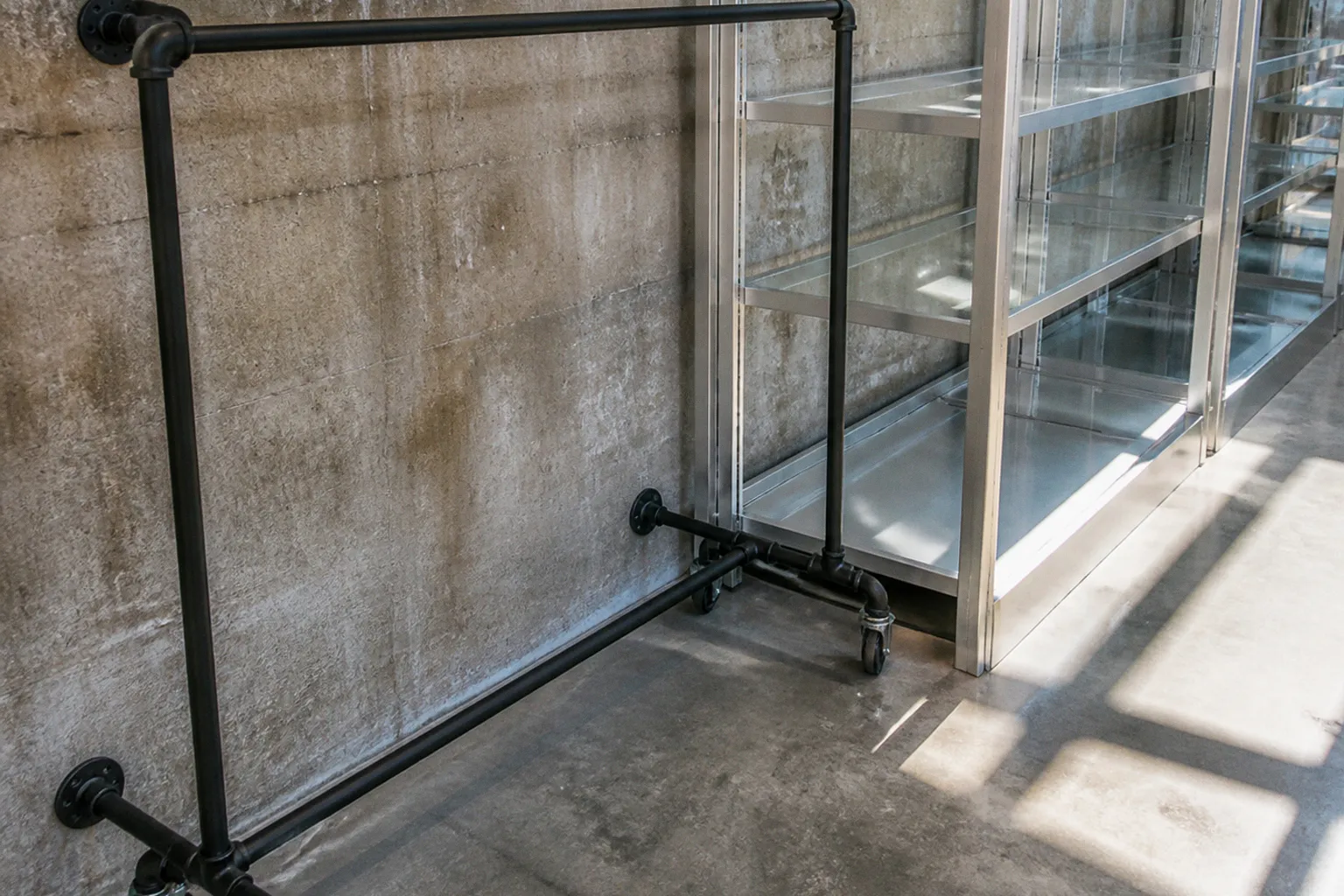
Pipe Garment Racks vs Commercial Modular Systems: A Floor Manager's Breakdown
Customers stop, glance at the bend, and keep walking — and just like that, you've lost dwell time, lost the conversion, and lost the credibility of your merchandising. The choice between a DIY black iron pipe build and a commercial modular system is not a hardware question. It's a Saturday-morning question. It's a dead-zone question. It's a question about how much inventory weight your fixture can carry before the metal starts telling your customer a story you never wanted to tell.
We see this all the time with independent retailers. Someone falls in love with the raw-industrial look of black iron pipe on a styling feed, spends a weekend cutting and threading in the back room, mounts a 6-foot bar to the wall, and hangs sixty pounds of denim on it expecting the math to hold. The math usually holds — until the Saturday sale. So let's walk the floor together and sort out what each system actually delivers when the racks are loaded, the sightlines are open, and the planogram is on the line.
Structural Integrity: Threaded Iron vs Engineered Modular Steel
The first thing we look at when we audit a fixture isn't the finish — it's the spec sheet, because the finish is decoration and the spec sheet is the structure. A properly built DIY pipe rack runs on minimum 12-gauge ASTM A53 Grade B black iron pipe with load-rated flanges. That designation matters: A53 Grade B is the same pressure-rated steel used in plumbing and gas lines, and the 12-gauge wall thickness is what gives the bar its resistance to bending under sustained load. When we spec a custom build for a client, we're choosing this pipe precisely because we know the threading is engineered to seat flush against a load-rated floor flange, and we know the joint won't pivot under asymmetric weight the way a set-screw fitting can loosen over time.
Commercial modular systems tell a different structural story. They arrive as engineered kits with self-aligning stacking lugs, pre-drilled uprights, and joint hardware that's been cycle-tested in factory conditions rather than assembled once in your stockroom. The upside is consistency: every crossbeam behaves the same way, every upright carries the load rating stamped on the spec card, and there's no risk that the person who built yours had an off day with the pipe wrench. The trade-off is that you're buying into the manufacturer's geometry, not yours, and if your ceiling height, wall stud spacing, or back-of-house corridor doesn't match the system's modular grid, you'll be working around it for the next decade.
The bend in your bar is a customer signal. Every visible sag on your selling floor tells shoppers that your inventory is heavier than your fixture — and shoppers walk away from that signal before they ever touch the fabric.
Load Capacity Benchmarks: What the Numbers Actually Mean on Your Floor
Numbers on a spec sheet are useful only when you translate them into garments per linear foot. Here's the conversion we use when we audit a floor:
A standard steel pipe hanging bar — properly mounted with load-rated flanges — can carry roughly 229 lbs across a 6-foot span. Compress that span to 2 feet and the same pipe can carry up to 689 lbs because the bending stress drops dramatically as the unsupported length shrinks. That's the physics working in your favor when you go with shorter, wall-anchored runs instead of long floating spans across an open floor.
For a custom DIY build using that 12-gauge black iron we mentioned, you're looking at 85 to 120 lbs of safe working load per 36-inch run before you see meaningful sag. Translated to merchandise: that's roughly fifteen to twenty heavy wool overcoats, or thirty to forty pairs of premium denim, or a much larger volume of lighter knits and tees — which is why the math feels fine in spring and fails in November when the seasonal weight hits.
On the modular side, commercial racking engineered for industrial apparel storage climbs from a few thousand pounds per bay up into multi-ton capacities for heavy textile rolls and bulk garment storage. You don't need that kind of rating on a boutique selling floor, but you should know it exists — because it's the same engineering discipline (load-rated fittings, cycle-tested joints, stamped spec cards) that gives a 1,500-lb-rated retail bay its consistency. If you're running a stockroom that backs a busy retail floor, those ratings translate directly into how many totes you can stack before the uprights start whispering.
| Load Parameter | DIY Black Iron Pipe (12-gauge A53) | Commercial Modular System |
|---|---|---|
| Safe load per 36" run | 85–120 lbs | Engineered per spec card; typically 200–1,500+ lbs per bay |
| Safe load on 6-ft span | ~229 lbs (drops as span grows) | Engineered for full-span consistency |
| Joint type | Threaded, load-rated flanges | Set-screw, slip-on, or bolt-together per system |
| Reconfiguration cost | High (rebuild required) | Low to moderate (modular swap) |
| Failure mode | Visible sag before collapse | Predictable spec compliance |
That last row matters more than the numbers above it. A pipe rack fails slowly — it sags, it bends, it telegraphs the problem to every shopper on the floor and to every buyer walking the back room. A modular system either meets its stamped rating or it doesn't, and the answer is in the paperwork, not in the curve of the bar.
Assembly Dynamics: When You Need to Pivot Your Floor by Tuesday
The retail calendar doesn't wait for your build schedule. If you're running a boutique, you know the rhythm: a buyer walks in on Monday with a new denim wall, and the floor needs to look right by Saturday morning. This is where the assembly story diverges sharply between the two systems.
A threaded black iron pipe rack is a one-and-done build. You cut, you thread, you wrench, and you've got a structure that's mechanically locked together — the threaded pipe fittings are rated to 300 psi of joint pressure, which is wildly more than your coat rack will ever see. The advantage is permanence: nothing pivots, nothing loosens, and the joint never drifts under load. The disadvantage is exactly that permanence. If you want to extend that bar by 18 inches for a new collection, you're cutting new pipe, re-threading, and starting the joint math from scratch.
Adjustable structural fittings — the set-screw systems and their commercial cousins — change the math entirely. You tighten a set screw with an Allen wrench, and the joint locks. You back the screw out, and the rack reconfigures. If you're running a store where planograms shift every six to eight weeks, this is the difference between a Saturday build session and a contractor invoice. Modular pipe racking systems layer on top of that with self-aligning stacking lugs that let you stack bay-on-bay without drift, and specialized structural joints that handle corners, tees, and vertical extensions without custom fabrication.
If your floor changes three times a year, a threaded pipe rack is a sunk cost. If your floor changes once a decade, a threaded pipe rack is the most rigid, longest-lasting fixture you'll ever own.
Here's the if-then we walk clients through: if you're opening a flagship boutique with a five-year visual merchandising plan and you want the industrial look as your brand signature, thread the pipe and own it. If you're running a pop-up, a traveling showroom, or a multi-location concept where the same square footage gets reinvented every season, the reconfigurable modular system pays for itself in labor savings before the second rebrand. And if your team is the kind that can rebuild an endcap with a pipe wrench on a Sunday night, the threaded system rewards your skill; if your team is the kind that needs a manual and a kit of identical parts, modular wins every time.
Material Science and Preservation: Why the Pipe Itself Matters
This is the section we wish more retailers read before they specified their fixtures. Black iron pipe — properly cleaned, properly sealed — emits zero chemical off-gassing. Zero. For a store selling acid-sensitive silks, protein-based wools, or any natural fiber that ages badly in the presence of formaldehyde and VOCs, that property isn't a footnote. It's the reason your $400 merino sweater still smells like the showroom six months after purchase instead of like the MDF it was hanging next to.
Painted MDF and laminated particleboard — the substrates most commercial modular systems use for shelves, base decks, and back panels — outgas continuously for the first few years of their life. In an enclosed fitting room or a tight back-of-house stockroom, that off-gassing concentrates, and delicate fabrics absorb it. We've walked into boutiques where the visual merchandising looked impeccable and the inventory smelled like a hardware store. The customer can't name what they're smelling, but they trust their nose, and they leave without the coat.
If your merchandise mix includes anything in the natural-fiber premium category — wool, silk, cashmere, leather, raw denim — the substrate question belongs in the same conversation as the load rating. A black iron pipe rack with a sealed wood base or a fully metal-and-glass modular system protects your inventory's resale value and your brand's sensory promise in a way that a laminated MDF fixture never will. This is also where the boutique-versus-warehouse decision gets interesting: if you're storing bulk cotton tees in a stockroom, off-gassing is a non-issue. If you're staging a $2,000 outerwear piece three feet from a customer's nose, it's the whole game.
Cost-Benefit Analysis: The Number That Actually Runs the Decision
Let's talk about the dollars, because the headline number on DIY is misleading and the headline number on modular is incomplete.
A basic wall-mounted DIY pipe clothing rack using 1-inch diameter black pipe runs about $30 in raw parts — that's the figure that gets shared on blogs and gets a boutique owner excited. What that figure doesn't include: a pipe cutter, a threading die if you're cutting to length, deburring tools, pipe wrenches, wood for the base or wall-mount blocking, finishing time, paint or sealant, and the labor hours of whoever's putting it together. Once you load those numbers, a custom DIY build lands somewhere well north of $30 — and the moment you add structural slip-on fittings for reconfiguration, you've crossed into modular-system territory anyway.
Commercial modular systems carry a higher unit cost per linear foot, but they arrive with engineering documentation, consistent load ratings, and a reconfiguration path that doesn't require new tools. For a retailer who needs to expand, contract, or relocate bays every season, the modular premium is recovered in labor and downtime savings within the first two reconfigurations. For a retailer with a fixed floor plan and a tight opening budget, the DIY route can deliver a structural result that holds its own — provided you respect the gauge, the flange ratings, and the span math.
Three things to budget honestly before you commit:
1. Tooling amortization. A pipe cutter, threading kit, and deburring tools run a few hundred dollars new. If you're only building one or two racks, that tooling cost dominates your per-unit math. If you're opening a chain, it amortizes across every location.
2. Surface finishing. Raw black iron pipe can leave residue on light-colored garments and on customer hands. Plan for sealing or powder-coating — and that means time, ventilation, and a curing window you can't rush.
3. Future reconfiguration. If there's any chance your floor changes within five years, price the rebuild, not the build. A $30 DIY rack that costs $400 to rebuild is more expensive than a modular system you can reconfigure in an afternoon.
Where the Floor Lands
We've been on enough selling floors to know that the wrong fixture doesn't announce itself — it just quietly costs you conversion, week after week, until you finally audit the dead zones and realize the rack has been the problem all along. The decision between a DIY black iron pipe build and a commercial modular system isn't really about the metal. It's about how often your floor changes, how heavy your inventory runs, how sensitive your merchandise is to off-gassing, and how much of your customer experience you're willing to delegate to a spec card versus a Saturday morning.
Thread the pipe when permanence is your brand, when your floor plan lives for a decade, and when the look itself is part of what you're selling. Buy the modular system when flexibility is your business model, when your load demand exceeds what a 36-inch pipe run can carry, or when your opening timeline doesn't allow for a custom build cycle. And if you're standing in your stockroom right now staring at a sagging bar, the answer is whichever one lets you replace it before next weekend's sale — and this time, with the right SKU density behind it.