Adapting Retail Displays for the Rapidly Shifting Sneaker Market
According to WWD, five sneaker retail and resale insiders see a 2026 market that is moving beyond a simple Nike-versus-Jordan playbook.
5 Sneaker Retail and Resale Insiders Talk Top 2026 Trends: ‘The Life Cycle of a Sneaker Feels Shorter Than Ever’
Vans, Nike, Jordan, Yeezy, Maison Mihara Yasuhiro and other labels are appearing in the conversation, while buyers describe a market that requires faster adaptation. For sneaker retailers, the message is practical: your display system must support shorter trend cycles without turning the sales floor into an overstocked wall of undifferentiated SKUs.
The trend is less about one winner—and more about a wider mix
WWD’s interviews include representatives from RIF, Union, The Magnolia Park, Syndicate and What Should I Call My Store. Their answers do not point to a single universal bestseller, but they do show a broader assortment logic.
Vans was repeatedly highlighted. Jeff Malabanan of RIF gave the simplest answer—Vans—while Union’s head buyer Vianca Kazsuk described an upswing tied to more distinctive styles, storytelling and low-profile footwear rather than only the standard black Authentics or Old Skools. WWD also notes attention around bedazzled and charm-adorned skate styles.
Nike remains important, but the source frames its strength as diversified across running, lifestyle and basketball. Union also pointed to community activations, experimentation and upcoming releases as factors keeping interest high. Jordan continues to perform through retros and collaborations, and one retailer specifically pointed to a return to Jordan alongside Vans.
Other signals are more specialized. The Magnolia Park’s Miki Guerra said Yeezy had regained momentum with the YS-01, citing its pricing and everyday comfort, while Maison Mihara Yasuhiro was described as maintaining steady demand outside the usual Nike, Jordan and Asics group. Syndicate’s Cristian Rodriguez summarized the shift differently: the store now sells “a little bit of everything,” and its buying has changed substantially since opening.
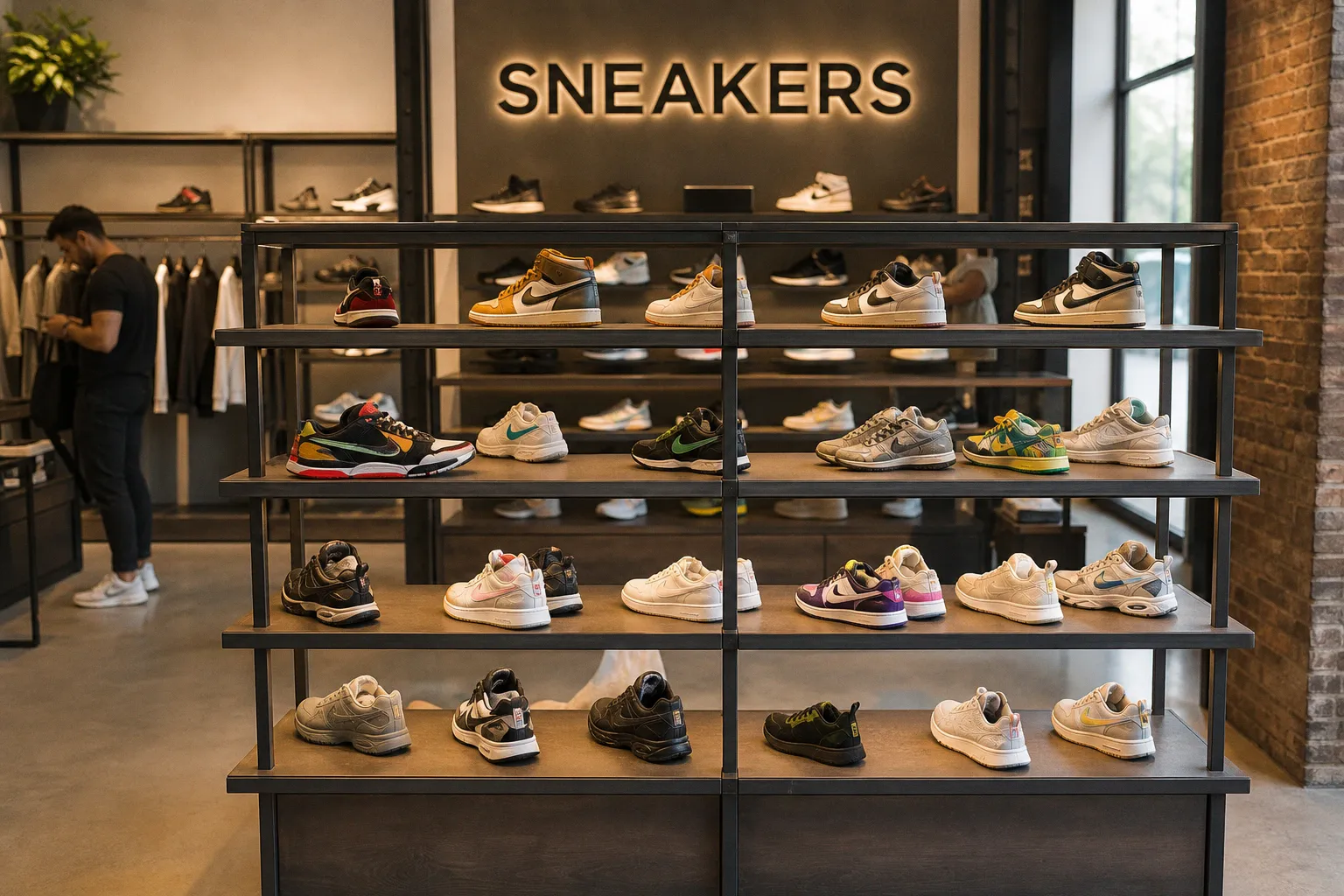
For merchandising, that means a single hero brand should not consume every prime sightline. Use the strongest endcap for a clear story—such as skate, low-profile, retro or comfort-led footwear—then give adjacent space to complementary labels. If every product is presented as the same kind of hype release, the customer has less reason to slow down and compare.
Build the floor for a shorter product life cycle
The WWD headline describes sneaker life cycles as feeling shorter than ever. That should change how we treat fixtures, planograms and SKU density.
A permanent wall organized only by brand can become a dead zone when the customer’s attention moves elsewhere. A more flexible configuration lets you refresh the front of the store without rebuilding the entire run: adjustable shelving, movable display tables and modular endcaps can rotate the visual message as new releases, collaborations or category demand change.
The source also points to the importance of narrative. Vans’ reported resurgence is linked not simply to a basic product return, but to styles, storytelling and a connection with consumers beyond its regular audience. Your display should therefore give the product enough breathing room for that story to register. Keep the key silhouette at eye level, avoid excessive SKU density around the hero pair and use neighboring product to explain the category rather than compete with it.
Nike offers another useful layout lesson because the brand appears across several communities and categories. If your store carries running, lifestyle and basketball product, do not force them into one undifferentiated Nike block. Separate the customer missions with visible category cues, then use cross-merchandising where it helps shoppers move between them. The goal is higher dwell time without creating a maze of repeated logos.
What to check before the next reset
Start with sightlines from the entrance: can a customer immediately identify the current story, or do they see a crowded inventory grid? Next, review the planogram by product role rather than brand alone. Mark the fixtures that carry newness, the ones supporting reliable everyday demand and the ones holding slower or more specialized product.
Track sell-through by display position, not only by SKU. A pair that performs on an endcap but stalls on a low-visibility shelf is giving you a layout signal. Also compare dwell time around story-led displays with traffic through standard brand runs. The evidence from WWD does not establish a universal formula, but it does support a clear operating principle: keep the fixture architecture stable while making the merchandising message easy to change.
For the next floor walk, use three questions:
- Which display can be refreshed without moving the whole category?
- Are low-profile, retro, skate, comfort and performance stories visibly separated?
- Does the current endcap reflect what is moving now, or only what the store has always carried?
In a market where buyers describe demand as broader and product momentum as faster-moving, flexibility becomes part of the selling system—not just a design preference.