Casters for heavy-duty racks: rubber or polyurethane?
A four-post garment rack with a “1,000 lb capacity” sticker can still be remarkably difficult to move.
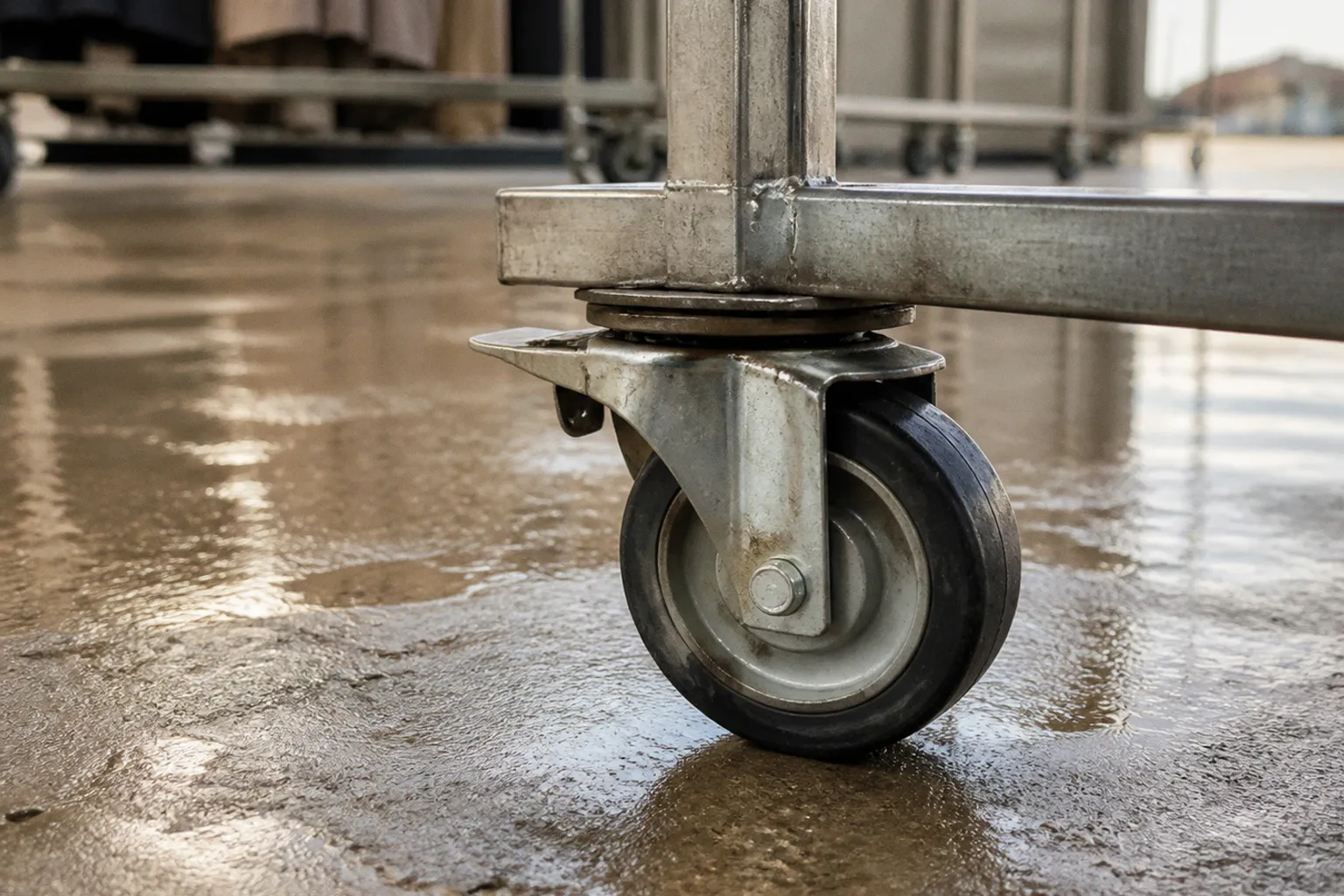
One wheel develops a flat spot, another starts marking the floor, and the whole rack turns into a heavy piece of storage furniture that happens to have wheels attached.
I start every caster question at floor level, because that is where the rack becomes either useful mobile storage or a daily exercise in frustration. Choosing heavy duty garment rack caster wheels is not simply a matter of finding the wheel with the highest load rating. The tread compound has to survive the actual load, the route, the floor surface, and the way people move the rack. Rubber and polyurethane both survive some of those conditions. Neither survives everything.
For loaded racks moving through reasonably smooth commercial interiors, polyurethane is usually the stronger all-around choice. Rubber earns its place where quiet movement, shock absorption, and traction on rough floors matter more than minimum rolling effort. The useful answer is therefore not “polyurethane wins.” It is more specific: polyurethane resists permanent deformation and rolls more efficiently; rubber dampens vibration and noise more effectively. A properly selected caster lets those strengths match the work instead of asking one wheel compound to do every job badly.
Loaded racks deform the wheel before they bend the frame
The most important difference between rubber and polyurethane appears under a sustained load. Every wheel compresses slightly where its tread meets the floor. That is normal. The trouble begins when the tread stays compressed after the load is removed.
Rubber caster wheels typically measure around 67–75 Shore A. Polyurethane caster wheels usually fall in a harder 83–95 Shore A range. Those figures describe indentation hardness, not a universal weight limit, but the practical consequence is straightforward: the softer rubber tread deflects more readily. Under prolonged heavy loads, it can compress and develop permanent flat spots more quickly.
That flat spot matters because a rolling garment rack rarely distributes its mass perfectly. The theoretical load on four casters is not always the real load on all four. A threshold lifts one wheel, a floor crack unsettles another, and a hard turn pushes sideways forces through the swivel heads. Clothing shifting on hangers creates another moving load. The rack can look stationary and still be imposing changing forces on each contact patch.
A wheel that holds its shape retains a rounder rolling path. Less energy is wasted repeatedly flattening the tread and letting it spring back. That is one reason polyurethane casters generally require less effort to start and keep moving, especially when the rack is fully loaded. Their higher hardness also gives them better load-bearing capacity per wheel diameter than rubber, which is why “heavy duty” polyurethane is a sensible pairing rather than a contradiction in terms.
None of this means a rack should be pushed up to the stated caster capacity simply because the wheels are polyurethane. Capacity ratings belong to complete caster assemblies and should account for the intended use, not just the words printed beside a wheel. Shock loads, uneven load distribution, rough floors, and worn components all increase the strain. Treat the advertised figure as a limit, not a dare.
The best heavy duty garment rack caster wheels are not the ones with the biggest number on the box; they are the ones that preserve movement after the load is real.
The permanent-deformation problem is particularly relevant in garment storage. A stockroom rail may be fully loaded for hours, moved only a few meters, and returned to the same position. That is enough time for a poor wheel choice to become obvious. The first push after loading reveals whether the tread has recovered or whether the rack now needs a running start.
Maneuverability comes from the whole rolling system
Polyurethane’s lower rolling resistance is most valuable in dense storage. When clearance between rolling clothing racks, wardrobes, and shelving is tight, the operator needs to overcome inertia, change direction, and stop without wrestling the entire loaded frame. A tread that compresses excessively makes every one of those actions more demanding.
Rubber provides better traction and a softer grip, but that grip has a cost. Its tread deforms more as it rolls, increasing resistance. On a rough or uneven surface, that can be useful: the wheel can maintain contact where a harder material might bounce or lose purchase. On a smooth storage floor, however, the same compliance can make a loaded rack feel stubborn.
The material is only part of the maneuverability problem. I have seen perfectly suitable wheels mounted in poorly made swivel heads, and I have lost enough skin to cheap brackets to distrust any caster that looks like an afterthought. Inspect the bearing, swivel action, axle retention, brake mechanism, and mounting plate as carefully as the tread. A premium compound cannot rescue a caster that binds, rattles, or allows the wheel to wobble under load.
Wheel size also changes the decision. Moving to a larger wheel can improve how the rack crosses seams, cracks, and small floor transitions because there is more rolling surface available to climb the obstruction. But larger wheels are not free verticality. They raise the rack and may reduce clearance beneath an overhead garment rail, alter the operator’s pushing height, or create clearance problems at doorways. A 4-inch wheel on a frame designed around a smaller mounting height is not automatically an upgrade.
Polyurethane’s easy rolling can introduce a less obvious issue: the rack may move when it should stay put. A slightly inclined floor, an accidental bump, or a poorly positioned brake is enough to send a lightly loaded mobile rail drifting. Do not use rolling resistance as a substitute for proper brakes. The easier the wheel rolls, the more deliberately the rack needs wheel locks, end stops, or another method of keeping the loaded frame stationary.
For directional control, fixed and swivel casters solve different problems. Swivel casters make turning easier, but they also allow sideways movement. Fixed-position casters track more predictably along a straight path but demand more space to redirect the entire frame. In a narrow storage aisle, a mixed arrangement is often more practical than four wheels that can turn in every direction. The correct polyurethane vs rubber casters decision cannot rescue bad caster geometry.
A low-resistance wheel saves effort during the move; it also has less natural resistance when the move should not have happened.
Floor protection depends on tread chemistry and housekeeping
Floor scuffing is where rubber produces the most misleading reputation. Some buyers see black marks and conclude that all rubber is dirty, while others assume polyurethane cannot damage any floor. Both conclusions skip the details.
Standard soft black rubber can contain carbon black filler, and that material may transfer dark marks to a floor. Polyurethane tread does not transfer color in the same way and is generally more compatible with delicate or polished floor finishes. That is a meaningful advantage in boutiques, showrooms, and finished retail areas where one dark crescent behind a garment rail can ruin an otherwise orderly presentation.
It would be wrong to say every rubber caster marks every floor. Non-marking grey hard-rubber formulations exist. The durometer and compound matter, not the color alone. Nevertheless, a carbon-filled rubber wheel creates a marking risk that polyurethane largely removes.
The floor itself still matters. Polyurethane can be non-marking while a damaged wheel carries grit, metal fragments, thread, or hair into the contact patch. I treat embedded debris as a tiny but determined cutting tool. Garment storage creates a steady supply of lint and loose fibers, and a dusty caster can turn those fibers into grinding paste against the floor.
| Decision factor | Rubber caster | Polyurethane caster |
|---|---|---|
| Typical tread hardness | 67–75 Shore A | 83–95 Shore A |
| Deformation under sustained load | Compresses and can flat-spot more readily | Better shape retention under heavy loading |
| Rolling effort | Higher because the softer tread deforms | Lower rolling resistance, especially when loaded |
| Shock and vibration absorption | Stronger due to softer, elastic material | Less damping; impacts can transmit through the wheel |
| Noise on rough floors | Usually quieter | Does not isolate noise as effectively |
| Traction | Better grip where traction is a priority | Prioritizes efficient rolling; suitability for a slope should be verified |
| Floor-marking risk | Standard black rubber can scuff; grey non-marking compounds are available | Polyurethane tread does not transfer color |
| Strongest working environment | Uneven routes, quiet areas, and applications needing grip | Loaded movement across relatively smooth commercial floors |
The practical floor test is simple: run the proposed caster over the actual route with a representative load. Check the floor afterward and inspect the tread for compacted debris. An empty-wheel test conducted in a clean office corridor proves very little about a fully loaded rack crossing an epoxy expansion joint at the warehouse entrance.
Polyurethane is usually the safer choice for finished flooring when rolling efficiency is also important. Rubber can still be appropriate, but the selected compound should be clearly identified as non-marking rather than assumed to be. A sales drawing that merely says “rubber wheel” is not enough specification for a floor you care about.
Rubber wins when quiet and impact control lead the brief
A rack may be rated for an impressive static load and still produce an unacceptable working environment. Hard wheels transmit vibration from cracks, thresholds, and uneven joints into the frame. The frame then acts as a large sounding board. Bearings can chatter, shelves can amplify the movement, and dozens of metal hangers can turn one small impact into a travelling rattle.
Rubber is better at absorbing those shocks. Its softer, elastic tread dampens ground vibration and reduces the high-frequency noise generated at the wheel-to-floor contact. That makes rubber the more comfortable choice on rough surfaces and in locations where the rack is moved during opening, closing, cleaning, or customer hours.
This advantage is not unlimited. Rubber absorbs energy because the tread deforms; it does not eliminate every vibration before it reaches the operator or the garments. If the wheel bearing is rough or the frame is loose, no compound will turn the rack into a silent piece of equipment. Noise control starts with the route and assembly, then uses tread compliance to remove what remains.
Polyurethane tread is available in several durometer ranges. The distinction is more useful than a generic “soft” or “hard” label:
- Soft polyurethane, approximately 70A–85A, prioritizes cushioned movement and vibration damping.
- Medium polyurethane, approximately 85A–95A, is intended for general applications and often provides a practical balance for commercial garment racks.
- Hard polyurethane, 95A and above, prioritizes maximum load support and tear resistance.
These are starting categories, not promises carved into stone. A wheel is more than a Shore number. Its construction, bearing condition, diameter, alignment, and the rack’s total height all affect the result. I would not select 95A+ polyurethane solely because it sounds tougher, any more than I would select extremely soft rubber because it sounds gentler. The floor and the load have to justify the compound.
There is also a garment-handling consideration. Loaded rails can swing, twist, and sway as a rack crosses an uneven joint. Better shock absorption may reduce the abrupt movement transferred to the frame, but the casters cannot correct an overloaded rail, poor frame bracing, or unsafe pushing speed. Move the rack under control. Turning a long hanging display at speed is how a compact storage layout becomes an expensive collection of bent uprights and scattered clothes.
Polyurethane should not be described as the quieter wheel on rough ground. Rubber is specifically better at noise and vibration isolation. If the operating route is smooth and the rack is heavily loaded, polyurethane’s low rolling effort may outweigh the acoustic benefit. If the route is cracked, uneven, or used while staff and customers are present, rubber’s softer ride is often worth the additional push force.
Match the durometer to the rack, not the other way around
The correct wheel choice becomes much easier once the rack is treated as a moving system rather than a frame with accessories. Start with the worst normal operating condition, not the cleanest moment in the showroom.
1. Calculate the maximum working load. Include the rack frame, garments, hangers, shelves, bins, covers, and any accessories carried at the same time. Use the number of casters only for a rough distribution estimate. A threshold or uneven caster can remove the assumption that every wheel carries an equal share.
2. Map the route. Separate smooth tile or polished concrete from rough concrete, expansion joints, thresholds, transitions, slopes, and outdoor gaps. A caster that performs well inside may be wrong at the loading dock. The vertical clearance beneath hanging rails and around doorways belongs in the same review because larger wheels can raise the entire rack.
3. Identify the dominant problem. If the complaint is excessive push force, drifting flat spots, or racks that become difficult to move after hours under load, start with polyurethane. If the complaint is vibration, rattling, or unacceptable noise over uneven flooring, consider rubber or a softer polyurethane.
4. Select a reasonable durometer. Medium polyurethane in the 85A–95A range is the practical general-purpose zone for many commercial garment racks. Softer polyurethane can add damping where shock matters, while 95A+ is the category to examine when maximum load support and tear resistance outweigh ride softness.
5. Inspect the complete caster. Confirm the wheel and swivel bearings move freely, the tread has no deep cuts or embedded debris, the axle is secure, and the brake actually stops the loaded rack. Check the mounting plate and frame for distortion. A flexible frame can twist the caster so that the swivel and wheel no longer move in the same direction.
6. Test with the real load and route. The first movement should not happen on delivery day if it can be prevented. Push, pull, turn, brake, and restart the loaded rack over every floor transition it will regularly cross. Watch for wheel lag, sideways scrubbing, drift, noise, floor marks, and developing flat spots.
For most heavy-duty garment racks operating on relatively smooth commercial floors, I would start with medium-durometer polyurethane. It offers the most useful balance of load retention, floor protection, and low rolling resistance. I would move toward rubber when quiet operation, impact absorption, or traction on uneven ground is the main requirement. I would consider hard polyurethane only when the load and operating conditions support that choice.
Do not choose a wheel from hardness alone, and do not treat rolling clothing rack wheels as interchangeable accessories. A larger wheel can improve transition handling while stealing vertical clearance. A harder wheel can preserve its shape while transmitting more vibration. The lower rolling effort of polyurethane can make the rack easier to move and easier to leave unintentionally in motion. Every material advantage creates a matching responsibility.
The reality check before purchase
- Use the rack’s maximum loaded weight, not its empty weight, as the starting point.
- Match the tread to the roughest regular floor transition, not the smoothest patch of floor in the building.
- Choose polyurethane when shape retention, lower rolling effort, and non-color transfer dominate the decision.
- Choose rubber when shock absorption, quieter travel, and traction deserve priority over minimum push force.
- Treat Shore A as a material guide, never as the complete load rating for the caster assembly.
- Check total rack height, overhead clearance, doorway clearance, and the operator’s pushing position before changing wheel diameter.
- Verify brake performance, swivel response, bearing condition, and axle security on the loaded rack.
- Run a representative loaded-route test and look for marks, noise, drift, wheel lag, and permanent tread deformation.
- Reject any setup that only works when the rack is empty.
The best caster is the one that still moves predictably, leaves the floor alone, and stays where it was parked after months of actual use. Everything else is a specification-sheet encore.