Floating closet shelf anchors: installation traps to avoid
Floating closet shelves do not fail because the shelf is too heavy in isolation. They fail because the load is applied at a distance from the wall, creating a cantilever force that pulls the anchor outward while pressing the bracket downward.
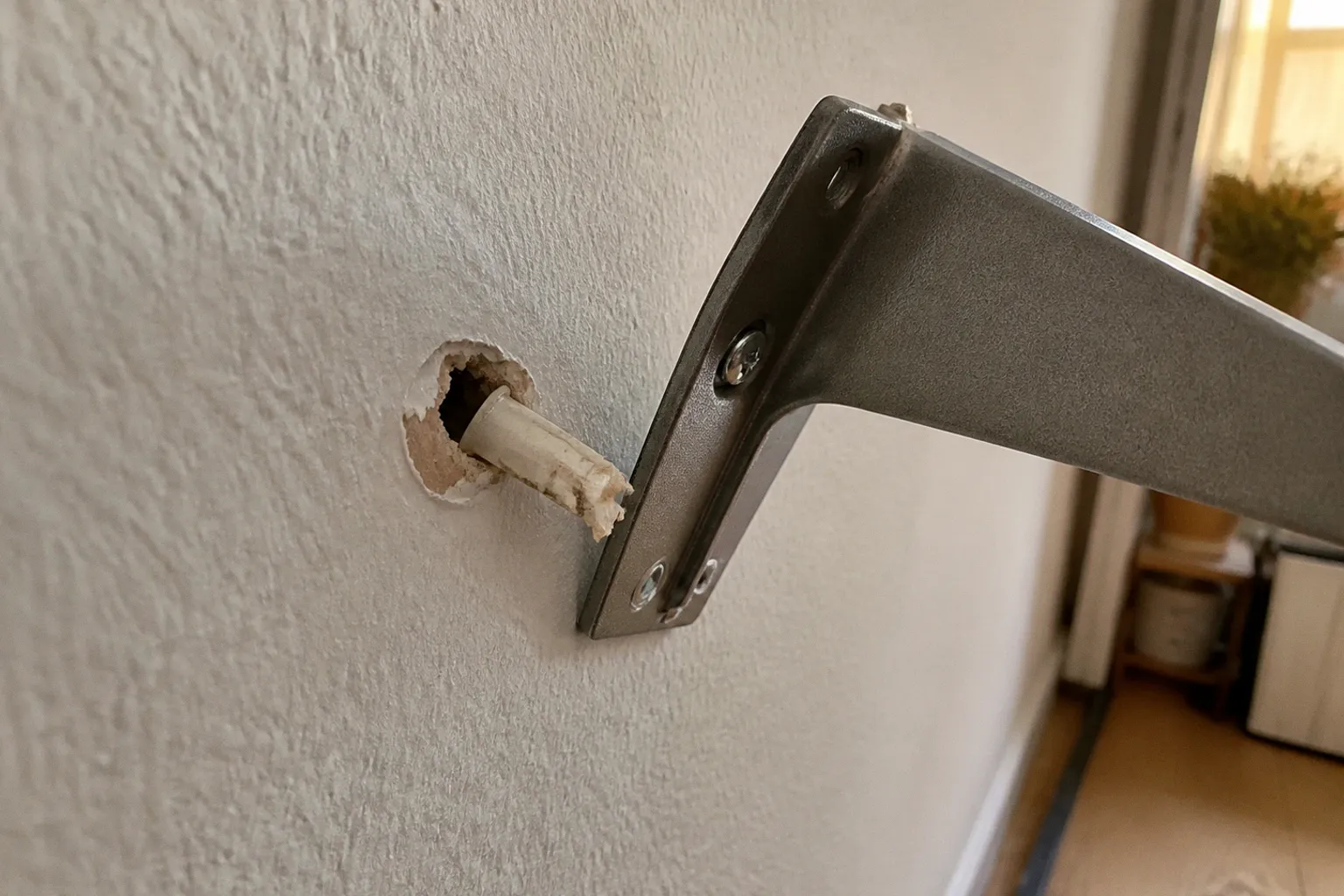
Drywall is a facing material, not a structural substrate. A plastic expansion plug rated for a vertical load can perform poorly when used on a floating shelf with forward leverage.
The practical distinction is between a shelf that rests on a supported frame and one that is suspended from concealed hardware. A garment shelf above a closet rod may carry folded clothing, storage bins, or luggage. The load is not static in the strict sense: items are added near the front edge, removed from the center, and shifted during use. The bracket and anchor system must tolerate this geometry without progressive pullout, local crushing, or shelf sag.
The most reliable installation uses wall studs for at least part of the bracket attachment. Where stud alignment is not available, heavy-duty toggle bolts distribute the load behind the drywall more effectively than standard plastic or self-drilling anchors. Neither solution changes the basic rule: the stated anchor rating is not automatically the safe capacity of a floating shelf assembly.
A floating shelf is a cantilevered structure. Its anchor must resist both downward shear and outward pull. A vertical pullout rating alone is incomplete.
The load problem is leverage, not shelf mass
A shelf bracket transfers load into the wall through two primary actions:
- downward shear at the fasteners;
- outward tension caused by the distance between the load and the wall plane.
If a folded garment stack weighs 30 lbs and its center of gravity sits 12 in from the wall, the bracket experiences a bending moment of approximately 360 lb-in before accounting for the shelf, bracket, uneven loading, or movement during use. The anchor is not only holding 30 lbs downward. It is resisting the tendency of the shelf to rotate away from the wall.
This distinction explains why a small shelf can damage drywall despite a load that appears moderate. The front edge produces more leverage than the rear edge. A storage bin placed at the shelf nose creates a more severe condition than the same bin positioned against the back wall.
The concealed bracket also concentrates force. A floating closet shelf commonly uses steel rods, a welded frame, or a plate with projecting pins inserted into a hollow shelf. The wall connection may be sound while the shelf body deforms around the pins. Standard MDF is vulnerable to local crushing under concentrated support. The material can compress around the hidden rods, allowing the front edge to drop even when the anchors remain in place.
This is a separate failure mode from anchor pullout. Replacing the anchors will not correct a shelf that is crushing internally around the bracket pins.
Why the front edge controls the design
The useful capacity of a floating closet shelf is governed by the worst-loaded position, not the average arrangement of clothing. A shelf carrying evenly distributed folded garments produces a lower bending moment than one carrying a dense box at the front edge.
For a residential closet, the critical variables are:
- shelf projection from the wall;
- distance from the wall to the center of the load;
- bracket spacing;
- fastener spacing within each bracket;
- drywall thickness, commonly 1/2 in or 5/8 in;
- shelf material and local compression strength;
- stud position and stud condition;
- repeated loading and unloading.
A manufacturer’s capacity figure may describe the bracket, the fastener, the substrate, or the complete assembly. These are not interchangeable values. A bracket rated for a certain load in a stud is not automatically rated for that load in 1/2-inch drywall. A toggle bolt rated for a high holding force is not automatically a guarantee that the shelf will remain level.
Drywall anchors are not equivalent
The phrase “drywall anchor” covers several mechanical designs with different failure behavior. Treating them as equivalent is one of the common installation traps.
Basic plastic expansion anchors are the weakest choice for a floating shelf mounted only to drywall. The anchor expands inside or near the gypsum core, but it does not create a large bearing surface behind the panel. Under cantilever loading, the screw pulls the sleeve toward the room. The plastic body can deform, rotate, or withdraw from the gypsum. Adding more plastic anchors does not safely multiply the total capacity in a linear way. The drywall panel may fail between anchors, or the shelf bracket may distribute load unevenly so that one fastener takes most of the force.
Self-drilling drywall anchors are convenient for light accessories. Convenience is not structural capacity. Their threads engage the gypsum locally, and the load path remains concentrated near the face of the wall. They can be acceptable for low-load items with minimal projection. They are a poor default for a floating closet shelf intended to carry dense storage.
Molly bolts use a metal sleeve that expands behind the drywall. Their performance depends on the sleeve design, panel thickness, installation quality, and the direction of force. A basic molly bolt may provide a more substantial bearing arrangement than a plastic plug, but it should not be treated as a universal heavy-load solution for a cantilevered shelf.
Heavy-duty toggle bolts use a larger body behind the drywall to distribute force over a broader area. Depending on bolt size and drywall thickness, published holding-power ratings can range from approximately 70 lbs to 238 lbs. Those figures describe the fastener under specified conditions. They do not define the safe working load of a complete shelf carrying a forward load through a concealed bracket.
The distinction between rated holding power and practical shelf capacity is essential. Fastener ratings may be derived from pull tests or controlled substrate conditions. A shelf introduces bending, eccentric loading, bracket deformation, local damage, and load concentration. The usable design value must be reduced to account for the actual geometry.
Comparative behavior of common anchor types
| Anchor type | Load distribution behind drywall | Behavior under cantilever force | Appropriate role in a floating closet shelf |
|---|---|---|---|
| Plastic expansion anchor | Small and localized | High risk of sleeve pullout or gypsum failure | Not a structural choice for a loaded floating shelf |
| Self-drilling drywall anchor | Local thread engagement in gypsum | Can loosen or tear out under forward leverage | Light accessories with low projection only |
| Molly bolt | Metal sleeve bears behind the panel | Better than plastic, but dependent on installation and panel condition | Moderate loads where stud access is unavailable, subject to bracket design |
| Heavy-duty toggle bolt | Broad bearing surface behind drywall | Better resistance to pullout and load spreading | Preferred drywall-only fastener when correctly sized |
| Lag screw or wood screw into stud | Direct engagement with structural wood | Highest stability when properly installed | Gold-standard connection for the primary bracket points |
No anchor type eliminates the need to inspect the wall. Damaged gypsum, previous holes, loose panels, and stud edges reduce effective capacity. A toggle installed too close to a damaged opening does not recover the original strength of the wallboard.
The first trap: missing the stud
A floating closet shelf bracket should be laid out against the actual framing, not against an assumed stud pattern. Residential studs are commonly spaced on a regular module, but closet construction includes corners, door openings, blocking, plumbing chases, and irregular framing. The visible wall surface does not identify the load-bearing path.
Use a stud finder as an initial location tool, then confirm the position by a small probe hole or another non-destructive method. The goal is not merely to locate one stud. The bracket must be evaluated as a complete attachment pattern. A long shelf with only one fastener in a stud and several fasteners in drywall may still rotate if the stud connection is positioned near one end.
The strongest layout typically places multiple primary fasteners into studs along the bracket. Wood screws or lag screws must penetrate sound structural wood, not only the drywall surface or a thin trim component. The screw length must account for the drywall thickness, bracket material, any spacer, and the required embedment in the stud. Longer is not automatically better if the screw contacts wiring or plumbing behind the wall.
A stud connection also has limits. The stud may be narrow relative to the bracket plate. The screw may be installed near the stud edge, increasing the chance of splitting in some framing conditions. A bracket can be rigid while the shelf body remains weak. Structural stability is determined by the weakest link in the load path.
When the bracket does not align with the framing
If the shelf position cannot be moved to align with studs, do not compensate by installing a larger number of small plastic anchors. That changes the appearance of the attachment pattern without addressing the failure mechanism.
The better options are:
1. Use heavy-duty toggle bolts sized for the drywall thickness and the bracket holes. The toggle must fully open behind the panel and seat against the back face rather than remain trapped in the hole.
2. Add structural blocking behind the drywall where the wall is open during construction or renovation. Blocking creates a direct wood connection for the bracket.
3. Install a wall-mounted rail or backer designed to spread the bracket load across several attachment points. The rail still requires structural fastening, but it can improve load distribution.
4. Reduce the shelf projection or intended load. Leverage decreases as the load moves closer to the wall.
5. Select a supported closet system instead of a fully floating shelf where the storage requirement exceeds the wall connection capacity.
The fourth and fifth options are engineering changes, not cosmetic compromises. Reducing the cantilever moment is often more effective than changing the shelf finish or adding another anchor.
The second trap: trusting the anchor rating without reducing it
A label stating “50 lbs” does not mean that a shelf mounted with two anchors can safely carry 100 lbs. The rating may represent a maximum test value for one fastener under a particular pull direction. It may not include a safety factor suitable for long-term residential use. It may assume an intact panel with no eccentric load.
For floating closet shelves, the actual design load should include:
- the shelf itself;
- all clothing and containers;
- the bracket assembly;
- uneven placement near the front edge;
- accidental downward force during loading;
- repeated cycles of loading and unloading;
- deterioration of the gypsum around the fastener;
- deformation of MDF or another low-density shelf core.
A practical capacity calculation therefore starts below the published maximum. The reduction is not a universal percentage because the geometry and materials differ. A 10-in-deep shelf and an 18-in-deep shelf do not impose the same moment with the same stored mass. A bracket with a continuous wall plate does not distribute force like two short concealed rods. A 5/8-in drywall panel does not behave identically to a damaged 1/2-in panel.
The correct interpretation is conservative: the anchor rating is a component limit, not an assembly approval.
The number printed on the anchor package is not the shelf capacity. The shelf capacity is limited by the weakest connection, the most distant load, and the least rigid material.
Load categories for residential closet use
The word “clothing” covers a wide range of densities. A shelf carrying shirts is not equivalent to a shelf carrying shoes, folded denim, books, or storage bins. Dense items create greater load concentration and increase the probability that the front edge will be loaded first.
For planning purposes, separate the intended contents into three groups:
- Low-density garments: shirts, light knitwear, and similar folded clothing. These impose a lower mass per unit length but may still cause sag if the shelf spans too far between supports.
- Medium-density storage: folded denim, sweaters, handbags, and small containers. These create higher distributed loads and more local concentration.
- High-density items: shoes, books, tools, luggage, or packed bins. These should not be assigned the same capacity assumption as garments.
A shelf designed for garment storage should not be upgraded informally after installation. If the use changes from clothing to boxes, the load path changes with it.
The third trap: ignoring the shelf material
The wall anchor receives most of the attention because it is visible during installation. The concealed shelf body often controls long-term performance.
Standard MDF has adequate stiffness for many interior applications, but its low-density fiber structure is vulnerable to localized crushing around narrow bracket pins. Under sustained load, the material can deform at the contact points. The bracket may remain fixed to the wall while the shelf rotates downward at the front edge. This is one explanation for a shelf that appears securely anchored but develops progressive sag.
The bracket interface must therefore be inspected as a bearing problem. A narrow steel rod inserted into MDF generates high contact stress over a small area. A larger internal frame, a hardwood reinforcement block, a metal sleeve, or a denser shelf core can distribute that pressure. The correct reinforcement depends on the shelf construction and the bracket manufacturer’s installation requirements.
The outer finish does not provide structural reinforcement. Veneer, laminate, paint, and decorative edge bands change the surface condition. They do not materially solve crushing at a concealed support point unless bonded to a structural layer designed for that purpose.
Shelf span also matters. A long shelf can deflect between brackets even when the wall attachment is stable. Deflection may remain within acceptable limits at first and increase as the material creeps under sustained load. The visible symptom is a low center or a front edge that no longer remains parallel to the floor.
Signs of a material or bracket-interface failure
A shelf should be unloaded and inspected if any of the following conditions appear:
- the front edge is lower than the wall edge;
- the shelf rocks when pressure is applied near the front;
- the bracket pins have enlarged or loosened their holes;
- the MDF around a pin is crushed, cracked, or powdered;
- the wall plate remains flat but the shelf body has rotated;
- a fastener head is pulling through the bracket;
- gypsum around an anchor is fractured or pushed outward;
- the shelf position changes after repeated loading.
Do not correct visible sag by tightening the wall screws alone. If the shelf body has deformed, tightening may increase local damage without restoring stiffness.
Installation sequence that avoids predictable failures
A reliable installation is controlled by the load path from the shelf surface to the wall structure. The sequence should expose uncertainty before the bracket is permanently fixed.
1. Define the actual load
Estimate the mass of the shelf and its intended contents. Include the heaviest realistic arrangement, not the current empty condition. Identify whether dense objects can be placed at the front edge. If the shelf will carry bins or luggage, design for those contents rather than labeling the space as garment storage.
2. Measure the geometry
Record shelf depth, bracket projection, bracket spacing, and the distance from the wall to the expected center of mass. A deeper shelf increases the bending moment even when the total mass remains unchanged. A narrow shelf with a rear-loaded arrangement is structurally less demanding than a deep shelf loaded at the nose.
3. Map the wall
Locate studs and inspect the drywall thickness. Residential panels are commonly 1/2 in or 5/8 in. Confirm that the selected toggle bolt is compatible with the actual panel thickness and the bracket hole diameter. Check for electrical and plumbing services before drilling.
4. Select the primary connection
Use lag screws or wood screws into studs wherever the bracket layout permits. Use heavy-duty toggle bolts for necessary drywall-only points. Do not treat standard plastic expansion anchors as equivalent substitutes.
5. Keep the bracket level without enlarging damaged holes
A bracket must be installed against a sound wall surface. If a hole is misplaced or enlarged, move the fastener location or repair the substrate. Do not force a larger anchor into a damaged opening and assume the increased diameter restores capacity.
6. Tighten to seat the hardware, not crush the wall
Over-tightening a toggle bolt can compress or fracture the gypsum around the bracket. The fastener should hold the bracket firmly against the wall without deforming the panel. A distorted wall surface is evidence of excessive installation force, not improved structural integrity.
7. Inspect the shelf-to-bracket interface
Before loading the shelf, confirm that the hidden rods or frame are fully engaged. Check for excessive clearance around the pins. If the shelf body is MDF and the bracket contact area is small, assess whether internal reinforcement is required.
8. Apply load incrementally
Load the rear portion first, then add contents toward the front while observing the shelf, bracket, and wall. Stop if the shelf rotates, the wall plate separates, the drywall begins to deform, or the shelf body shows local crushing. A controlled incremental load test is more informative than placing the full intended load on the shelf at once.
The fourth trap: treating more anchors as a substitute for a better load path
Anchor quantity has diminishing value when the substrate or bracket geometry is weak. Three anchors located in a damaged strip of drywall do not create the same connection as one properly placed structural screw into a stud. Multiple anchors may also share the load unevenly. The bracket can rotate slightly, shifting force to the fastener nearest the high-moment region.
The wall plate should be rigid enough to distribute force across its attachment points. A thin plate that bends under load can convert a broad connection into a sequence of concentrated pulls. Concealed hardware with short wall plates is particularly sensitive to this condition.
The shelf length should also influence bracket spacing. A long storage surface requires more than a stronger anchor at each end. Intermediate support reduces bending in the shelf and limits the load carried by the end connections. If the design permits only two concealed supports, the shelf material, depth, and intended mass must remain within the limits of that arrangement.
For modular closet systems, a vertical standard or continuous rail can provide a more predictable load path than isolated floating brackets. Such systems are not floating in the strict structural sense, but they are often the correct solution when the storage requirement includes dense contents or frequent reconfiguration.
Repairing sagging floating closet shelves
A sagging floating shelf has several possible causes, and the repair depends on which component has yielded.
If the wall anchor has pulled out, remove the load and inspect the gypsum. A new anchor installed in the same damaged hole is not a repair. Move the connection to sound material, locate a stud, install a suitable toggle in an undamaged area, or open the wall and add blocking.
If the bracket has rotated but the wall remains intact, inspect the fasteners and the bracket plate. A loose screw, a bent plate, or inadequate bracket stiffness may be responsible. Replacing the fastener without correcting the bracket geometry will not solve the rotation.
If the shelf has crushed around the hidden pins, the shelf body must be reinforced or replaced. Do not rely on adhesive alone unless the complete bracket system is designed for adhesive bonding. The repair must restore the bearing area and prevent renewed local compression.
If the center of the shelf deflects between supports, add intermediate support or reduce the span and load. Tightening the end connections does not increase the bending stiffness of the shelf span.
A useful diagnostic sequence is:
1. Remove all contents.
2. Check whether the wall plate is still tight against the wall.
3. Inspect the drywall around every anchor for cracking, bulging, or pullout.
4. Check the shelf body around each concealed support for crushing or enlarged holes.
5. Measure the shelf level at the wall and front edge.
6. Determine whether the deformation is local at the bracket or distributed across the span.
7. Repair the failed component before reinstalling any load.
The original failure should be treated as evidence. It identifies the actual weak point in the system.
Material and environment still matter in a bedroom closet
A residential closet is usually a dry interior environment, but moisture exposure can occur near exterior walls, laundry areas, bathrooms, garages, and poorly ventilated dressing spaces. Humidity affects gypsum, wood-based shelf cores, fastener corrosion, and adhesive performance.
For steel components, zinc-plated hardware provides a basic corrosion-resistant surface. It is not equivalent to stainless steel and should not be treated as a solution for persistent moisture. Epoxy-polyester coatings can protect a bracket surface, but coating integrity depends on preparation, edge coverage, and damage during installation. A scratched coating at a fastener hole can become a local corrosion point in a damp environment.
Wood-based shelves also respond to moisture. MDF can lose stiffness or swell at exposed edges. A shelf that fits tightly when dry may bind against the bracket or wall after moisture uptake. Edge sealing reduces exposure but does not convert MDF into a structural panel designed for wet conditions.
The environmental rule is simple: use hardware and shelf materials consistent with the location. Do not specify ordinary zinc-plated steel and unsealed MDF for a space with recurring condensation, then compensate with additional anchors.
A decision rule for floating closet shelves
Floating closet shelf drywall anchors are appropriate only when the complete connection has been evaluated as a cantilevered assembly. The decision should follow the load path rather than the appearance of the hardware.
Use a stud-mounted bracket when:
- the shelf carries dense or irregular loads;
- the projection is substantial;
- the shelf will be loaded near the front edge;
- the bracket has multiple attachment points aligned with framing;
- the contents may change over time;
- long-term stability is more important than concealed installation.
Use heavy-duty toggle bolts when:
- stud alignment is impossible or incomplete;
- the drywall is sound and its thickness is known;
- the bracket manufacturer permits drywall installation;
- the load is controlled and distributed;
- the shelf depth and bracket projection remain moderate;
- the system includes enough bracket support for the shelf span.
Do not use basic plastic expansion anchors as the primary attachment for a loaded floating shelf. Do not assume that doubling the number of anchors doubles the safe capacity. Do not assign a fastener’s maximum pull rating to the entire shelf. Do not ignore the shelf core, concealed pin diameter, or distance to the load center.
The definitive recommendation is rule-based:
For any floating closet shelf expected to carry more than light garment storage, secure the primary bracket points into studs or structural blocking. If that is impossible, use correctly sized heavy-duty toggle bolts in sound drywall, reduce the shelf projection and load, and treat the fastener rating as an upper component limit rather than a working shelf capacity.
A floating shelf is not a decorative panel with hidden screws. It is a cantilevered structure operating through gypsum, steel, fasteners, and a shelf core that may deform under concentrated stress. Design the connection for the load at the front edge, inspect the weakest material, and reject any installation that depends on plastic expansion plugs to resist a sustained outward pull.