Tension garment racks: wall damage and collapse risks
A tension garment rack installs without screws, anchors, or brackets. The entire load-bearing system rests on internal spring pressure pushing outward against two opposing walls.
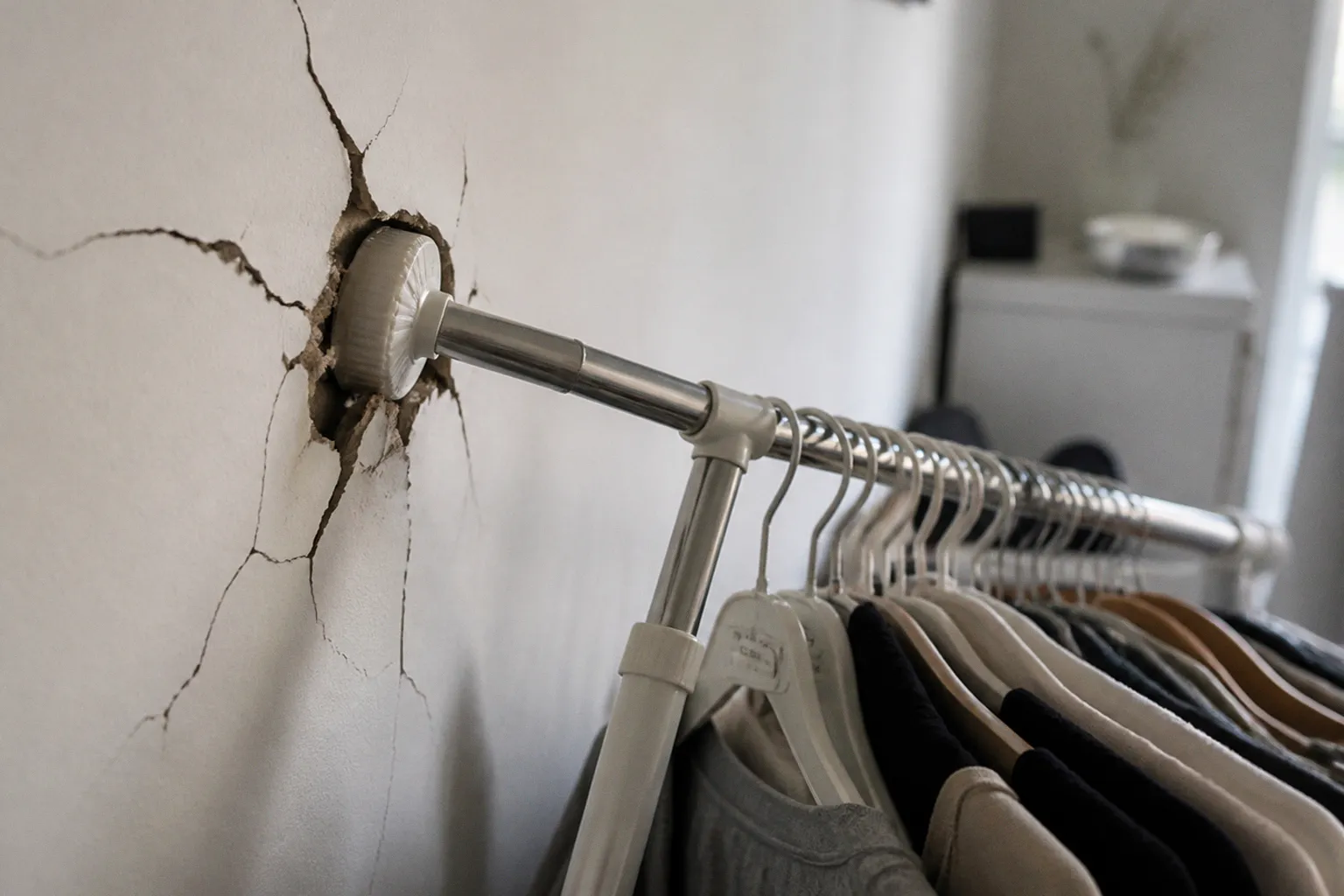
When the spring force exceeds the static friction at each contact point, the unit stays put. When it does not, the rack drops, often without warning, and in most residential cases the wall loses the argument before the rack does. Drywall is the weakest link in this equation. It is a compressed gypsum core wrapped in paper facing, with a crush strength measured in single-digit pounds per square inch. A tension rod transfers its entire spring load through two circular contact pads into this material. The result is predictable: indentation, crumbling, cracking, and in documented cases, full punching through the surface.
The mechanism misleads consumers because it looks engineered. Telescoping tubes, threaded end caps, rubber tips, often marketed as "no damage" solutions. The marketing premise is that the rack grips the wall without penetrating it. The structural reality is that the rack grips the wall by pressing hard enough to deform it. On plaster, on cement board, on a brick or concrete-filled partition, the equation changes. On hollow interior drywall — the standard in most North American residential construction since the 1970s — the equation is hostile.
A tension rod holds nothing. It relies on the wall to hold it. Drywall is not a structural material.
The Mechanics of Friction-Based Storage and Drywall Vulnerability
The physics of a tension rod are simple. A spring inside the inner tube pushes the outer tube outward. The end caps contact the wall surface. The spring force, distributed across the cap surface area, generates a normal force. The friction coefficient between the cap material and the wall surface multiplied by the normal force equals the maximum static load the rod can hold before sliding. This is the shelf's entire load-bearing model. There is no mechanical interlock, no fastener, no structural connection.
The problem is friction. Drywall paper facing has a friction coefficient against rubber of roughly 0.4 to 0.6 when dry. Against smooth plastic, it drops to 0.2 or lower. Against the painted surfaces common in residential interiors — latex or semi-gloss — the coefficient further degrades. Humidity, wall texture, and dust accumulation between contact surfaces all reduce the effective grip. The user sees a rod that does not move. The user does not see the microscopic slip cycles occurring each time a garment is added or removed.
When a tension rod is installed without backing plates in a plasterboard-only wall, the system depends entirely on the compressive strength of the gypsum core. Standard 1/2-inch residential drywall has a compressive strength of approximately 40 to 60 psi. A 1.5-inch diameter end cap loaded with 40 lbs of spring force generates roughly 28 psi of contact pressure. This sits within the material's tolerance — until the user tightens the rod further to compensate for slight slippage. At 80 lbs of spring force, the contact pressure climbs to 56 psi, approaching the drywall's structural ceiling. Beyond that, the gypsum core begins to fracture internally. The surface still looks intact. The damage is already structural.
Why Over-Tightening Leads to Structural Surface Failure
The instinct of any competent user is torque. The rack slips. The user twists the rod tighter. The slip stops. The user assumes the problem is solved. What actually happened is that the spring force was increased beyond the wall's ability to absorb it. The new equilibrium is held by damage rather than friction.
Over-tightening a tension rod against hollow interior drywall to prevent slipping can crack or puncture the drywall material. This is not a theoretical risk. The failure mode follows a consistent pattern: the paper facing on the contact side dimples, the gypsum core crushes under the cap, and a micro-fracture network propagates radially. If the rod is tightened enough to handle a heavy load of winter coats, the drywall will fail before the rack does. The spring is a stored energy device. It will continue to push until something gives. Given the choice between a steel tube and a gypsum panel, the panel loses.
The most common failure signature is a circular depression in the wall where the cap was seated, surrounded by a spider-web of hairline cracks. In severe cases, the cap punches entirely through the drywall, leaving a clean hole and depositing the rod — still under spring tension — on the floor. Repair requires patching, sanding, and repainting. The wall is never as strong as it was before because the gypsum core is now a compressed powder in that zone.
Tightening a tension rod does not increase safety. It increases the force the wall must absorb.
Weight Thresholds and the Physics of Sudden Rack Collapse
A common reference figure for tension rod applications in closet organizers is 12 lbs per linear foot. This is not a marketing number. It is a structural limitation derived from the friction model and the typical drywall installation. A 4-foot rod rated at 12 lbs per linear foot is engineered to hold 48 lbs of distributed load. Add the dynamic loading factor — the fact that a user pulling a coat off the rack briefly multiplies the effective load by 1.5 to 2.0 times — and the real-world ceiling drops to 24 lbs of static weight for safe use.
Tension rods can collapse when clothing weight exceeds the friction threshold or when internal spring tension degrades over time. Spring degradation is a metallurgical problem. The constant cyclic loading of a compression spring — each installation, each adjustment, each removal — causes work hardening, then micro-cracking, then permanent deformation. A spring that delivered 50 lbs of force when new may deliver 35 lbs after two years of use. The user does not notice the spring weakening. The user notices the rack falling.
The collapse is sudden. There is no warning creak, no gradual sag. The spring force drops below the friction threshold, the static friction transitions to kinetic friction, and the entire rack — tubes, garments, and all — slides down the wall in under a second. For a 6-foot floor-to-ceiling rack holding 30 lbs of clothing, the falling assembly strikes the floor with roughly the same impact energy as a 30-pound object dropped from mid-rod height. The garments are not the casualty. The drywall anchors, the floor finish, and any feet or shins in the landing zone are.
| Parameter | Specified Limit | Real-World Operating Limit |
|---|---|---|
| Static load (12 lbs/linear ft) | 48 lbs on 4-ft rod | 24 lbs after dynamic factor |
| Spring force at installation | 40–60 lbs | 35–50 lbs after 2 years |
| Drywall contact pressure | 28 psi at 40 lbs force | 56 psi at 80 lbs force |
| Compressive strength of 1/2″ drywall | 40–60 psi | 30–45 psi when pre-damaged |
The Hidden Risks of Plastic End Caps on Smooth Surfaces
Plastic end caps on tension rods offer low compressibility, causing them to lose grip and slip down smooth or slick surfaces under dynamic load. This is the most common failure mechanism in the field. The user installs the rod against a painted wall. The paint creates a low-friction interface. The plastic cap cannot deform to match the wall micro-texture. The contact area is reduced to whatever high points the cap actually touches. The effective friction coefficient drops, the spring force is unchanged, and the rack slides.
Rubber-capped rods improve the situation. Rubber has a higher friction coefficient against most painted surfaces and can deform to increase the real contact area. But rubber degrades. UV exposure, ozone, and thermal cycling all cause the elastomer to harden and lose its grip. A rubber cap that worked when new will fail within three to five years in a heated interior. The failure is silent. The drop is not.
Metal end caps — typically zinc-plated steel — solve the deformation problem but reintroduce the drywall damage problem. A hard cap on a soft wall concentrates the entire spring force on a small area. The math is unfavorable. The user trades grip for damage. The wall does not care which end of the trade it receives.
The end cap determines the failure mode. Plastic slips. Rubber hardens. Metal punches through.
Mitigating Structural Failure: Load Management and Reinforcement
For tension garment racks in residential closet systems, structural failure is not a matter of if but when. The wall material is the limiting factor, not the rack. Mitigation strategies exist, and they fall into three categories: load reduction, wall reinforcement, and system replacement.
Load reduction. The most direct control. Limit the rod to light garments — shirts, blouses, thin jackets. Calculate the weight before hanging. A typical winter coat weighs 4 to 6 lbs. Six coats on a 4-foot rod consume the entire 12 lbs/linear ft specification before any allowance for dynamic loading. Denser items — wool overcoats, leather jackets, layered parkas — should not be used on tension installations. Treat the 12 lbs/linear ft figure as a ceiling, not a target.
Wall reinforcement. Where the installation must remain non-penetrating, the only viable reinforcement is a surface-mounted backing plate — a flat plate of plywood, steel, or composite panel that distributes the spring force across a wider area of the drywall. A 6-inch by 6-inch plate of 1/2-inch plywood under each cap reduces the contact pressure by a factor of four relative to a 1.5-inch cap. The wall now absorbs the spring force without exceeding its compressive strength. The downside is that the plate is visible and the installation is no longer "no damage" in the strict sense of the term.
System replacement. For permanent closet storage, a mechanically anchored rod is the only specification that eliminates the tension rod failure mode. A steel rod hung on flanges bolted into wall studs or blocking carries the load through the stud framing, not through the drywall. The drywall becomes a cosmetic surface, not a structural one. The rod can hold 30 to 40 lbs per linear foot indefinitely. It requires drilling, anchors, and a different installation procedure. It also eliminates the collapse risk entirely.
Tension rods are rated for friction. Drywall is rated for paint. The two ratings do not meet.
The structural engineer in this situation does not recommend a tension garment rack for wardrobe storage above 24 lbs of static load. The friction model cannot be trusted for heavier applications because the wall material is the weak element in the system, and the wall material cannot be upgraded without penetration. For light-duty, short-term, or temporary installations — a single curtain rod, a lightweight closet liner, a display rack for scarves — tension hardware remains acceptable. For any installation supporting more than one season of dense clothing, the mechanical anchor is the only specification that survives the load test.