Modular closet systems: wood vs metal options
Walk into any master closet that was spec'd without a plan and you'll see it immediately — that awkward dead zone behind the door where three garments hang in shadow, the top shelf nobody touches…
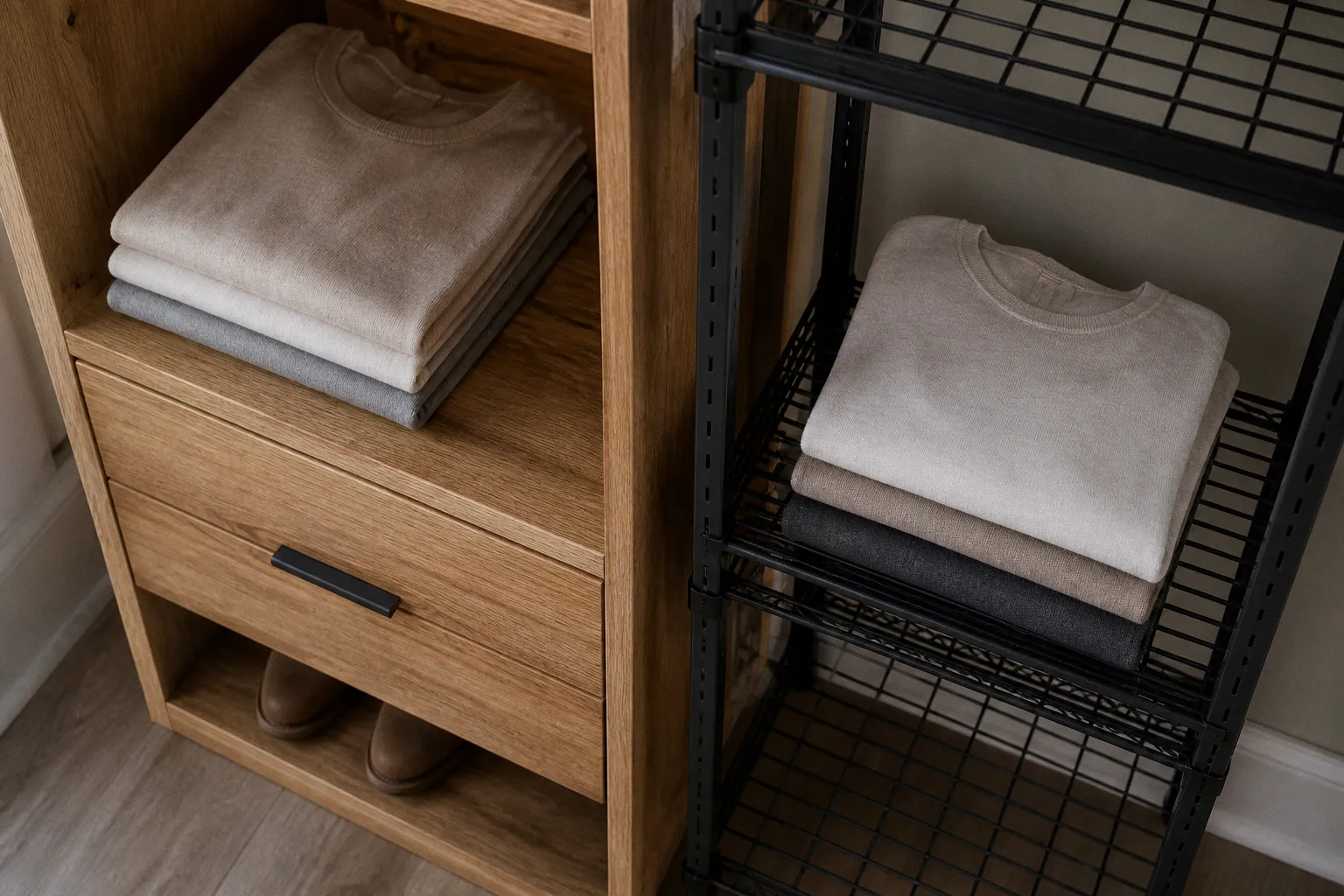
Walk into any master closet that was spec'd without a plan and you'll see it immediately — that awkward dead zone behind the door where three garments hang in shadow, the top shelf nobody touches because the sightline is broken, the wire rack bowing under the weight of a winter coat collection. A closet isn't just storage; it's a small retail environment where you are simultaneously the buyer, the merchandiser, and the customer, and the material you choose for the fixtures decides how every one of those roles performs. When we sit down with clients weighing wood vs metal modular closet systems, the conversation almost never starts with "which looks nicer." It starts with traffic flow, dwell time, and how the space will hold up under the kind of daily, repeated use that accumulates fast. That framing changes everything about the comparison.
Structural Integrity and Impact Resistance: Steel vs. Wood Performance
Here's the thing about a closet floor plan that mirrors a store floor — every shelf, bracket, and hanging rod is a display surface, and if the fixture fails, the merchandise (your clothes) fails with it. In our merchandising audits we treat structural load like a category manager treats planogram compliance: non-negotiable. Cold-pressed carbon steel modular systems are engineered to take a beating, with impact thresholds that sit well above what most household closets will ever throw at them. That matters because closets aren't quiet — vacuum cleaners bump into lower cabinets, kids' backpacks get tossed on shelves, and the occasional overstuffed bag gets shoved rather than placed.
Wooden wardrobes, by contrast, start showing damage at significantly lower impact thresholds. That's not a flaw in craftsmanship; it's the physics of a material that compresses and splinters under concentrated stress rather than flexing the way steel does. For a walk-in where you might be leaning into a shelf to reach a high rod, or pulling a heavy drawer aggressively, that difference in impact resistance is the difference between a system that ages gracefully and one that shows every bump and ding within a few years. If you're building out a primary closet for a household that uses it twice a day, every day, the math quietly favors metal under stress conditions even when the visual weight of the room leans warm and traditional.
The practical takeaway is straightforward: steel absorbs the accidental abuse that wood logs as permanent damage. A scratched powder-coated shelf still holds weight; a dented or splintered wooden shelf starts a slow decline that compounds with every subsequent knock. Over a decade of real use, that gap widens into a visible difference in how the whole closet reads.
If your closet sees daily traffic like a sales floor sees footfall, the impact rating isn't a spec sheet detail — it's your shrink rate.
Humidity Tolerance and Environmental Longevity in Modern Closets
Now let's talk about the environment, because this is where retail fixture planning and closet planning diverge in the worst possible way. A store floor has HVAC. A closet, especially one adjacent to a bathroom or in a coastal climate, often does not. We've watched beautiful wooden installations swell, warp, and develop finish cracks after a single humid season, and the research backs up what we see in the field: sustained exposure to elevated humidity is enough to cause structural damage to wooden cabinets. That's not a worst-case scenario — that's a regular Tuesday in a ground-floor bedroom in Houston, Miami, or anywhere along the Gulf Coast where moisture hangs in the air for months at a time.
Steel modular systems, particularly those with epoxy or powder coating, hold their strength even when humidity climbs well into the range that punishes wood. The coating does the heavy lifting on corrosion resistance; the steel underneath provides the structural backbone. For a coastal homeowner or anyone running a closet in a converted basement, this single environmental factor can override every aesthetic argument in favor of wood. And the gap isn't subtle — we're talking about a significant difference in humidity tolerance that, in practice, determines whether your master closet holds its finish over time or starts showing wear much sooner than expected.
The nuance worth noting: not all wood fails equally. Marine-grade plywood and properly sealed hardwoods handle moisture far better than particleboard or MDF, which act like sponges the moment the seal breaks. If you're committed to wood in a humid climate, the species and the finish system matter as much as the material category. But even the best wood installation demands a climate management plan — a dehumidifier, a vent, or at minimum a door that stays open long enough to let the air equalize. Steel doesn't ask that of you.
Aesthetic Versatility: From Melamine Finishes to Solid Wood Luxury
Let's be honest — this is the section most homeowners actually came here for. Material performance matters, but you also have to live with the look every morning when you walk in to get dressed. The good news is that the wood vs metal modular closet systems comparison is no longer an either-or decision, because melamine (thermally fused laminate over particleboard) has closed the visual gap dramatically. Melamine is created by bonding paper and resin particles to particleboard under extreme heat, which produces a water-resistant finish that prevents mold and mildew while delivering a wood-grain appearance that, at a glance, reads as genuine timber to most visitors.
But there's a hierarchy here, and we walk clients through it the same way we'd walk a category buyer through a shelf set. At the top: solid wood — warm, quiet under hand, with grain variation that reads as built-in luxury. Solid wood wardrobes can last decades in dry conditions with proper maintenance, which is why they're still the default for high-end master closets in climate-controlled new builds. In the middle: melamine and engineered wood products that deliver most of the wood aesthetic at a fraction of the installation cost, with better humidity performance than raw wood. At the base: open wire steel shelving that prioritizes airflow and visibility over warmth, and earns its place in utility closets, pantries, and high-traffic secondary wardrobes.
| Material tier | Look & feel | Best-fit closet type |
|---|---|---|
| Solid wood / plywood | Warm, built-in, custom-luxury | Climate-controlled primary closets, traditional bedrooms |
| Melamine / MDF laminate | Wood-grain visual, water-resistant surface | Family homes, humid climates, mid-range renovations |
| Coated steel / wire | Industrial-clean, high airflow | Utility rooms, coastal homes, basement conversions |
| Aluminum framing | Lightweight modern, minimalist | Small footprints, rental-friendly installs |
The honest caveat: solid wood still wins for emotional response. If you're building a forever home and your closet is part of the design language, nothing photographs like a walnut or white oak run. The grain, the depth of finish, the way light moves across a hand-rubbed surface — that's a sensory experience melamine approximates but doesn't replicate. Just pair it with a dehumidifier and respect the climate ceiling. And if budget or environment pushes you toward melamine, know that the best thermally fused laminates have gotten genuinely good: textured finishes that mimic hand-scraped oak, matte surfaces that don't scream "laminate," and edge-banding that disappears at conversational distance. The gap between what melamine was ten years ago and what it is now is one of the quiet success stories in closet manufacturing.
Airflow and Maintenance: Why Wire Systems Outperform Enclosed Cabinets
Here's where the retail lens gets interesting, because the principle is identical to what we do with open-back gondola shelving versus enclosed cases on a sales floor. Air circulation is a merchandising tool disguised as a maintenance issue. Open wire steel shelving features an epoxy or powder coating to resist chipping, rusting, and chemical corrosion, but the real win is the airflow — increased circulation reduces stale odor buildup, which matters more in a closet than most people admit. Sweaters, workout gear, and down jackets trap moisture against any surface; on an enclosed wood shelf that moisture sits, and over months you get that musty smell that no amount of lavender sachet fixes.
Wire shelves let the air move through and around garments the way a well-ventilated produce section keeps vegetables from wilting. We spec wire systems into any closet that holds athletic wear, seasonal storage, or anything that goes in slightly damp. The other maintenance advantage is visibility: on wire shelving, you can see every garment at a glance, which means the bottom of the pile doesn't become a graveyard of forgotten pieces. Your closet turnover — the rate at which you actually wear what's in there — goes up, and that's a metric we track for clients the same way we'd track inventory sell-through.
Cleaning is another quiet win. Wire shelves can be wiped down in seconds; enclosed wooden shelves collect dust on flat surfaces and demand more attention to stay presentable. In a closet that doubles as a linen store or holds off-season items in open bins, the difference in maintenance time adds up over a year. Nobody wants to spend Saturday morning deep-cleaning a closet, and wire systems make sure you don't have to.
If you want the airflow benefit with the warm aesthetic, the hybrid approach is worth considering: a melamine-faced perimeter with wire inserts in the high-moisture zones, or an aluminum frame with wood-look panels on the visible faces. You don't have to choose one material for the whole closet anymore. The best closet designs we've spec'd in the last few years mix materials deliberately — wood where you see it, steel where you stress it, wire where you need air — and the result performs better than any single-material system at a comparable budget.
Cost-to-Lifespan Analysis: Investing in Long-Term Storage Solutions
Let's talk numbers, because at the end of the day every closet build is a line item that has to justify itself against the mortgage or the renovation budget. The basic wire shelving unit runs roughly $20 to $50 per unit, and a full closet's worth of coated steel components typically lands at a fraction of the cost of a comparable solid wood or custom installation, which generally starts around $100 to $200+ per unit and climbs quickly with finishes, soft-close hardware, and custom millwork.
But cost-per-unit is the wrong frame. What we walk clients through is cost-per-year-of-use, weighted for environment. Solid wood in a dry climate at a long expected lifespan gives you a lower annual cost than a metal system that has to be replaced sooner in a humid environment. Flip that math in a coastal or basement install and the numbers move hard toward metal. Here's the framework we use:
- Climate-controlled primary closet, long-term hold: Solid wood or high-grade plywood wins on annual cost once you cross the long-term ownership threshold, and the aesthetic return is permanent.
- Humid climate, high daily use, family household: Coated steel or melamine-over-steel frames typically deliver the best lifespan-per-dollar because you avoid the wood failure curve entirely.
- Secondary closet, utility zone, rental property: Wire shelving is almost always the right call — low cost, easy to reconfigure, and the airflow advantage is a free upgrade.
- Hybrid specification: Use melamine for the visible vertical surfaces (where the look matters) and steel framing for the structural horizontals (where the load matters). Best of both, modest cost premium.
The hidden cost most people miss is reconfiguration. Life changes — kids arrive, a home office replaces a guest room, downsizing forces a rethink. Modular steel systems can be reconfigured in an afternoon with basic tools. Tearing out custom millwork to adapt a wood closet to a new layout is a demolition project that often costs more than the original install. If you're not certain the closet layout will serve you for fifteen-plus years, the reconfigurability of metal is a financial hedge worth taking seriously.
Cost-per-year is the only number that survives contact with reality — sticker price is just the opening offer.
The Layout Checklist: Spec'ing the Right Material for Your Space
Before we close out a closet consultation, we run every project through a short list that ties material choice back to how the space will actually perform. If you're standing in an empty closet right now with a tape measure and a decision to make, walk through these the way you'd walk a store floor before opening:
- Climate check: Measure or estimate humidity in the room across at least one full season. Sustained elevated levels? Lean metal or melamine. Stable and dry? Solid wood is back on the table.
- Traffic check: How many times a day does this closet get opened? Twice or more, with heavy garments moving in and out? Lean toward steel framing for the load-bearing pieces.
- Garment mix: Lots of athletic wear, damp items, or seasonal storage? Wire inserts in the high-moisture zones will pay back in odor control within months.
- Aesthetic priority: If the closet is part of a photographed primary suite and the look matters as much as the function, plan a hybrid — wood-look verticals, steel structure behind them.
- Tenure check: Are you in this home five years or twenty-five? The longer the horizon, the more solid wood or premium melamine justifies the upfront spend.
- Reconfigurability check: If your life stage is likely to change — kids, downsizing, home office conversion — modular steel frames reconfigure faster and cheaper than tearing out millwork.
The bottom line from the floor: there's no universal winner in the wood vs metal modular closet systems matchup, but there is a clear winner for every specific closet, and it almost always comes down to climate, traffic, and how long you plan to live with the result. Spec the material to the room, not to the showroom photo, and your closet will perform like a well-merchandised floor for years to come.