How Mother’s Beverly Hills Flagship Redefines Premium Denim Retail Through Experiential Design
Mother just opened its first-ever flagship in Beverly Hills — a 3,850-square-foot statement on why premium denim needs real estate, not just a checkout page.
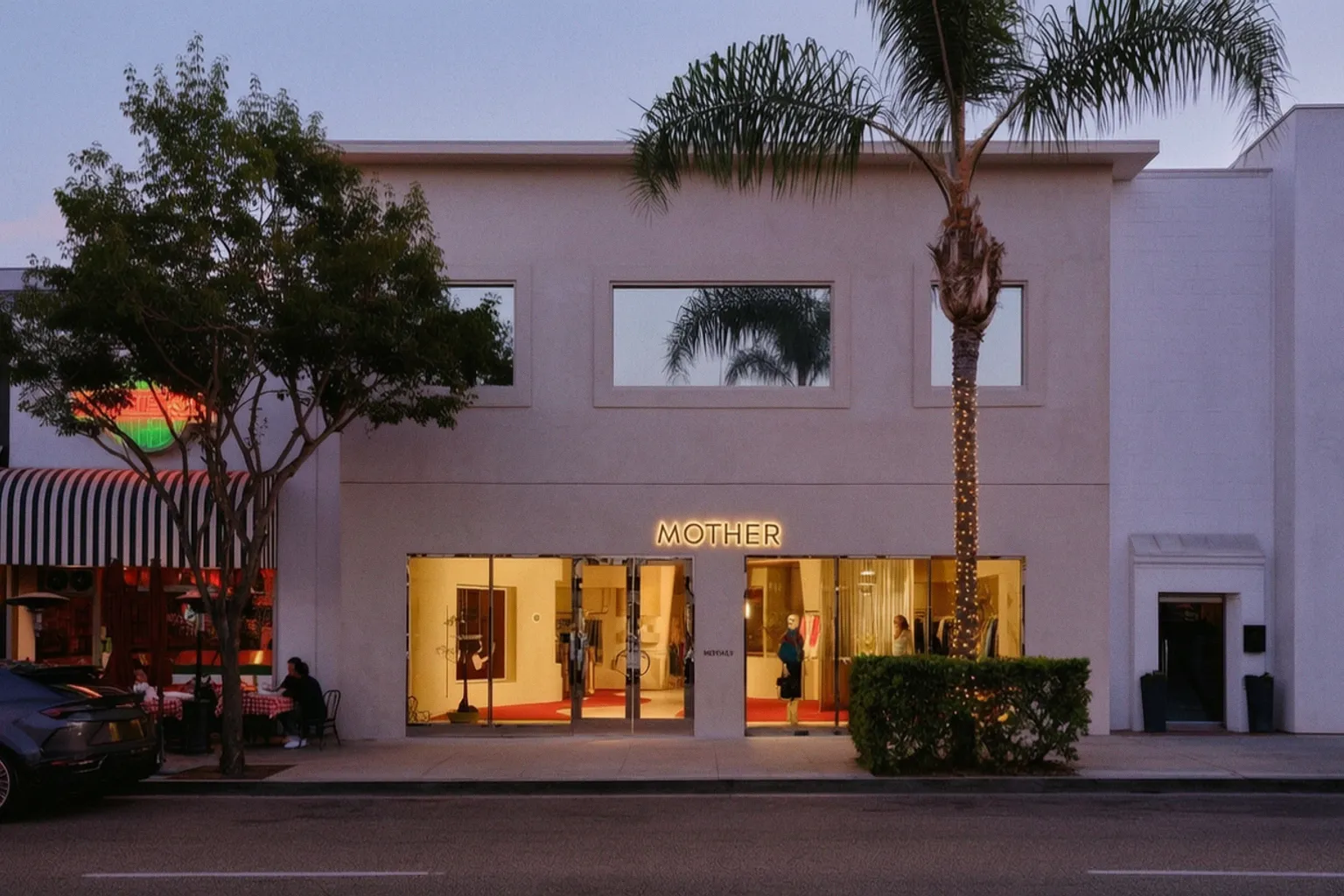
As Forbes reports, the L.A.-based brand cut the ribbon in August 2026 with co-founders Lela Becker and Tim Kaeding framing the space as a "discovery" destination rather than a transaction counter. For anyone working on store layout, fixture flow, or visual merchandising strategy, this is the kind of project worth dissecting before you brief your next floor plan.
Reading the floor before you walk it
The big move here is zoning — and we mean it in the truest planogram sense. Mother handed the design to studio Mahte, and the result is a layout that surrenders traditional retail muscle memory. There's a conversation pit pulling customers off the aisle, a cafe extending dwell time well past the average fitting-room visit, and sightlines engineered to reward wandering rather than marching from door to register. The product wall still does its job — full premium denim assortment, ready-to-wear, plus items exclusive to Beverly Hills — but it's staged as a backdrop to the experience, not the lead actor. When SKU density stops being the hero and atmosphere takes over, you know the brand is playing a different conversion game.
The back story sharpens the merchandising read. Mother originally built out a flagship in Pacific Palisades, finished construction, and watched the Lachman Fire destroy it along with more than 6,000 homes and businesses. Instead of cloning that concept for Beverly Hills, Becker and Kaeding rebuilt the brief from scratch — same learnings, new spatial language. That's the move every retail strategist should underline: a damaged concept is a chance to retest sightlines, fixture density, and customer flow against a new neighborhood, not a reason to salvage tired layouts.
Why the store earns the foot traffic
Tim Kaeding put it plainly: "You can buy almost anything from your couch now, so there has to be a reason to go somewhere in person." In our language, that's a dwell-time problem masquerading as a marketing problem. Mother answers it with three levers every retailer can borrow. First, anchor zones that don't sell anything at all — the conversation pit, the cafe seating, the Instagram-ready corners — so the customer treats the space as a third place. Second, exclusivity as a merchandising filter: pieces you can only touch and try in Beverly Hills, which kills the show-rooming risk that haunts premium apparel. Third, rotating installations, meaning the floor plan is officially a living document, not a frozen planogram your team resets once a season.
The commercial backdrop makes the gamble look reasonable. Per the same Forbes reporting, the US denim market generated roughly $21.3 billion in 2025 and is on track for $32.7 billion by 2033. Premium is the slice of that pie where experiential retail actually pays back, because the margin covers the build-out and the customer already self-selects for in-store discovery.
What to put on your own merchandising checklist
If you're sketching your next flagship or just trying to justify a fixture refresh, pull these threads out of the Mother play. Test a non-revenue anchor zone on your floor — even a single lounge chair can recalibrate how long shoppers stay in the denim or outerwear bay. Audit your sightlines from the door: if the first ten feet tell customers it's a store and not a destination, you've already lost the discovery pitch. Build at least one SKU line into your assortment that can only be found in that location, so the trip carries urgency. And budget your planogram for change — Mother is treating the Beverly Hills space as an evolving canvas with rotating installs, which means your fixture choices should favor modularity over permanence.
Watch this store over the next two quarters. If the conversation pit and cafe pull measurable dwell time without cannibalizing the fitting rooms, you'll be looking at a template the premium segment will copy fast. If they don't, the lesson flips: atmosphere only converts when it's wired into the merchandising logic, not floating beside it. Either way, Mother's flagship just gave the rest of us a very expensive focus group to study.