Gold garment racks: electroplating vs powder coating
A gold garment rack can either sharpen a boutique’s visual identity or become the most expensive-looking weak point on the sales floor.
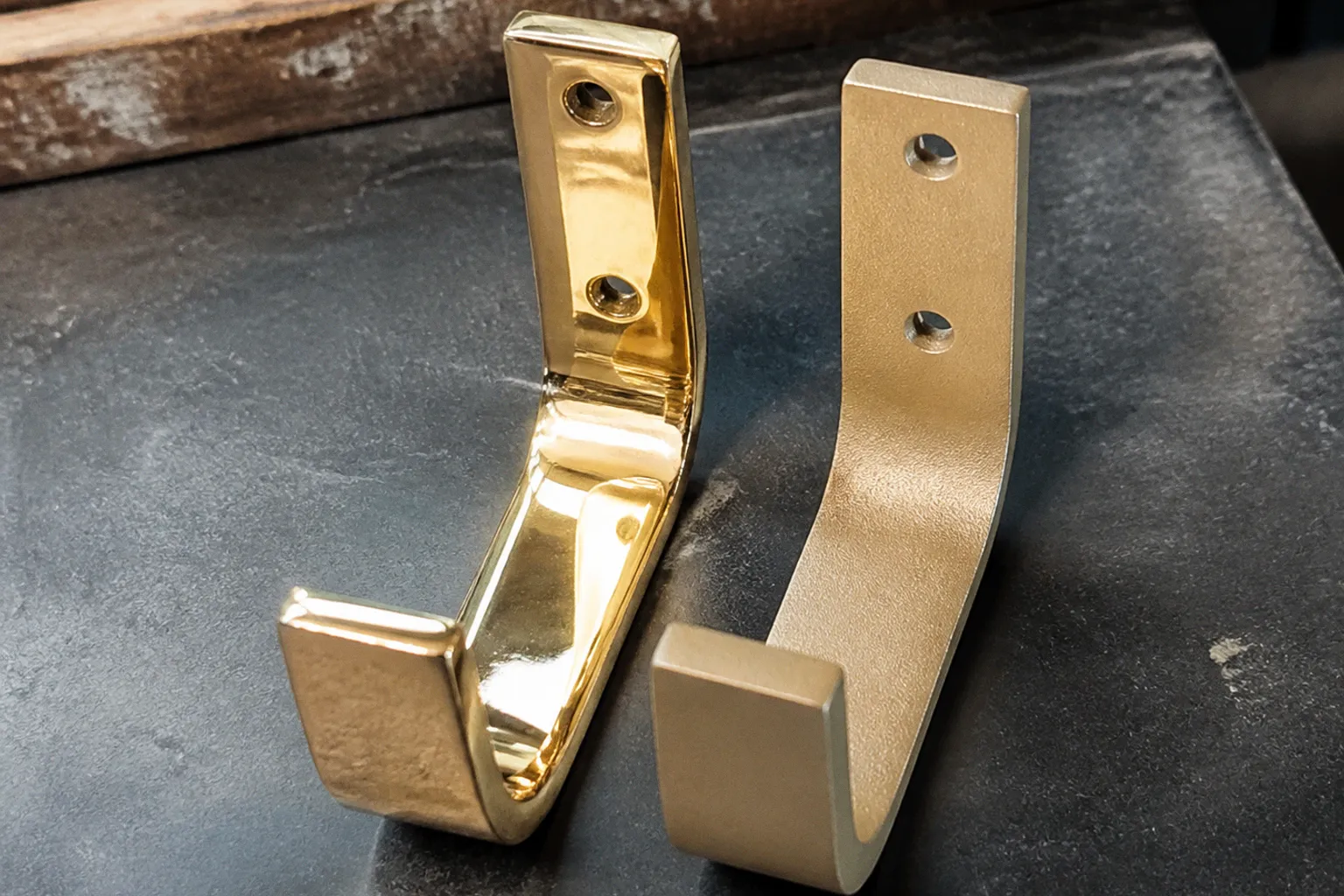
The difference usually appears after opening day: hangers strike the rail, garments are pulled through dense runs, fixtures are repositioned for a new collection, and the finish begins to tell customers whether the store is carefully managed or simply decorated.
That is the practical question behind gold garment rack plating vs powder coating. Electroplating gives us the seamless, mirror-like surface associated with luxury retail, while powder coating creates a tougher protective skin that handles repetitive contact more confidently. Neither finish wins in every environment. The right choice depends on whether your rack is acting primarily as a visual merchandising asset, a high-traffic storage tool, or both.
If we choose only by the sample board, we risk buying a beautiful finish for the wrong customer journey. If we choose only by abrasion resistance, we may lose the polished metal effect that makes a boutique fixture earn its footprint.
The chemistry behind the finish matters on the sales floor
The two finishes do not simply create different colors. They create different surface systems, and that distinction affects appearance, wear, maintenance, and the way a rack behaves in a working store.
Electroplating deposits a thin metallic layer onto a conductive metal substrate through an electrochemical process using direct electrical current. Depending on the finish specification, the plated system may involve layers such as nickel, brass, or gold. The result is a continuous metallic surface with a polished texture and deep reflectivity.
Powder coating takes a different route. Dry resin and pigment powder are statically charged and applied to grounded metal components. The components then pass through an oven, where the coating is thermally cured into a protective skin over the steel or other metal substrate.
That difference is easy to miss when you are looking at two gold samples under showroom lighting. It becomes much more obvious when the fixture is installed between fitting rooms and the cash wrap, where the rack encounters hundreds of small contacts every day.
| Parameter | Electroplated gold finish | Gold powder-coated steel |
|---|---|---|
| Visual character | Deep, seamless, mirror-like metallic shine | Controlled color with a more uniform coated surface |
| Best commercial role | Luxury focal fixture, boutique presentation, premium endcap | High-contact rack, everyday garment storage, dense merchandise run |
| Surface construction | Thin metallic layer deposited onto conductive metal | Thermally cured resin and pigment coating |
| Hanger friction | More vulnerable to visible scuffing and damage over time | Better resistance to repetitive scuffing, chipping, and scratches |
| Environmental profile | Uses an electrochemical plating process with liquid baths | Zero VOC emissions; excess overspray can be recycled |
| Merchandising strength | High visual impact and reflective presence | Reliable durability and finish consistency |
| Typical design language | Polished gold, bright brass, luxury metalwork | Matte, satin, or controlled-color gold steel appearance |
The central distinction is not “premium versus cheap.” That framing is too blunt for commercial interiors. Electroplating is often the stronger visual tool; powder coating is often the stronger operational tool. Your planogram, SKU density, hanger type, and traffic pattern decide which advantage has more value.
The finish is part of the fixture’s selling job, but it is also part of its maintenance budget.
Why electroplated gold still wins the luxury visual argument
When a boutique needs the rack itself to communicate value, electroplated gold has a clear advantage. Its mirror-like shine catches movement across the store, lifts the perceived finish level of the environment, and creates a stronger relationship with polished accessories, lighting, and premium materials.
This is why gold polished garment racks work especially well in spaces where the fixture is visible from several sightlines. A rack positioned on an endcap or at the end of a narrow aisle is not merely holding product. It is framing the customer’s first view of a collection. Reflective metal can help that fixture read as an intentional focal point rather than another storage line.
We should think about this through customer eye-tracking rather than decorative preference. Shoppers scan the floor quickly. They notice contrast, brightness, color blocking, and the outline of a dense product group before they process individual garments. A polished gold rail can draw attention to a launch collection, a high-margin capsule, or a carefully edited outfit story.
That visual effect is strongest when the rack has enough breathing room around it. If a highly reflective finish is placed inside an overcrowded planogram, the shine competes with the merchandise and creates visual noise. The rack may attract the eye, but not necessarily direct it toward the product you need to sell.
Use electroplated finishes strategically when:
- The rack sits in a premium zone with controlled SKU density and deliberate spacing.
- The fixture is part of the store’s identity, not just a back-of-house workhorse.
- Lighting is warm or directional enough to reveal the depth of the metallic surface without producing distracting glare.
- The merchandising concept depends on polished brass, gold, or jewelry-like accents.
- The rack will be moved occasionally rather than repeatedly dragged through a high-volume floor reset.
- Customers are expected to browse slowly, with higher dwell time around the fixture.
Gold electroplating can also help create continuity across a boutique display system. If door hardware, shelf brackets, accessory tables, and garment rails share a polished metal language, the store feels more resolved. That coherence matters because customers often read material consistency as a signal of product consistency. The fixture does not need to shout; it needs to make the environment feel considered.
But polished gold is not automatically better simply because it looks more expensive. The question is how much of the customer experience depends on that surface staying visually perfect. If the answer is “almost all of it,” the rack needs a location and handling routine that protect the finish.
Plating large rack components requires controlled coverage
For large, long, or heavy display components, rack plating is the primary electroplating technique. Components are mounted individually on frames so electrical current can pass through them more evenly during the process.
That manufacturing detail matters to retailers because a garment rack is not a small decorative fitting. It may include long horizontal rails, upright posts, base frames, brackets, and welded junctions, all of which need to present consistently when viewed from the sales floor. A well-specified finish should be evaluated across the complete fixture, not only on a small flat sample.
Ask to see how the manufacturer handles:
- Long rails and exposed ends.
- Welded joints and corners.
- Base plates that receive direct contact during relocation.
- Areas around hooks, brackets, and fasteners.
- Finish continuity on both customer-facing and staff-facing surfaces.
A sample may show beautiful reflectivity while hiding the areas that will receive the most handling. We want the finish decision to be based on the rack’s actual construction, not on the most flattering square inch of metal.
Where powder coating earns its place: friction, resets, and dense merchandising
A gold powder-coated steel rack is usually the more rational choice when the fixture will be worked hard. Think of the main apparel run, the seasonal clearance zone, a stock-heavy store with frequent replenishment, or any floor where metal hangers are pushed tightly along the rail all day.
Hanger friction is not one dramatic event. It is a repeated series of small impacts: a hanger is pulled sideways, another is pushed back, a garment is removed from the center of a dense group, and the rail receives contact at the same locations over and over. Add the occasional collision with a steamer, rolling rack, display table, or cleaning equipment, and the finish is operating under a much less forgiving brief.
Powder coating withstands repetitive scuffing, chipping, and scratch damage from metal clothing hangers better than standard electroplated finishes. That makes it a strong option when the fixture’s primary KPI is dependable service across a high-contact merchandising cycle.
The visual result is different from a true polished metal surface. Powder coating can deliver an attractive gold, brass-like, satin, or other controlled finish, but it does not reproduce the same seamless depth and reflective quality as a polished electroplated surface. That is not a defect; it is a design trade-off.
If your store is built around dense product presentation, the powder-coated finish may actually support the merchandise better because it provides a stable background rather than a reflective competing element. A satin gold rail, for example, can preserve the warmth of the palette while keeping the customer’s attention on the garments and price architecture.
This is where the brass plating vs powder coat decision becomes less about material labels and more about traffic mapping. Put the polished plated rack at the front of the store, where it establishes the brand. Put the tougher coated rack in the operational zones, where customers repeatedly handle product. A mixed finish strategy is often more commercially intelligent than specifying one finish everywhere.
Durability is a layout issue, not only a materials issue
Retailers sometimes ask which finish is more durable as if the rack exists in isolation. In practice, durability depends heavily on placement, rack loading, hanger behavior, cleaning routines, and the number of times the fixture is moved.
A plated rack placed in a low-density premium display with soft-touch hangers may perform well for a long time because the environment reduces contact. A powder-coated rack placed in a poorly planned aisle can still suffer damage if it is constantly struck by carts, squeezed against another fixture, or dragged over uneven flooring.
We should map the rack’s exposure before choosing the finish:
1. Identify the contact pattern. Is the rail touched continuously by metal hangers, or does it hold a small edited assortment with generous spacing?
2. Mark relocation frequency. A rack that moves for every weekly floor reset has a different finish requirement from a fixed wall run.
3. Check sightline importance. If the fixture is visible from the entrance, a polished finish may justify additional care. If it sits in a service-heavy zone, abrasion resistance may be worth more.
4. Review SKU density. Dense rails increase hanger friction and make the coating work harder. Low-density presentation gives a more delicate finish room to perform.
5. Separate customer contact from staff contact. Base frames, lower rails, and rear-facing supports may be damaged by handling even when the customer-facing rail looks untouched.
6. Match the hanger material. Metal hangers create a different abrasion profile from wood, molded plastic, or velvet hangers.
This is also why the phrase “commercial grade” is not enough to close the specification. A fixture can be structurally sound and still be poorly matched to the way your team sells. Structural integrity, finish resilience, and visual performance are three separate decisions.
A rack does not wear out evenly. It wears at the points where the planogram forces customers and staff to touch it.
The rack’s position determines how much finish you are buying
Let’s divide the sales floor into practical zones.
Brand and arrival zone: This is where sightlines and first impressions matter most. A polished electroplated rack can function as a visual anchor for a new collection or premium category, provided the area is not overloaded.
Core apparel run: Here, SKU density and product turnover usually matter more than mirror reflectivity. Powder-coated steel is often the safer choice, especially when customers compare several sizes on the same rail.
Endcap: An endcap has unusually high merchandising value because it interrupts the aisle and captures forward movement. Either finish can work, but the decision should follow the product story. Use polished gold when the fixture is part of the theater; use powder coating when the endcap will be restocked aggressively.
Fitting-room approach: Customers in this zone are already engaged with product, so the rack must tolerate handling while keeping the space visually calm. A coated finish can be practical here, particularly where garments are moved quickly between rack and fitting room.
Back-of-house or overflow storage: The customer-facing luxury argument is weaker in this zone. Prioritize durability, cleanability, and cost control rather than specifying a finish for visual drama that shoppers may never see.
This zoning approach protects the budget without flattening the store’s design language. We can reserve the high-visual-impact finish for the locations where it contributes to dwell time and conversion, rather than paying for the same aesthetic treatment on every rail.
Sustainability and operational efficiency belong in the finish conversation
The environmental profile of the finish is not a side note, especially for retailers managing a large fixture package or planning repeated rollouts across multiple locations.
Powder coating produces zero volatile organic compounds and allows excess overspray to be recycled. Because the process uses dry resin and pigment powder that is thermally cured onto the metal, it offers a different operational profile from electroplating’s electrochemical liquid-bath process.
That does not mean powder coating automatically makes every project sustainable. The full picture includes the substrate, manufacturing logistics, fixture lifespan, repairability, packaging, and how often components are replaced. A finish that survives longer in a high-contact zone may reduce replacement pressure, while a visually superior plated fixture may be justified in a premium location if it remains protected and continues to support the store’s commercial identity.
The useful question is not which finish sounds greener in isolation. Ask which finish gives the best service life and merchandising result for that specific location.
For a multi-store rollout, powder coating can also offer operational consistency. The finish is applied as a cured coating system, and excess powder can be recycled during application. That can support a repeatable specification across many steel components, especially where the design calls for a controlled gold rather than a highly reflective plated surface.
Electroplating remains valuable when the visual requirement is non-negotiable. If the brand depends on polished metal accents and the rack is a prominent part of the customer-facing environment, selecting a less reflective coating solely because it has a simpler environmental story may weaken the store’s overall selling proposition. Sustainability has to be evaluated alongside durability and commercial purpose, not separated from them.
How to specify the finish without losing the commercial objective
The most effective fixture briefs describe the retail job first and the finish second. Instead of asking a manufacturer for “gold racks,” define the role, exposure, and visual target.
A useful specification should state:
- Whether the rack is a focal display, core stock fixture, endcap, or overflow unit.
- The desired visual effect: mirror-like polished gold, brushed brass, satin gold, or a flatter coated appearance.
- Expected hanger density and the type of hanger used.
- How often the fixture will be moved or reconfigured.
- Which surfaces are customer-facing and which are exposed to staff handling.
- Whether the rack must coordinate with other plated or powder-coated hardware.
- Whether the finish needs to remain consistent across long rails, welded joints, bases, and accessories.
- The maintenance conditions, including cleaning frequency and the likelihood of contact with equipment.
This brief allows the manufacturer to recommend the appropriate finish system instead of forcing a binary decision based on color alone.
Be precise about the word “gold,” too. Gold can mean a bright yellow metallic, a muted champagne, a brushed brass finish, a warm antique tone, or a reflective luxury surface. Those are different visual outcomes. A polished brass-plated rack may sit beautifully beside warm timber and amber lighting, while a brighter gold can become too dominant under high-output retail illumination.
The same issue applies to black. A mirror black polish finish, for example, creates a very different sightline and contrast relationship from a black powder coat. One reflects the store around the fixture; the other absorbs more of the visual field. The finish changes not just the rack but the perceived spacing between garments, fixtures, and architectural elements.
Three practical finish strategies
1. The hero-fixture strategy
Use electroplated gold for the racks customers see immediately: entrance statements, capsule collections, premium accessories, or central presentations with controlled SKU density.
This approach concentrates visual investment where it can influence first impressions and dwell time. The rack becomes part of the brand’s merchandising vocabulary.
2. The workhorse strategy
Use powder-coated steel for dense apparel runs, replenishment-heavy sections, fitting-room approaches, and fixtures that will be reset frequently.
This approach protects the operational side of the store. The finish is selected to withstand the repetitive contact that comes with real product handling.
3. The hybrid strategy
Combine both finishes within one store, using polished electroplating for high-visibility fixtures and powder coating for high-contact support fixtures.
In many commercial environments, this is the strongest route. It preserves a premium visual cue without asking every rack to perform the same job. The customer sees a coherent gold language, while the back-end fixture specification reflects actual wear conditions.
What to ask before approving a sample
A sample board is useful, but it cannot answer every question. Before approving a finish for production, look at the complete rack under the lighting used on the sales floor. Rotate it. Check the ends, welds, corners, base, and underside. A finish that looks even on a flat sample may show variation across a complex tubular structure.
Then run the sample against the merchandising reality:
- Slide the intended hangers across the rail repeatedly.
- Check whether the finish creates glare along key sightlines.
- Place dark and light garments beside it to evaluate contrast.
- View it from the entrance, not only from arm’s length.
- Compare it with the store’s flooring, timber, mirrors, and lighting temperature.
- Confirm that the base and lower structure do not look visually heavier than the product.
- Review how the finish will be cleaned and maintained in daily operation.
We should also examine whether the rack design itself increases wear. Sharp transitions, exposed fasteners, tight clearances, and poorly positioned brackets can create contact points that damage the finish regardless of the chosen system. A better layout can sometimes protect a finish more effectively than a more expensive specification.
For large components, ask how the manufacturer approaches rack plating and how the finish is managed across the full assembly. For powder-coated steel, ask how components are prepared before application and thermal curing. The objective is not to bury the project in engineering terminology; it is to understand whether the finish process matches the scale and geometry of the fixture.
The final decision: visual equity or operational resilience?
The answer to gold garment rack plating vs powder coating should come from the rack’s job in the store.
Choose electroplating when the fixture is a visible brand asset, when polished metal is central to the boutique’s aesthetic, and when the merchandising plan gives the surface enough protection to retain its impact. It is the stronger choice for deep, mirror-like luxury presentation and for locations where the rack’s appearance contributes directly to the customer’s perception of the collection.
Choose powder coating when the fixture is exposed to constant hanger friction, frequent resets, dense SKU presentation, or rougher staff handling. It is the stronger choice when surface resilience, consistent performance, and environmental efficiency matter more than a seamless reflective metal effect.
And if the store contains both high-visibility and high-contact zones, do not force one finish across the entire planogram. Use the polished rack where it can earn attention, and the powder-coated rack where it can earn its keep.
Before the order is released, walk the floor and answer four questions:
- Where must the fixture attract the eye?
- Where will hangers and staff create the most friction?
- Which racks are moved often enough to punish a delicate surface?
- Which finish supports the product story without competing with it?
That is the route to a commercially sound fixture package: polished gold where sightlines and brand value demand it, powder-coated steel where turnover and contact set the pace, and a finish strategy measured not by showroom drama alone but by durability, dwell time, product handling, and the condition of the store months after opening.