PVD gold vs electroplating for luxury garment racks
The gold finish on a luxury garment rack is usually judged on opening day, when the lighting is perfect and the hardware has not yet met a metal hanger. That is the wrong moment to make the decision.
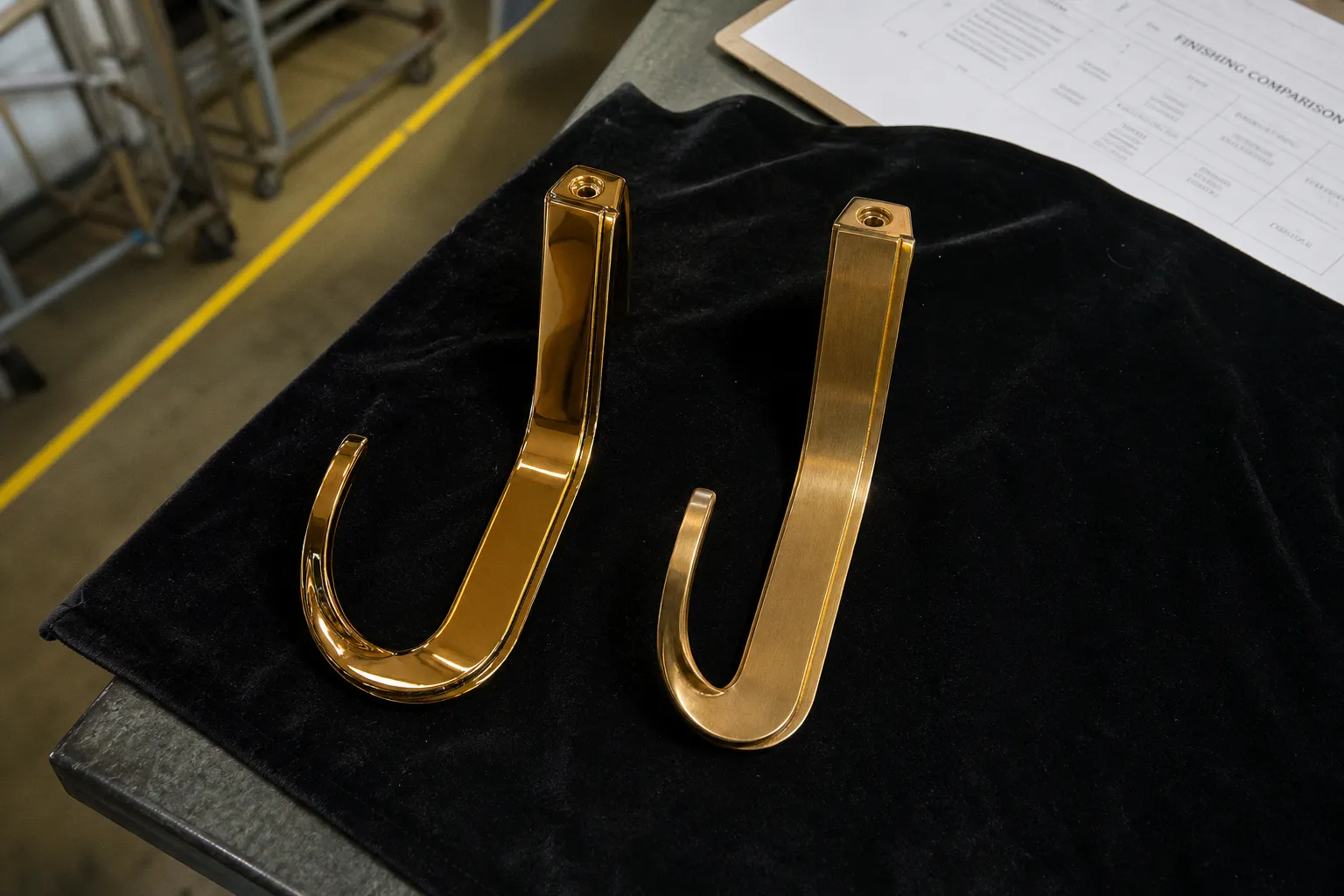
The meaningful test comes later, when rails are handled during every fitting, hangers are pushed along the bar, stock is changed between collections, and the fixture is cleaned at the end of a long trading day. A polished gold surface can look exceptional when new and still be poorly suited to that routine. The choice between PVD gold and electroplating is therefore not only a question of color or initial price. It is a decision about surface hardness, coating adhesion, geometry, maintenance, substrate preparation, and how gracefully the rack is expected to age.
Compare car rental deals in United Kingdom
See available offersPartner link — DiscoverCars comparisonFor luxury clothing displays, the difference between PVD gold and electroplated gold garment racks becomes most visible in the places customers and staff touch most. Top rails, waterfall arms, brackets, base rings, and endcap hardware carry the real burden of retail use. The finish has to survive there without turning the rack into a visual distraction.
Molecular Bonding: Why PVD Outlasts Traditional Electroplating
A finish is not simply a color applied to metal. It is a surface system, and the way that system is formed determines how it responds to abrasion, moisture, cleaning chemicals, and impact.
Traditional electroplating places the component in a liquid bath and uses an electric current to deposit metal onto the prepared substrate. Depending on the specification, the visible gold may be a genuine gold alloy or a gold-colored alloy deposited over intermediate layers such as nickel. The process is well established, adaptable, and capable of producing a rich polished appearance. It is also familiar to manufacturers that already plate brass, steel, zinc, or decorative castings for furniture and retail interiors.
The result is a distinct deposited layer sitting over the base material. Its performance depends on several linked variables:
- how carefully the substrate was cleaned and polished;
- whether the intermediate layers are compatible with the base metal;
- how evenly the plating thickness was controlled;
- whether the component contains pores, weld contamination, or sharp edges;
- and how the finished rack is handled after it leaves the factory.
When the surface is repeatedly rubbed, the visible layer can become thinner in high-contact zones. Once the top finish is compromised, the underlayer may begin to affect the color and reflectivity. On brass or copper, tarnishing can alter the appearance around exposed areas. On steel, corrosion resistance becomes a system issue rather than a question of gold color alone.
PVD, or Physical Vapor Deposition, uses a vacuum chamber rather than a conventional wet plating bath. A metallic target is vaporized and deposited onto the prepared component. The vapor condenses as a thin coating, often based on titanium, zirconium, chromium, or related compounds selected for color and performance. A gold appearance may come from the coating chemistry itself, from the interaction of the coating with the polished substrate, or from a specified gold-bearing system.
The important distinction is not that PVD somehow turns the entire surface into gold. It does not. PVD remains a separate coating applied to the substrate, and its performance depends on adhesion, surface preparation, chamber conditions, coating design, and quality control. A poorly prepared component can still fail. A coating applied over contamination, weak oxide layers, or an unsuitable pretreatment may blister, crack, or delaminate.
What PVD generally offers is a harder and more tightly controlled surface system than conventional decorative gold plating. The coating can be thin while still providing strong resistance to the fine abrasion associated with daily retail handling. It also allows manufacturers to repeat a particular tone and gloss across a production run when the process is properly managed.
The real comparison is not “gold versus gold.” It is a comparison between two surface systems under the specific abuse your retail floor delivers every day.
That distinction matters when reading supplier language. “PVD gold” is not a universal performance grade. The phrase may describe several coating chemistries, substrate combinations, and levels of pretreatment. A rack with PVD applied over properly prepared stainless steel is not automatically equivalent to a rack with the same-looking coating applied over mild steel with an inadequate barrier layer.
The best gold finish for clothing racks is therefore the one that combines the right visible appearance with a process suited to the rack’s material and use. PVD often has the advantage in high-contact applications, but it is not a substitute for engineering discipline.
Surface Hardness and Scratch Resistance in High-Traffic Retail
Retail fixtures do not usually fail because someone attacks them with a tool. They fail through accumulation: a hanger edge sliding across the same section of rail, a buckle striking a bracket, a steamer hose brushing against an upright, or a cleaning cloth carrying fine grit across a polished surface.
That type of wear is easy to underestimate because each contact is minor. The finish is not being challenged once; it is being challenged repeatedly, often along the same narrow bands. A rack that looks untouched after installation can develop a different visual character around the points where merchandise is moved most often.
PVD coatings are commonly selected for this environment because their surface hardness is substantially higher than that of many decorative electroplated gold finishes. Depending on the coating chemistry and test method, PVD systems used in architectural and fixture applications may be specified in the high-hundreds or thousands of Vickers range, while soft decorative gold layers can sit far lower. The exact figures should be treated as coating-specific rather than as a universal promise. A supplier should be able to identify the coating system and the test basis instead of offering “PVD” as a complete technical answer.
Hardness is not the same thing as immunity. A hard coating can still be scratched by a harder particle, damaged at a sharp edge, or compromised when the substrate flexes underneath it. Adhesion and substrate preparation remain critical. So does the design of the rack: a narrow exposed edge, a poorly finished weld, or a sharp transition can concentrate force and create a failure point regardless of the coating selected.
For a luxury garment rack, the most exposed zones normally include:
- the upper rail where metal and wooden hangers slide;
- waterfall arms and front-facing display bars;
- brackets that staff grip during merchandising changes;
- base members that collect dust and are wiped frequently;
- endcap fittings exposed to bags, belts, and other accessories;
- and any polished trim positioned at hand or hip height.
A polished electroplated finish may remain appropriate when those areas receive light use, when the fixture is primarily decorative, or when the design allows damaged components to be replaced without disturbing the wider installation. It becomes a more cautious choice when the rack is expected to carry dense merchandise and be rearranged constantly.
PVD is usually the stronger candidate when the brief calls for a gold polished garment rack that must retain its reflective character under repeated contact. The advantage is not that the surface will look untouched forever. The advantage is that normal abrasion is less likely to become visually dominant as quickly, provided the coating has been applied correctly and the cleaning regime is compatible with it.
The visible appearance also depends on what lies beneath the coating. PVD is thin enough that the preparation of the substrate remains legible. A mirror-polished stainless steel tube will produce a different result from a brushed tube, even when the nominal coating color is identical. A satin finish can soften the gold and hide minor handling marks more effectively than a high-gloss mirror surface. This is one reason a finish sample should be viewed under the actual store lighting rather than approved from a small color card.
Electroplating can sometimes provide a more substantial deposited layer, but thickness alone does not solve every durability problem. A thicker soft layer may still mark under repeated sliding contact. It may also reveal unevenness, edge build-up, or changes in reflectivity if the underlying preparation is inconsistent. A thinner, harder PVD coating can perform better in one application while being less suitable in another. The correct comparison is always between complete specifications, not between process names in isolation.
What the staff will notice first
Customers may not identify a worn coating technically, but they notice when a luxury fixture looks tired. The first visible signs are often not dramatic peeling. They are dull tracks along the rail, a change in color near a frequently handled bracket, small dark points around an edge, or a difference between the front of a rack and the less-used rear side.
Maintenance teams tend to encounter a different set of problems. Aggressive cleaners, abrasive pads, and improvised touch-up products can turn a manageable finish into an inconsistent one. A rack may still be structurally sound while its visible surfaces no longer match. In a premium environment, that mismatch can force a decision about refinishing, component replacement, or full fixture renewal.
A PVD specification can reduce the frequency or severity of appearance-related maintenance, but it does not remove the need for care. The cleaning instructions should be part of the handover package. Staff should know which cloths, detergents, and methods are permitted, particularly for polished finishes that show fine scratches more readily than satin or brushed surfaces.
The Geometry Challenge: Coating Uniformity and Line-of-Sight Limitations
PVD has a technical limitation that matters as much as its hardness: it is fundamentally a line-of-sight process.
The coating material travels through the chamber toward the component. Parts can be rotated and positioned to improve coverage, but recessed areas, deep internal corners, narrow channels, and surfaces hidden behind other geometry may not receive the same deposition as exposed faces. The result can be a difference in thickness, color, gloss, or long-term performance between the front of a component and its shadowed areas.
For a straightforward garment rack made from tubular steel, square section, or simple bar stock, this is usually manageable. The components can be arranged for effective exposure, and the visible surfaces are relatively easy to reach. The same process becomes more demanding when the rack includes:
- deep decorative grooves;
- scrollwork or leaf-shaped castings;
- enclosed cavities;
- intricate finials;
- recessed sign holders;
- overlapping brackets;
- or internal faces that are visible from the sales floor.
Electroplating has a legitimate advantage in these situations because the liquid bath surrounds the component. The current distribution is still affected by geometry, edges, and recesses, so “full submersion” does not mean perfectly uniform thickness everywhere. Even so, complex decorative elements can often be coated more consistently through a wet process than through a strictly directional vapor-deposition setup.
This is where the phrase “PVD always wins” becomes unhelpful. It may win decisively on the exposed structural rail and lose its advantage on a deep ornamental casting. The right answer can be a process decision by component rather than a single finish applied indiscriminately to every part.
A hybrid specification may place PVD on the high-touch structural rails, uprights, brackets, and base hardware, while using electroplating for decorative pieces whose geometry makes uniform vapor coverage difficult. That approach can preserve the design language of a gold luxury fixture without forcing one coating process to solve incompatible problems. It also requires careful color matching. Two processes that appear similar in a supplier’s sample book may show different warmth, reflectivity, or edge tone when installed side by side under retail lighting.
The geometry review should happen before the final finish is approved. A two-dimensional elevation will not reveal every shadowed surface. Ask the manufacturer to identify which areas are directly exposed in the chamber and which rely on rotation, masking, or secondary processing. For a complex rack, a physical prototype or representative component is more useful than a verbal assurance that the finish is “uniform.”
| Parameter | PVD Gold | Electroplated Gold |
|---|---|---|
| Surface behavior | Generally harder and more resistant to repeated abrasion, depending on coating chemistry | Can provide a rich decorative appearance but may be more vulnerable to wear in high-contact zones |
| Coating structure | A distinct vacuum-deposited coating; adhesion depends on preparation and process control | A deposited metallic layer, often used with intermediate layers over the substrate |
| Complex recesses | Coverage can be limited by line-of-sight geometry | Liquid immersion can be advantageous on many recessed decorative forms |
| Appearance | Strongly influenced by substrate polish, texture, and coating formulation | Influenced by bath chemistry, layer sequence, thickness, and substrate preparation |
| Damage modes | Scratching, cracking, or delamination are possible if the system is poorly specified or abused | Wear-through, discoloration, tarnishing, and delamination can occur depending on the layer system |
| Environmental profile | Vacuum process with less wet chemical effluent than conventional plating, though upstream and finishing steps still matter | Requires management of process chemicals, rinsing, and regulated waste streams |
| Best application | High-touch rails and relatively accessible geometry | Decorative or complex components, cost-sensitive projects, and applications where wet-process coverage is valuable |
The table is a starting point, not a substitute for a coating schedule. The details that decide performance are often hidden in the supplier’s process sheet: substrate, pretreatment, intermediate layers, coating chemistry, thickness range, color standard, adhesion test, and cleaning limitations.
Lifecycle Costs and the Sustainability Premium
The first cost comparison is easy. Electroplating may produce a lower initial price, while PVD often carries a premium because of chamber capacity, pretreatment requirements, coating controls, and the cost of qualifying the finish. That difference is visible before the fixtures reach the store.
The second comparison is more useful: what happens when the finish begins to look worn?
A rack rarely enters a maintenance spreadsheet under the heading “coating lifecycle” alone. Its cost appears through labor, store disruption, replacement parts, freight, refinishing logistics, and the decision to remove a fixture that is structurally usable but visually unacceptable. In a luxury environment, the visual standard is part of the operating requirement. A rail that would be tolerated in a warehouse may be rejected on a premium sales floor.
PVD can offer a lifecycle advantage because its harder surface is typically better suited to repeated contact. That advantage is most meaningful when the rack is expected to stay in service through multiple merchandising cycles and when replacing the fixture would create labor or design-consistency problems. It should be described as a typical benefit, not a guaranteed service-life promise. Actual performance depends on traffic, hanger material, cleaning, substrate, coating quality, installation, and the conditions around the rack.
Electroplating can still be financially sensible in several situations. A short-term installation may not justify a higher coating premium. A decorative rack with limited handling may never expose the difference in abrasion resistance. A design based on intricate castings may require the coverage characteristics of a wet process. And if individual decorative components can be removed and refinished economically, the total ownership equation may favor electroplating even when the finish itself is less hard.
The useful question is not “Which finish is cheaper?” It is “Which cost is the project trying to control?” A procurement team may prioritize initial capex. A retail operations team may prioritize fewer interventions on the floor. A brand team may prioritize color consistency across stores. A sustainability team may focus on chemical management and supplier transparency. The same finish can look attractive to one group and expensive to another.
What sustainability claims should actually mean
PVD is often presented as the environmentally cleaner choice because it is a dry vacuum process rather than a conventional wet plating bath. That distinction is meaningful. Traditional electroplating involves process chemicals, rinsing, wastewater, and waste treatment obligations. PVD can reduce the wet chemical burden associated with the visible finish, but it should not be described as impact-free.
The full environmental picture includes substrate preparation, polishing, degreasing, cleaning, pretreatment, electricity used by the vacuum equipment, target material, packaging, transportation, and end-of-life handling. A PVD rack made with a poorly chosen substrate and shipped through a fragmented supply chain may not automatically be the more responsible product.
For a credible comparison, ask the supplier:
- Which pretreatment steps are used before the vacuum coating?
- Are any electrochemical barrier layers required?
- How are cleaning agents, rinse water, and process residues managed?
- Is the coating applied in-house or sent to another facility?
- Can damaged components be replaced individually?
- Is the substrate recoverable or recyclable at the end of the fixture’s use?
- What documentation supports the environmental claims?
A responsible PVD specification is not “zero impact.” It is a finish choice that may reduce certain wet-process burdens while extending the period during which the fixture remains visually usable. Extending useful service can matter because premature replacement carries its own material, transport, and installation costs.
The sustainability premium is credible only when the coating lasts in the environment it was designed for and the supplier can explain the process behind the claim.
Substrate Compatibility: When Galvanic Pre-treatment Is Mandatory
The base material is where many finish discussions become vague. A supplier may show a beautiful gold sample without making clear whether it was produced on stainless steel, brass, copper, or mild steel. That omission matters because the same coating can behave differently on each substrate.
Stainless steel is often a strong starting point for PVD. It can provide a stable, corrosion-resistant base and is widely used for premium polished or brushed garment racks. The surface still needs proper cleaning, activation, and preparation, but the substrate is generally compatible with a durable decorative coating system.
Mild steel presents a more complicated case. It needs protection from corrosion, particularly at welds, cut edges, pores, and areas where the surface preparation is inconsistent. Brass and copper bring their own issues: tarnishing, oxidation, porosity, and movement between the substrate and the applied layers. In these cases, a galvanic pretreatment or barrier system may be required before PVD. That may include nickel, nickel-copper, or another specified layer designed to stabilize the surface and improve corrosion resistance and adhesion.
This is not a contradiction of the claim that PVD is a different process from electroplating. A component can receive an electroplated pretreatment and then a PVD topcoat. The processes serve different purposes. The galvanic layer may act as a leveling, barrier, or corrosion-control layer; the PVD coating provides the visible finish and additional surface performance.
The exact stack should be documented. “PVD over steel” is not enough information for a serious commercial fixture specification. The manufacturer should identify:
1. The base metal and its grade or composition.
2. The surface preparation and polishing standard.
3. Any galvanic or chemical pretreatment.
4. The PVD coating chemistry and target color.
5. The expected coating thickness or process range.
6. Adhesion and corrosion testing used for approval.
7. Cleaning products and methods permitted after installation.
8. The repair or replacement route if a component is damaged.
The most vulnerable areas are often not the broad, polished faces that look perfect in a sample. They are the transitions: welded joints, drilled holes, cut ends, threaded connections, sharp corners, and places where two materials meet. If the pretreatment does not cover those areas properly, corrosion or discoloration can develop beneath or around the visible coating. Once that happens, polishing the exposed gold surface will not solve the underlying problem.
Brass, copper, and the question of visible warmth
Brass and copper are popular in luxury interiors because their natural warmth gives a fixture more depth than a flat yellow coating. PVD can preserve that design intention while reducing the exposure of the substrate to handling and atmosphere. It can also produce a more stable appearance than leaving brass or copper untreated in a humid stockroom, coastal location, or space with inconsistent climate control.
But the finish should be approved as a complete visual system. The color of a PVD-coated brass sample may differ from PVD on stainless steel. The same nominal “gold” can appear warmer over one substrate and cooler over another. Polished copper beneath a transparent or lightly tinted system will not read like brushed stainless beneath a gold-colored nitride. If the project combines rails, brackets, and cast decorative parts from different materials, request samples of each actual combination.
That is especially important for a hybrid specification. PVD on the structural rail and electroplating on an ornamental fitting may be technically sensible, yet visibly wrong if the tones do not match. The store lighting, surrounding stone, timber, mirrors, and garment colors all affect how the gold is perceived. Approval under neutral workshop light is not enough.
Choosing the Finish for the Rack You Are Actually Building
For a high-traffic luxury store with metal hangers, frequent floor resets, and visible structural rails, PVD is usually the stronger starting point. It is well suited to simple, accessible geometries where the coating can be applied consistently and where abrasion resistance has a direct effect on appearance.
For a decorative rack built around deep recesses, cast details, scrolls, or enclosed ornamental forms, electroplating may remain the more practical process for selected parts. Its coverage characteristics can make it easier to achieve a continuous decorative effect across complex geometry. The trade-off is that high-touch areas may need more careful protection, maintenance, or eventual refinishing.
For a project with mixed priorities, specify by zone:
- PVD for structural rails and high-touch bars where hangers and hands create repeated abrasion.
- PVD for brackets and exposed hardware when the geometry allows reliable chamber coverage.
- Electroplating for complex decorative castings where recesses and shadowed surfaces dominate the visual result.
- A compatible pretreatment system for mild steel, brass, copper, and any porous or welded substrate.
- A single approved color standard supported by physical samples from every process used.
- A maintenance instruction that names acceptable cleaners, cloths, and repair methods.
Do not let the finish decision arrive after the rack design is frozen. Geometry, material, weld quality, and coating method are connected. A deep recess introduced by the design team may be easy to draw and difficult to coat. A polished tube may look luxurious in a showroom and expose every handling mark on a busy floor. A less reflective satin surface may deliver a more stable appearance even when the coating chemistry is identical.
The same applies to supplier evaluation. Ask for test pieces that reproduce the actual rack: the same tube, the same welds, the same polish, the same edges, and the same coating system. A flat coupon can demonstrate adhesion and color, but it may not reveal what happens around a welded corner or inside a recessed bracket.
The Bottom Line: What to Specify and When
The debate over pvd gold vs electroplated gold garment racks is often framed as a simple choice between premium technology and lower cost. In practice, it is a choice between different strengths.
PVD is generally the better fit for exposed rails, high-touch hardware, and relatively simple rack geometry. Its harder surface and controlled deposition can help a gold finish resist the repeated abrasion of commercial use. Its lifecycle benefits are typical advantages, not guarantees: the coating can still fail if adhesion, pretreatment, geometry, or maintenance is neglected.
Electroplating remains useful where complex decorative geometry, recessed coverage, or initial cost carries more weight than maximum abrasion resistance. It can produce an excellent luxury finish, but the specification needs to acknowledge the areas most likely to wear and the environmental controls associated with the process.
The most thoughtful projects do not treat either process as a universal answer. They match the finish to the component, the substrate, the touch points, the lighting, and the expected maintenance model. A hybrid approach may be appropriate, but its performance should be described honestly: it can place the more durable process where it matters most, without claiming a precise percentage of the durability of an all-PVD installation.
A garment rack is a sales-floor tool dressed in architectural detail. The gold is part of the brand language, but it is also a working surface exposed to friction, cleaning, movement, and time. Specify it as both. When the coating chemistry, substrate preparation, geometry, and maintenance plan agree with one another, the finish remains an asset to the merchandise rather than becoming another problem for the store team to explain.