Copper Garment Racks: Three Finish Paths for Boutiques
Copper garment rack finishes for retail space come down to three working paths — natural unlacquered copper, lacquered copper, and copper-plated steel — and they all photograph identically in the showroom catalog.
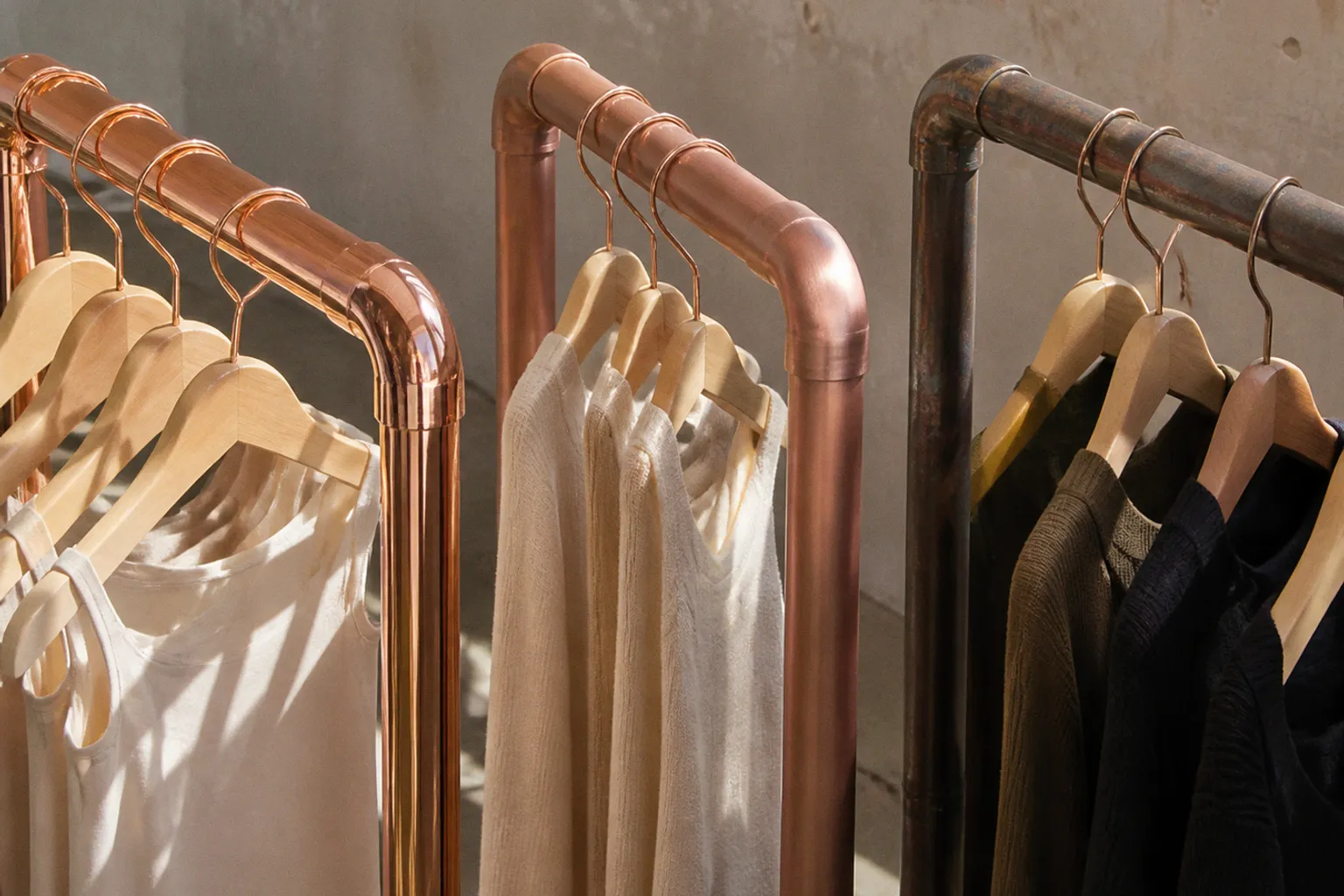
They do not perform identically on a working sales floor. The finish you choose decides how the rack wears under customer touch, how it cleans during your weekly reset, and how many kilos of inventory it can actually carry before you start seeing sag in your sightlines by Tuesday afternoon. Pick the wrong one and you're either polishing fixtures every month, replacing rails that bowed under a denim drop, or staring at a patina that's drifted half a shade away from your brand book.
We walk boutiques through this decision often enough that the conversation always lands on the same three questions: how much weight is the rack actually expected to carry, how disciplined is your team with cleaning products, and do you want the finish to evolve with the store or stay locked to the photograph you bought it from.
The Aesthetic Evolution of Unlacquered Copper: Embracing the Patina
Natural copper tells a story your customer can see within the first three seconds of dwell time near the rack. Out of the box, a properly polished unlacquered copper garment rail hits a rose-gold shine that warms a boutique floor and reads beautifully against both neutral and saturated backdrops — we've watched it pull foot traffic off-center from planogram sightlines because the warm hue behaves like a magnet on a cool-toned retail floor.
But here's the trade we always talk through with retailers before they sign the order: the shine is a starting point, not a destination. Leave the lacquer off and atmospheric oxygen starts working on the surface almost immediately. By month three you'll see the first shadow of oxidation, usually along the high-touch zones where customers brush the rail while pulling garments. By month six to twelve the rack has deepened into that dark, rustic patina you see in heritage menswear stores and artisan homewares shops. The metal hasn't degraded — copper oxidizes into a stable protective layer — but the visual identity has shifted in a way your brand may or may not want.
If your brand lives in that patina world — heritage tailoring, slow-fashion curation, vintage resale, restoration-driven labels — this finish is your friend and will compound with the store over time. If your brand lives on a crisp, repeatable Instagram feed and seasonal lookbooks, you need to understand that the rose-gold you shot in January won't match the rack in July unless you commit to a polishing reset schedule.
There's a quieter benefit people forget to ask about, and it matters in fitting rooms where the same rail gets handled by every customer trying on new arrivals: natural copper carries documented antimicrobial properties. The metal's surface reacts with bacteria and slows their growth on contact. The moment you seal the copper under lacquer, that benefit goes away — the coating acts as a physical barrier between the metal and the skin.
Unlacquered copper is the only finish in the boutique world that gets more interesting the longer your customers touch it — but it also stops looking like the photograph you bought it from.
Preserving the Rose-Gold Shine: The Role of Marine-Grade Lacquer
If the patina trajectory worries you — and for most contemporary apparel brands it does, because visual consistency across seasons and across locations is non-negotiable — the answer most manufacturers reach for is a marine-grade clear lacquer applied over polished copper.
The process is straightforward in principle: the pipe or sheet is polished to the desired sheen, satin or high-mirror, then sealed with two to three coats of clear marine-grade lacquer. Each coat is applied, cured, and lightly keyed before the next goes on, building up a hard, transparent skin that locks the surface chemistry in place. Atmospheric oxygen can't reach the metal, so the patina process is essentially paused.
What you get is a stable, repeatable finish. The rose-gold shine you selected at order is the rose-gold shine your customer sees in month eighteen, in month thirty-six, and in the second store you open across town. For multi-location brands and franchise concepts, that consistency is the entire reason for choosing this path — a flagship in SoHo and a satellite in Austin have to read as the same family, and lacquered copper is what gets you there.
What you give up is the antimicrobial surface. The lacquer is a barrier, and once it's cured you've replaced metal-on-skin with coating-on-skin for hygiene purposes. That's not a deal-breaker for most apparel retailers — we're not running clinical environments — but it's worth knowing the trade before you order.
Two practical warnings we give every retailer before they sign off on a lacquered copper order:
- Abrasives are out. The moment a stock clerk reaches for a scouring pad or a magic eraser on a scuff, they cut into the lacquer and you now have a patch of exposed copper that will patina at a different rate than the surrounding sealed surface. The fix is a full re-lacquer by a specialist, not a spot repair.
- Solvent-based cleaners are out. Lacquer thinner, acetone, and most heavy-duty graffiti removers will strip marine-grade lacquer in seconds. Wipe-down protocol has to be locked into your store's standard operating procedure — soft dry cloth for daily, warm soapy water and a microfiber for the weekly reset, and nothing stronger without sign-off.
The lifespan of a marine-grade lacquer under commercial retail use is the one number we can't pin down with full confidence — it depends on customer volume, climate (humidity and salt air shorten the life), and how disciplined your team is with cleaning products. Treat it as a five-to-ten-year finish before you budget for a re-coat, not a lifetime seal.
Structural Integrity: Why Copper-Plated Steel Outperforms Pure Pipe
This is where the conversation stops being about how the rack photographs and starts being about what it can actually hold.
A pure copper pipe rail — 22mm diameter, which is the industry standard for boutique garment rails — is a beautiful piece of plumbing, but it's still plumbing. Copper is a relatively soft metal. Hang 25 kilograms of heavy winter coats across a 1.2-meter span and the pipe will bow. Hang 30 kilograms and you'll see a visible sag by the end of the first week. Push toward 35 and the rail deforms permanently and never recovers. The realistic working load for a pure copper pipe garment rack sits between 20kg and 30kg — roughly 44 to 66 pounds — spread evenly across the rail.
That number is fine for summer collections, fine for lightweight knits, fine for a curated showroom where every garment is a single sample piece. It is not fine for a high-density retail floor running endcap promotions, denim walls, or outerwear drops. It is definitely not fine if your merchandising plan calls for a customer to lean on the rail while pulling a jacket off the next hook — and we have watched that exact scenario deform a 22mm copper pipe inside a fortnight.
The structural answer that most commercial retailers and most serious boutique rollouts land on is copper-plated steel, often a stainless steel core finished in high-gloss copper or rose gold. The steel underneath carries the load; the copper plating on the outside delivers the visual. Working capacity jumps to between 50kg and 100kg depending on tube diameter, base geometry, and how the rack is anchored to the floor or wall. That's enough headroom to handle dense outerwear, layered merchandising, and the daily stress of a busy sales floor without watching your sightlines tilt.
There's a secondary commercial benefit that doesn't show up in the catalog: copper-plated steel tolerates relocation. If you re-merchandise seasonally and your fixtures get moved, knocked, or shipped between stores, the steel under the surface absorbs the impact. Pure copper pipe dents, and a dented copper rail is an eyesore you cannot polish out — you replace the unit. Industrial copper pipe racks in raw form look the part, but they punish you the moment a stockroom trolley catches one at the wrong angle.
The customer sees copper. The fixture has to behave like steel. Copper-plated display fixtures built on a steel core are the only finish that lets you keep both promises on a working retail floor.
Load Capacity and Dimensions: Matching Fixtures to Inventory Density
Choosing a finish is half the decision; choosing the right physical footprint is the other half, and the two have to be set together before you place an order, because a beautiful finish on the wrong-sized frame will quietly strangle your sell-through.
Standard freestanding copper racks — whether pure pipe or plated — come in three working widths: 60cm, 90cm, and 120cm. The 60cm unit is your single-SKU hero piece: one dress, one jacket, one curated look, photographed from the side and lit by a directional spot. The 90cm unit handles a small category cluster — three to four garments on hangers, plus a folded stack on the lower bar or a small accessory drop. The 120cm unit is your workhorse wall, dense enough to carry six to ten hanging garments plus a shoe or accessory run on the integrated shelf.
Heights split into two practical bands. The 125cm to 150cm range covers standard adult apparel, fits comfortably below most sightline-blocking signage, and works in stores with standard 2.7m to 3m ceilings. The 2100mm — roughly 82 inches — high-gloss unit is a different animal. It's a showroom statement piece, usually mounted against a feature wall or used as a bridal and eveningwear display where the height sells drama. It does not belong next to a checkout counter or in a high-traffic turning radius; customers can't reach the top bar without a step stool, and a SKU your team has to ladder up to is a SKU they won't rotate.
How you map SKUs to fixture footprint is where the copper finish choice meets your planogram and your conversion numbers. A 60cm single-garment rack next to the entrance can hold a featured piece at a premium price point and convert at a much higher rate than the same garment on a 120cm wall — the eye reads it as a hero, not a commodity. A 120cm copper-plated steel wall at the back of the store, behind the fitting rooms, is where you stack your volume drivers and capture the basket size you couldn't get from a single-piece display.
| Fixture Spec | Best Retail Use Case | SKU Density | Load Range |
|---|---|---|---|
| 60cm pure copper pipe | Single hero piece, entrance display, photo wall | 1–2 garments | Up to ~20kg |
| 90cm pure copper pipe | Small category cluster, accessory rail | 3–5 garments | Up to ~25kg |
| 120cm copper-plated steel | Volume wall, outerwear drop, denim run | 6–10 garments | 50–80kg |
| 2100mm high-gloss copper-plated steel | Showroom statement, bridal/eveningwear | 4–6 hero pieces | 50–100kg (decorative load) |
If your boutique copper clothes rack setup lives on hero pieces and you rotate weekly, pure copper pipe in any width is workable. If your store lives on inventory turn, you want copper-plated steel under the rose-gold skin and you want it in the 120cm width.
Maintenance Protocols for Long-Term Display Brilliance
Maintenance is where retailers either protect their copper investment or watch it slowly turn into a fixture they're embarrassed by. The protocol changes depending on which finish path you chose, and the wrong cloth on the wrong surface is the single most common reason a copper rack ages badly before its time.
Unlacquered copper — embrace and restore on a schedule.
The patina is the point, but you still need a quarterly reset. A specialized metal polish — Brasso is the classic and it works — applied with fine wire wool brings a raw copper rail back to its bright rose-gold shine in under ten minutes per unit. Schedule this into your seasonal reset, not after the rack has gone so dark it's reading as black metal under your spotlights. If you want a halfway house, with partial patina and the warm rose-gold undertones still visible, polish only the customer-facing edges and let the back of the rail age naturally.
Lacquered copper — protect, and don't touch aggressively.
Daily wipe: soft dry microfiber. Weekly wipe: warm soapy water, microfiber, dry immediately. Anything beyond that requires a specialist. Stock clerks should never be handed general all-purpose cleaner near a lacquered copper fixture; if your cleaning supplier doesn't have a documented safe product for coated metal, default to water and dry buff. If a scuff happens despite the protocol, do not try to spot-polish it — the surrounding lacquer is harder than the repair and you'll end up with a visible halo. Send the unit back for a full re-lacquer.
Copper-plated steel — treat it like the steel it actually is.
The plating is tough but not invincible. Avoid stacking heavy cartons on the lower bar that could bang the vertical risers during a stock delivery. Wipe with a damp cloth weekly; for the high-gloss 2100mm showroom units, a dedicated stainless steel cleaner used sparingly and buffed dry keeps the mirror finish without attacking the plating.
The Call We Make on the Floor
Three paths, one customer who doesn't care which one you picked — as long as it looks right, holds the garment, and doesn't tilt by Wednesday.
If you're a single-store boutique running a tight, curated assortment on a high-end floor, unlacquered copper gives you character that compounds with time and a quieter antimicrobial surface that fits a fitting-room-heavy traffic pattern. Budget for the polish reset each season and treat the patina as part of your visual brand.
If you're running multi-location retail, franchise concepts, or any brand where the Instagram shot in January has to match the floor in July, lacquered copper is your workhorse. Lock the SOP for cleaning, train every new hire on the no-abrasive rule, and budget for a re-coat in the five-to-ten-year window.
If you're running volume, dense merchandising, outerwear, or anything heavier than a silk shell, skip the pure copper debate and go straight to copper-plated steel. You keep the warm rose-gold look that pulls customers off the planogram, and you stop worrying about the rail sagging into your sightline by midweek.
The finish you choose is a merchandising decision, not a design decision. It sits in your store the same way your pricing strategy and your planogram do — visible to every customer, load-bearing on every sales day. Pick the path that matches how you actually sell, not the one that photographed best in the showroom.