Gold polished garment racks: plating traps that cost money
Gold polished garment racks rarely fail because the gold layer is inherently weak. They fail because liquid was left inside the assembly before the finish was applied.
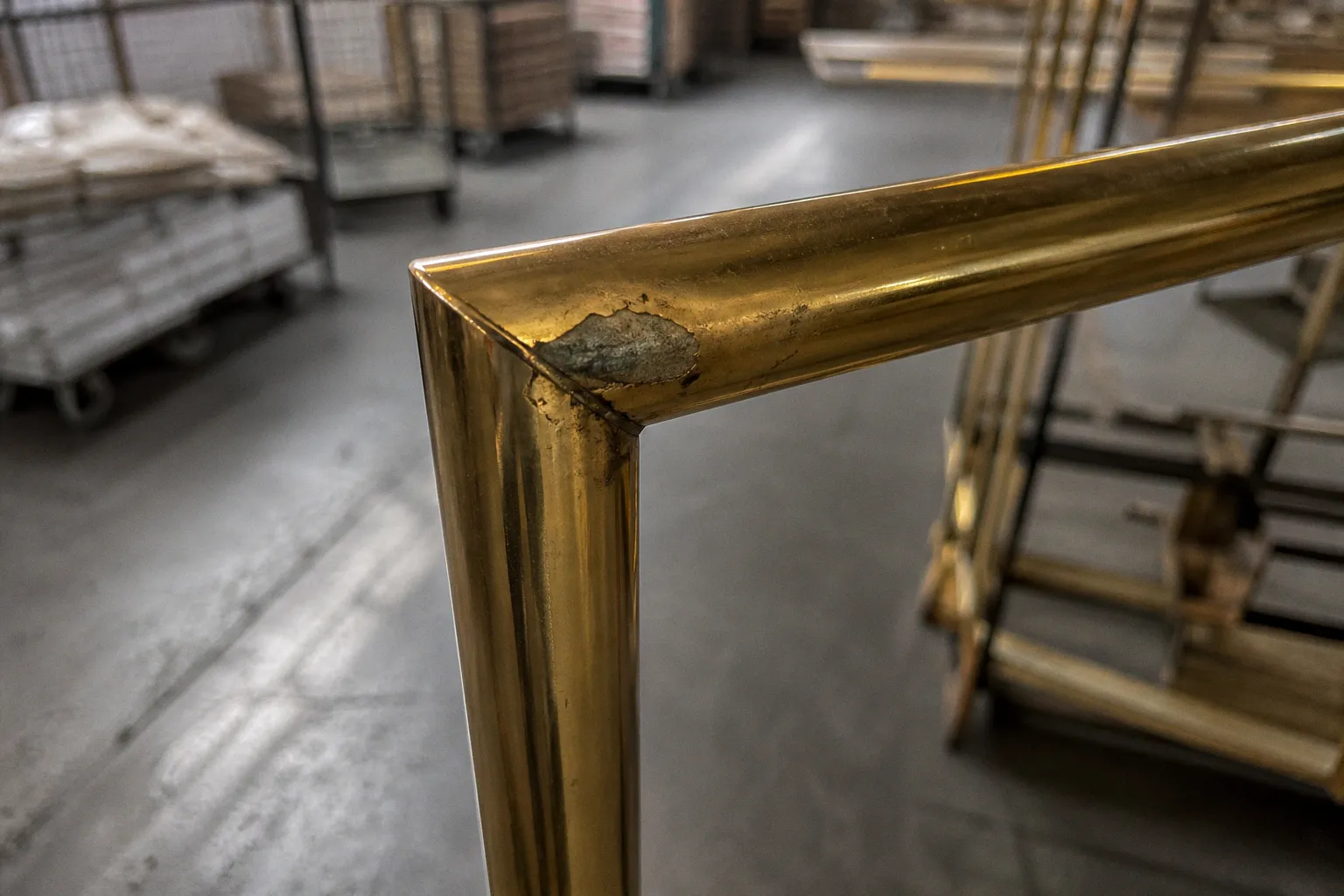
The visible defect arrives later: a brown halo at a weld, a blister beside a joint, or a line of discoloration emerging from a supposedly sealed tube. By then, the rack has already passed fabrication, polishing, plating, packing, and often installation.
For gold polished garment racks, plating quality is therefore not a final-inspection issue. It is a fabrication and drainage issue. A rack can carry 100 kg without measurable structural distress and still be commercially defective because trapped alkaline cleaner or acid migrates through a seam after plating. Load capacity and finish durability are separate engineering problems. They must be specified separately.
The expensive mistake is treating a gold finish as decoration applied to a completed rack. Electroplating is a chemical process imposed on geometry. Every overlap, spot weld, blind tube, poorly closed seam, laser-cut edge, and inaccessible corner becomes part of that process.
A gold finish does not conceal a fabrication defect. It records it, then exposes it under humidity.
Bleed-out begins inside the joint
Electroplated gold display racks move through a sequence of cleaning, activation, rinsing, and deposition stages. Each stage introduces liquid. On an open, accessible component, that liquid drains and rinses away. On a welded tubular frame with sealed cavities or capillary gaps, it can remain trapped.
The relevant failure mechanism is solution entrapment, generally called bleed-out or acid bleed-out. It occurs when process chemistry enters locations such as:
- incomplete seam welds along square or round tubing;
- overlapping sheet-metal joints;
- spot-weld interfaces;
- gussets fitted tightly against uprights;
- blind ends with no drainage provision;
- decorative collars, bases, and fittings assembled before plating;
- tight crevices between a tube and a welded bracket.
The trapped chemistry may be alkaline cleaning residue, acid from activation or plating stages, dissolved metallic salts, or contaminated rinse water. During processing, the rack may appear clean because the liquid is physically contained. After it leaves the plating line, temperature changes, handling, vibration, and ambient humidity allow that residue to migrate outward.
The result is not random tarnishing. It is localized corrosion driven from beneath or beside the plated surface. On a gold-colored finish, the defect is obvious because the surrounding surface is uniform and reflective. A small brown or greenish stain at a weld is enough to downgrade the entire unit.
A factory that specifies “continuous weld” without examining the actual weld profile can still create a plating trap. A weld bead may bridge the visible opening while leaving a narrow internal channel. The channel is sufficient for chemical entry and insufficient for rinsing. This is a geometry problem measured in access and drainage, not in visual weld appearance.
Hollow tubing requires deliberate drainage
Round and square tube frames are the usual failure location. If the tubing has enclosed sections, the manufacturer needs drainage holes positioned so process liquids can enter, escape, and rinse through the component in its actual plating orientation.
Hole placement is not cosmetic. A drain hole located at the wrong end of a tube can leave the lowest section flooded when the rack is suspended on the plating fixture. A single vent hole may relieve pressure but still fail to provide circulation. The part must drain at every process position, not merely when standing upright on a showroom floor.
For a commercial gold rack durability specification, the fabrication drawing should identify:
1. Every enclosed volume. Tubes, capped ends, boxed feet, cast housings, and overlapping folded sections all count.
2. Drain and vent locations. These must correspond to the orientation used for cleaning, rinsing, plating, and drying.
3. Assembly sequence. Components that create inaccessible crevices should be plated before final assembly where feasible.
4. Weld type and continuity. “Welded” is not enough. The drawing should distinguish a structural stitch weld from a sealed weld intended to prevent liquid entry.
5. Masking and attachment points. Racking hooks and electrical contacts can create unplated or poorly rinsed zones if they are not planned before finishing.
A rack manufacturer that cannot show this sequence is not controlling plating quality. It is hoping that rinse time compensates for inaccessible geometry. It does not.
Dry racks can still contain active salts
A common operational error is assuming that heat drying resolves bleed-out. It does not. Drying removes free water. It does not remove dried plating salts lodged in a crevice.
Those salts are hygroscopic. They absorb moisture from ambient air. A rack can leave the finishing line dry, remain stable through packing, and begin bleeding after installation in a humid retail environment. The delayed timing creates confusion: the retailer sees a finish defect months after delivery, while the fabricator sees a part that looked acceptable at dispatch.
Both observations can be true. The chemical residue was present from the start. Humidity activated it later.
This matters especially for brass plated clothing rack wear claims. Not every loss of surface quality is abrasion. A finish can discolor or lift from chemical activity under the coating while the rack has experienced minimal mechanical contact. Misdiagnosing corrosion as ordinary wear leads to the wrong remedy. Adding a thicker topcoat may slow visible damage, but it does not neutralize salts trapped inside the frame.
The distinction is practical:
| Failure signature | Probable mechanism | Correct engineering response |
|---|---|---|
| Brown stain emerging from a weld or bracket edge | Acid or salt bleed-out from a crevice | Redesign joint, add drainage, strip and reprocess |
| Local blistering near a sealed tube end | Entrapped solution attacking the substrate | Open and drain the cavity; evaluate internal corrosion |
| Broad dulling on contact zones | Mechanical abrasion or insufficient coating hardness | Change coating system or increase wear resistance |
| Flaking along laser-cut edges | Oxide scale or poor pretreatment adhesion | Remove oxide mechanically or chemically before plating |
| Isolated chips at impact points | Handling damage or brittle coating stack | Review packing, rack geometry, and coating system |
The table is not a substitute for inspection. It prevents a more basic mistake: treating every defect on gold plating as the same defect.
If a stain originates at a seam, inspect the seam before blaming the gold.
The cost appears after the rack is already complete
A plated garment rack is not a low-cost stamped component. Its value accumulates through cutting, bending, welding, grinding, polishing, fixture handling, pretreatment, plating, inspection, and packaging. A finish failure discovered at the end of that sequence invalidates work from every earlier stage.
Stripping and re-plating a defective part can double the plating price. That figure is conservative in assemblies requiring manual polishing after stripping, re-masking, or rework at welded joints. A stripped surface may also lose dimensional crispness. Threaded features, tight-fitting collars, engraved branding, and polished edges are particularly vulnerable to repeated chemical exposure and mechanical correction.
Industry quotation practices reflect this risk. Rack plating commonly assumes approximately 1% fallout. Barrel plating commonly assumes approximately 2%. Those allowances are not permission to accept defects in a commercial order. They are an admission that finishing is a controlled-loss process even with competent production.
For gold polished garment racks, the financial exposure rises because the defective unit is visually prominent. A basic zinc-plated stockroom rail can sometimes be segregated for internal use. A gold retail fixture cannot. Its finish is part of the display system. One visibly compromised upright can force replacement of a matched bay, not merely a single tube.
The cost chain is usually longer than the plating invoice:
- the fabricator strips or remakes the frame;
- the finisher repeats pretreatment and deposition;
- the assembler replaces glides, caps, casters, or hardware damaged during rework;
- packing is repeated;
- freight is repeated;
- the installation team removes and reinstalls the fixture;
- color variation between the original batch and the replacement becomes a secondary defect.
Gold tone consistency is a further constraint. Electroplated finishes can vary with substrate condition, layer stack, current distribution, and process control. Re-plating one replacement component may produce an acceptable finish in isolation but a mismatch beside units produced weeks earlier. This is why rework should be treated as a manufacturing failure, not a routine repair path.
Laser-cut edges are an adhesion trap
Not all gold garment rack chipping starts with impact. Some starts at the laser cutter.
Laser-cut sheet metal can develop a hard black oxide scale on the cut edge. That oxide is not a stable base for subsequent plating. If it remains after fabrication, the deposited coating may not anchor correctly. The failure often presents as lifting or flaking at the perimeter of a bracket, footplate, logo plate, or laser-cut hook.
Polishing the visible face is not sufficient. The cut edge must be addressed. Depending on part geometry and substrate, this can involve mechanical tumbling, abrasive finishing, aggressive pickling, or a combination of methods. The goal is not merely to make the edge look clean. The goal is to expose a chemically receptive surface before activation and plating.
This is one reason mirror-black polish and gold plating should not be specified interchangeably as generic “premium finishes.” The substrate preparation requirements, defect visibility, and coating behavior differ. A highly reflective finish magnifies edge defects and polishing lines. A dark mirror finish amplifies dust and micro-scratches. Gold plating amplifies contamination, porosity, and color inconsistency. The rack geometry must be built for the selected finish.
A useful forensic check is the location of the chip. A coating that lifts precisely along a laser-cut profile, while the adjacent flat surface remains intact, indicates an edge-preparation issue more readily than ordinary operational abuse. The inspection should then move backward through the fabrication route: cutting method, oxide removal, deburring, cleaning, activation, and rack handling.
PVD and electroplating solve different problems
Traditional electroplating remains widely used for gold-colored retail hardware because it can produce the required appearance across complex forms and can be integrated into established metal-finishing workflows. But it is not the most wear-resistant route by default.
Physical Vapor Deposition, or PVD, produces a substantially harder gold finish. Typical PVD hardness is in the range of 2,000–3,000 HV. Traditional gold electroplating typically falls around 50–100 HV. The difference is not marginal. It changes the rack’s resistance to micro-scratching from hangers, garment hardware, metal rails, repeated adjustment of brackets, and cleaning contact.
PVD also forms a dense, sealed barrier. Conventional liquid electroplating can create a micro-porous network that retains oils, sweat, and moisture. On a high-contact garment fixture, those contaminants can enter the coating system and contribute to corrosion over time.
The comparison should remain precise. PVD does not fix a poorly fabricated frame. A sealed coating over a contaminated weld or a tube containing trapped chemical residue does not remove the underlying defect. It only changes the exterior barrier performance. Likewise, PVD is not automatically appropriate for every rack assembly: component size, coating chamber capacity, fixture geometry, substrate preparation, desired shade, and batch economics determine whether it is feasible.
| Parameter | Traditional gold electroplating | Gold-tone PVD |
|---|---|---|
| Typical hardness | 50–100 HV | 2,000–3,000 HV |
| Coating structure | Can be micro-porous | Dense, sealed barrier |
| Resistance to micro-scratching | Limited in high-contact service | Higher |
| Sensitivity to trapped process liquids | High where fabrication has crevices or blind cavities | The substrate still requires correct fabrication and cleaning |
| Suitability for intricate plated assemblies | Established process, but geometry requires drainage control | Dependent on chamber, fixture, and component constraints |
| Primary failure concern | Bleed-out, porosity, inconsistent deposition, poor adhesion | Poor substrate preparation, edge defects, damage before coating |
The decision is not “electroplate versus PVD” in the abstract. It is a service-condition calculation. For display racks carrying lightweight garments in dry, low-contact locations, a properly engineered electroplated finish may be adequate. For rails with repeated hanger movement, heavy garment hardware, frequent repositioning, and visible contact surfaces, the hardness advantage of PVD is material.
The same restraint applies to structural claims. A 100 kg rated steel garment rack is not necessarily a durable gold rack. The rating may refer to static, evenly distributed load under a defined configuration. It says nothing about coating thickness, weld sealing, drain-hole design, or corrosion resistance. The frame and the finish must each pass their own criteria.
What should be specified before production
The purchase order is often too late. Finish reliability is determined during design release, when changing a tube end, bracket overlap, or weld access costs little. After the rack has been fabricated, the same correction can require cutting, re-welding, grinding, polishing, stripping, and full reprocessing.
A defensible specification for gold polished garment racks should state the following in direct terms:
- Base material and fabrication route: steel grade, tube wall thickness where structurally relevant, sheet-metal processing method, and whether welded joints are sealed or intentionally open.
- Drainage requirement: all hollow members and trapped volumes must have drainage and venting adequate for the actual pretreatment and plating orientation.
- Surface preparation: laser-cut oxide must be removed; weld spatter, grinding contamination, polishing compound, and embedded abrasives must not remain on surfaces intended for plating.
- Finish system: identify whether the gold tone is electroplated or PVD, rather than accepting “gold polish” as a complete description.
- Acceptance standard: inspect weld zones, tube ends, laser-cut edges, hidden returns, and bracket interfaces after an appropriate dwell period, not only immediately after drying.
- Repair rule: parts showing bleed-out, blistering, or edge flaking should be quarantined for root-cause review. Re-plating without correcting the geometry repeats the failure.
A note on thickness: coating thickness can matter, but it is not an independent warranty of quality. A thicker electroplated deposit over trapped acid is still built over trapped acid. A high-hardness PVD layer over laser oxide is still anchored to an unstable edge. Thickness is one variable in a larger system of substrate condition, geometry, adhesion, hardness, and environmental exposure.
The rule is simple, and it is not aesthetic
Gold finishes are specified for visibility. That visibility removes tolerance for fabrication shortcuts.
Use electroplated gold only where the rack geometry can be fully drained, rinsed, and inspected, and where the contact load does not demand extreme surface hardness. Use PVD where hanger traffic and cleaning abrasion justify a 2,000–3,000 HV finish, provided the component can be properly prepared and coated. Reject enclosed tubing, unvented cavities, overlapping joints, and untreated laser-cut edges before they reach the finishing line.
The controlling principle is fixed: design the rack for the chemistry before specifying the color.