Boutique garment rack finishes: four luxury metal paths
Walk into any boutique fixture showroom and ask for a "gold polished garment rack" and you will walk out with one of four completely different products, and your floor manager won't be able to tell them apart from across the store. That's the trap.
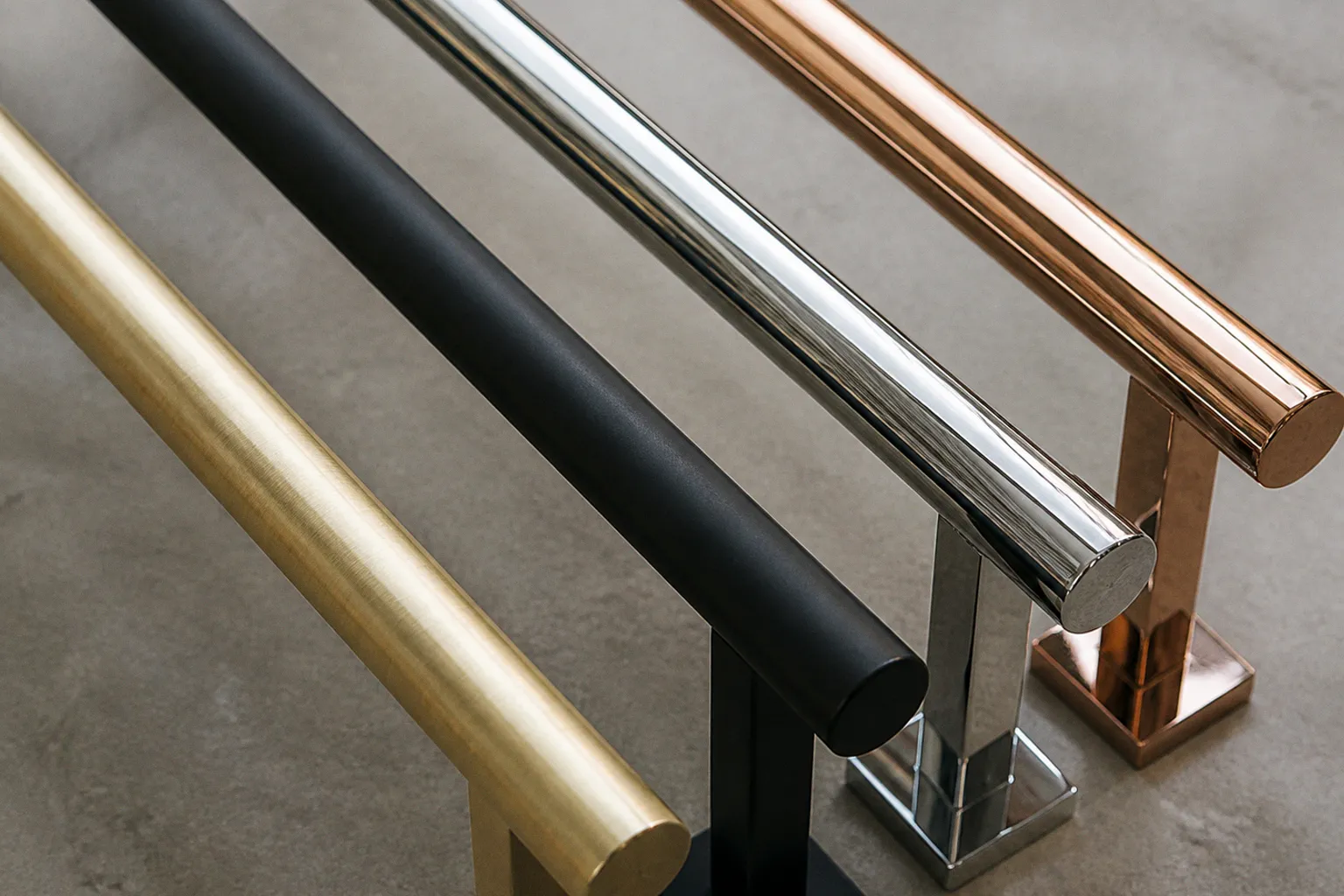
"Gold polished" is a marketing term, not a material specification, and right now it can mean titanium-nitride PVD over stainless steel, gold electroplating over mild steel, a gold-toned powder coat over mild steel, or solid lacquered brass. The visual read at the endcap is almost identical. The behavior under eighteen months of hanger traffic, customer touch, and Friday-night dressing-room pile-up is not. Every one of those paths behaves differently on your P&L, and most of the failures happen in places you can't see from the front of the house.
A single marketing phrase can hide four finish systems — and three of them will fail faster than your next seasonal reset.
Let's open the hood.
The Engineering of PVD: Hardness and Mirror-Finish Integrity
When we spec a true premium boutique fixture — the kind that lives behind a glass storefront and never gets rotated out for a sample sale — we're usually looking at Physical Vapor Deposition, or PVD. Here's how I explain it to junior merchandisers on the floor: think of PVD as a vapor-locked armor plating that bonds at the molecular level rather than sitting on top of the metal like paint. Inside a vacuum chamber, chromium or titanium-nitride atoms are deposited onto a stainless-steel substrate, building a film that is typically 0.1 to 3 μm thick. That's microscopically thin, but the hardness numbers tell the real story.
PVD coatings measure 2,000 to 3,000 HV on the Vickers scale. Traditional gold electroplating sits at 50 to 100 HV. Do the math — and we do, every time we spec a high-touch fixture — and you're looking at roughly thirty times the scratch resistance of a plated finish. On a floor where metal hangers slide along the bar forty, fifty, sixty times a day per SKU, that difference is the gap between a fixture that still photographs beautifully for the lookbook in year two and one that goes dull before the first anniversary.
Mirror black PVD is the variant you'll see in modern flagship stores — the dark chrome that throws reflections without looking like polished aluminum. To get that read, the stainless substrate has to be polished to a No. 8 super-mirror finish with surface roughness below 0.05 μm Ra before the chromium atoms go into the chamber. When you walk a buyer past a mirror-black display, the reflection on the bar should be clean enough to read a watch face in. If it's hazy, you're looking at a No. 7 or worse, and the PVD will lock in that haziness permanently.
We should be clear here: PVD is not scratch-proof. A determined customer with a steel-belted handbag can still leave a mark, and repeated sliding contact with chromed wire hangers will eventually burnish the high points. But for a flagship fixture that anchors a brand wall, PVD buys you the longest visual runway of any finish on the commercial market.
PVD isn't indestructible — but at 2,000 to 3,000 HV, it buys you seasons, not months.
Powder Coating vs. Electroplating: Film Thickness and Durability
Now here's the finish path most boutique buyers actually end up with, because it's the one the sales rep pushes when the budget gets tight: powder coating over mild steel. It's not a bad finish. It's just a fundamentally different finish than electroplating, and treating them as interchangeable is where we lose money.
The thickness difference alone reframes the conversation. Powder coating lays down a polymer barrier of 50 to 125 microns — that's 2.0 to 5.0 mils of cured film sitting on top of the steel. Traditional wet electroplating — the chrome, gold, brass, and copper finishes — deposits a metal film of just 5 to 25 microns. The powder coat is roughly five to ten times thicker. In a store where customers don't touch the racks, that doesn't matter much. In a store where customers grab, lean, and slide hangers, it matters a lot, because the powder coat has a much longer runway before it wears through to bare metal.
Here's the comparison I walk every junior buyer through before they sign a PO:
| Parameter | Powder Coating (over mild steel) | Electroplating (chrome, gold, brass, copper) |
|---|---|---|
| Film thickness | 50–125 microns (2.0–5.0 mils) | 5–25 microns |
| Surface hardness | Roughly 80–120 HV (polymer matrix) | 50–1,100 HV 0.1 depending on metal |
| Typical wear pattern | Slow, uniform burnish over years | Edge peeling, flaking, base-metal bleed |
| Touch feel | Warm, slightly grippy | Cold, slick, mirror-smooth |
| Best retail use case | High-touch traffic, denim walls, outerwear | Decorative trim, low-contact display |
Notice that gold electroplating line: 50 to 100 HV. That's softer than a quality powder coat. It looks more premium on day one because of the mirror reflectivity, but in a high-touch zone it wears through and exposes the mild-steel substrate underneath, which then corrodes and bleeds rust onto your garments. We've all seen the orange stain on a white silk blouse. That is almost always electroplated gold over mild steel that failed at the wear point.
If you're speccing for a chrome look specifically, you also need to know about black chrome — it's become a favorite for minimalist boutiques, but it's a softer finish than standard bright chrome. Black chrome measures 250 to 350 HV 0.1; bright chrome sits at 950 to 1,100 HV 0.1. That's roughly a three-to-four-fold hardness drop. Beautiful for a low-touch statement wall. Wrong choice for a clearance rack where customers grab-and-yank.
The thinnest finishes on the market are the ones that look most premium on day one — and fail the fastest in a busy store.
The Hidden Risks of Acid Bleed-Out and Joint Geometry
Here's the failure mode that ends more boutique fixture investments than any of the obvious wear issues, and it's almost never caught during the showroom walk-through. We call it acid bleed-out, and it shows up six to eighteen months after install as a brown or green stain creeping out of a tube seam, a base plate, or a weld joint.
The mechanism is straightforward once you've seen it. During fabrication, the rack goes through pickling acids to clean the welds and through plating salts to deposit the finish. If any of those process chemicals get trapped in an unvented tube, a closed seam, or a capillary gap between components, they sit there during shipping and install. Then, months later, moisture and temperature swings in the store pull them back out through the joint. What you see is a permanent stain that no amount of cleaning will remove, and what you smell on a bad day is a faint metallic tang that customers can't identify but definitely notice.
If-then scenario time: if you're speccing a rack with welded U-frames where the bottom rail is capped but not vented, you are creating a reservoir for acid bleed-out. Then, when the first humid summer hits, you'll see staining at the cap. If you're speccing a rack with bolted fittings where the joint geometry leaves a micro-gap between the tube wall and the fitting shoulder, the same thing happens at the bolt line. The fix is on the manufacturer's side — vented tube ends, sealed weld seams, and proper post-plating rinsing — but it's on your side to ask about it before you place the order.
What I want every floor manager to do before signing a fixture PO: ask the manufacturer how they rinse after plating, whether tube ends are vented, and whether welded seams are passivated. If the rep can't answer those three questions, you're buying a rack that's already on the clock.
Brass and Copper: Balancing Aesthetic Patina with Protective Lacquers
Brass and copper occupy a different corner of the boutique finish map. They're the finishes buyers ask for when they want warmth, weight, and that heritage feel — the kind of read you get from a brushed brass valet stand or a polished copper top-shelf display in a made-to-measure suit room. They also oxidize. That's the deal. Brass tarnishes. Copper patinas. The question isn't whether the finish will change; it's how you slow that change down without ruining the look the buyer paid for.
There are three sourcing paths here, and they perform very differently on a working retail floor. Natural unlacquered copper is the purist's choice — it will start shifting tone within weeks of install and needs polishing roughly every quarter to maintain its showroom shine. Most boutique operators we work with skip this option because the labor cost of quarterly polishing across a thirty-fixture floor is brutal, and the day you miss a cycle, your endcap starts looking distressed in a way the buyer didn't authorize.
Lacquered copper, sealed with a marine-grade lacquer, is the middle path. The lacquer buys you twelve to twenty-four months of stable finish, depending on traffic and UV exposure. But here's the catch: traditional spray-applied lacquer tends to be thinner on the peaks of a brushed grain, and those peaks are exactly where hanger friction concentrates. The lacquer fails first at the high points, then the tarnish creeps down into the brush pattern, and you're left with a striped, mottled look that no amount of spot-polishing will fix.
The third path is the one we recommend for high-density retail: copper-plated steel. You get the visual read of copper on a tougher substrate, and the plating is dense enough to handle daily contact without going uneven. It's also the path most commercial fixture catalogs mean when they list "copper" without qualification — which is exactly why the salesperson's answer matters.
For brass, the same logic applies with an added wrinkle: brushed brass is where the finishing technique really earns its keep. Electrophoretic lacquer — e-coating — deposits a denser, more uniformly bonded protective film than spray-applied lacquer, especially across the peaks of the brush grain. If your brass rack is going to live in a dressing-room alcove where customers handle it constantly, ask for e-coated brass, not spray-lacquered. The cost difference is small. The lifespan difference is not.
Lacquer isn't a permanent shield — but the way it's applied decides whether your brass ages gracefully or just ages.
Structural Standards: Load Capacity and Material Specifications
Finish gets you the look. Structure keeps the fixture standing after the first markdown sale. And this is where boutique buyers get burned more often than they'd like to admit, because finish catalogs rarely list the tube specs, and showroom reps don't volunteer them.
The minimum specifications for a commercial-grade garment rack, the ones we spec into every floor plan regardless of finish, are these: a tube diameter of at least 25.4 mm (1 inch) and a wall thickness of 0.8 mm to 1.0 mm. That combination supports a rated load of 120 to 200 lbs per bay, which covers a fully stocked denim wall or a winter coat display without meaningful deflection.
If you're getting a quote on a rack with 19 mm tubing and a 0.6 mm wall, you're looking at a residential-grade product dressed up in a boutique finish. It will photograph fine for opening week. By month three, with a full load of wool overcoats, the front rail will bow visibly and the hangers will start migrating toward the center of the bar under gravity. The customer notices — even if they can't articulate what they notice, they register it as a low-end read, and your dwell time drops.
Two more structural checkpoints we run on every spec. First, joint geometry: a welded joint is stronger than a set-screw joint at the same tube dimension, but it also creates more opportunities for acid bleed-out if the weld isn't passivated. A properly crimped and glued mechanical joint can outperform a sloppy weld. Second, base plate footprint: a 25.4 mm tube on a 100 mm round base will rock under load on any floor that isn't perfectly level. We spec rectangular base plates at least 150 mm on the long axis for any rack that holds more than 80 lbs per bay.
The KPI I leave every floor manager with: a properly finished and properly structured boutique rack should deliver a minimum of three years of visual runway in a high-touch zone before the finish becomes a merchandising liability. Less than that, and you're shopping by price. More than that, and you bought into a system — not a SKU.