Boutique rack finishes: which metal plating suits your brand?
A boutique garment rack can either reinforce the merchandise or quietly compete with it.
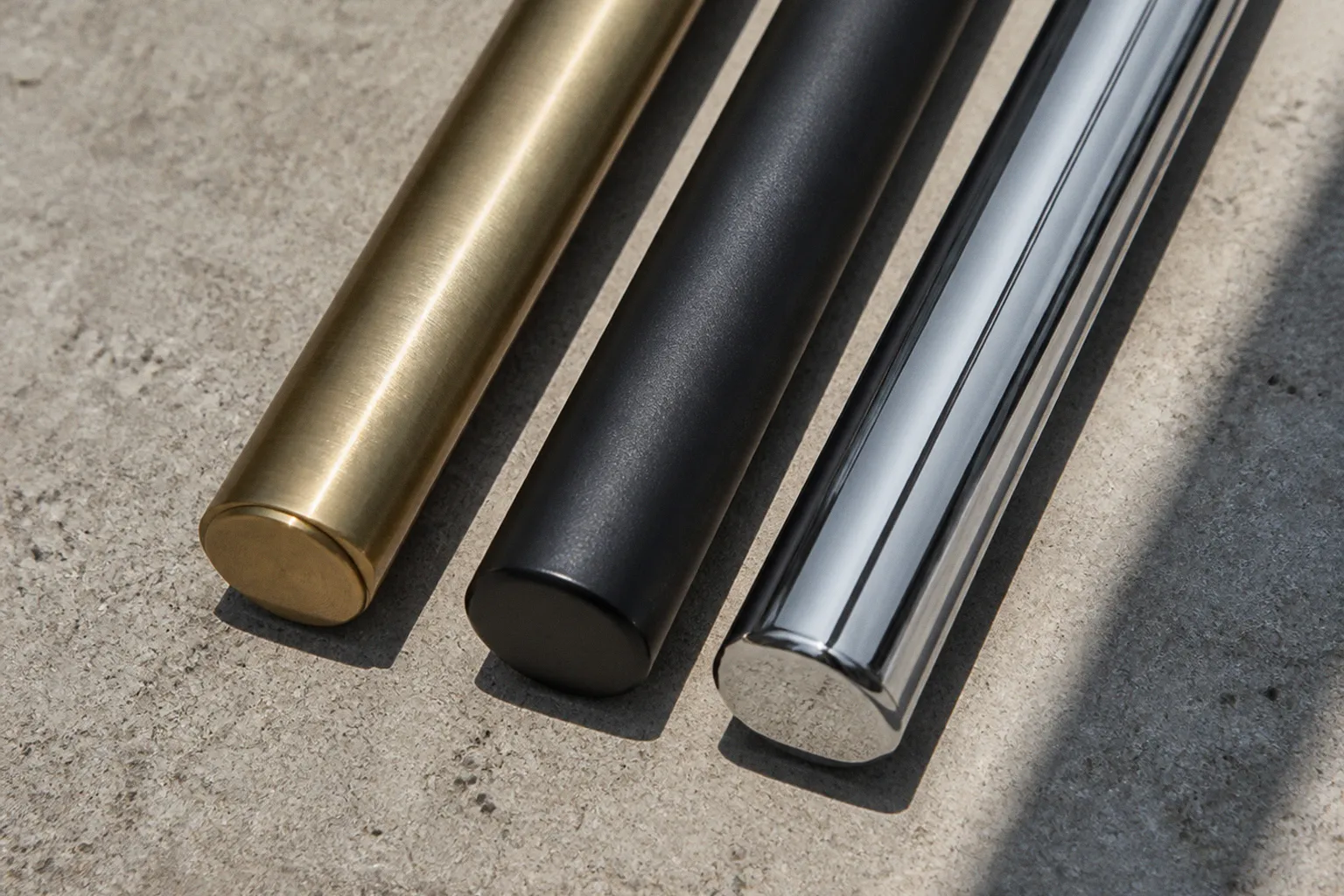
A warm brushed brass finish can make a premium collection feel considered; a mirror black polish finish can sharpen a monochrome concept; a bright chrome or polished stainless rack can keep the room crisp and architectural. But the finish is not just a color decision. It is the surface your hangers, hands, cleaning routine, moving fixtures, and daily customer traffic will test.
That is where many retail fit-outs go wrong. The sample looks excellent under showroom lighting, then the rack enters a high-dwell zone, metal hangers drag across the rail, staff reposition it several times a day, and the first visible wear appears exactly where customers look: at hand height and along the front edge. Choosing among boutique garment rack metal finishes means balancing brand identity with coating structure, substrate quality, and the actual friction pattern on your sales floor.
Electroplating: the classic route to gold, brass, chrome, and copper
Traditional wet electroplating remains one of the most recognizable retail rack plating options because it produces the visual language many boutiques already understand: polished gold garment racks, chrome rails, copper accents, and brass-toned display hardware with a thin metallic skin over a structural substrate.
The process deposits a metal film onto the rack, and the finished appearance depends heavily on what lies underneath it. A well-prepared steel or stainless component can carry a clean, reflective surface; a poorly ground weld or uneven joint can remain visible through the finish, particularly on mirror-polished pieces where reflected light exposes every transition.
Traditional electroplated finishes typically measure between 5 and 25 microns in thickness. That is enough to create the desired metal appearance, but it is still a relatively thin layer compared with powder coating. The practical implication is straightforward: electroplating is excellent at delivering a refined visual finish, but it does not create a thick polymer barrier around the rack.
We should therefore separate two decisions that are often bundled together:
- What does the rack need to look like? Gold, brass, chrome, copper, or another polished metal effect.
- What kind of daily abuse will the surface receive? Light boutique handling, constant hanger movement, frequent fixture changes, or aggressive cleaning.
Electroplating can be the right answer when the rack sits in a controlled, high-visibility environment and the finish is central to the brand. It becomes a more exposed choice when the same rail is used for dense SKU presentation, when hangers are pulled rapidly across the bar, or when staff routinely drag fixtures instead of lifting them.
A polished finish also changes the customer’s visual experience. Reflective surfaces catch sightlines from across the floor and can make an endcap or feature wall feel brighter. That can increase the perceived importance of the merchandise around the rack. But the same reflectivity will reveal fingerprints, dust, water marks, and surface damage more quickly than a low-sheen texture.
Where electroplated finishes make sense
Electroplating works particularly well when you are building a visual hierarchy rather than covering every fixture in the same high-shine treatment. A boutique might use polished gold garment racks in the entrance statement zone, brushed brass garment racks through the main collection, and a quieter painted or powder-coated back-of-house system for replenishment.
That approach protects the most expensive-looking finish from being asked to do every job in the store. The entrance fixture carries brand theater; the denser rails carry SKU density and turnover.
A metallic finish should earn its place on the floor by doing two jobs: attracting the eye and surviving the way customers handle the merchandise.
PVD: a thin coating with a very different hardness profile
Physical Vapor Deposition, or PVD, is often discussed as if it were simply a more modern version of electroplating. That is too simple. The visual result may overlap with plated gold, black, brass, or other metallic finishes, but the coating system and performance profile are different.
PVD is applied in a vacuum environment and typically measures 0.2 to 5 microns. The layer is thinner than a traditional electroplated film, yet its reported surface hardness is substantially higher: approximately 2,500 to 3,000 Vickers (HV), compared with roughly 100 to 800 HV for traditional electroplating.
Those figures do not mean a PVD rack is immune to damage. Metal hangers can still mark surfaces over prolonged use, and a hard coating cannot compensate for a weak weld, a poorly prepared substrate, or careless handling during installation. What the hardness difference tells us is that PVD is engineered to resist surface wear through a harder coating system, not by adding a visibly thick layer.
That distinction matters on racks because hanger friction is repetitive, localized, and easy to underestimate. The same section of rail may be contacted hundreds of times during a busy trading day, especially in a high-conversion zone where customers compare sizes, colors, and adjacent SKUs. If the finish is dark, reflective, or highly contrasting with the base metal, any change in surface appearance will be more noticeable.
PVD versus traditional plating
| Parameter | Traditional electroplating | PVD coating |
|---|---|---|
| Typical coating thickness | 5–25 microns | 0.2–5 microns |
| Reported hardness | Approximately 100–800 HV | Approximately 2,500–3,000 HV |
| Visual applications | Chrome, gold, brass, copper, polished metallic effects | Metallic and colored finishes, including premium contemporary effects |
| Main performance question | How well will the thin metal film tolerate contact and cleaning? | How well will the hard coating and prepared substrate handle repeated surface friction? |
| Critical manufacturing dependency | Surface preparation, weld finishing, and adhesion | Surface preparation, weld finishing, adhesion, and controlled vacuum application |
| Best retail role | Brand-led feature fixtures and decorative display moments | High-touch or high-visibility fixtures where surface wear is a primary concern |
In practical merchandising terms, PVD deserves serious consideration when the rack is both a visual asset and a working fixture. That may include a premium wall bay, a central display with strong dwell time, or a compact boutique where every piece of hardware is close to the customer’s hands.
However, we should not turn hardness into a substitute for operational discipline. If staff use the rack as a temporary storage point, hangers are thrown onto the rail, or fixtures are repeatedly knocked against one another, the coating is still being asked to manage impact and abrasion. PVD improves the surface performance equation; it does not remove the equation.
Powder coating: the thicker barrier and the broader color system
Powder coating solves a different problem. Instead of depositing a thin metallic film, it lays down a cured polymer barrier over the steel display rack. The typical film thickness is 50 to 125 microns, or 2.0 to 5.0 mils.
That greater thickness gives powder-coated steel a visual and practical character distinct from electroplated or PVD surfaces. The finish can be smooth, textured, matte, or satin depending on the specification, and the color system is not limited to the appearance of a particular metal. Deep black, warm neutrals, muted colors, and strong brand tones are all natural territory for powder coating.
For a retailer, this opens a useful route between design consistency and operational resilience. A black powder-coated rack can support a dark interior without the fingerprint sensitivity of a mirror black polish finish. A warm neutral can echo a boutique palette without pretending to be brass. A textured surface can reduce the visual emphasis of minor handling marks, although it should not be treated as a guarantee against wear.
Powder coating is particularly logical when the rack needs to support a dense planogram, frequent stock movement, and a high number of customer contacts without making a polished metal statement. It also provides a coherent finish across uprights, bases, shelves, hooks, and accessory frames, which can be valuable when the display system has many different components.
The commercial trade-off
Powder coating often gives us more freedom in the visual system, but it changes the kind of luxury signal the rack sends. Polished metal display racks reflect light and create a sharper sense of occasion. Powder-coated surfaces absorb or soften light, making the merchandise, signage, and lighting scheme carry more of the visual work.
Neither is automatically better. If the brand depends on jewelry-like hardware, a matte black rail may feel underpowered. If the merchandise is the hero and the store already has strong lighting, graphics, and color blocking, a quieter powder-coated frame may improve sightlines by reducing competing reflections.
Use the finish as part of the merchandising plan:
- Choose a reflective finish when the fixture needs to function as a visual beacon or premium focal point.
- Choose powder coating when the rack should disappear behind the assortment and support clear product reading.
- Use a high-contrast finish selectively when you want to define an entrance zone, endcap, or capsule collection.
- Avoid covering every fixture in the strongest finish available; repetition can flatten the store’s visual hierarchy and increase maintenance exposure.
Substrate integrity is where the finish either succeeds or fails
Retail buyers often compare samples as though the coating were the whole product. It is not. The substrate and the preparation beneath the finish determine whether the surface looks controlled once it leaves the sample board.
Commercial stainless steel garment racks commonly use Type 304 or Type 316 stainless steel as the base substrate for brushed or mirror-polished finishes. That choice gives manufacturers a stable foundation for a visible metal surface, but the grade alone does not guarantee a flawless result. Weld grinding, edge transitions, polishing quality, and cleaning before application all remain critical.
The same principle applies to coated steel. Powder coating can cover a broad range of visual imperfections, but it cannot turn poor fabrication into precision manufacturing. An uneven weld may create a raised line beneath the coating. A contaminated surface may compromise adhesion. A rough cut edge can remain a weak visual or physical point even after the color is applied.
When reviewing a rack specification, we look beneath the finish and ask how the component was made:
1. Are the welds cleanly ground where the rack will be viewed at close range?
This matters most on polished stainless, mirror black, and bright plated finishes, where reflected light makes transitions obvious.
2. Are the visible tubes and connectors aligned consistently?
A premium coating cannot correct a rail that appears twisted, uneven, or poorly indexed against the upright.
3. Has the base metal been properly cleaned and prepared?
Both PVD and powder-coated finishes depend directly on surface preparation for adhesion and long-term visual quality.
4. Are the edges and contact points designed for retail handling?
Sharp transitions, exposed fasteners, or poorly finished hanger stops create friction points for both the customer and the garment.
5. Does the finish continue across the parts customers actually touch?
A rack may look premium from the aisle while showing a mismatched or less durable treatment on the rail, base, or adjustment hardware.
This is not an engineering exercise for its own sake. A customer notices uneven reflections, rattling connections, chipped edges, and inconsistent color before they can explain why the fixture feels cheap. That impression transfers to the merchandise.
The coating is only as convincing as the fabrication underneath it. Clean weld grinding is part of the customer experience, not a hidden factory detail.
Match the finish to hanger friction, dwell time, and SKU density
The correct finish depends on how the rack is used, not merely where it appears on the mood board. We can map the decision against four retail conditions: customer contact, hanger movement, product density, and visual responsibility.
Low-contact feature display
A rack holding a tightly edited capsule collection may have relatively low hanger movement and a strong role in the entrance sightline. Here, polished gold, copper, chrome, or a high-end PVD finish can make sense because the fixture is functioning as a brand signal as much as a storage solution.
The assortment should remain edited enough that the rack does not become visually crowded. If the rail is packed, the customer’s eye reads hardware and garment mass as one congested block, and the finish loses its ability to frame the product.
High-contact main-floor rail
A main-floor rail with high SKU density experiences a different pattern. Customers push hangers aside, compare sizes, and return items unevenly. Staff replenish it throughout the day. In this zone, a robust PVD specification or a well-prepared powder-coated steel rack may be more commercially sensible than a delicate-looking plated surface, depending on the required aesthetic.
The merchandising goal is not simply to keep the rail attractive. It is to maintain easy product access. If a finish makes the retailer overly cautious about normal customer handling, the fixture is working against conversion.
Flexible fixtures and frequent resets
If the floor plan changes often, the rack will experience more than hanger friction. It may be lifted, rolled, nested, or moved near other fixtures. Surface selection should then be paired with physical protection during resets and clear staff handling procedures. No coating should be described as eliminating scratches or wear under prolonged abuse.
A practical layout move is to reserve the most reflective or premium finishes for fixtures that will not be repeatedly relocated. Keep flexible, modular units in a finish that can tolerate the rhythm of seasonal floor changes without making every scuff a visual emergency.
Humid or demanding environments
Where the store environment places greater demands on corrosion resistance or cleaning, stainless substrates deserve closer attention. Type 304 and Type 316 are common commercial options for stainless garment racks, but the finish and fabrication still matter. A mirror polish will expose marks more readily than a brushed surface, while a plated or coated finish requires its own care and inspection standards.
Avoid promising universal service life. Retail traffic, cleaning chemistry, hanger material, installation quality, and maintenance routines vary too widely for a single lifetime claim to be useful. Instead, ask the manufacturer what surface preparation, cleaning method, and handling conditions the specified finish is designed to support.
Brushed brass, mirror black, and polished stainless: reading the brand signal
The finish is also a customer-psychology tool. Customers do not evaluate a rack in isolation; they read it as evidence about the store’s price point, confidence, and product curation.
Brushed brass garment racks
Brushed brass gives us warmth without the full reflectivity of a mirror gold finish. The directional texture can soften fingerprints and reduce glare, while the warm tone supports fashion, interiors, beauty, and lifestyle assortments that need a more tactile environment.
Its strength is controlled richness. It can make a fitting-room approach, accessory wall, or premium collection feel elevated without turning the entire floor into a reflective surface. The quality of the brushing pattern matters because uneven grain direction can make separate components appear mismatched.
Mirror black polish finish
A mirror black polish finish creates strong contrast and can work beautifully in a modern, minimal, or monochrome store. It also has a demanding maintenance profile from a visual standpoint: reflective dark surfaces show dust, fingerprints, and handling marks readily.
Use it where the store can support the finish with disciplined cleaning and controlled fixture placement. If the rack sits in a busy queue, beside a high-contact fitting-room entrance, or in a zone where bags and carts strike the uprights, the dramatic appearance may come with a higher visible-maintenance burden.
Polished stainless steel
Polished stainless provides a bright, technical, clean-lined effect and can support a wide range of product categories. It often works when the interior needs light reflection without the warmer or more decorative signal of gold or brass.
The substrate conversation matters here. Commercial racks commonly use Type 304 or Type 316 stainless steel for brushed or mirror-polished finishes, but the final appearance still depends on the polishing sequence and weld treatment. On a mirror surface, every fabrication inconsistency becomes part of the merchandising environment.
Copper and colored metallic effects
Copper polished racks can bring warmth and distinction to a store, especially when the brand uses terracotta, leather, cream, or deep green tones. The more unusual the metallic color, the more carefully it should be repeated across the space. A single copper rack can look intentional; scattered, unsupported metallic accents can look like leftover procurement.
Gold, copper, brass, and chrome are not interchangeable simply because they are all reflective. Gold tends to push the fixture toward luxury, copper toward warmth and craft, brass toward heritage or tailored premium, and chrome toward precision and modernity. The right choice depends on what the customer should feel before touching the garment.
A practical selection route for your next rack specification
We can make the decision faster by starting with the floor behavior rather than the finish catalog. Before requesting samples, define the rack’s commercial assignment:
- Is it a feature fixture, an everyday rail, or a replenishment unit?
- How dense will the SKU presentation be?
- Will customers move metal hangers across the rail continuously?
- Will staff relocate the fixture for launches, markdowns, or seasonal resets?
- Does the rack sit in a direct sightline from the entrance or an endcap?
- Should the fixture attract attention, frame the product, or visually recede?
- Will fingerprints and dust be obvious under the store’s lighting?
- Are the base metal, welds, edges, and finish specified together, or only the color name?
Then compare the likely routes:
| Retail requirement | More suitable direction | Why |
|---|---|---|
| High-impact entrance fixture with edited assortment | Polished plating or premium PVD | Strong visual presence and clear brand signaling |
| High hanger friction on a visible rail | PVD or carefully specified powder coating | Surface performance becomes more important than decorative tradition |
| Quiet framework behind colorful merchandise | Powder-coated steel | Lower visual competition and broad color flexibility |
| Warm premium identity without maximum glare | Brushed brass or satin metallic treatment | Adds warmth while moderating reflection |
| Crisp, architectural interior | Brushed or mirror-polished stainless | Clean visual language with a commercial, precise feel |
| Dark, contemporary concept | Mirror black polish or black powder coating | Choose based on desired reflectivity and maintenance visibility |
| Frequently reconfigured floor | Powder-coated modular system or resilient PVD specification | Better aligned with repeated handling, provided fabrication is sound |
The strongest specification will state more than the finish name. It should identify the substrate, surface preparation, weld treatment, coating or plating route, and the components that receive the finish. A phrase such as “brass effect” or “black metallic” is a visual starting point, not a complete manufacturing brief.
When samples arrive, review them under the lighting used in the store, not only under a supplier’s showroom lights. Put a hanger on the rail. Look at the front edge from the customer’s eye line. Check the welds, the underside, the joints, and the points where staff will grip the fixture. A finish that looks impressive at arm’s length can feel inconsistent when the customer stands within touching distance.
The finish should support the KPI, not become the KPI
A rack finish is successful when it helps the customer see, approach, touch, and select the product with less friction. That may mean a polished gold rail that creates an entrance stop, a brushed brass system that raises perceived value without glare, a black powder-coated rack that lets color-led merchandise dominate, or a PVD surface specified for a high-contact presentation zone.
We should measure the decision against retail outcomes: cleaner sightlines, stronger dwell time at the intended feature, easier hanger movement, fewer visibly worn touchpoints, and a fixture that still supports the planogram after repeated resets. The coating’s technical data matters because it predicts how the surface may behave; the layout matters because it determines what the customer and staff will actually do to it.
Choose electroplating for its classic visual language when the traffic pattern supports it. Choose PVD when surface hardness is central to the specification and the rack must carry both attention and contact. Choose powder coating when you need a thicker polymer barrier, broad color control, and a quieter visual system. In every case, insist on substrate integrity and clean preparation, because the most expensive finish cannot rescue careless fabrication.
The final test is simple: walk the floor from the entrance, then from the customer’s hand position. If the rack pulls attention toward the merchandise, keeps the sightline clean, and remains credible after the workday’s handling pattern, it is doing its job. If the finish is the first thing you notice—or the first thing you worry about—it needs to be reassigned, redesigned, or specified more honestly.