Clear coat on raw steel racks: does it stop rust?
I've lost count of how many times a buyer has asked whether a rack described as “clear-coated raw steel” will stay rust-free. The wording sounds reassuring.
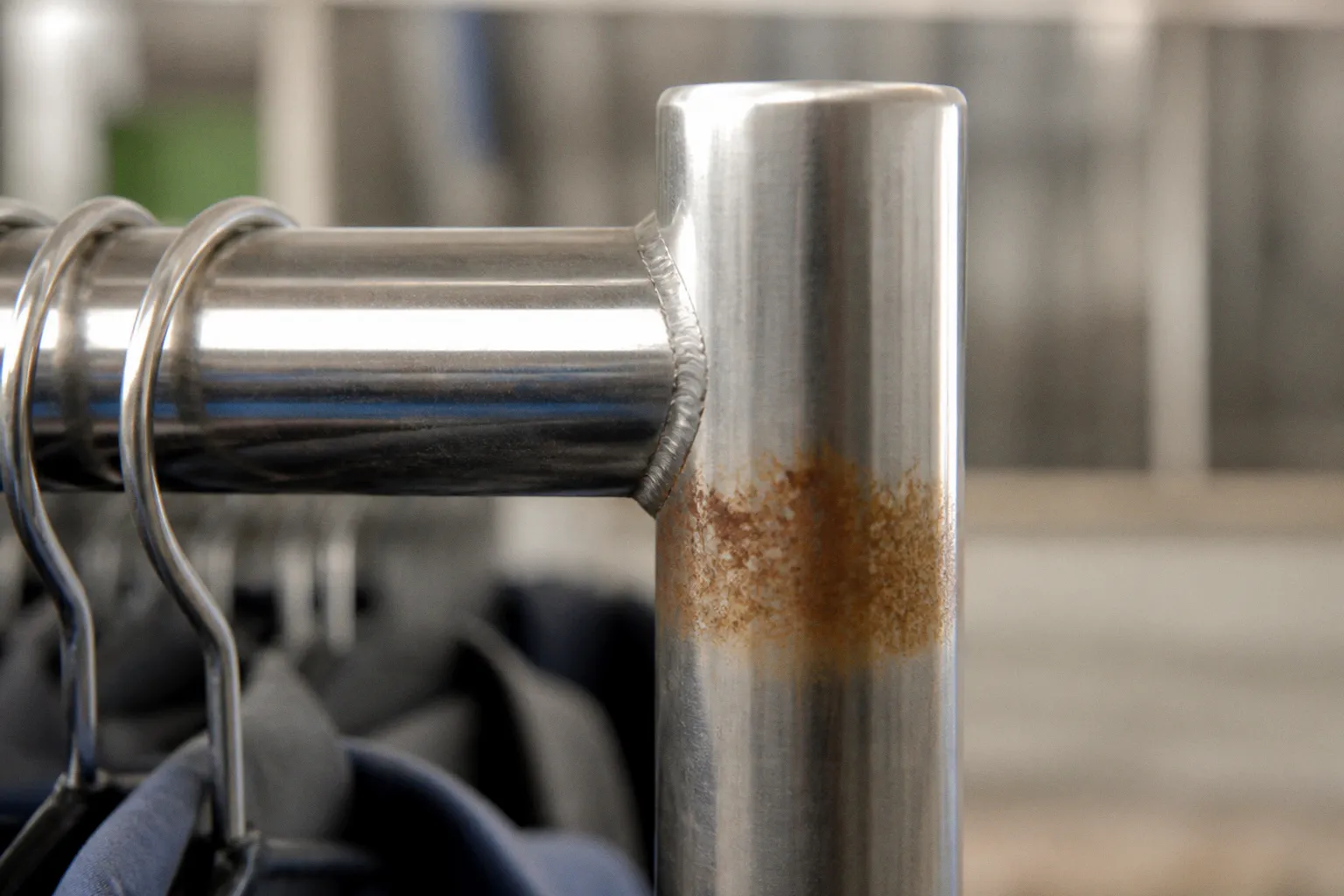
Clear Coat on Raw Steel Racks: Does It Actually Stop Rust?
It suggests that the steel has kept its honest, unfinished look while gaining an invisible layer of armor.
That is not quite what is happening.
A clear coat on a raw steel garment rack is a real barrier against oxidation, but it is not a permanent force field. It delays corrosion rather than eliminating the conditions that cause it. How long that delay lasts depends on the steel preparation, the coating system, the amount of contact the rack receives, the surrounding humidity, and what gets used to clean it.
That distinction matters in commercial interiors. A rack in a dry, climate-controlled showroom may remain presentable for years. The same finish on a basement stockroom rail, a coastal shop, or a heavily handled display can deteriorate much sooner. The material has not changed; the workload and environment have.
How a Clear Coat Protects Bare Steel
The basic mechanism is straightforward. Untreated steel reacts with oxygen and moisture in the surrounding air. The result is iron oxide: rust. A clear coat interrupts that process by placing a film between the steel surface and the environment.
That sounds simple, and at a basic level it is. The difficulty is that the film has to remain continuous and well bonded. A scratch, pinhole, contaminated patch, or worn contact line can create a route for moisture to reach the steel. Once corrosion begins under the coating, the film may hide the problem rather than prevent it.
In this category, “clear coat” can describe several different finish systems. They are not interchangeable:
- Clear lacquer is usually a solvent-based finish sprayed over the prepared steel. It can provide an attractive low-cost surface, but it is comparatively easy to scratch and may soften under aggressive cleaning chemicals.
- 2K urethane clear is a two-component coating that cures into a harder, more chemically resistant film than ordinary lacquer. It is often used where the appearance of raw metal matters but the rack still needs to tolerate regular indoor handling.
- Clear powder coating is applied as a dry powder and cured with heat. It can produce a more uniform and durable film, although the final result still depends on the preparation of the steel and the quality of the application.
- Clear conversion or specialty finishes may also appear in a supplier’s documentation. These can combine chemical treatment with a transparent topcoat, so the name of the system matters more than the word “clear.”
All of these finishes buy time. None makes raw steel immortal. A clear coat is a sealed lid, not a vacuum chamber—and lids develop leaks.
The most important question is therefore not simply whether the rack is clear-coated. It is what was done before the clear coat went on, how thick and uniform the film is, how it was cured, and whether the supplier has considered the rack’s actual use.
Where the Barrier Breaks Down
The finish usually does not fail because the idea of a clear coat is wrong. It fails because one part of the system was weak from the beginning or because everyday use gradually creates an opening.
Contamination before coating
Oil from fingerprints, silicone residue, dust, polishing compounds, and cleaning products can interfere with adhesion. A surface may look clean while still carrying a thin contaminating film. The coating bonds well around the affected area but poorly over it, leaving a weak interface where moisture can work its way underneath.
This is why degreasing is not a cosmetic preparation step. It is part of the corrosion system. If the steel is not properly cleaned before coating, the top layer may look excellent at installation and still have a built-in failure point.
Rust that begins before the finish
Raw steel does not need a dramatic exposure period to start oxidizing. Small corrosion sites can develop before the coating is applied, especially if the steel has been handled, stored in humid air, or left with residue from fabrication.
Those sites may be difficult to see once the clear finish is applied. The coating then traps a problem that was already present. Later, the rust expands, lifts the film, and creates the familiar orange halo around a scratch or fitting.
A transparent finish makes this more noticeable because it does not hide the substrate. That is part of its appeal, but also part of its burden: every discoloration, prep mark, and corrosion site remains visually available to the customer.
Friction from hangers
Garment racks have a failure mode that decorative steel furniture does not: constant sliding contact along the same narrow section of the rail.
Plastic and fabric-covered hangers are relatively forgiving. Bare metal hangers are more aggressive, particularly when a packed row is pushed sideways or when a hanger is dragged rather than lifted. Repeated contact can dull the surface, create a bright wear track, and eventually break through the protective film.
There is no universal timetable for this. A lightly used display with soft hangers may show little meaningful wear for a long period. A busy rail with metal hangers, frequent restocking, and lateral force can develop a damaged contact zone much earlier. The correct expectation is conditional: the busiest section of the rail will usually age faster than the rest of the rack.
Humidity and ambient moisture
A clear coat is better at resisting occasional splashes than at solving a persistently damp environment. Bathrooms, kitchens, laundry areas, coastal storefronts, poorly ventilated basements, and stockrooms without stable climate control all place more stress on the finish.
The issue is not only visible liquid water. Water vapor can move through microscopic defects and along edges. Condensation can form where a cold metal component meets warmer humid air. Moisture can also remain trapped beneath a base, foot, bracket, or joint where it is difficult to wipe away.
A rack does not need to be outdoors to corrode. It only needs a combination of vulnerable steel, a path through the coating, and enough moisture for long enough.
| Failure mode | What causes it | How it appears | What can be done |
|---|---|---|---|
| Contamination beneath the film | Oils, silicone, dust, or residue before coating | Blisters, lifting, or isolated orange spots | Usually requires removing the affected finish and preparing the steel again |
| Pre-existing corrosion | Steel exposed to moisture before coating | Rust halos or spreading discoloration beneath a clear surface | Local touch-up is unreliable if corrosion has spread under the film |
| Hanger friction | Repeated metal-on-rail contact and lateral dragging | Dull or bright trough along the most-used section | Reduce abrasion, use coated hangers, and repair early damage |
| Chips and pinholes | Impact, poor application, sharp edges, or transport damage | Local rust at a specific point | Sometimes repairable if the steel is cleaned and dried before touch-up |
| Moisture at joints and bases | Condensation, damp floors, or trapped water | Corrosion around feet, welds, brackets, and lower rails | Improve the environment and keep water from remaining in the joint |
| Chemical attack | Harsh cleaners, solvents, bleach, ammonia, or high-pH products | Haze, softening, loss of gloss, or exposed patches | Stop the chemical exposure; damaged coating may need refinishing |
The visible surface is only part of the inspection. On a garment rack, pay attention to welds, corners, threaded fittings, tube ends, adjustable joints, and the underside of lower rails. These areas are harder to coat evenly and harder to clean or dry.
Clear Coat, Powder Coat, and Plated Finishes
The usual comparison is clear coat versus powder coat. That is useful, but it needs one important qualification: powder coating is a process family, not a single level of performance.
A colored powder coat generally hides the steel beneath an opaque pigmented film. That makes early corrosion harder to see, but it can also protect the appearance from minor discoloration. A clear powder coat leaves the metal visible and may offer a tougher, more consistent surface than a liquid clear finish. It does not remove the need for proper preparation, and it does not make scratches or edge defects harmless.
Plated and PVD finishes operate differently from clear organic coatings. They have different layer structures, deposition methods, adhesion characteristics, and wear behavior. A chrome finish, for example, is normally part of a plated system that may include underlayers, while PVD deposits a very thin hard film over a prepared base. The layers are not simply thicker versions of a clear coat, and they should not be evaluated by thickness alone.
A thin PVD film can be highly wear-resistant in ways that a thicker liquid coating is not. A plated finish can provide a different kind of surface durability and appearance. At the same time, performance still depends on the substrate, edge coverage, underlayers, application quality, and the environment. “Plated” or “PVD” is not a substitute for a complete finish specification.
| Option | What it is good at | Main weakness on garment racks | What to ask the supplier |
|---|---|---|---|
| Clear lacquer | Low-cost transparent appearance for light indoor use | Easier scratching and greater sensitivity to solvents and cleaners | What preparation was used, and what cleaners are approved? |
| 2K urethane clear | Harder, more chemically resistant transparent film | Still vulnerable at friction zones, edges, and damaged areas | Is it a two-component system, and how is it cured? |
| Clear powder coat | Consistent film and good general resistance | A chip or poorly coated edge can still expose raw steel | How are welds, tube ends, and sharp edges covered? |
| Colored powder coat | Durable opaque finish with practical commercial use | Hides the condition of the steel beneath the film | Is repair paint available, and what pretreatment is used? |
| Chrome plating | Hard decorative surface and familiar retail appearance | Damage can expose the underlying system; quality varies by layer structure | Which plated layers are used, and how are edges protected? |
| PVD finish | Very hard, distinctive surface with strong wear potential | Extremely thin film can still be compromised by substrate defects or deep damage | What base finish and substrate preparation sit beneath the PVD layer? |
The practical conclusion is not that one finish wins in every situation. A transparent finish is chosen because the steel itself is part of the design. That visual benefit comes with a maintenance cost: damage, stains, corrosion, and inconsistent preparation remain visible.
Retail-Specific Wear You Do Not Get in a Brochure
Brochures are written in climate-controlled conference rooms. Your store is not.
The most damaging conditions are often ordinary rather than dramatic. A rack does not need to be dropped or flooded to develop a problem. Repetition is enough.
- Hanger traffic. Every hanger that slides across a rail contributes a small amount of abrasion. The effect is cumulative, and the most-used section will not age at the same rate as an untouched upright.
- Metal hangers. Bare metal contact is harsher than plastic, wood, velvet, or rubberized contact. It becomes more aggressive when the rail is tightly packed and hangers are pushed sideways.
- Customer browsing. Customers lean into a rail, pull garments forward, rotate hangers, and sometimes push a whole group against a bracket. The damage concentrates in the reach zone and at the points where rails meet supports.
- Restocking. A stock clerk trying to make room for one more garment can create more lateral force than normal browsing. That force can scratch the film, mark the rail, or loosen a weakly finished edge.
- Transport and installation. A rack may leave the factory in good condition and arrive with a small chip at a foot, weld, or threaded connection. That defect can matter more than a minor scratch on the middle of a tube because water tends to remain around hardware and floor-level parts.
- Cleaning chemistry. A product that is safe for glass or tile is not automatically safe for a clear metal finish. Solvents, bleach, ammonia, abrasive powders, and strongly alkaline cleaners can haze, soften, or strip the coating over time.
- Floor-level moisture. Lower rails, feet, and base plates are exposed to mop water, condensation, dust, and damp floors. They deserve more attention than the clean upper sections of the rack.
- Storage between seasons. A rack stored under plastic in a humid room can experience condensation even when it is not being used. Covering does not always equal protection; trapped moisture can make conditions worse.
A clear coat is a finish, not a strategy. If the store environment works against the steel, no amount of wet-look sheen on installation day will rescue the rack by itself.
A sensible maintenance routine is not complicated. Wipe the rack with a soft cloth and a mild, finish-compatible cleaner. Remove moisture rather than letting it air-dry around joints. Do not use abrasive pads on a dull section. If a scratch exposes bright metal, repair it before the first orange spot appears. If rust has already spread beneath the clear layer, a surface dab is likely to disguise the issue temporarily rather than solve it.
The rack should also be checked after moves and layout changes. A display system that is harmless in one position may sit directly beside a humidifier, cleaning station, exterior door, or damp wall after a refit.
The Maintenance Window Is Not a Universal Number
A clear-coated raw steel rack may remain attractive for years in suitable indoor conditions, but there is no honest universal service-life promise based only on the phrase “clear coat.” A light-use residential rack, a customer-facing boutique rail, and a continuously handled commercial display do not experience the same wear.
It is more useful to think in terms of inspection and intervention windows:
1. Inspect the friction zones first. Look along the hanger path, not only at the uprights. A rail can be structurally sound while its protective film is already thinning where the hangers travel.
2. Check edges and joints. Welds, tube ends, fastener points, and feet often reveal application or moisture problems before broad flat surfaces do.
3. Clean without adding damage. Use the cleaner specified for the finish, a soft cloth, and enough drying time around joints and bases.
4. Repair small defects promptly. A clean, dry, isolated chip is easier to address than corrosion that has spread beneath a transparent film.
5. Reassess the environment. If the rack is repeatedly exposed to condensation or high humidity, refinishing the same surface without changing the environment only resets the clock temporarily.
Refinishing is possible, but it is not as simple as spraying a new transparent layer over an old one. The existing coating may need to be removed or mechanically prepared. Corrosion has to be taken out rather than sealed in. The steel must be degreased, dried, and given a surface that the new system can actually bond to.
For inexpensive portable racks, replacement may be more economical than professional refinishing. For a built-in commercial display or a coordinated retail system, refinishing can make sense because the cost includes more than the metal: matching dimensions, hardware, finish, and the disruption of replacing the installation.
The familiar idea that a clear-coated raw steel rack automatically has a three-to-five-year maintenance window is too broad to use as a guarantee. Those kinds of ranges may be reasonable planning references for certain indoor applications, but they are not a specification. Hanger material, traffic, humidity, cleaning, edge quality, and the coating chemistry can move the result in either direction.
Before You Buy: The Reality Check
“Industrial raw steel with clear coat” is a materials description, not a complete maintenance plan. Before signing a purchase order, ask questions that turn the finish name into something testable.
- What is the exact finish system? Lacquer, 2K urethane, clear powder coat, plated construction, and PVD are not interchangeable labels.
- How was the steel prepared? Look for a clear description of degreasing, removal of mill scale or corrosion, surface profiling, pretreatment, and coating application. The exact process will vary by material and supplier, but “we just spray it” is not a useful specification.
- How are welds, corners, tube ends, and joints handled? These areas are more difficult to coat consistently and often become the first corrosion points.
- What is the intended indoor environment? Ask whether the finish is designed for a dry, climate-controlled retail space or for a more demanding commercial setting. Do not infer environmental performance from appearance.
- What cleaning products are approved? A maintenance instruction that names compatible cleaners is more useful than a vague claim that the finish is durable.
- How does the supplier define wear resistance? If the rail is intended for metal hangers or heavy daily browsing, ask whether the finish has been evaluated for repeated sliding contact.
- Is there a repair system? Transparent touch-up can be difficult to blend. The supplier should be able to explain how small chips and scratches are handled.
- What does the warranty exclude? Corrosion caused by humidity, cleaning chemicals, standing water, or abrasion may be outside the warranty even when the rack is marketed for commercial use.
- Can the finish be inspected before installation? Check rails, feet, welds, and fittings as soon as the shipment arrives. Photograph damage before the rack enters service.
Do not treat missing information as proof of a failed product. If a spec sheet does not state a humidity tolerance, that does not prove the finish was never tested. It does mean the document does not give you enough information to assume a particular humidity performance. Ask for the test method, rating, environmental limits, or application guidance instead of filling the gap with optimism.
The same caution applies to claims such as “rust-proof,” “permanent,” or “maintenance-free.” On raw steel, such language needs a defined test condition and a defined environment. Without those limits, it is marketing language rather than a useful purchasing criterion.
Where Plating and PVD Fit
Plated and PVD finishes are often considered when a rack needs a more polished retail appearance or greater resistance to visible wear. They should be understood as different systems, not as automatically superior versions of clear coat.
Plating builds a metallic layer through a controlled surface process, often with underlayers that affect adhesion, leveling, corrosion resistance, and appearance. PVD deposits a very thin hard coating over a prepared base. The performance of either system depends on what lies beneath it and how the rack is formed, handled, cleaned, and installed.
That matters because a hard surface can still fail at a weak edge, a damaged substrate, or a poorly treated weld. A thin PVD film is not evidence of poor quality simply because it is thinner than a liquid or powder coating. Conversely, a thicker clear film is not automatically more durable in a sliding-contact application. Thickness, hardness, adhesion, flexibility, and resistance to the actual chemicals and mechanical forces all play different roles.
For a garment rack, the most demanding location is often not the broad visible face but the rail where hangers travel. Ask how the selected finish behaves there. A display that looks impressive under showroom lighting can still be a poor choice if the contact zone was never considered.
Where I Land on This
Clear-coated raw steel is a legitimate finish for indoor commercial garment racks. It makes sense when the design depends on the visible grain, variation, and industrial character of the steel, and when the store can provide a reasonably dry, stable environment.
It is the wrong choice when “clear coat” is being used as a synonym for permanent protection. It is also a poor fit for a damp stockroom, a space exposed to condensation, or a rail that will spend every day under heavy metal-hanger traffic without maintenance.
The right question is not whether a clear coat stops rust forever. It does not. The right question is whether the coating system, preparation, environment, and maintenance plan are appropriate for the job.
If the documentation gives only a finish name and a glossy product photograph, you are being asked to buy an appearance. If it identifies the coating chemistry, describes the substrate preparation, explains the intended environment, states cleaning limitations, and accounts for abrasion at the hanger rail, you have something much more useful: a finish specification.
That is the difference between raw steel protected by a clear coat and raw steel merely covered by one.