Powder coating vs electroplating for retail display racks
If you have walked a freshly opened apparel floor at 9 a.m. on a Saturday, you have seen what happens to a metal garment rack that nobody thought through.
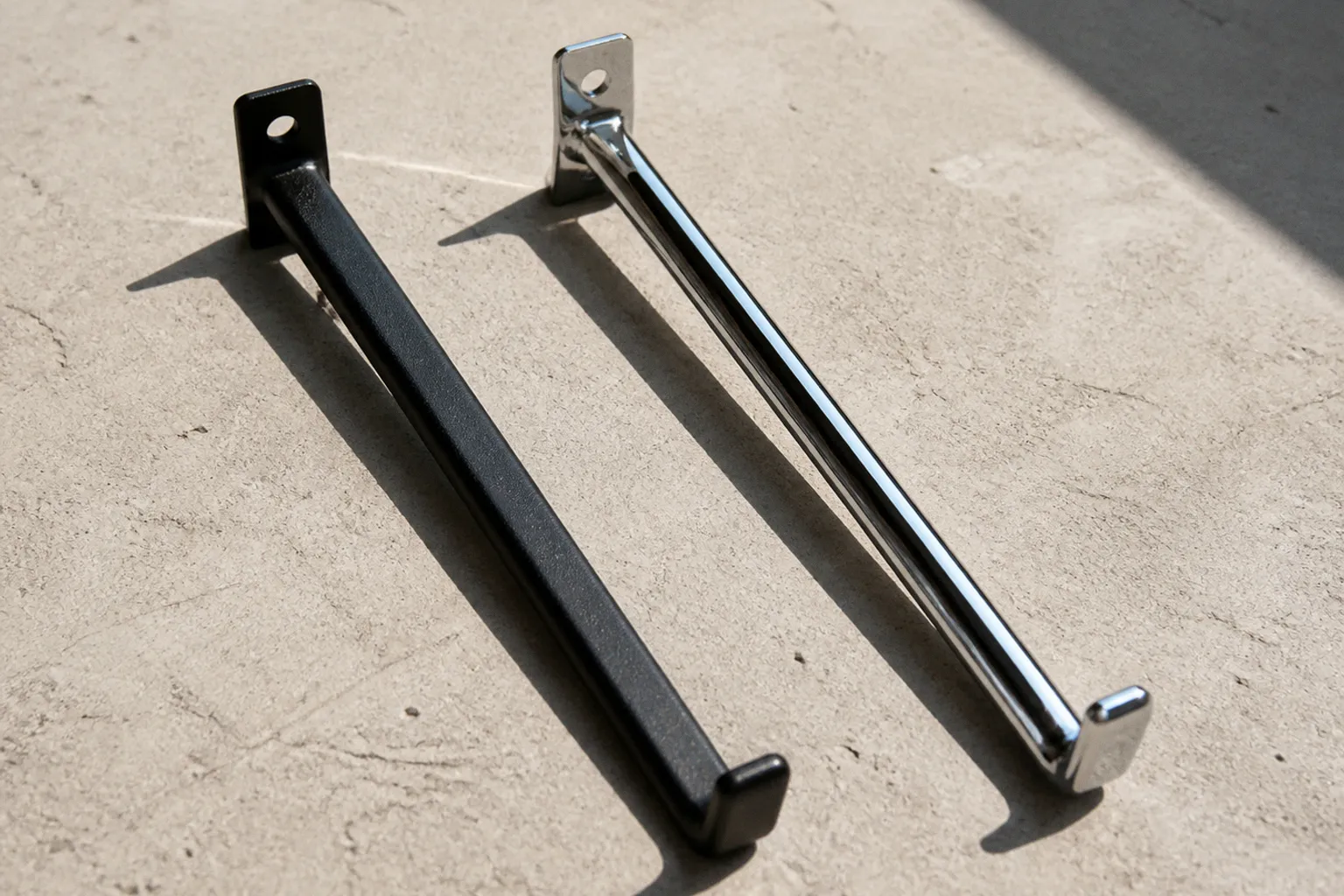
Powder Coating vs Electroplating for Retail Display Racks: A Floor Manager's Take
Endcaps that looked mirror-bright in the vendor's catalog now show a constellation of fine scratches along the crossbar. The four-way rack you spec'd for a premium denim zone has fingerprint oils blooming on the chrome uprights by lunch. The planogram you spent three weeks perfecting is undermined by a finish that reads as tired before the first markdown cycle even starts. Most of the time, that failure traces back to one decision made months earlier in a sourcing meeting: powder coated vs electroplated steel racks.
Compare car rental deals in United Kingdom
See available offersPartner link — DiscoverCars comparisonThat choice is not really about color. It is about how a fixture will behave when fifty customers a day drag metal hangers across it, when a stock clerk bumps a cart into an upright, when humidity from the loading dock rolls through the store at six in the morning. So let me walk you through what each finish actually does at the retail floor level, what it costs you in dwell time and visual turnover, and where the third path — PVD and mirror black polish — earns its premium.
The Physics of Protection: Coating Thickness and Durability
Here is the part of the conversation that nobody on the merchandising side wants to wade into, but that determines whether your fixtures still photograph well six months in: the thickness of the protective layer sitting on top of the steel.
Powder coating lands as a dry polymer that is electrostatically applied and then heat-cured into the substrate. On a properly prepared garment rack, you are looking at a finished film thickness in the 50 to 125 micron range — somewhere between 2.0 and 5.0 mils. That sounds abstract until you press a thumbnail into a swatch. You feel a real polymer barrier, the kind that absorbs a dropped hanger instead of teleporting the impact straight to the base metal underneath.
Electroplating is a wet chemical process, and the numbers tell a different story. Traditional electroplated finishes — chrome, gold, brass, copper — typically measure somewhere between 5 and 25 microns. That is a beautiful, reflective layer, but it is fundamentally a skin, not a jacket. If you have ever seen a chrome rack start to pit along the bottom rail where mop water collects overnight, you have watched a 10-micron layer lose its argument with chloride ions.
A powder coat is a jacket you can lean against. An electroplate is a mirror you cannot touch without leaving evidence.
For high-traffic apparel environments — think a 4-way rack running 30+ customer interactions per hour — that thickness gap is the entire game. The thicker polymer film is what gives powder coating its real-world advantage in scratch and chip resistance, particularly against metal hangers that are themselves the most abrasive object your fixtures will ever meet.
Aesthetic Intent: When to Choose Premium Electroplating
Now, none of that means electroplating is the wrong call. There are retail environments where the finish itself is doing half of the merchandising work, and you cannot fake that with a matte RAL chart.
A deep, mirror-bright chrome upright next to a folded stack of selvedge denim is not decoration. It is part of the price justification. The customer does not think the word "electroplating," but they read the rack as "this brand spends money on details," and that read lifts the perceived value of the merchandise before a single tag is flipped. Same logic applies to polished gold and brass finishes on a handbag wall or a footwear endcap where the fixture is meant to function as jewelry.
The honest comparison is this: electroplating gives you a depth and reflectivity that powder coating cannot match, especially in bright, jewelry-grade golds and in chrome that reads as liquid. Powder coats can simulate metallic tones — and modern metallic powder formulations have gotten impressively convincing — but at a certain level of light, the customer can still tell. If your brand is built on a luxury aesthetic cue, electroplating pays for itself in dwell time and conversion at the fixture.
The trade-off is operational. Electroplating costs more per linear foot of rack because the process demands chemical baths, electrical rectification, and increasingly strict effluent handling. For a flagship store with a tight SKU density and a single fixture program, that delta is absorbable. For a 60-store rollout where every fixture has to match across regions, the math usually pushes you toward powder coating and a controlled metallic palette.
| Parameter | Powder Coated Steel | Electroplated Steel |
|---|---|---|
| Film thickness | 50–125 microns (2.0–5.0 mils) | 5–25 microns |
| Surface character | Uniform polymer, matte to satin to soft metallic | Deep mirror reflectivity, true metallic depth |
| Scratch behavior | Absorbs abrasion, resists chipping | Shows micro-scratches and oils readily |
| Cost per linear foot | Lower; scales for large rollouts | Higher; specialized chemical process |
| Color range | Full RAL palette, easy color matching | Limited to plating chemistry (chrome, gold, brass, copper, nickel) |
| Environmental profile | Zero VOC emissions | Wet chemistry; regulated wastewater |
| Best fit | High-traffic apparel, big-box, multi-store rollouts | Luxury flagships, jewelry zones, premium endcaps |
Operational Efficiency and Environmental Impact
This is the part of the spec sheet your operations director will actually read. Powder coating is a dry process, which means it releases zero VOCs into the atmosphere. If your brand has a public sustainability commitment — and most do, whether it is on the website or buried in an ESG deck — powder-coated fixtures let you defend that commitment at the fixture level without a footnote. There is no solvent trap, no stack emissions, and the overspray that does not adhere to the part is recoverable and reusable.
Electroplating is a different regulatory world. The chemistry that gives you that mirror finish — typically involving acids, cyanides in legacy lines, or nickel and chromium salts in modern trivalent systems — has to be captured, treated, and disposed of under strict compliance regimes. That cost lives inside every electroplated rack you buy, even when it does not show up as a line item. It also lengthens lead times in regions where plating capacity is constrained, which is increasingly the case in markets with aggressive water-quality rules.
If your fixture program needs to defend a sustainability claim at the floor level, powder coating is the only finish that does it without a footnote.
For a single flagship, this is academic. For a 200-store program where every district has a different environmental officer reading the spec, the simplicity of powder coating is a quiet operational win.
Managing High-Traffic Wear: Scratch Resistance and Maintenance
Let me talk about what actually kills a finish on a retail floor, because it is rarely what the finish chart predicts.
The number-one enemy of an electroplated garment rack is not customer abrasion. It is the stock clerk. Every time a cart rolls past an upright, every time a fresh box of folded stock is dragged across a crossbar, you are depositing micro-abrasions into a 5 to 25 micron layer. On a powder-coated rack, the same contact deposits the abrasion into a polymer film that is roughly five to ten times thicker — and the polymer has a memory. It flexes back. The electroplate does not. It records.
The second enemy is hand oil. Chrome, polished gold, and brass finishes are unforgiving. A high-visibility apparel zone — a fitting room bank, a "shop the look" moment near the entrance — turns every electroplated surface into a fingerprint ledger. You can buff it, but you cannot eliminate it, and over a quarter the rack starts to read as "well-loved" in the wrong direction. Powder-coated matte and satin finishes hide hand contact beautifully. They are the finish equivalent of a forgiving carpet in a busy household.
Maintenance protocol matters too. Powder-coated racks can be wiped down with standard retail cleaners. Electroplated racks, particularly brass and gold, want pH-neutral care and a soft cloth. Hand that protocol to a part-time seasonal hire and you will see what compliance looks like in practice.
Advanced Alternatives: PVD and Specialized Surface Hardening
There is a third path that has moved from boutique to mainstream over the last few seasons, and it deserves its own paragraph because it solves a specific problem the other two do not. Physical Vapor Deposition (PVD) over polished stainless steel produces finishes like mirror black polish — the deep, glassy, almost obsidian black you now see anchoring premium menswear floors and contemporary eyewear walls. The PVD layer itself is thin, typically 1 to 3 microns, but the surface hardness it produces is extraordinary: 2,500 to 3,000 HV on the Vickers scale. For context, that is harder than the cutting edge of a high-carbon steel knife.
What that means in retail is a finish that looks liquid, photographs like jewelry, and resists the day-to-day abuse that would mark up a chrome rack in a week. The catch is cost. PVD is a vacuum-chamber process, batch sizes are smaller, and lead times run longer. It is not a finish you spec for a 400-rack rollout. It is a finish you spec for a signature wall.
For the rest of the floor — the back wall of four-way racks, the fitting room queue, the side cap near the register — powder coating with a controlled metallic or matte palette gives you the durability you need at the unit cost the P&L will accept. Use PVD where the customer is meant to stop and look. Use powder coating where the customer is meant to keep moving and shop.
The Spec Decision, In Practice
When we sit down with a retailer, the conversation usually starts with three questions. First, what is the brand reading the rack supposed to do — announce luxury, or support throughput? Second, what is the expected SKU density and dwell time at this fixture — five seconds per customer, or thirty? Third, what is the multi-store rollout reality, and how much finish variance can we tolerate across regions?
If the answer to question one is "announce luxury" and question two is "thirty seconds, jewelry wall," we are talking electroplating or PVD. If the answer to question one is "support throughput" and question two is "five seconds, eight interactions per minute," we are talking powder coating every time. Most apparel floors are closer to the second profile than the merchandising mood board suggests, and that is where powder-coated steel racks quietly do the most reliable work.
Choose the finish that matches how long the customer is meant to stand in front of the rack, not how long the fixture is meant to last on the loading dock.
Measure the decision the way you measure any merchandising move: by the conversion at the fixture, the photo quality four months in, and the number of touch-up labor hours your store manager logs in a quarter. The finish that wins those three numbers is the finish that belongs in your spec.