Do stainless steel garment racks rust in coastal stores?
Every retail buyer has heard it: "It's stainless steel, so it won't rust." I have watched that sentence get written into thousands of purchase orders for coastal boutiques and seaside department stores.
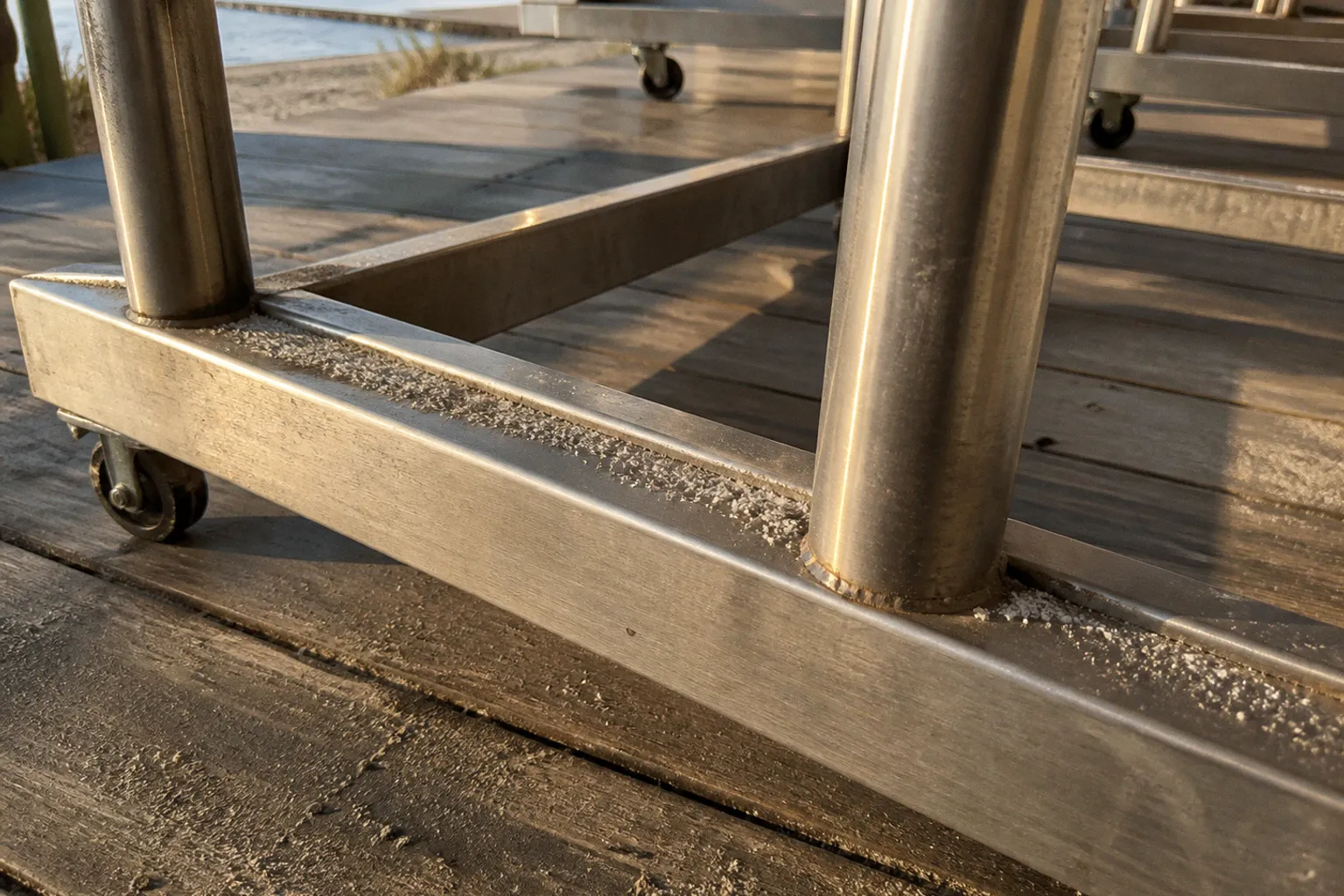
The "rust-proof" promise that quietly bleeds budgets
The racks arrive shiny, the displays go up, the season turns, and then a thin brown haze appears on the uprights near the fitting rooms. Eighteen months in, the manager is calling the supplier, the supplier is pointing at the invoice, and someone is out several thousand dollars per floor set. None of this would surprise a metallurgist. It surprises everyone else.
The problem is not that stainless steel fails. The problem is that "stainless" is a marketing adjective, not a guarantee. Whether a stainless steel garment rack rusts in a coastal store depends on three real variables: the alloy grade, the surface finish, and how close the storefront actually sits to breaking surf. Get any of those wrong, and the rack corrodes. Get them right, and the same rack will outlast the lease.
Stainless does not mean stain-less. It means stain-less than ordinary steel. Coastal air remembers that distinction.
What stainless steel actually does (and what it doesn't)
Stainless steel fights rust with a microscopic trick. When chromium content in the alloy reaches at least 10.5%, the surface reacts with oxygen and forms a thin, self-healing film of chromium oxide. That film is what separates stainless from regular steel. Scratch it, and as long as oxygen is around, it rebuilds. That is the whole mechanism.
Here is where coastal environments attack the trick. Airborne salt — chlorides — breaks down that chromium oxide layer faster than it can reform. The film is "passive," meaning chemically inert under normal indoor conditions. It is not passive in the sense of inactive. Salt actively disrupts it. So the corrosion resistance of stainless steel is not a permanent property; it is a rate-dependent property. Push the salt content high enough, or drop the chromium content low enough, and rust shows up.
I have pulled apart rack uprights in seaside stores where the brown discoloration looked like a powdery stain, not a structural failure. That is tea staining — the technical term for cosmetic surface corrosion that does not eat through the metal quickly but absolutely destroys the look of a polished display. In a fitting room, where customers lean against the rack and notice every fingerprint and streak, tea staining reads as neglect. It does not matter that the structure is fine.
Grade matters more than the word "stainless"
Walk into a procurement meeting and someone will say, "We specified stainless." That tells you nothing. The meaningful specification is the grade number, and that is where buyers get tripped up by price-tier catalogues.
| Parameter | Grade 201 | Grade 304 | Grade 316 (marine) |
|---|---|---|---|
| Chromium content | 16–18% | 18–20% | 16–18% |
| Nickel content | 3.5–5.5% | 8–10.5% | 10–14% |
| Molybdenum content | None | None | 2–3% |
| Coastal chloride resistance | Poor | Marginal | Strong |
| Typical use case | Budget indoor displays, dry climates | Standard indoor retail, non-coastal | Coastal, marine, humid, poolside |
| Price tier | Lowest | Middle | Highest |
Grade 304 is the default. It is what most catalogues mean when they say "stainless steel." It contains no molybdenum, which is the alloying element that specifically resists chloride-driven pitting. In a dry inland mall, 304 performs beautifully for years. In a beachfront store, it tea-stains. Grade 316 adds 2–3% molybdenum, and that addition is the difference between a rack that looks tired in a year and a rack that still photographs well after five.
Grade 201 is the one to watch for on tight-budget jobs. It skimps on nickel and saves cost, but its chloride resistance is worse than 304. I have seen 201-spec racks develop visible brown patches within six months of opening, even in suburban locations, simply because the store ran aggressive HVAC humidification. Avoid 201 anywhere moisture is a variable.
Tea staining: the brown haze you didn't budget for
Tea staining is not rust in the structural sense. It will not snap a tube or collapse a shelf. It is surface discoloration — a brown, sometimes iridescent film that concentrates on the lower sections of uprights and around base plates where moisture sits. From a sales floor perspective, that distinction is meaningless. A rack with tea staining looks broken.
Two factors drive it: salt content in the air and the surface roughness of the steel. The standard guidance from industry associations places the worst-case zone within roughly 5 kilometers of breaking surf. Beyond that, exposure drops sharply — but it does not vanish. Airborne salt can travel more than 20 kilometers inland under the right conditions: high humidity, steady onshore winds, local industrial pollution that carries chloride particulates further. I have personally inspected racks in stores about 14 km from the coast that showed clear tea staining. The store manager thought the racks were defective. They were not defective — they were the wrong grade for the microclimate.
If your store sits within 20 km of surf, the salt is already at your door. Spec the steel as if it has arrived.
Why the finish changes everything
Here is the part most catalogues never explain. The geometry of the surface finish — not the alloy grade alone, but how the steel is polished — has a measurable effect on how much salt accumulates.
A mirror-polished surface is smooth. Chloride particles land, but they have nowhere to lodge. A rinse or a wipe-down removes them. A brushed or satin finish has parallel micro-grooves from the abrasive belt. Those grooves are salt traps. Moisture wicks into the grain, sits, and accelerates the breakdown of the chromium oxide layer locally. In a coastal store, satin-finished uprights will stain faster than mirror-polished ones, even on identical Grade 316 base material.
This is also why high-end garment displays with mirror-black or polished chrome finishes are common in flagship coastal boutiques — not purely because of the look, but because the smooth surface is easier to keep clean. The aesthetic and the maintenance schedule are the same decision.
Spec'ing a coastal rack: what I actually order
When a client opens a store within that 5-kilometer high-risk zone, the conversation is short. I specify Grade 316 base material, mirror-polished or chrome-plated finish, and welded (not bolt-together) joints wherever the rack sees spray or hand-contact. Bolt-together racks have micro-gaps that trap salt at the threads. In a dry inland store, those gaps do not matter. In a coastal store, those gaps are the first place tea staining appears.
For a store between 5 and 20 km from the coast, the calculus changes. Grade 304 with a mirror finish and a documented cleaning schedule can perform acceptably for years — but only if the cleaning actually happens. I have lost count of stores that bought the right rack and never wiped it down. Salt does not evaporate. It accumulates. A weekly microfiber wipe along base plates is the difference between a five-year display and an eighteen-month embarrassment.
Two further notes from the install side:
- Base plates matter more than uprights. Salt creeps up from the floor. If the base plate is Grade 304 and the upright is Grade 316, the rack fails at the floor first. Match the grade across the entire assembly.
- Chrome plating is not the same as stainless. Chrome-plated mild steel can look identical to a stainless rack on the showroom floor, but a scratch in the plating exposes carbon steel underneath. That scratch will rust aggressively in coastal air. Verify the spec, not the appearance.
Pre-purchase reality check
Before the purchase order goes out, I run through the same list every time. No exceptions, no "we'll figure it out later":
- Distance from breaking surf. Under 5 km: Grade 316, no discussion. 5–20 km: Grade 316 preferred, Grade 304 acceptable with documented maintenance. Beyond 20 km: Grade 304 is fine for indoor dry retail.
- Alloy grade on the paperwork, not the catalogue. The invoice line should read "Grade 316 stainless steel" or "AISI 316." "Stainless steel" alone is not a specification.
- Surface finish. Mirror polish or chrome plating preferred. Satin and brushed finishes trade aesthetics for faster salt accumulation.
- Joint construction. Welded frames beat bolt-together in any humid or coastal environment.
- Base plate and upright grade matched. A mixed-grade assembly fails at the weakest link, which is almost always the base.
- Cleaning protocol. If the store cannot commit to a weekly wipe-down of base plates and lower uprights, upgrade the grade. Maintenance is part of the spec.
- Warranty terms read for chloride exclusions. Some manufacturers explicitly exclude coastal or "high-humidity" installations. Read the warranty before you trust the sales pitch.
Stainless steel garment racks do not "rust-proof" their way through a coastal store on reputation. They survive because someone — somewhere between the architect, the fixture supplier, and the installer — made the right call on grade, finish, and maintenance. Skip that call and the racks will indeed rust. Make it deliberately, and the same racks will outlast every other fixture on the floor.