Brushed brass racks: does lacquer prevent tarnishing?
Walk into any showroom pushing brushed brass garment racks and you'll hear the same line: "It's lacquered, so it won't tarnish." Sales staff lean on that word the way a bouncer leans on a door — like it ends the conversation. It doesn't.
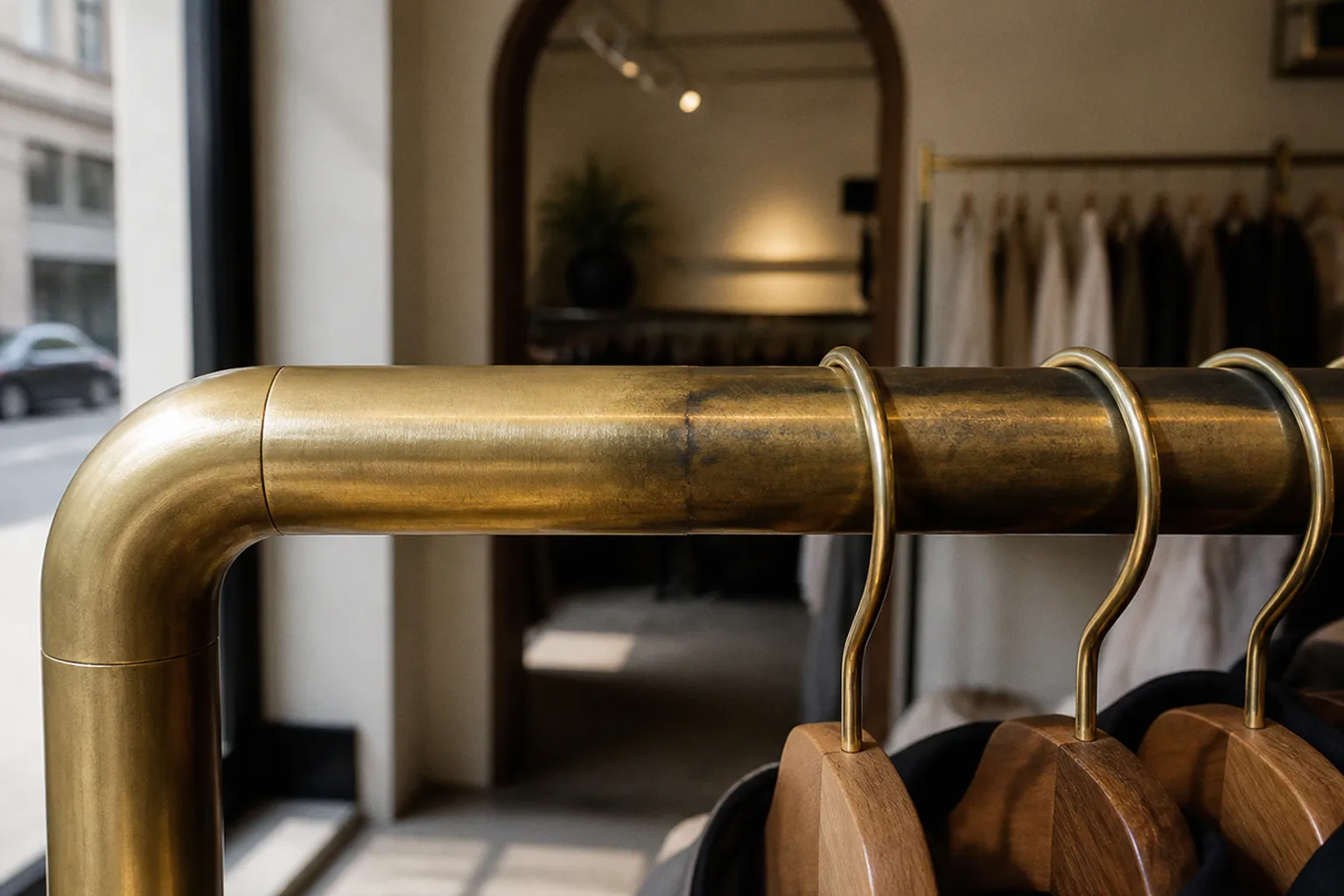
Brushed Brass Racks: Does Lacquer Actually Stop Tarnishing?
I've spent enough afternoons retrofitting display fixtures in boutiques and warehouses to know that the relationship between lacquer and a brushed brass finish is closer to a temporary ceasefire than a permanent peace treaty. The coating absolutely does something useful, but the moment you slide a metal hanger across that rail, you're renegotiating the terms.
Brushed brass looks fantastic when it's clean — that warm, satin glow that makes a garment rack feel like it belongs in a high-end concept store rather than a back stockroom. The problem is that raw brass hates its own environment. Oxygen, humidity, skin oils, even the trace acids in fingerprints — they all want to oxidize the metal. A lacquer coating is essentially a thin polymer film that sits on top of the brass and blocks those bad actors from making contact. When the film is intact, the brass underneath stays exactly the color the day it left the factory. When the film fails, the brass does what brass does: it patinas, darkens, and develops that uneven, blotchy character that manufacturers pretend won't happen if you just buy their product.
A lacquered finish is a delay mechanism, not a shield — and a garment rail is the worst possible place to ask a coating to hold up.
So the real question isn't whether lacquer prevents tarnishing. It does, partially, until it doesn't. The real question is how long that protection survives under the actual conditions a commercial clothing rack faces — and whether the manufacturer who sold it to you has any clue what those conditions look like.
How Lacquer Actually Works on a Brass Surface
Lacquer is a transparent film — usually a nitrocellulose or acrylic-based resin dissolved in solvents — that gets sprayed or dipped onto the brass and then cures into a hard, glossy skin. Its job is mechanical: sit there, stay clear, and prevent oxygen and moisture from reaching the metal substrate. Think of it as cling wrap for metal. When it works, the brushed grain pattern underneath stays visible because the coating is thin enough to let the texture read through, but thick enough to block the chemical reactions that cause tarnish.
Brass tarnishes through oxidation. Copper content in the alloy reacts with sulfur compounds in the air, moisture, and contaminants, forming a darkened layer of copper sulfide or copper oxide. That's patina. On raw brushed brass, patina develops unevenly because the brushing creates microscopic peaks and valleys — oil and moisture pool in the low spots, accelerating oxidation in patches. A continuous lacquer film eliminates that differential by giving the brass a uniform barrier. No air contact, no reaction, no tarnish. In a controlled environment — say, a sealed display case that nobody touches — lacquered brass can hold its factory color for years.
But here's the friction point nobody at the trade show booth mentions: lacquer is a finish designed for static decorative hardware. Door handles, cabinet pulls, light fixtures — pieces that get wiped occasionally but never scraped, never slid against. A garment rack is the opposite of that. It's a working surface. Every customer interaction, every restock, every time a metal hanger gets pushed along the rail, the coating is under mechanical attack. The moment a scratch penetrates the film, you've created a tiny window where oxygen can reach the brass. And tarnish starts there, spreading outward under the remaining lacquer like rust creeping under chipped paint.
| Brass Finish Type | Tarnish Resistance | Maintenance Demand | Typical Use Case |
|---|---|---|---|
| Raw / Unlacquered Brushed Brass | Low — patinas within weeks of exposure | High — requires regular polishing | Decorative static displays, vintage reproductions |
| Spray-Lacquered Brushed Brass | Moderate — holds well in low-contact settings | Low — dry cloth wipe only | Residential wardrobes, boutique back stock |
| Electrophoretic Lacquered Brass | High — uniform, dense film with strong adhesion | Low — same dry-cloth protocol | Commercial garment rails, high-traffic retail |
| Polymer Sealant (e.g., ProtectaClear) | High — engineered for abrasion resistance | Low — mild soap and water | Heavy-duty rails, rental wardrobe systems |
The takeaway from that comparison: not all "lacquered brass" is equal, and the application context matters more than the marketing copy. A 19mm brushed brass hanging rail in a residential closet will outlast its coating by years. The same rail in a retail store with daily customer traffic might not.
Why a Garment Rack Is the Worst Place for Any Coating
I want to be specific about this because the industry loves to wave around vague durability claims. A garment rack — particularly a brushed brass one — faces a combination of stressors that no decorative brass component has to deal with:
- Continuous metal-on-metal contact. The standard hanger is steel wire, often chrome-plated. When that hanger slides along a brass rail, it's acting like a file. Each pass removes an imperceptible amount of lacquer, but over hundreds of cycles, you've worn a channel into the coating. Once the film is breached, tarnish develops in a line exactly where the hangers travel. I've seen rails in retail stores with dark stripes down the middle and bright brass on the sides — that's the signature of coating wear, not "natural aging."
- Fingerprints and skin contact. Every time someone touches the rail to pull a hanger, they deposit oils, salts, and acids. On raw brass, that just adds to the patina. On lacquered brass, those contaminants sit on top of the film and slowly etch into it. The edges and ends of the rail — where people grab — go first.
- Load stress and flex. Heavy garments (denim, wool coats, leather jackets) put real weight on a rail. A 25mm or 38mm solid brass tube can handle it, but the lacquer on top doesn't flex with the same elasticity as the metal. Over time, micro-flexing at load points causes hairline cracks in the film. You won't see them. The tarnish will.
- Environmental exposure. Brass racks near exterior walls, HVAC vents, or fitting rooms with steam and humidity face accelerated oxidation. Lacquer slows this down; it doesn't stop it.
The honest timeline: a lacquered brushed brass rail in commercial use will start showing localized tarnish eventually. How long that takes varies enormously — it depends on the volume of daily contact, the type of coating, how the rail is handled, and the environment it lives in. A low-traffic boutique might enjoy years of clean performance before the first signs of coating fatigue. A busy retail floor with heavy, constant use might see wear in a matter of months. There is no single number that covers every situation, and anyone who gives you one is selling, not advising. The brass itself stays structurally sound; the coating simply reaches the end of its useful life at the points of contact.
Electrophoretic vs. Spray Lacquer: Not the Same Animal
Most buyers don't realize there are at least two different ways manufacturers apply "lacquer" to brass, and the difference matters if you're outfitting a commercial space.
Traditional spray lacquer is the older method. Liquid resin gets atomized and sprayed onto the brass surface, then air-dried or oven-cured. It's fast, cheap, and produces a decent finish on flat or gently curved parts. The problem is adhesion. Spray lacquer bonds to the brass surface mechanically — the resin grips the micro-texture of the brushed grain — but the bond is uneven. On the peaks of the brushing, the coating is thinner. In the valleys, it pools slightly thicker. When a metal hanger slides along that surface, the thinnest spots fail first. Once one spot fails, the rest follows in a cascade because moisture and oxygen now have an entry point.
Electrophoretic lacquer (sometimes called electrophoretic painting, e-coating, or electropainting) is a different process entirely. The brass component is submerged in a liquid resin bath, and an electrical current is applied. The resin particles migrate to the metal surface and deposit uniformly — a continuous, even film with consistent thickness across every contour, including the brushed grain. The result is a denser, more tightly bonded coating with significantly better adhesion and corrosion resistance.
If you're buying a lacquered brass garment rack for a commercial space, find out which process was used. If the manufacturer can't tell you, that's your answer.
In my own installations, the difference between spray-lacquered and e-coated brass rails shows up within the first year. Spray-lacquered rails develop those tell-tale wear stripes and edge darkening. E-coated rails hold their finish longer — not forever, but long enough to justify the cost premium if you're running a retail floor where downtime for refinishing is expensive.
The catch is that most spec sheets and product listings won't disclose the application method. They'll just say "lacquered finish." That's a red flag, not a feature.
Maintenance: What Actually Works on a Lacquered Brushed Brass Rack
This is the part where I have to be blunt. A lot of the maintenance advice floating around online is actively wrong for lacquered brass. It might be right for raw brass, but applying it to a coated surface will destroy the very protection you paid for.
Do not use brass polish. Brasso, Goddard's, Twinkle — all of these are designed for unlacquered brass. They're mildly abrasive and chemically active. They'll strip lacquer in a single application. I've watched store owners strip the coating off perfectly serviceable lacquered rails by applying polish meant for raw brass. The surface looks brighter for a few weeks — then the unprotected brass goes blotchy and dark, often worse than before the polish touched it.
Do not use acidic cleaners. Vinegar, lemon juice, citric-based degreasers — these will etch and cloud lacquer. Same chemistry as the polish problem, just slower acting.
Do not use abrasive cloths. Microfiber is fine for routine dusting. Anything with a scrubbing texture — even the green side of a kitchen sponge — will score the film.
What does work:
- Dry, lint-free cloth for routine dusting. Soft cotton or microfiber. Wipe along the grain of the brushing, not against it.
- Mild soapy water and a damp cloth for occasional deeper cleaning. Wipe dry immediately. Don't let moisture sit on the surface.
- Avoid prolonged contact with anything wet. If a garment drips onto the rail, dry it. Standing water will creep under any lacquer eventually.
The maintenance protocol for lacquered brass is, ironically, closer to "leave it alone" than "take care of it." The less you touch it, the longer the coating lasts. In a retail setting, that means training staff not to wipe down the racks with whatever multi-surface spray they use on the rest of the fixtures.
Beyond Lacquer: Sealants and Hard Coatings Worth Considering
For high-traffic environments where lacquer — even electrophoretic lacquer — won't survive the duty cycle, there are heavier-duty options. These aren't standard on most garment racks, but they're worth asking about if you're specifying a custom build or retrofitting a system for a high-volume store.
ProtectaClear is a specialized polymer sealant that's marketed specifically for brass that sees regular handling. It goes on as a liquid, cures into a clear film, and is engineered to be more scratch-resistant than traditional lacquers. It's not magic — nothing is — but it does hold up better to the kind of metal-hanger abrasion that destroys spray lacquer. Application requires careful surface prep (the brass needs to be completely clean and free of oxidation first) and the coating is thinner than lacquer, so it doesn't hide the brushed grain pattern. In commercial wardrobe systems and rental garment operations, it's a reasonable step up.
Everbrite Coatings is another option in this category — a clear protective coating designed for architectural metalwork. Some formulations have heat resistance up to roughly 260 to 285°C before the coating begins to degrade at higher temperatures, which is irrelevant for a garment rail but tells you something about the thermal stability of the chemistry. For ambient retail environments, these coatings provide a longer service life than standard lacquer.
Powder coating is sometimes offered on brass-look finishes (usually on steel substrate, not solid brass), but this changes the aesthetic entirely. Powder coating is opaque, so you lose the depth and warmth of brushed metal. If you're specifying brushed brass for its visual character, powder coating defeats the purpose — even if the durability is superior.
The honest answer: there is no coating that makes brushed brass maintenance-free on a working garment rack. Every option is a compromise between appearance, lifespan, and cost.
So, Does Lacquer Prevent Tarnishing? — The Reality Check
Let's pull this back together with the same honesty I'd give a client standing in a showroom:
- Lacquered brushed brass does resist tarnishing — significantly more than raw brass — as long as the coating is intact.
- The coating will not remain intact indefinitely on a garment rack under commercial use. Metal hangers, skin contact, and load flex will breach the film eventually. How soon depends on traffic intensity, handling patterns, and environmental conditions — there is no universal timeline.
- Once the coating is breached, tarnish develops locally and spreads. There is no way to "spot repair" lacquered brass without creating a visible boundary between the old and new coating.
- Maintenance protocols matter enormously. Using brass polish or abrasive cleaners will destroy the coating faster than any environmental factor.
- Electrophoretic lacquer outperforms spray lacquer. If you're buying commercial-grade hardware, specify e-coating — or at minimum, ask the manufacturer which process they use.
- For high-abrasion environments, consider polymer sealants like ProtectaClear or specify a heavier-grade coating system from the manufacturer.
Before you commit to a brushed brass garment rack for a commercial space, here's the reality check:
- Confirm whether the finish is lacquered, electrophoretically coated, or sealed with a polymer — and get it in writing.
- Ask about the brass tube diameter — 19mm residential, 25mm or 38mm commercial. Smaller diameters flex more, which accelerates coating failure at load points.
- Check the rail length and configuration — standard modular lengths of 50cm and 90cm, or full commercial lengths of 1.83m and 3000mm, will have different wear patterns depending on hanger travel distance.
- Plan for refinishing or replacement on a cycle that matches your actual traffic and environment — spray-lacquered rails in busy retail settings will need attention sooner than e-coated systems in lower-traffic spaces.
- Train staff on do-not-clean protocols: no polish, no abrasives, no acidic sprays.
- Consider rack sleeves or hanger stops to limit metal-on-metal sliding on the most exposed sections of the rail.
Brushed brass racks look superb when they're new. They can stay looking superb for years — but only if you understand that lacquer is a finish with a service life, not an immortality spell. The coating buys you time, not permanence. Plan accordingly, and your rack will earn its keep. Ignore the physics, and you'll be refinishing or replacing it sooner than the warranty suggests.