Brushed brass garment racks: the lacquer peeling trap
A standard organic clear lacquer on a brushed brass garment rack is usually only a thin protective film, often in the range of roughly 12 to 25 micrometers.
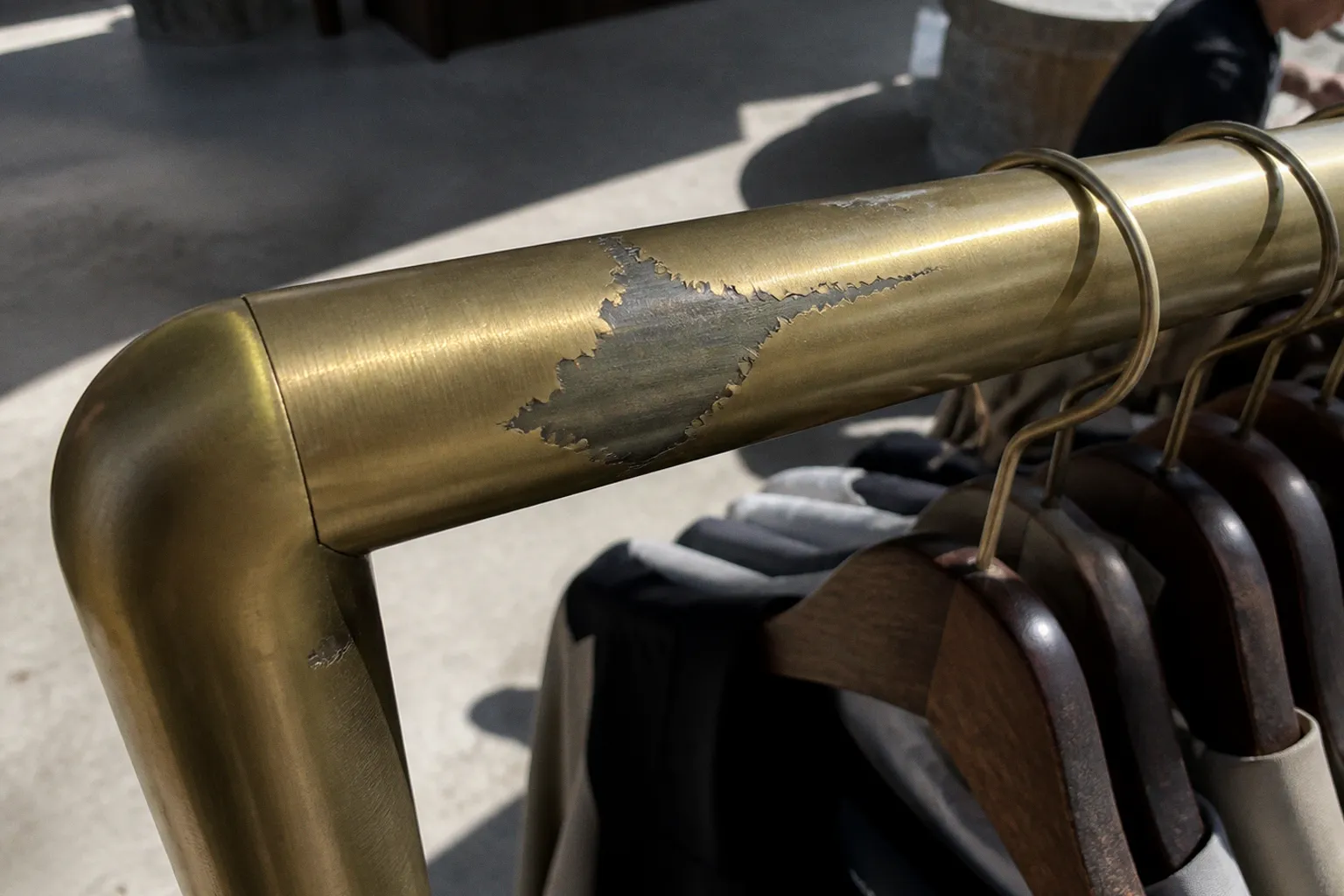
It sits over the brass as a separate coating, held by adhesion and mechanical keying into the prepared surface. That distinction matters. The film may look like part of the metal, but it still has an interface with the substrate, and that interface can be damaged by repeated contact.
When hangers slide across a horizontal rail in a retail store, the contact is not a single impact. It is a recurring combination of friction, pressure, and shear. In a busy environment, the clear coat can develop fine abrasion marks at the highest-wear contact patches long before the rest of the rack looks worn. Once the coating is breached, moisture, oxygen, cleaning residues, and airborne contaminants can reach the brass beneath it. The result is localized tarnish that cannot usually be corrected with a quick polish while the original coating remains in place.
The brushed finish adds another variable. A brushed brass surface has directional micro-grooves created by abrasive finishing. These grooves give the rack its texture and help disguise minor handling marks, but they also make coating coverage more dependent on surface preparation and application control. A spray-applied lacquer may leave thinner areas along the sides or bottoms of the grooves. It does not necessarily fail immediately, but those variations can become weak points when the rail is subjected to constant hanger movement.
Heat and humidity can increase the stress on the system. Retail lighting, cleaning routines, seasonal changes, and the thermal expansion of the metal all contribute to a coating environment that is less stable than a decorative sample on a showroom wall. The issue is not that every lacquered brass rack will peel. It is that the finish has several failure routes, and high-traffic use activates more of them at once.
The Mechanics of Lacquer Failure in High-Traffic Retail
A garment rack in a commercial retail environment experiences repeated hanger cycling along the same rail zones. The exact load depends on the store category, rail length, hanger design, garment weight, merchandising habits, and how often staff rearrange the display. A lightweight plastic hanger gliding over a smooth rail is not equivalent to a metal hook dragged across a rough or contaminated surface.
Each cycle introduces sliding shear at the contact patch. The hook can also create small impact points when garments are added quickly or pushed together. Those events matter because a clear lacquer is an organic polymer film rather than a bulk metal surface. Its behavior depends on formulation, cure, thickness, adhesion, flexibility, and the condition of the brass underneath.
The film is held to the substrate through a combination of chemical adhesion, surface preparation, and mechanical interlocking with the microscopic texture of the metal. It is inaccurate to treat the bond as a single simple mechanism: the performance of a clear coat depends heavily on cleaning, activation, primer compatibility, and curing. If the brass carries oil, oxide residue, polishing compound, or embedded contamination, the coating can be well formed in appearance but poorly anchored in service.
Repeated movement creates several possible forms of damage:
1. Surface burnishing removes some of the visual texture and gloss from the contact zone without immediately exposing brass.
2. Micro-abrasion creates fine scratches that collect dirt and cleaning residue.
3. Crack initiation occurs where the film is stressed at a scratch, edge, groove, or impact point.
4. Moisture ingress allows tarnish to develop beneath or around the damaged area.
5. Delamination begins when the coating loses adhesion and lifts from the substrate.
The timing is not uniform. A rack may show only a polished-looking contact band for months, while another develops visible lifting much sooner because of a sharp hanger profile, poor pretreatment, aggressive cleaning, or a defect inherited from production.
Once a crack reaches through the coating, atmospheric contaminants can reach the brass. Sulfur compounds, chloride residues, humidity, and some cleaning chemicals can accelerate discoloration. The exact appearance depends on the brass alloy and environment, but darkened spots, brownish staining, greenish residues, and uneven loss of the original tone are all possible. Tarnish is not simply dirt sitting on top of the clear coat. In many cases, the coating must be removed before the substrate can be properly cleaned and refinished.
| Failure stage | Typical trigger | Visible result |
|---|---|---|
| Initial wear | Hanger friction at recurring contact zones | Loss of gloss or a polished-looking band |
| Micro-cracking | Repeated shear, impact, or thermal movement | Fine lines, dull patches, or small breaks in the film |
| Substrate exposure | Coating breach or local delamination | Dark spots, color change, or exposed brass |
| Expanding failure | Moisture and contaminants entering damaged areas | Lifting edges, flaking, and wider tarnish |
| Refinishing requirement | Damage beneath or throughout the film | Stripping and recoating rather than spot polishing |
The important point is that a failure visible on the surface may have started as a process problem underneath. Peeling at the rail is not always caused by the latest hanger contact. It may reveal inadequate preparation, incompatible layers, trapped contamination, or insufficient cure.
Why Organic Clear Coats Struggle with Mechanical Abrasion
The commonly specified thickness for a spray lacquer on brass hardware reflects a compromise. The manufacturer needs enough material to cover the finish evenly and protect the metal, but excessive wet film can sag, ripple, trap solvent, or produce orange peel. Multiple spray passes may be used, with flash-off between coats, yet thickness can still vary across a brushed profile, around corners, and near welds or cut ends.
The mechanical properties of the finished film are also more complicated than a single hardness number suggests. Acrylic and nitrocellulose lacquers can be evaluated with pencil-hardness methods such as ASTM D3363, but that test measures resistance to a particular scratch procedure. It does not reproduce the repeated sliding, impact, contamination, and cleaning cycles of a garment rail. A coating with a respectable pencil-hardness result may still wear quickly when a hanger repeatedly travels over one narrow track.
Conversely, a softer film is not automatically defective. Some flexibility can help a coating tolerate movement and minor impact without cracking. The useful question is whether the full coating system—substrate preparation, primer if used, lacquer chemistry, cure, and thickness—has been tested for the intended contact pattern.
Brass itself is much harder than a typical organic film, but comparing the two using a simple hardness ratio is misleading. Brass hardness is often reported on a metal scale such as Vickers hardness, while a lacquer may be reported using pencil grades or another polymer-specific method. These measurements do not describe the same property and cannot be divided into a meaningful coating-to-substrate ratio. A metal’s resistance to indentation does not directly predict how a polymer film will respond to sliding abrasion, and pencil hardness does not measure the brass’s ability to support that film.
For a commercial buyer, the more useful variables are:
- the actual hanger material and hook geometry;
- the load carried on each section of rail;
- the number and speed of hanger movements;
- whether the rail is cleaned with abrasive or solvent-containing products;
- the coating’s adhesion after conditioning;
- the wear result from a test that resembles the intended service.
A 20-micrometer film may survive well in a lightly used display and fail quickly in a high-contact zone. The same finish can also wear differently on a straight rail, a tight bend, a welded joint, or a rack with poorly deburred ends. The thickness alone does not establish service life.
Traditional clear lacquer on brass is a sacrificial barrier, not a permanent finish. Once the barrier is breached, the substrate can tarnish faster than the coating can be repaired in place.
Impact damage deserves separate attention. A dropped hanger, a metal size marker, or a garment fitting dragged across the rail can produce a small dent or cut. The original defect may be barely visible, but repeated movement turns it into a stress concentrator. Cleaning compounds can then work into the damaged area, and the contrast between a bright brushed field and a darkened breach becomes more pronounced.
This is why “durable metal finish” is an incomplete description. The rack may be made from durable metal, while the visible color and protection depend on a much thinner, less durable layer.
The Science of Molecular Bonding: PVD vs. Traditional Plating
Physical Vapor Deposition, or PVD, uses a vacuum process to deposit a hard decorative coating onto a prepared component. Depending on the target material and process, titanium- or zirconium-based compounds can produce gold, brass, bronze, or other metallic tones. Coating thickness is often much lower than that of a conventional organic clear coat, commonly measured in micrometers rather than tens of micrometers.
The advantage is not that PVD eliminates the coating–substrate interface. It does not. PVD is still a coating applied to a substrate, and its adhesion can fail if the base metal is contaminated, poorly prepared, excessively rough, or exposed to stresses the system was not designed to handle. The advantage is that a properly deposited PVD system can achieve strong adhesion and substantially higher wear resistance than a conventional decorative lacquer. The interface is engineered to resist delamination; it is not absent.
The coating may also be built as a multilayer system. A base layer, graded transition layer, and decorative top layer can be selected to improve adhesion and manage differences between the brass substrate and the harder surface film. The details vary by supplier. “PVD brass” is therefore not a complete technical specification by itself.
PVD coatings can be very hard, with reported values depending on chemistry, test method, and layer structure. Those figures should not be compared directly with the pencil hardness of an organic lacquer. The measurement scales, test loads, and material behavior are different. A high Vickers value indicates resistance to indentation under a defined test; it does not guarantee immunity to every scratch, edge impact, or installation mistake.
| Parameter | Organic lacquer | Electroplated brass-tone finish | PVD coating |
|---|---|---|---|
| Basic structure | Polymer film over prepared metal | Metallic deposit, often with additional protective layers | Thin hard film deposited over prepared metal |
| Main strength | Easy color adjustment and relatively simple application | Familiar decorative process and broad finish range | High potential wear resistance and stable decorative surface |
| Main risk | Abrasion, cracking, moisture ingress, and delamination | Poor activation, layer incompatibility, edge lifting, or tarnish | Adhesion failure if preparation or process control is poor |
| Typical failure appearance | Dulling, scratches, peeling, or exposed brass | Flaking, discoloration, or lifting at edges and defects | Burnishing, scratching, or localized delamination in severe cases |
| Repair approach | Usually strip and recoat for a consistent result | Often strip and re-plate or replace | Usually replace or return to the specialist finisher |
| Specification need | Film thickness, adhesion, wear, and cure | Layer structure, activation, adhesion, and wear | Substrate preparation, layer system, adhesion, and abrasion data |
For retail hardware, the practical difference is that a well-specified PVD finish is generally better positioned to handle repeated hanger contact than a basic clear lacquer. It may show a change in gloss, a burnished track, or a visible scratch before the brass substrate is exposed. Whether it actually avoids substrate exposure over the service life depends on the coating chemistry, film structure, contact conditions, and test results. No responsible specification should turn that tendency into a universal performance guarantee.
The same caution applies to the phrase “scratch resistant.” A PVD rail can still be damaged by a sharp metal hook, grit trapped under a hanger, an abrasive cleaning pad, or a tool used during installation. PVD improves the margin for error; it does not make the surface indestructible.
Traditional electroplating has its own process logic. Flaking or lifting can result from incomplete cleaning, inadequate activation of the brass, contamination in the bath, excessive stresses in the deposited layer, or poor compatibility between the metallic finish and its clear protective top coat. Welded areas, corners, drilled holes, and cut ends deserve particular attention because their surface condition can differ from the main flat or cylindrical section.
A supplier who offers electroplated brass-tone rails should be able to explain the layer sequence and the intended use environment. A decorative metallic layer protected by an organic top coat may perform acceptably in a moderate-contact display, while the same construction carries a higher failure risk on a rail where metal hangers are constantly pushed across one narrow path. That is a risk distinction, not an absolute ban on the technology.
PVD also has manufacturing constraints. The component must fit the chamber and receive adequate line-of-sight exposure. Long rails, deep recesses, complex assemblies, and areas hidden during fixturing can create coverage limitations. For a custom rail longer than the available chamber, the manufacturer may process sections separately or use another finishing route. The buyer should confirm which surfaces were actually coated and whether assembly, welding, drilling, or cutting took place after finishing.
Electrophoretic Lacquer: The High-Temperature Curing Alternative
Electrophoretic lacquer, commonly called e-coating, addresses one of the weaknesses of spray application: uneven deposition around a complex profile. The brass component is immersed in a water-based coating bath, and an electrical potential moves charged particles toward the component. In a controlled process, the film can reach recessed and textured areas more consistently than a straightforward spray pass.
That does not mean every groove receives identical coverage. Geometry, electrical conductivity, bath condition, immersion position, and pretreatment still influence the result. However, e-coating can reduce the extreme thin spots that occur when a spray gun reaches the surface at an unfavorable angle.
After deposition, the component is cured in an oven. The heat drives off water and completes the cross-linking of the polymer system. Cure temperature and time depend on the chemistry and the part, so a single temperature-and-time pair should not be treated as a universal recipe. The finished film can offer better uniformity and, in some systems, greater hardness and chemical resistance than an uncured or poorly cured spray film.
E-coating is not a way to make a brass rail immune to abrasion. It remains an organic coating, with an interface that can be damaged by poor pretreatment, impact, excessive flexing, or repeated mechanical wear. Its benefit is process consistency, not a guarantee of unlimited hanger cycling.
The process introduces its own defect risks. Pinholing can occur when gas or volatile material escapes from the substrate during curing. Porous castings, residues in cavities, and insufficient pre-baking can make this more likely. A pinhole may appear as a small circular opening or crater and can become a route for moisture to reach the brass.
E-coating improves coverage in brushed grooves, but it does not remove the need for clean metal, controlled pretreatment, and a proper cure.
Surface contamination remains a common cause of trouble. Oil, silicone, polishing compound, and handling residue can interfere with adhesion and produce craters or fisheyes. Bath contamination, incorrect voltage, unstable solids content, or poor filtration can affect texture and uniformity. A coating that looks acceptable under soft showroom lighting may reveal process problems under angled inspection.
The specification should therefore distinguish between appearance and performance. A mild orange-peel texture may be primarily cosmetic, while a crater with a raised edge can indicate a local adhesion problem. A small isolated defect may be repairable on a noncritical component, but a rail with repeated defects across its working length suggests a process issue rather than a one-off blemish.
Identifying Coating Defects: Pinholing, Cratering, and Flaking
Coating defects on brushed brass are easier to interpret when viewed under controlled, directional light. Diffuse retail lighting tends to hide shallow scratches and changes in gloss. Raking light reveals uneven texture, narrow polished tracks, edge lifting, and differences between the rail and its fittings.
A buyer or quality inspector should look at the rail as a working surface, not only as a decorative object. Pay particular attention to the top and front contact zones, bends, welds, drilled holes, threaded areas, end caps, and places where the coating may have been masked during production.
- Pinholing: Small, often circular openings or craters distributed across the finish. They may be associated with outgassing, trapped contamination, or incomplete film formation. A pinhole is more serious than a harmless color variation because it can expose a route through the protective layer.
- Orange peel: A wavy or pebbled texture resembling citrus skin. It may result from spray conditions, bath condition, solvent release, or deposition rate. It is primarily an appearance problem, but a pronounced texture can also indicate inconsistent process control.
- Cratering or fisheyes: Larger circular depressions, sometimes with raised edges, commonly associated with oil, silicone, or other surface contamination. These defects can become adhesion weak points.
- Edge flaking: Lifting at sharp corners, cut ends, holes, or weld transitions. It may indicate insufficient activation, poor edge coverage, excessive internal stress, or damage introduced after coating.
- Polished contact bands: Narrow areas where repeated hanger movement has changed the gloss or flattened the brushed visual effect. This is an early wear signal, even if no brass is visible.
- Tarnish beneath the finish: Dark or discolored areas that appear to sit under the clear layer. These usually indicate a breach or an adhesion problem that has allowed moisture and contaminants into the system.
- Blistering: Raised bubbles or islands in the film. Blistering can be linked to trapped moisture, contamination, corrosion beneath the coating, or inadequate curing.
The defect pattern often reveals more than an isolated mark. Uniform pinholing across many parts points toward a process or substrate problem. Flaking only at cut ends points toward edge preparation or post-coating fabrication. Wear concentrated along one hanger path points toward service abrasion. A supplier should be able to distinguish these causes rather than dismissing every failure as misuse.
Incoming inspection requirements should be realistic and tied to the finish being purchased. A buyer may specify a consistent visual standard, adhesion testing, a defined abrasion method, and inspection of representative production parts. If a hardness value is requested, the test method must match the coating material. A pencil-hardness result for an organic film is not interchangeable with a Vickers result for a PVD layer or brass substrate.
The same principle applies to salt spray testing. ASTM B117 results can be useful for comparing systems under a defined accelerated exposure, but they do not reproduce hanger abrasion or predict the exact life of a retail rail. The test report should identify the actual substrate, coating stack, pretreatment, scribe method, and evaluation criteria. Generic literature for a different alloy or a flat test panel is weak evidence for a brushed, welded garment rack.
Procurement Specification: Environment-Driven Selection
The right finish depends on how the rack will be used. A lightly handled indoor display with plastic hangers, controlled humidity, and careful cleaning places a different demand on the coating than a high-turnover apparel floor with metal hooks, frequent rearrangement, and heavy contact at the same rail zones.
For moderate use, a properly prepared and cured lacquer or e-coat may be a reasonable choice. It can offer the desired warmth and visual depth at a lower process cost, provided the buyer accepts that the finish is a protective film and plans maintenance accordingly. For intense recurring hanger contact, a well-engineered PVD system may offer a larger wear margin. Electroplated systems can also be viable, but their suitability depends on the layer sequence, pretreatment, top coat, and evidence from testing that resembles the intended application.
The most useful procurement questions are specific:
- What is the substrate alloy, and how was it cleaned and activated before coating?
- Is the finish sprayed, electrophoretic, electroplated, PVD, or a combination of processes?
- Which surfaces were coated before assembly, and were any areas welded, drilled, or cut afterward?
- What coating thickness range is controlled on the working surface, not only on a flat witness panel?
- Which adhesion and abrasion tests were performed on the actual coating system?
- Were the test pieces brushed, curved, welded, or otherwise representative of the rack design?
- What cleaning chemicals and tools are permitted in service?
- How are edge coverage, pinholes, craters, and visible color variation judged?
- Is there a repair or replacement route if the finish fails in the field?
A Taber abrasion result, salt-spray result, or hardness number is useful only when its limitations are understood. None of these tests alone recreates a store: a hanger rail combines sliding contact, impact, dust, fabric fibers, cleaning, humidity, and occasional abuse. The strongest evidence comes from a group of tests and a clear explanation of how the results relate to the proposed use.
Maintenance also affects the outcome. Remove grit before wiping the rail, use the cleaner approved for the coating, and avoid abrasive pads or metal tools on a lacquered or PVD surface. Do not polish a damaged clear coat aggressively in an attempt to restore its gloss. Polishing may remove more of the surrounding film and create a larger visible transition. Once tarnish has developed beneath a coating, a consistent repair normally requires stripping, surface preparation, and refinishing rather than a spot treatment.
The phrase “brushed brass” describes an appearance, not a single technology. Two racks can look nearly identical at delivery and behave very differently in service: one may use a clear organic film over brushed brass, another a tinted metallic layer with a top coat, and a third a PVD finish designed to imitate the same tone. The maintenance instructions, expected wear pattern, and procurement evidence should reflect that difference.
The lacquer peeling trap is not simply that brass is delicate. It is that a visually convincing finish can hide a relatively vulnerable layer at the exact place where commercial use is most repetitive. Choose the finish by contact conditions, specify the process rather than only the color, and ask for test evidence that matches the rail’s actual working life. That is the difference between buying a brushed brass garment rack and buying a finish that can remain credible after the first season of real retail use.