Brushed brass or chrome plating: choosing the right rack finish
A commercial garment rack does not fail because its surface is brushed or polished.
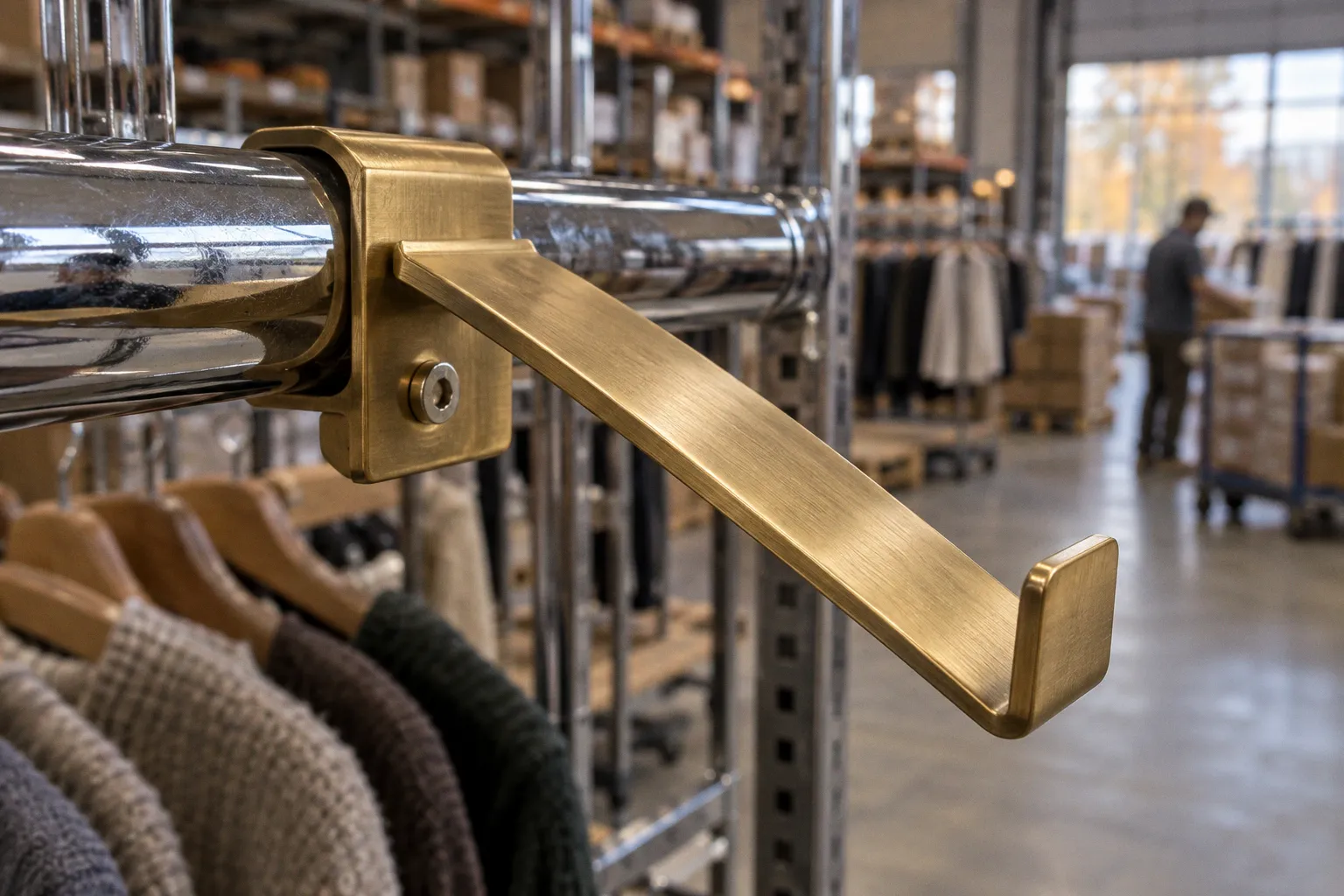
It fails because the tube wall is too thin, the span is too long, the weld is poorly executed, or the base connection transfers bending stress into a section that cannot absorb it. Finish is a surface system. Structural capacity belongs to the substrate, geometry, joints, and anchorage.
Compare car rental deals in United Kingdom
See available offersPartner link — DiscoverCars comparisonThis distinction matters when comparing brushed brass vs chrome plating for garment racks. A brass-toned rack may use solid brass, brass-plated steel, PVD-coated steel, or a powder-coated steel tube with a metallic effect. These are not interchangeable materials. They differ in hardness, abrasion behavior, corrosion mechanisms, repairability, and the way visible wear develops under commercial handling.
Chrome is not automatically the stronger option. Brass is not automatically the more durable option. The procurement decision depends on whether the rack must resist concentrated garment loads, repeated hanger impact, cleaning chemicals, humidity, fingerprints, or gradual tonal change.
The Mechanics of Surface Hardness and Structural Integrity
The first error in finish selection is treating the visible metal as the structural metal. In commercial display hardware, the outer finish is frequently only a thin layer over steel, stainless steel, brass, nickel, or another base material. The rack’s load-bearing behavior is governed primarily by the base tube and its connections.
A rack rail carrying garments is subjected to several simultaneous loads:
- Vertical bending from the total garment load and the weight of hangers.
- Local impact when hangers are pushed against the rail or dropped onto it.
- Torsion when customers pull garments from one side of the rack.
- Lateral force from contact with the frame, floor, or adjacent fixtures.
- Fatigue caused by repeated loading and unloading rather than one static event.
The finish contributes little to the rack’s section modulus or resistance to bending. A decorative chrome layer does not compensate for an undersized steel tube. A solid brass rail does not become equivalent to structural steel simply because the section appears substantial.
Brass is primarily an alloy of copper and zinc. Its Brinell hardness commonly falls between 45 and 80. That is materially softer than many steel substrates used in commercial fixtures. The practical result is direct: exposed brass is more susceptible to denting, edge marking, and surface deformation under hard contact than a steel component with a harder plated or coated surface.
This does not make brass unusable. It defines where brass belongs in the material stack. A solid brass component may be appropriate for light or moderate display duty, particularly where the section is oversized and the load is controlled. It should not be specified as a structural substitute for carbon steel in a heavy retail rack without engineering verification. Raw material cost is higher, and lower hardness does not provide an advantage under repeated impact.
Chrome plating presents a different problem. Decorative chrome is electroplated as a thin outer layer, normally over a nickel undercoat. The chrome supplies the reflective appearance and surface character. The nickel layer supplies much of the corrosion protection for the substrate. The underlying steel still carries the load.
The structural question therefore has two separate answers:
1. Can the rack carry the intended load?
Examine tube diameter, wall thickness, span, support spacing, welds, fasteners, feet, and anchorage.
2. Can the finish survive the handling environment?
Examine coating thickness, undercoat quality, edge coverage, abrasion, cleaning agents, moisture, and repair options.
Surface finish controls degradation and appearance. Tube geometry and joint design control load capacity.
A procurement specification should identify the substrate and finish separately. “Brass rack” is incomplete. “Steel tube with brushed brass finish” is still incomplete unless the finish process is stated. The difference between metal plating, PVD, powder coating, and solid alloy construction is not cosmetic terminology. It determines how the fixture fails.
Structural variables that matter more than finish
For a garment rack, the following variables should be established before selecting a surface treatment:
- Tube outside diameter and wall gauge. A larger diameter increases resistance to bending. Wall thickness affects local denting, weld behavior, and connection strength.
- Unsupported rail span. Bending stress increases as span increases. A central support can change the load path more effectively than a harder finish.
- Support configuration. End supports, intermediate brackets, and base frames determine whether the rail behaves as a simple span or a continuous member.
- Connection design. Welded joints, threaded fittings, concealed sleeves, and mechanical fasteners have different stress concentrations and maintenance requirements.
- Load distribution. Evenly spaced garments impose a different condition from a dense group of garments pushed into one section.
- Floor and wall anchorage. A rack may have adequate rail strength and still overturn if the base footprint or anchorage is insufficient.
- Contact points. Hanger hooks and metal accessories create concentrated abrasion at the exact locations where garments are moved most often.
A finish comparison performed without these structural inputs is incomplete. It may produce a useful material preference, but not a safe rack specification.
Brushed Brass and Chrome: Different Surface Systems
Brushed brass is a texture and a color family, not one material definition. The brushed effect is created by finely distressing the surface with a wire brush or abrasive process. This removes high gloss and creates a directional matte or satin texture. The same visual result can be applied to solid brass, brass-plated steel, stainless steel, or another metal substrate.
Chrome plating is a reflective electroplated surface. It is normally unbrushed and highly reflective, which makes it more sensitive to visible fingerprints, smudges, and water spots. The finish can remain visually uniform while the substrate and undercoat perform the structural and corrosion-protection work below it.
The following comparison separates the visible finish from its engineering consequences.
| Parameter | Brushed brass finish | Chrome plating |
|---|---|---|
| Typical visual behavior | Warm, low-glare, directional surface | Cool, high-reflectivity surface |
| Surface definition | Brushed texture reduces uniform reflection | Polished surface reflects light and surrounding objects |
| Common construction | Solid brass, brass plating, PVD, or metallic coating over steel | Thin chrome layer, generally over nickel and a base metal |
| Hardness consideration | Brass itself is relatively soft, with Brinell hardness around 45–80 | Chrome surface is hard, but overall rack strength still comes from the substrate |
| Fingerprint visibility | Lower on brushed or satin textures | High, especially on polished horizontal rails |
| Wear visibility | Local scratches can blend into the directional grain; plating loss may expose a contrasting substrate | Scratches, pits, and breaks in the reflective layer are immediately visible |
| Patina behavior | Unlacquered brass changes tone and can develop uneven patina | Chrome does not develop brass-like patina; damage can expose underlayers |
| Corrosion mechanism | Tarnishing or oxidation at exposed brass; substrate corrosion if plating is breached | Moisture through micro-defects can reach nickel and steel, causing subsurface oxidation |
| Best control for high abrasion | PVD or a properly specified protective topcoat | PVD or a robust plated system with adequate nickel undercoat |
| Main procurement risk | Mislabeling plated steel as solid brass, or expecting stable color from unlacquered brass | Assuming reflective chrome is maintenance-free or immune to pitting |
The phrase “brushed brass” should therefore trigger a specification request. Ask whether the component is solid brass, brass-plated steel, PVD-coated steel, or powder-coated steel. Those options may look similar on installation day. They will not age in the same way.
Solid brass versus brass-toned steel
Solid brass has a consistent brass substrate beneath the surface. If it is scratched, the exposed material remains brass. That does not make the scratch harmless. The softer alloy can still dent, deform, and accumulate contact marks. Its color is also not automatically stable. Unlacquered brass acts as a living finish: exposure to air and contact changes the tone, often unevenly.
Brass-plated steel has a different failure mode. The visible brass layer may be thin, and a deep scratch can expose steel. Once the substrate is visible, the repair is not equivalent to polishing solid brass. The defect may require refinishing, replacement, or acceptance as permanent damage.
PVD-coated steel can provide a more controlled surface system. Physical Vapor Deposition technology can increase abrasion resistance by up to 23 times compared with standard chrome plating, according to the supplied research. That figure should not be converted into a universal service-life guarantee. It describes abrasion resistance under the relevant test conditions, not bending strength, impact resistance, corrosion immunity, or guaranteed retail longevity.
Visual Impact Without Treating Appearance as Engineering
The aesthetic differences in metal rack finishes are operationally relevant because the surface changes how damage, contamination, and lighting are perceived.
Brushed brass scatters reflected light across the directional grain. Small fingerprints and light handling marks are less conspicuous than on polished chrome. The texture also reduces the visual contrast of minor surface disturbances. This is not the same as higher scratch resistance. It is a change in defect visibility.
Chrome reflects light directly. On a retail floor, that can create a precise, high-contrast surface, but it also exposes contamination. Fingerprints appear as breaks in the reflection. Water spots remain visible after evaporation. Dust and cleaning residue collect as irregular patches. Horizontal rails are especially affected because they are touched repeatedly and viewed at close range.
The difference is most obvious on these components:
- Hand-height rails, where customers move hangers and touch the surface.
- Front-facing uprights, where lighting reveals scratches and plating defects.
- Base tubes, where footwear, carts, and cleaning equipment create impact.
- Fitting-room fixtures, where repeated contact and frequent cleaning increase surface stress.
- Short display arms, where garments concentrate load and hanger hooks scrape the same zone.
Brushed finishes are more forgiving of minor handling marks. Chrome demands better cleaning discipline and stronger control of contact damage. Neither finish can conceal a structural defect, a bent tube, a failed weld, or corrosion blistering.
Unlacquered brass introduces another variable: change over time. It will not remain visually constant. Air exposure, skin contact, moisture, and cleaning practices influence the rate and distribution of patina development. If the rack must retain a consistent tone across multiple locations, unlacquered brass is a poor choice unless the maintenance program accepts periodic treatment and variation.
Lacquered brass or chemically aged antique brass provides better tonal control. It also creates a new failure mode. If the lacquer is scratched or degraded, localized discoloration may appear around the damaged area. A stable appearance then depends on both the underlying brass and the integrity of the protective layer.
Maintenance Realities: Fingerprints, Abrasion, and Patina
Maintenance is not a secondary concern for commercial displays. It is part of the finish specification. A rack may be wiped several times a day, exposed to oils from hands, and contacted by metal hangers, buckles, and garment hardware. The cleaning method can cause as much damage as normal use.
Polished chrome requires control of three visible contaminants:
1. Fingerprints. Oils interrupt the reflective surface and produce dark or cloudy patches.
2. Water spots. Minerals remain after evaporation and are difficult to ignore on a mirror-like finish.
3. Cleaning residue. Incomplete removal of detergent or disinfectant leaves an uneven film.
Brushed brass reduces the visibility of fingerprints because the surface does not reflect as a single uninterrupted field. It still collects oils and residue. The difference is visual tolerance, not immunity.
The maintenance method must match the surface:
- Use a soft, non-abrasive cloth for plated and polished surfaces.
- Remove moisture rather than allowing it to dry on chrome.
- Avoid abrasive pads that can cut through plating or flatten the brushed grain.
- Do not treat unlacquered brass as if it were lacquered. Polishing changes the surface and can create inconsistent tone across adjacent components.
- Keep aggressive chemicals away from unknown coatings. A cleaner suitable for stainless steel may not be suitable for lacquer, PVD, or decorative plating.
- Inspect edges, weld zones, drilled holes, and fittings. Coating damage often begins at discontinuities rather than the broad face of the tube.
A maintenance schedule should be based on traffic and exposure, not on the finish name. A low-touch stockroom rack may require little surface intervention. A front-of-store rail handled continuously will show wear regardless of whether its initial finish is brass or chrome.
Where each finish creates more work
Brushed brass generally creates more work when the specification requires a stable, uniform tone. Unlacquered brass will change. If several racks are installed at different times or in different lighting zones, tonal variation may become visible. Regular polishing can restore brightness but may erase or alter the brushed texture if performed aggressively.
Chrome generally creates more work where the surface is frequently touched or exposed to water. The cleaning burden is predictable: fingerprints, smears, and spots will be visible. The benefit is that a sound chrome system does not require the owner to manage natural patina. Its appearance is more stable until the plated system is breached or corrosion begins.
The correct maintenance question is not which finish is maintenance-free. No commercial metal finish is maintenance-free. The useful question is whether the facility can manage the specific form of degradation:
- visible contamination on chrome,
- tonal change on unlacquered brass,
- localized coating failure on plated steel,
- scratches across a directional brushed texture,
- chemical damage from unsuitable cleaning agents.
A finish that hides fingerprints may still fail under abrasion. A finish that remains reflective may simply make every maintenance error visible.
Corrosion Resistance and the Role of Nickel Undercoats
Corrosion resistance of polished metal fixtures depends on the complete coating system, not the color of the outer layer.
Decorative chrome is applied as a thin outer layer over nickel. The nickel undercoat provides the majority of the corrosion protection for the substrate. If moisture enters through a micro-defect, scratch, pore, edge, or damaged fitting, oxidation can begin below the visible surface. Chrome plating therefore can pit or corrode. It is not an impermeable barrier.
The risk increases in environments with:
- persistent humidity,
- wet cleaning procedures,
- salt or chloride exposure,
- inadequate drying,
- damaged edges,
- dissimilar-metal contact,
- unsealed drilled holes,
- poor plating coverage around joints.
Retail environments are usually less aggressive than industrial washdown areas, but the local conditions around a rack can still be severe. Wet floors, cleaning carts, damp garments, and repeated chemical wiping concentrate exposure at the base and lower uprights.
Brushed brass also requires a substrate assessment. Solid brass does not rust like steel, but it can tarnish and develop patina. Brass plating over steel remains vulnerable if the plating is breached. A brass-colored steel rack with an exposed scratch can develop corrosion at the steel substrate even if the surrounding surface remains visually intact.
Stainless steel introduces another path. It may offer strong corrosion performance, but it is not defined by a finish alone. A polished stainless rack, brushed stainless rack, or PVD-coated stainless rack still requires correct grade selection, fabrication, and cleaning. Surface contamination from carbon-steel tools or improper fabrication can create localized corrosion problems that are incorrectly blamed on the finish.
For commercial procurement, the corrosion specification should include more than “chrome” or “brass.” Establish:
- substrate metal,
- plating or coating process,
- undercoat where applicable,
- exposed-edge treatment,
- finish continuity at welds and drilled points,
- cleaning chemical compatibility,
- expected humidity and water exposure,
- replacement policy for damaged components.
A rack installed in a dry retail interior can use a different surface system from one placed near a loading entrance, fitting-room cleaning station, food-adjacent sales area, or humid storage zone. The environment changes the failure mechanism.
The PVD Advantage in High-Traffic Displays
PVD has become a significant option for commercial rack finishes because it separates metallic appearance from some of the wear limitations associated with conventional decorative plating.
Physical Vapor Deposition applies material in a controlled vacuum process. The resulting finish can produce brass, black, chrome-like, and other metallic effects over a compatible substrate. The key benefit in the supplied research is abrasion resistance: PVD can provide up to 23 times the abrasion resistance of standard chrome plating.
That advantage is relevant where the rack experiences repeated sliding contact from hangers or accessories. It is less relevant to static vertical load. PVD does not increase the beam strength of a thin tube. It does not prevent a poorly designed bracket from bending. It does not correct an undersized base or a weak weld.
PVD should be evaluated as a wear-control layer:
- It can improve resistance to repeated surface abrasion.
- It can provide more consistent color than unlacquered brass.
- It can support brass-toned or dark metallic finishes over steel substrates.
- It does not eliminate impact damage from carts, tools, or hard hardware.
- It does not make the substrate immune to corrosion once the system is breached.
- It should be specified with substrate preparation and edge coverage, not as an isolated color label.
For high-traffic garment displays, PVD-coated steel may offer a more controlled compromise than solid brass or conventional brass plating. The decision still depends on the coating supplier, process control, tube fabrication, and repair strategy. A PVD surface on a structurally inadequate rack remains an inadequate rack.
Mirror black and other high-contrast finishes
Mirror black polish finishes deserve the same forensic treatment. They show reflections, fingerprints, dust, and scratches with greater contrast than brushed surfaces. Their appearance depends heavily on uninterrupted surface continuity. A small defect on a high-reflectivity finish can be more visually disruptive than a similar defect on brushed brass.
Powder-coated steel is different again. Powder coating forms a thicker polymer-based film than decorative plating and can provide broad color control. It is not metal plating, and its wear behavior depends on film thickness, pretreatment, cure, impact resistance, and edge durability. A powder-coated brass color should not be described as brass construction.
This distinction is useful when reviewing display rack manufacturing drawings. The finish schedule should identify the process and the base material. Color names alone are not engineering data.
Choosing Between Brass and Chrome for Store Interiors
The correct choice follows the exposure and load path.
Choose a brushed brass system when:
- the retail concept requires a warm metallic field rather than a high-reflectivity surface;
- the rack is handled heavily and fingerprint visibility must remain low;
- tonal variation is acceptable, or the brass is lacquered, chemically aged, or PVD-coated;
- the supplier clearly identifies whether the brass is solid, plated, or applied over steel;
- the structural member is engineered independently of the surface finish.
Choose chrome plating when:
- a cool reflective surface is required;
- the store can support frequent wipe-downs and spot removal;
- water exposure is controlled;
- the nickel undercoat and plating process are documented;
- the rack will not be exposed to repeated unprotected impact at edges and joints.
Choose PVD when:
- abrasion from hanger movement is a primary concern;
- the finish must remain more uniform than unlacquered brass;
- the supplier can provide process information and substrate details;
- the project requires a brass, black, or chrome-like appearance with higher wear resistance than standard decorative plating.
Do not select solid brass solely because the rack must look substantial. Do not select chrome solely because it appears hard. Do not select powder-coated steel solely because the color resembles brass. These are different material systems with different failure modes.
A practical specification should be written in this form:
- Structural substrate: steel, stainless steel, or brass, identified separately.
- Tube geometry: outside diameter, wall thickness or gauge, unsupported span, and support spacing.
- Joint method: welded, bolted, threaded, sleeved, or mechanically locked.
- Surface process: brushing, electroplated chrome, brass plating, PVD, powder coating, or lacquer.
- Undercoat and pretreatment: especially for plated steel and coated systems.
- Exposure class: dry retail floor, humid zone, frequent wet cleaning, or industrial environment.
- Maintenance method: compatible cleaners, cloth type, drying requirement, and repair procedure.
- Acceptance condition: allowable scratches, color variation, coating discontinuities, and edge defects.
This format prevents a finish label from carrying information it cannot provide.
The Definitive Rule
For heavy garment loads, specify the rack by steel geometry, span, joint design, and anchorage first. Finish comes afterward.
For high-touch retail displays, choose brushed brass or another satin surface when fingerprint visibility and daily visual maintenance are the limiting factors. Choose polished chrome when reflectivity and stable cool tone justify the additional cleaning burden. Choose PVD when repeated hanger abrasion is more severe than ordinary handling and the supplier can document the coating system.
If the environment is humid or frequently wet-cleaned, do not approve decorative chrome without confirming the nickel undercoat, edge coverage, and maintenance compatibility. If the brief calls for brass, determine whether tonal change is acceptable. Unlacquered brass will patinate. Plated steel may expose a different substrate when scratched. PVD may improve abrasion resistance, but it does not replace structural engineering.
The rule is simple: load determines the substrate and geometry; handling determines the surface system; moisture determines the corrosion specification. Select the finish only after those three conditions are defined.