Chrome plating for retail racks: prep checklist
I've lost count of how many times I've walked into a retail backroom or a boutique fitting area and seen a chrome plated retail display rack with peeling, flaking, rust-spotted finish that someone paid premium money for six months earlier.
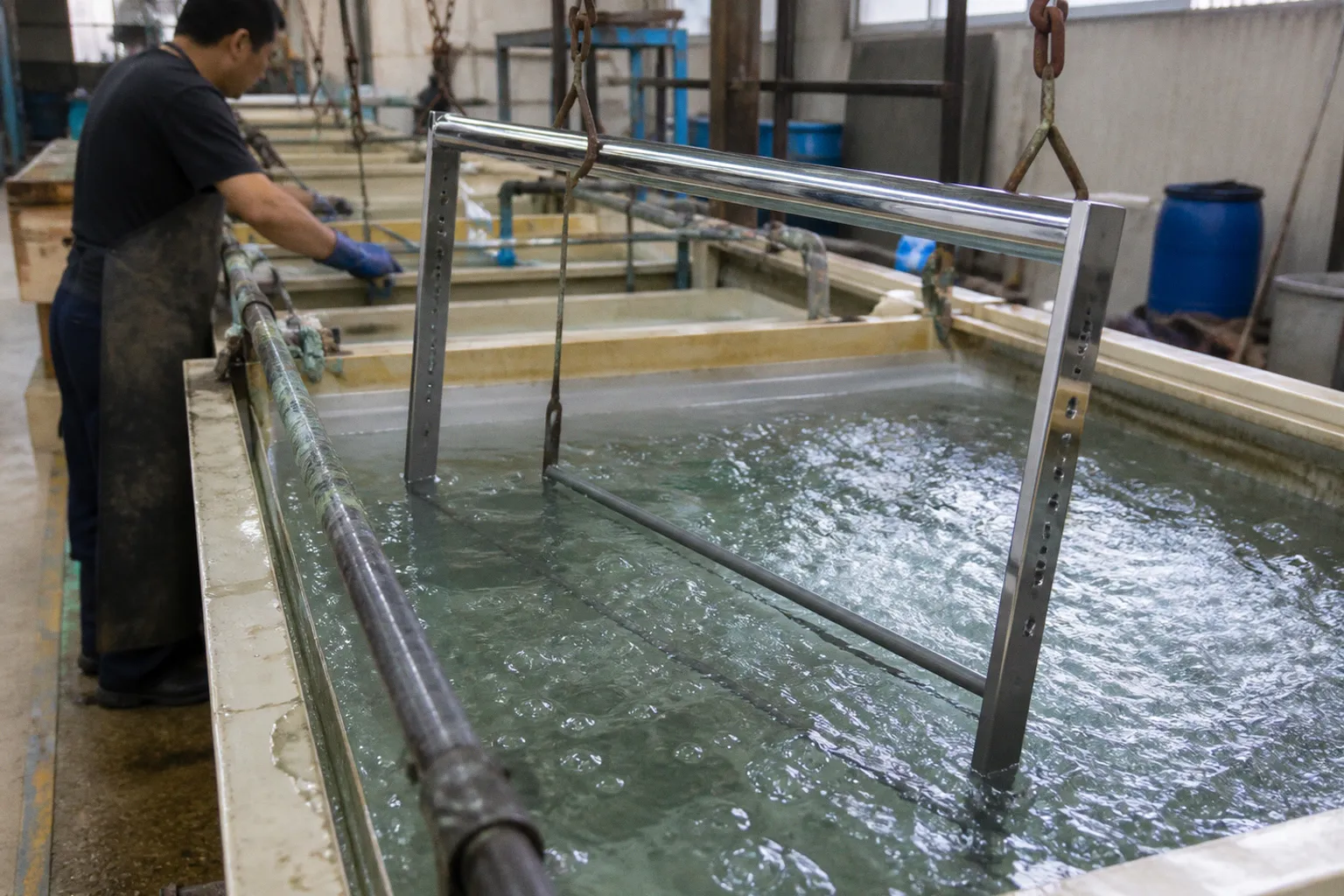
Every time, the buyer thought they were buying chrome. What they actually bought was bad prep work wearing a thin metallic costume.
Here's the uncomfortable truth about chrome plated retail display racks: the chrome itself is almost an afterthought. That mirror-bright surface you paid a premium for is roughly half a micron thick — thinner than a fingerprint — and it is decorative, not structural. The real corrosion protection, the real durability, lives in the layers underneath. And those layers only stick if the steel underneath them was prepped correctly before plating. Skip the prep, and you're not buying a chrome rack. You're buying a delayed-failure rack that will start spotting in the first fitting room that has a steam humidifier running.
This isn't a styling preference. It's a process. And if you specify commercial chrome clothing racks or heavy duty chrome garment rack systems without understanding what proper prep looks like, you're gambling with merchandise, staff time, and the customer's first impression of your fixtures.
How a proper chrome finish is actually built
A decorative chrome finish on a retail fixture is a sandwich, not a single coat. From the steel substrate outward, you typically get:
- Steel substrate — the tubing, brackets, base plates, the structural skeleton
- An optional copper underlayer — used for leveling on rougher steel and improving nickel coverage
- A nickel underlayer — the actual workhorse, carrying corrosion resistance, surface smoothness, and the bulk of the thickness you'll touch with your hand
- A micro-thin layer of decorative chrome on top — the bluish-white reflective surface, generally around 0.25–0.5 μm in retail-grade work
The chrome is the optics. The nickel is the durability. Both need an immaculately clean, properly activated steel surface to bond with. That's where ASTM B322 comes in — it's the standard guide for cleaning metals prior to electroplating, and it is the document that separates a rack that'll look good for a decade from one that'll go blotchy in a humid mall corridor.
The chrome is the optics. The nickel is the durability. The prep is what makes either of them stick.
The prep sequence that actually matters
This is the part no one selling you a "polished chrome garment rack" wants to dwell on. There are four gates every steel part has to pass through before any plating current ever flows, and the sequence is not negotiable. Reorder them and you contaminate the next bath. Skip one and you bond plating to a surface that was never ready for it.
| Stage | What it removes | Typical parameters | What happens if it's skipped or botched |
|---|---|---|---|
| Alkaline degreasing (or solvent vapor) | Stamping oils, cutting fluids, fingerprints, shop dust | Heated alkaline bath (~10% sodium carbonate, ~80°C, ~5 min) or vapor degrease | Oils carry into the acid bath, contaminate it, and prevent uniform pickling |
| Water-break test (verification) | Verifies the degreasing worked | Sheet water over the rinsed part — a continuous, unbroken film = pass; beading = fail | Without this check, contaminated parts silently move downstream and bond poorly |
| Acid pickling | Mill scale, rust, surface oxides | 5–10% sulfuric or hydrochloric acid immersion until scale is dissolved | Plating bonds to scale, not to steel; scale later lets go and takes the nickel with it |
| Electrocleaning | Last traces of microscopic contamination; activates the surface | Alkaline bath with electric current applied, commonly around 6V DC | Uneven plating adhesion, thin spots, and premature porosity failures in the chrome top layer |
The water-break test deserves its own paragraph because it's the cheapest quality check in the entire process and the one most often skipped. After degreasing and rinsing, the technician sheets water across the surface. If the metal is genuinely clean, the water films out into a continuous sheet that clings to the metal. If there's residual oil anywhere, the water beads up and pulls away into droplets. Beading means back to the degreaser — full stop. A thirty-second visual test that costs almost nothing to run, and it catches the exact difference between a rack that'll plate cleanly and one that won't.
Acid pickling is where the mill scale goes. Steel tubing and sheet arrive at any plating facility with a bluish-grey oxide layer from hot rolling, plus whatever rust and heat-treat scale accumulated in transit and storage. A 5–10% sulfuric or hydrochloric acid solution dissolves these and exposes active metal underneath. The parts sit long enough for full scale removal — not a quick dip. Under-pickle and the plating bonds to the scale; the scale eventually lets go, and your chrome takes the nickel with it. Then you're back to the fitting room flake show.
Electrocleaning is the final gate. Parts go into an alkaline bath with current applied — commonly around 6V DC — and electrolysis lifts the last traces of microscopic contamination while giving the surface a uniform activation that helps the first plated layer (copper strike or nickel strike) bond evenly. Skipping it shows up later as patchy adhesion and thin spots.
If the steel isn't clean enough to hold a continuous sheet of water, it isn't clean enough to plate.
What this means for retail rack metal finishes in practice
Now the industry reality check. Most retail rack metal finishes are sourced from manufacturers competing on price in a market where the buyer often can't tell the difference between a properly prepped rack and a shortcut one — until six months in. A few things worth knowing before you write the purchase order.
The finish you see is not the finish you paid for. Visual inspection at the showroom tells you almost nothing about prep quality. A properly prepped rack and a shortcut rack will look identical out of the box. The difference shows up at month eight, when the first humidity cycle or salt-air exposure (relevant for any storefront near a coastal road or an entry vestibule in winter) starts the corrosion under the chrome.
Welds are the weak link. A retail display rack with multiple welded joints has multiple zones where prep is harder to do correctly — inside corners, weld spatter zones, heat-affected areas. This is where shortcuts most often show up, and where delamination typically starts. If the steel shows visible spatter or heavy oxidation at the joints before plating, the prep is going to struggle in those zones regardless of what the spec sheet says.
The plating rack itself is a variable. Even at the plating facility, parts hang on conductive plating racks — typically titanium or copper — that have non-conductive PVC dip coatings on the non-contact areas. Those coatings direct the plating current to the workpiece and protect the rack from being plated itself. If the coatings are worn, thin, or patched incorrectly, you get uneven current distribution on the part, which translates directly into uneven plating thickness. Thin spots corrode first. Always first.
A practical checklist before you specify or buy
When I'm spec'ing chrome plated retail display racks for a client — boutique floor, supermarket perimeter, warehouse adjacency — I work through the same short list. It's not exhaustive, but it filters out the worst offenders and saves a callback six months later.
- Ask for the plating sequence in writing. A reputable manufacturer will name ASTM B322-compliant prep, identify the nickel underlayer thickness range, and state the chrome layer. If they deflect into vague terms like "industrial-grade plating," walk.
- Specify the nickel underlayer, not just "chrome." Decorative chrome without nickel is a porous coating sitting on bare metal. It will fail, and there is no version of the future where it doesn't.
- Inspect welds before plating. Weld spatter, heavy oxidation, and undercut at the toes are all prep problems in waiting. If you can see them at incoming inspection, the plater will struggle with them too.
- Check the interior tubing and contact points. A mirror black polish finish or brushed brass finish rack tells you about cosmetics. The chrome rack's contact points, interior tubing, and rack-touch zones tell you whether the plater could actually reach the surface to clean and plate it.
- Match the spec to the environment. A heavy duty chrome garment rack in a dry stockroom is a different corrosion risk profile than the same rack standing outside a humid fitting room or in a coastal storefront. Be honest about where it will live, then overspec if there's any doubt.
The reality check before purchase
Before I sign off on any chrome plated retail display rack order, I run this final list out loud. It is not negotiable.
- Is the substrate steel, and is it prepped to ASTM B322? If the supplier cannot confirm in writing, the answer is almost certainly no.
- Is there a documented nickel underlayer, and at what thickness range?
- Am I accepting that the chrome layer is decorative only — meaning corrosion protection is the nickel's job, not the chrome's?
- Where are the welded joints on this specific rack, and how were they finished before plating?
- What is the operating environment — humidity, salt exposure, customer contact frequency, cleaning chemicals?
- What does the warranty actually cover — finish failure, structural failure, or "manufacturing defects" defined narrowly enough to exclude everything above?
If I cannot get clear answers on the first two, I do not buy. A chrome rack that looks great at delivery and looks terrible at month ten is not a bargain at any price. The prep is invisible. The failure is not.