Copper polished garment racks: a boutique setup roadmap
A 120 cm clothing rail is a structural element, not a decorative tube. In a high-turnover boutique, a pure copper pipe at that span can sag under concentrated garment loads, particularly when the…
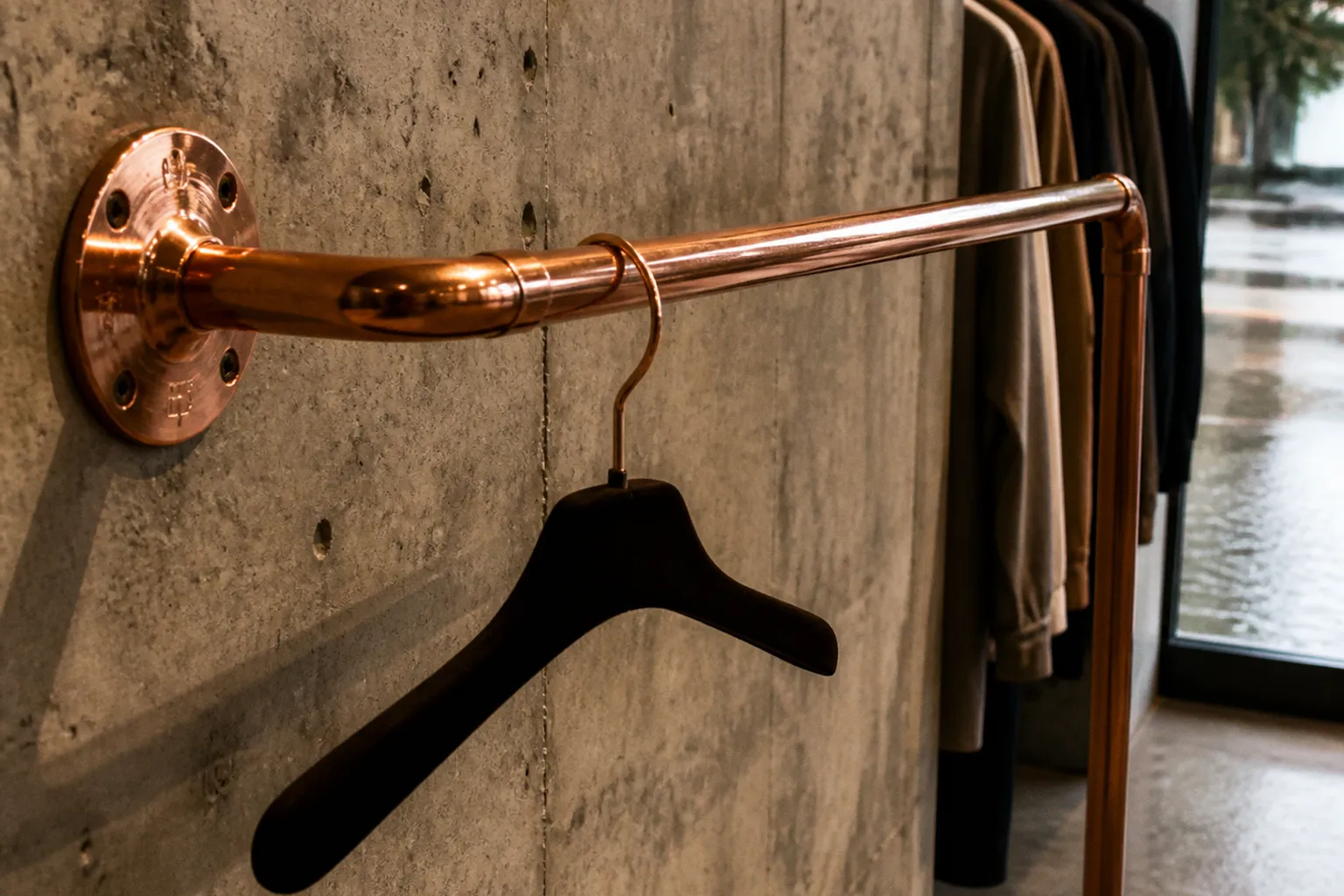
A 120 cm clothing rail is a structural element, not a decorative tube. In a high-turnover boutique, a pure copper pipe at that span can sag under concentrated garment loads, particularly when the rail is used continuously and hangers are moved across the same contact zones. Copper-plated steel is the more controlled specification for this application because the steel core carries the bending load while the copper layer supplies the visible finish.
The material decision determines more than appearance. It controls deflection, surface oxidation, cleaning frequency, fastener compatibility, and the point at which a polished copper clothing rack begins to look inconsistent across the sales floor. A boutique copper display fixture should therefore be specified as a structural assembly: core material, wall thickness, span, support spacing, finish system, and exposure conditions.
The copper surface is the finish. The steel core, support geometry, and fixing method determine whether the rack remains serviceable.
Structural integrity: pure copper pipe versus copper-plated steel
Copper and steel behave differently under load. Copper has useful corrosion resistance and a distinctive warm metallic tone, but a garment rail is governed by bending stiffness rather than surface chemistry. The relevant variables are span, tube diameter, wall thickness, support position, and the distribution of the merchandise load.
A rail does not fail only when it breaks. Excessive deflection is already a service failure. Hangers slide toward the lowest point, garments bunch in the center, brackets receive uneven force, and the rail begins to look misaligned relative to adjacent fixtures. In retail use, this process is accelerated by repeated loading and unloading rather than by one static event.
Pure copper pipe presents two separate concerns:
- Its stiffness is lower than that of a comparable steel tube with the same external dimensions.
- Plumbing-grade or thin-wall copper pipe may not be designed for repeated retail loading, impact from hangers, or long unsupported spans.
- Hollow pipe has limited resistance to local crushing at clamp points and threaded connections.
- Surface polish does not increase load capacity.
- A lacquered copper surface can preserve the finish while the underlying tube still deflects under merchandise weight.
Copper-plated steel changes the load path. The steel substrate carries the tensile and compressive stresses generated by bending. The copper plating forms the visible external layer. The plating should be treated as a finish system, not as a structural reinforcement. Its thickness, adhesion, and protective topcoat affect corrosion and wear, but they do not substitute for a properly sized steel tube.
For high-inventory-turnover boutiques, a copper-plated steel rail at 120 cm is the more defensible baseline than a pure copper pipe. This is not a universal load rating. It is a material-selection rule for a common retail span where garments are frequently added, removed, and redistributed.
What to request from the manufacturer
A display rack manufacturer should provide the following information before the finish is approved:
- Core material: mild steel, stainless steel, aluminum, or copper.
- Tube outside diameter and wall thickness in mm.
- Support spacing and maximum unsupported rail length.
- Rated load for the complete assembly, not only the tube.
- Test condition: evenly distributed load or concentrated load.
- Bracket material and fixing method.
- Plating or coating sequence.
- Protective lacquer specification, if used.
- Compatibility between the copper finish and the selected fasteners.
A statement such as heavy-duty is not a technical specification. It does not identify the tube gauge, section geometry, support interval, or test condition. The phrase should not be used to compare two racks.
The support assembly is often the weak component. A rail may have adequate bending resistance while the wall arm pulls out of masonry, the bracket twists, or the fastener head damages the finish. Floor-standing racks introduce another failure mode: lateral instability. A tall rack with a narrow base can remain intact yet become unsafe when garments are pulled from one side.
Load distribution matters more than nominal capacity
Garments rarely produce a perfectly uniform load. A customer removes several pieces from one end, pushes the remaining hangers toward the center, and then loads new stock at a single point. That produces a moving load concentration.
For this reason, a rack designed for a boutique should be evaluated under at least two conditions:
1. Distributed rail load. Garments are spaced across the full 120 cm length.
2. Concentrated rail load. A substantial portion of the merchandise is grouped in one zone rather than spread evenly.
The second condition is closer to actual retail handling. If the manufacturer supplies only a distributed-load figure, the figure does not describe the entire operating environment.
Pure copper pipe can be acceptable for low-load, low-frequency display use when the span is short and the support system is engineered around it. It is a poor default for dense merchandise drops. A copper-plated steel rack provides a larger structural margin without requiring the boutique to abandon the copper finish.
Managing the patina cycle in high-traffic retail zones
Unlacquered polished copper changes color. The initial surface has a rose-gold appearance, but exposure to oxygen, handling, cleaning residues, and fluctuating humidity initiates oxidation. In a retail environment, the first visible changes usually occur along the rail where customers and staff repeatedly touch or brush against the metal.
The development period is not fixed to a single day. Unlacquered copper can begin to darken within 3 to 12 months, with high-touch zones changing first. The result is a surface with local variation rather than a uniform finish. That variation may be acceptable when the rack is specified as an aging material. It is incompatible with a merchandising program that requires every fixture to retain the same rose-gold reflectance.
The choice is therefore between a controlled finish and a maintenance-dependent finish.
| Finish system | Surface behavior | Maintenance requirement | Appropriate use |
|---|---|---|---|
| Unlacquered polished copper | Gradual oxidation and darker patina, beginning at high-touch areas | Regular polishing or acceptance of visible color variation | Boutiques using patina as part of the material specification |
| Lacquered polished copper | More consistent color and reduced direct contact with oxygen | Gentle cleaning; damaged lacquer must be repaired or removed consistently | High-traffic zones requiring stable appearance |
| Copper-plated steel with protective clear coat | Steel provides the structural core; copper layer provides the visible surface | Inspect for scratches, edge damage, and plating wear | High-turnover merchandise rails |
| Copper-plated steel without adequate protection | Copper layer is exposed to abrasion and local chemical attack | Frequent inspection and controlled cleaning | Only where the manufacturer documents the finish system |
The table describes behavior, not a universal service life. Plating thickness and lacquer composition vary between manufacturers. Exact electroplating micron values should be requested rather than assumed.
Contact zones are the first maintenance zones
A copper finish does not age uniformly because the rail does not experience uniform contact. The highest-risk areas include:
- The front half of the rail where customers move hangers.
- The ends near collars and brackets.
- Areas touched during stock replenishment.
- Joints where moisture or cleaning residue can remain.
- Lower sections exposed to floor-cleaning chemicals or splashback.
A one-inch collar at the end of a wall-mounted arm prevents hangers from sliding off, but it also becomes a repeated contact point. If hangers strike the collar during daily use, the finish may wear locally even when the main rail remains intact.
A boutique should decide whether this contact pattern is acceptable before installing polished copper clothing racks. If the goal is a stable rose-gold surface, specify lacquered copper or copper-plated steel with a documented protective layer. If the goal is a changing natural surface, leave the copper unlacquered and establish a polishing protocol that does not attempt to force every section back to its original color after every handling cycle.
Strategic placement of wall-mounted display arms
Wall-mounted front-facing arms use less floor area than freestanding rails, but they transfer the merchandise load directly into the wall and bracket. The correct extension length depends on sightline, garment depth, aisle clearance, and the wall substrate.
Common arm extensions are 8, 12, and 16 inches. These dimensions should not be selected by visual proportion alone. A longer arm creates a larger lever arm at the wall fixing. The bending moment at the bracket increases as the load moves farther from the wall. The effect is simple: more projection requires stronger bracket geometry and more reliable anchorage.
The 8-inch arm
An 8-inch extension is suited to compact face-out displays and narrow circulation zones. It limits projection into the aisle and reduces the lever arm compared with longer arms. The usable display volume is lower, but the configuration is easier to control where wall space and customer movement are restricted.
The collar should sit at the outer end of the arm. A one-inch collar length is commonly used to keep hangers from sliding off during handling. The collar must be formed or fixed without creating a sharp edge that can catch fabric.
The 12-inch arm
The 12-inch extension is a balanced specification for many boutique wall runs. It provides more garment visibility than the 8-inch format while remaining less demanding on the wall fixing than a 16-inch arm. It should still be treated as a cantilevered load path, not as a lightweight accessory.
The bracket plate must be aligned with the wall substrate. Plasterboard alone is not equivalent to masonry, timber framing, or a steel stud. The fastener system must match the substrate and the expected load. A plated finish cannot compensate for a fixing installed into unsuitable material.
The 16-inch arm
A 16-inch arm increases projection, garment capacity, and the force applied to the wall connection. It should be reserved for locations with adequate structural backing and sufficient aisle width. Longer arms also create more opportunity for customers to pull on the outer rail while selecting garments.
The manufacturer should identify the load rating for the full 16-inch assembly. A rating for an 8-inch arm cannot be transferred automatically to the longer version. The bracket, welds, mounting plate, and wall fixings must all be evaluated as one system.
Every additional inch of wall-arm projection increases the demand on the bracket and fixing. The finish remains unchanged; the force path does not.
Placement rules for copper finish retail racks
Wall-mounted copper finish retail racks work best when the hardware is placed where it supports a clear front-facing presentation without forcing customers to load the rail from one side. The following arrangement reduces mechanical and operational problems:
- Use shorter arms near aisle corners and door approaches.
- Keep longer arms on straight wall runs with known clearance.
- Avoid placing the highest-touch rail at a point where customers must turn around it.
- Align bracket centers with structural backing rather than using spacing based only on visual rhythm.
- Keep copper collars and end stops consistent across the installation.
- Inspect the outer end of each arm for rotation, loosened fasteners, and coating damage.
- Separate garments from abrasive wall finishes that can rub against the plating during movement.
A wall-mounted arm is not a substitute for floor storage. It is a face-out display tool. Its value is visual control and floor-area reduction. Its limitation is the cantilever load path.
Optimizing floor configurations for visual sightlines
Floor-standing configurations change the problem from wall anchorage to base stability and load distribution. The primary formats are single-rail racks, 3-way or T-stand units, and circular round racks. Each supports a different relationship between merchandise density, customer access, and sightline control.
Single-rail racks
A single-rail rack provides a linear display with predictable loading. It is easier to position against a wall or within a defined merchandising run. The main structural concerns are rail deflection, base torsion, and lateral movement when garments are pulled from one side.
For a 120 cm rail, copper-plated steel is the appropriate default when inventory turnover is high. The rail should not be selected by external diameter alone. Two tubes can share the same outside dimension while having different wall thicknesses and therefore different bending resistance.
A single rail also needs a base wide enough to resist tipping. Increasing garment density without increasing base stability shifts the rack’s center of mass and raises the risk of lateral movement.
3-way and T-stand units
A 3-way or T-stand creates multiple display directions from one floor footprint. This can improve product visibility, but it also produces uneven loading when one arm carries more stock than the others. The central post, arm junctions, welds, and base connection require inspection.
The copper finish should be continuous across the junctions. Poorly prepared weld areas can show a different texture or color after plating. That is a manufacturing issue, not a polishing issue. If the copper layer is thin or poorly bonded at a joint, repeated garment contact can reveal the substrate.
A T-stand should be positioned so that one loaded arm does not project into a primary walking route. The floor plan must account for the full garment envelope, not just the central post.
Circular round racks
Circular racks increase hanging capacity within a compact area, but they complicate load distribution. Customers tend to push garments around the circumference, producing changing contact forces and repeated abrasion along the rail. The circular geometry also limits sightlines through the fixture.
Copper polished garment racks in round configurations require consistent support around the ring. A single unsupported segment can develop localized deflection even when the average load is moderate. The ring should be divided into supported spans according to the manufacturer’s engineering data rather than treated as one continuous tube.
Circular units are most defensible where the stock is dense, the customer can access the entire perimeter, and the surrounding aisle remains clear. They are less suitable where the display must preserve a long visual axis across the store.
Configuration comparison
| Configuration | Primary structural demand | Finish exposure | Best operational use |
|---|---|---|---|
| Single rail | Rail bending and base stability | Repeated hanger contact along one line | Linear displays and wall-adjacent runs |
| Wall-mounted arm | Cantilever bending and wall anchorage | High contact at collar and outer end | Front-facing displays with limited floor area |
| 3-way/T-stand | Central junction, arm balance, and base torsion | Abrasion at several arm ends | Directional displays from one floor position |
| Circular round rack | Distributed support and ring deflection | Continuous contact around the circumference | Dense stock accessible from multiple sides |
The configuration should follow the load path. A rack positioned for sightlines but overloaded at one arm is not an optimized display. It is a stressed structure with a merchandising function attached to it.
Manufacturing details that determine finish durability
Copper finish retail racks are commonly produced through different combinations of substrate preparation, metal plating, and clear protection. The final appearance can be similar at installation while the service behavior differs substantially.
The substrate must be clean and mechanically prepared before plating. Surface contamination, weld scale, sharp transitions, and poor edge preparation create defects in the finished layer. These defects are often visible at collars, joints, end caps, and bracket transitions.
A typical finish specification should identify whether the rack uses:
- A copper-plated steel tube.
- A copper-colored coating over steel.
- A solid copper component.
- A lacquered polished copper surface.
- A copper layer with a separate clear protective coating.
- A powder-coated steel substrate in a copper-toned color.
These are not interchangeable terms. Copper plating deposits a metal layer. Powder coating creates a polymer coating. A copper-colored powder coat may resist handling well, but it will not develop the same oxidation behavior as exposed copper. Conversely, exposed copper provides genuine patina development but requires a maintenance policy.
Plating and coating are not structural upgrades
A metal-plated tube does not automatically have the mechanical properties of the plated metal. The steel core remains responsible for most of the structural capacity. The plating adds surface protection and visual character. It may also introduce a galvanic interface that requires proper process control and edge protection.
The finish specification should cover the areas most likely to be missed:
- Cut tube ends.
- Welded joints.
- Drilled holes.
- Bracket edges.
- Internal faces of collars.
- Contact points under clamps.
- Areas hidden by end caps.
If these zones are not treated consistently, corrosion or discoloration can begin where moisture and handling residues accumulate. The result is often a dark line or localized stain that cannot be removed without disturbing the finish.
A clear lacquer reduces direct oxygen and moisture exposure, but it creates a different repair problem. Once the lacquer is scratched through, spot polishing can produce a visible boundary between protected and unprotected areas. The repair method must therefore be specified before installation. A boutique should not use abrasive steel wool on a lacquered surface unless the finish supplier explicitly permits it.
Maintenance protocols for restoring polished finishes
Maintenance begins with identifying the surface system. Unlacquered copper, lacquered copper, copper-plated steel, and copper-colored powder coating require different procedures. Treating them as one material creates unnecessary wear.
Unlacquered copper can be restored from tarnishing or patination with fine steel wool or a dedicated metal polish. The process removes or alters the oxidized surface. It does not prevent the next oxidation cycle. In high-touch areas, restoration may need to be repeated because handling transfers oils and residues to the same zones.
A controlled maintenance sequence is more reliable than informal cleaning:
1. Identify the finish. Confirm whether the surface is bare copper, lacquered copper, plated steel, or powder-coated steel.
2. Remove loose contamination. Use a clean, non-abrasive cloth to remove dust and dry debris before applying any compound.
3. Test an inconspicuous section. Check whether the polish changes reflectance, color, or the boundary between coated and uncoated areas.
4. Work with the tube geometry. Follow the length of the rail rather than creating isolated circular polishing marks.
5. Clean residue from joints and collars. Compounds left around hardware can hold moisture and abrade the surface during hanger movement.
6. Inspect the coating or plating. Look for scratches that expose a different substrate, especially at ends and brackets.
7. Record the treatment. The next maintenance cycle should use the same product and method where possible.
Fine steel wool is not a universal recommendation. It is relevant to restoring natural copper patina when the surface is unlacquered. It can damage a lacquer, dull a plated surface, and leave metallic debris at joints. A dedicated metal polish can also be unsuitable if it contains aggressive abrasives or chemicals that attack the protective layer.
Preventing copper rack tarnish
The most effective method for preventing copper rack tarnish is to choose the correct finish before the rack enters service. Cleaning cannot convert an unlacquered surface into a permanently stable one.
For high-traffic retail zones:
- Specify a lacquered or otherwise protected surface when color consistency is required.
- Use gloves during installation to reduce initial handling residue.
- Keep acidic cleaning products away from the rail.
- Remove moisture and detergent residue rather than allowing it to dry on the metal.
- Avoid adhesive labels directly on the copper surface.
- Inspect high-touch zones on a fixed schedule.
- Replace damaged protective components before the substrate is exposed.
- Do not polish one section to a new-metal finish while leaving adjacent sections heavily patinated unless the contrast is intentional.
Outdoor exposure and fluctuating humidity accelerate tarnishing and patination. Racks placed near open entrances, wet rooms, loading zones, or poorly conditioned storage areas need a stronger finish specification than fixtures located in a stable interior sales zone.
The maintenance interval should follow actual contact and exposure, not a generic calendar. A rack used for occasional editorial display will accumulate surface change more slowly than a 120 cm rail handling dense stock every day.
Selecting the complete boutique setup
The correct copper polished garment racks boutique setup is based on three linked decisions: load, environment, and visual function. The finish is selected after the structural use is defined, not before.
Use copper-plated steel when the rail will carry dense merchandise, the span approaches 120 cm, and inventory turnover is high. Use pure copper pipe only where the load is controlled, the span and support geometry are documented, and the manufacturer confirms suitability for the intended service. Do not treat hollow copper plumbing pipe as a heavy-load retail rail without reinforcement or a structural core.
Use wall-mounted arms when floor area is limited and the wall substrate can accept the cantilever load. Select 8-inch, 12-inch, or 16-inch extensions according to aisle clearance and bracket capacity. The 1-inch collar stop should be included where hanger migration is a risk.
Use single rails for controlled linear displays. Use 3-way or T-stand units when directional presentation justifies the additional junction and base demands. Use circular racks only when full perimeter access and ring support are compatible with the store layout.
Finally, choose between natural patination and a controlled polished surface. Unlacquered copper will change over time, beginning in the zones customers touch most. Lacquered and plated systems reduce that variation but require inspection when the protective layer is scratched.
The rule is direct: for high-turnover merchandise at a 120 cm span, specify copper-plated steel with a documented protective finish and engineered supports. Reserve unlacquered pure copper for lower-load applications where patina is an accepted operating condition. Every other choice should be justified by the load path and exposure environment, not by the sample board.