Brushed brass display racks: planning and sourcing checklist
Every retail buyer I've walked through a brushed brass garment rack spec has the same first instinct: they tap the rail in a showroom, like the weight of it, and assume solid metal. Most of the time, they aren't holding solid metal.
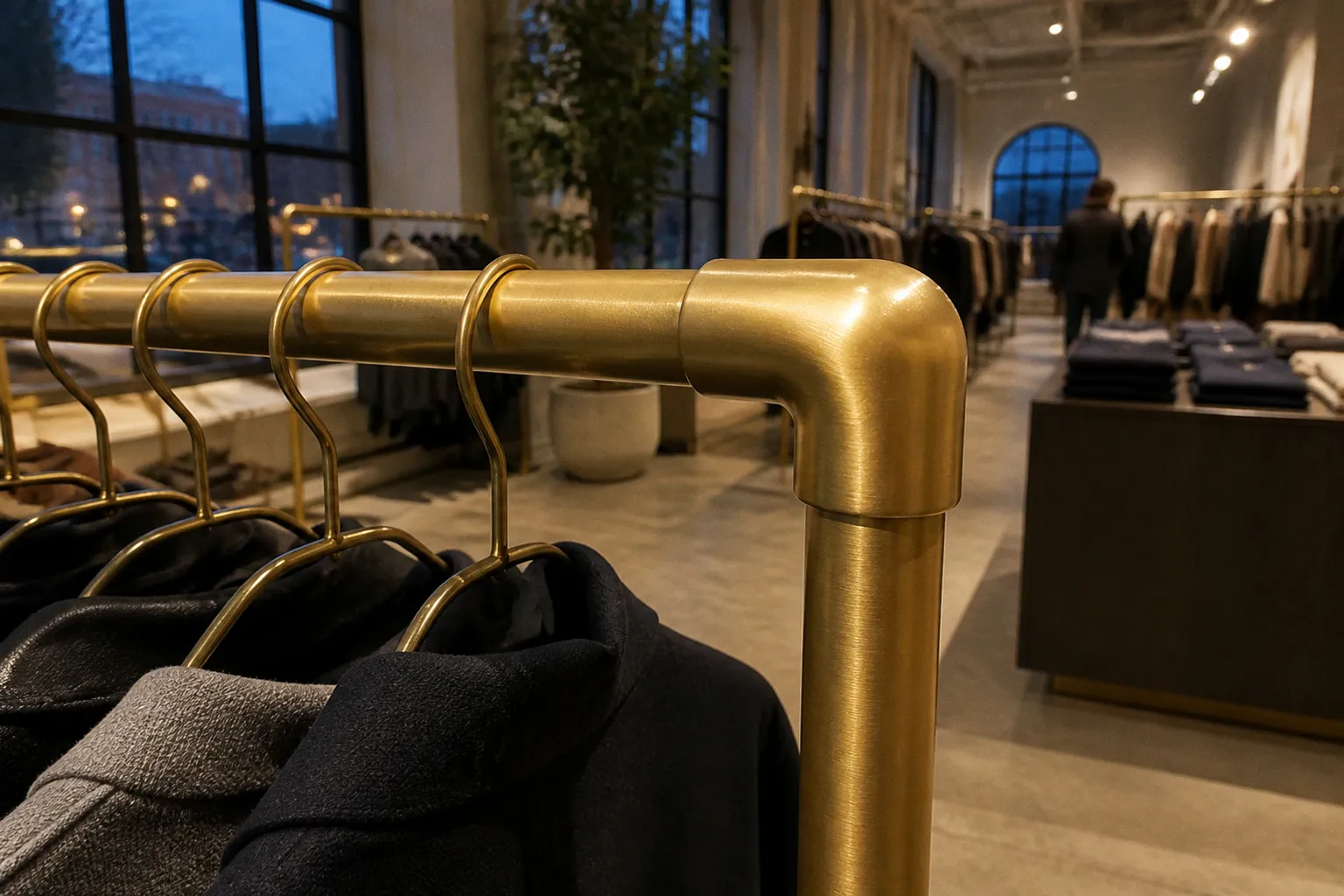
The vast majority of commercial brushed brass fixtures on the market are brass-plated steel, PVD-coated stainless steel, or powder-coated steel wrapped in a warm finish — and the word "brass" on the spec sheet is doing far more aesthetic work than structural work. That's not deceit exactly; it's the category quietly trading on look while engineering quietly picks what actually holds up under a Saturday sales floor.
I've specified these racks for boutiques, retail floors, and warehouse-style displays long enough to have pinched my fingers on enough cheap brackets to know what separates a fixture that lasts from one that looks great for six months and then sulks. Here's how I plan a brushed brass order before any money moves.
"Brass" on a spec sheet is an aesthetic, not a metallurgical guarantee — assume plated steel until proven otherwise.
What you're actually buying: solid brass, plated steel, or something in between
Three material families show up in commercial brushed brass garment rack orders, and they don't behave the same way once they're on your floor.
Solid brass — usually drawn from C26000 or C36000 alloy tubing — is the real-deal option. It machines cleanly, takes a brushed finish well, and feels hefty in the hand. It also costs several times what plated steel costs, has a maximum uncut rail length of about 3000 mm, and bends the budget before it bends the rail. Solid brass is what you specify when the fixture is part of the brand story and replacement isn't on the calendar for a decade.
Brass-plated or PVD-coated steel is the workhorse of the category. A thin brass layer — deposited chemically, electroplated, or laid down via Physical Vapor Deposition — sits over a structural steel or stainless core. The brass is measured in microns, not millimeters, and the steel underneath is what actually carries the load. PVD tends to outperform older plating methods for scratch and tarnish resistance, but thickness varies by vendor — usually somewhere in the rough neighborhood of 0.2 to 2.0 microns depending on who made it — so it's worth asking rather than assuming.
Powder-coated steel with a brass-toned finish is the third path. It's not brass at all — it's a pigmented film — but it's durable, color-consistent, and the cheapest of the three. Useful for back-of-house and warehouse displays where the rack needs to perform, not pose.
The trade-off is honest: solid brass wins on tactile feel and aging character, plated steel wins on structural strength per dollar, and powder-coated wins on cost and uniformity. Most commercial buyers I work with end up specifying plated or PVD-coated steel as the default and reserving solid brass for hero pieces near the storefront entrance.
| Parameter | Solid brass tubing | Brass-plated / PVD steel | Powder-coated steel |
|---|---|---|---|
| Structural core | Brass alloy (e.g., C26000 / C36000) | Steel or stainless steel | Mild steel |
| Brass layer thickness | Full material | Roughly 0.2–2.0 microns (varies by vendor) | None — pigment in cured powder film |
| Cost relative to baseline | High | Moderate | Low |
| Finish aging | Develops patina if unlacquered | Stable under lacquer or PVD; plating can wear at contact points | Color-stable; chips reveal substrate |
| Typical use | Hero pieces, signature displays, low-volume boutique rollouts | Standard retail floor racks, mid-to-high volume | Back-of-house, warehouse, high-volume rollouts |
Tubing diameter and structural geometry
Brass racks live or die by their tube diameter, and the commercial range is narrower than most catalogs suggest. Round tubing in the 25 mm to 38 mm outer diameter band covers the majority of fixtures you'll spec — that's roughly 1 inch to 1.5 inches. The heavier industrial pipe-style racks I've worked with usually sit in the 32 mm to 34 mm zone, paired with cast brass fittings that screw onto threaded pipe ends.
Smaller diameters (25 mm and under) belong to wall-mounted and light-duty units. They look elegant but they're not where you hang a winter coat collection. Larger diameters (38 mm and up) read as industrial, support more weight, and tend to anchor floor-standing hero pieces. Square tubing exists in the same family but is less common in true brass-look fixtures — when you see it, it's almost always on the plated or powder-coated side.
Length matters as much as diameter. Single uncut solid brass rail stock typically tops out around 3000 mm before shipping and handling get awkward; longer runs require either spliced sections or a shift to plated material, which can be produced in continuous lengths more easily. If your display wall footprint runs longer than 3 meters and the brief says solid brass, plan for visible joint hardware or reconsider the spec.
Load capacity: reading past the brochure numbers
Here's where brochures and reality diverge most aggressively. Commercial metal clothing racks span a wide range — from about 30 kg on light wall-mounted units up to 80 kg or more on heavy-duty floor-standing frames with square or round tubular construction. The number on the spec sheet is usually the static, evenly distributed load on a level surface, mounted correctly, with the brackets you were supposed to use.
In practice, three things collapse those numbers:
- Concentrated load. A rack rated for 80 kg doesn't mean a single hanger with a heavy wool overcoat can hang anywhere. Real garments cluster. The bracket nearest the cluster takes the brunt.
- Mounting integrity. A wall-mounted rack is only as strong as the anchor in the wall. Drywall plus plastic anchor is a recipe for a Sunday morning repair call. Specify into studs, masonry, or steel framing — and budget for it.
- Frame geometry. A round tube will deflect differently than a square tube under the same load. Square sections resist torsion better when the rack is mobile or bumped by a cart.
Vertical load and cantilevered weight are different problems too. A 30 kg rating on a wall-mounted cantilever is more demanding than the same number on a freestanding floor unit, because the wall anchor takes shear force, not just weight.
When I spec a rack, I take the manufacturer's number and apply a working load around half of it for safety margin on floor units and roughly a third for wall-mounted units. The brochure 80 kg becomes a working 40 kg on the floor and 25 kg on the wall. That's not pessimism; that's what survives a Black Friday.
Finish behavior: living patina, lacquer, and PVD
The brushed brass look is only stable if you decide it should be. Brass is a reactive metal — it oxidizes in air, reacts with skin oils, and shifts color over months and years. How your rack behaves depends on whether the surface is sealed.
Unlacquered (living finish). The brass ages visibly. Fingerprints darken to brown, polished spots wear to a softer satin, and the whole fixture drifts toward a warm patina. Many buyers love this — it's the honest-material argument. In a high-touch retail environment, though, it means the rack near the entrance looks noticeably different from the one in the back within a season.
Lacquered. A clear protective coat locks in the brushed look and slows oxidation dramatically. The rack looks the same in month 18 as it did on day one, assuming the lacquer isn't scratched through. Once scratched, the exposed spot starts to age and the difference becomes visible.
PVD-coated. The most stable of the three for finish consistency. PVD bonds a thin ceramic-metal layer to the substrate and resists scratching and tarnish better than lacquer. It still won't survive a steel-wool scrub, but in normal retail use it holds its color for years.
The honest framing: if you want the rack to look like the catalog forever, specify PVD or lacquered and plan for replacement of any units that get scratched. If you want the rack to look like it's been in your store for thirty years from day one, unlacquered will get you there — just not uniformly.
Unlacquered brass doesn't fail; it tells the truth. Plan for it, or specify a seal, but don't pretend it isn't aging.
Casters and mobility for floor configurations
Mobile brass racks complicate the spec because the casters are almost always the weakest link and the most overlooked. Commercial mobile brass fixtures I've seen typically run 75 mm diameter castor wheels with dual foot-operated total-brakes and a per-caster load rating around 50 kg. Four casters on a rack give you a theoretical mobile capacity of 200 kg — but the brakes, the frame, and the floor all have to agree.
A few practical notes from installations:
- Brake type matters. Total-lock brakes (brake + swivel lock together) keep a loaded rack from drifting when a customer bumps it. Single-function brakes don't.
- Caster material matches the floor. Soft polyurethane tread for hardwood and tile; harder wheels for carpet and warehouse concrete. Brass racks almost always live on hard floors; default to non-marking rubber or polyurethane.
- Stem vs plate mounting. Most commercial casters are either stem-mounted (threaded into a socket welded to the frame) or plate-mounted (bolted to a base plate). Plate mounts handle more abuse; stem mounts look cleaner. Either works as long as the frame was designed for it.
- Load distribution. A 50 kg-per-caster rating assumes even load. An overloaded top rail shifts weight to the front casters and accelerates wear on the wrong wheels.
Mobile brass fixtures change the rack's footprint and its center of gravity; spec the casters before you commit to the rail length. For static floor racks that occasionally need to move, recessed leveling feet instead of casters keep the look clean and the rack stationary. Casters are for racks that move daily; don't add them to a fixture that won't roll just because the catalog offered them.
Pre-purchase reality check
Before you commit to an order, walk this list:
- Ask what the structural core actually is. "Brushed brass" alone tells you nothing about the substrate. Get the alloy if it's solid brass, or confirm plated, PVD, or powder-coat over what steel.
- Confirm tubing OD against the load. 25 mm is light-duty. 32–38 mm is where commercial floor racks should start.
- Apply your own safety factor. Halve the manufacturer's static load for floor use, third it for wall mounting. If the working number doesn't cover your garment weight with margin, size up.
- Decide on finish behavior upfront. Unlacquered, lacquered, or PVD — pick one based on how much aging you can tolerate, not based on price.
- Inspect the casters separately from the rack. Don't trust a caster rating pulled from a generic catalog. Match the brake type to the use case.
- Check joint and bracket hardware. Cast brass fittings on threaded pipe feel substantial; stamped steel brackets with a brass-tone finish do not. Pinch-test the welds where you can.
- Plan mounting before delivery. Wall-mounted racks need the right anchors in the right substrate. Have those ready, or the rack sits in the box for a week.
- Get a finish sample in hand. Order a swatch or a small off-cut. Photos flatter brass. The rack under your lighting will look different than the catalog image.
- Think about modularity and retrofit. Racks that accept replacement casters, brackets, or rail sections outlast sealed units. Brass-plated steel can be re-plated; solid brass can be re-brushed. Either is repairable; a pressed-together import often isn't.
Closing position
Brushed brass garment racks aren't mysterious — they're just under-documented. The category leans hard on a finish name to do the work of a material spec, and most buyers don't push past the first line of the product sheet. Push past it. Decide whether you're buying brass for its surface, its structure, or both. Specify the tube diameter to your load, the load to your working reality, and the finish to your tolerance for aging. The rack that lasts ten years on a retail floor is rarely the one that looked best in the showroom — it's the one whose spec was honest about what it actually was.