Optimizing Sports Retail Layouts for a $422 Billion Market Surge
The sports retail floor is about to get crowded — and not in a bad way. ElectroIQ's fresh look at global sports retail puts the whole sector at roughly $422 billion in 2025, with sporting goods alone…
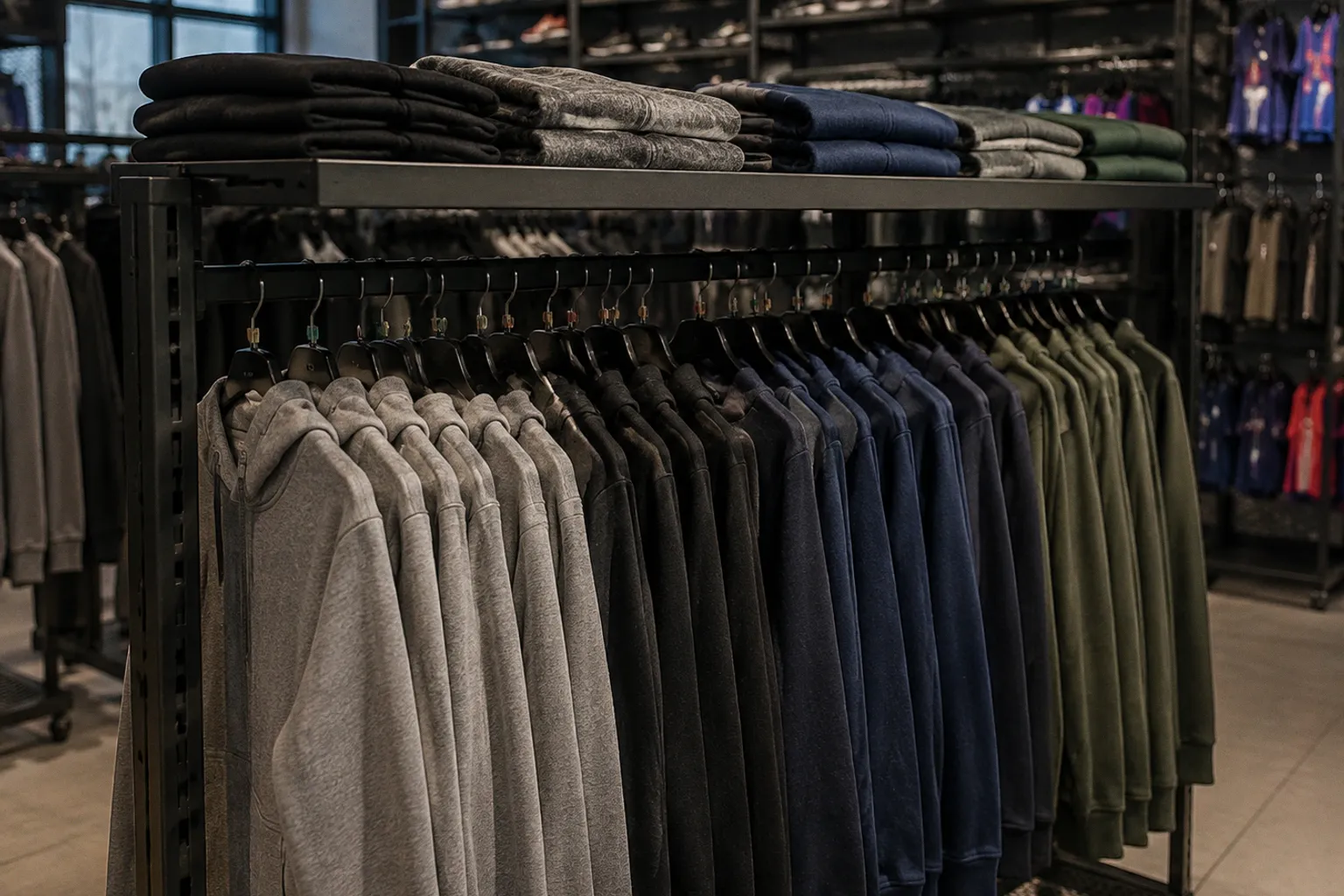
The sports retail floor is about to get crowded — and not in a bad way. ElectroIQ's fresh look at global sports retail puts the whole sector at roughly $422 billion in 2025, with sporting goods alone tracking from $112.62 billion this year to a projected $193.67 billion by 2034. For anyone responsible for planograms, endcaps, and garment racks, that trajectory isn't a footnote. It's a layout brief.
What the growth curve is telling your fixture plan
The headline number most retailers miss is the quiet one: annual market value grew between 5.1% and 6.2% from 2023 through 2026, and projections hold a 6.2% CAGR out to 2030. Some sources push the ceiling past $800 billion by 2034; the more conservative read still sits above $600 billion. Either way, your square footage is going to be asked to carry more SKUs, not fewer. If your gondola run was sized for last year's range, the next reorder cycle will expose every dead zone you let slide.
Here's what the mix shift means on the rack. Sportswear is the dominant slice of that $422 billion pie, valued somewhere between $220 billion and $400 billion in 2025 depending on the source — and the category is no longer a gym-only shopper. Customers are pulling sports apparel and footwear for school runs, office days, and travel, which means your sightlines need to read like a lifestyle wall, not a locker room. When a buyer isn't a buyer, dwell time stretches, and your endcap has to do the storytelling your sales associate can't.
Where the merchandising pressure actually lands
Three calls we keep making on athletic floors right now:
- Apparel walls want width, not just height. When a category grows into fashion-adjacent territory, customers compare across colorways and silhouettes. If your wall is single-sided or stacked too tight, you're forcing a decision before the customer is ready, and that's where conversion quietly leaks.
- Footwear needs the room, not the runway. Athletic footwear is being worn by people who never set foot in a gym. Plan for try-on comfort, not just display density — bench seating near the wall, enough aisle width for a second pair to come out of the box, and sightlines that let customers see size variants without walking the full run.
- Endcaps are where the 6% lives. A steady mid-single-digit CAGR, layered on top of fashion-style trial behavior, means seasonal drops land harder and faster. Rotate endcaps on a fixed cadence — every two to three weeks — and tie each one to a measurable KPI, not a calendar date.
Watch this on your next floor walk
Before your team resets the athletic zone, pull three numbers: current SKU density per linear foot, average dwell time in the apparel section, and endcap sell-through per rotation. If your density is high but dwell is low, your sightlines are the problem, not your assortment. If dwell is high but sell-through is flat, your endcaps aren't doing the handoff to the wall. The growth is real, the customers are walking in — now the question is whether the rack is ready for them.