Optimizing Retail Fixtures for Shifting SKU Density and Load Demands
According to retail-insider.com's "From The Desk" column dated August 8, 2026, Canadian retail is being framed as "Navigating Growth and Resilience." The framing belongs to the source; the structural read belongs here.
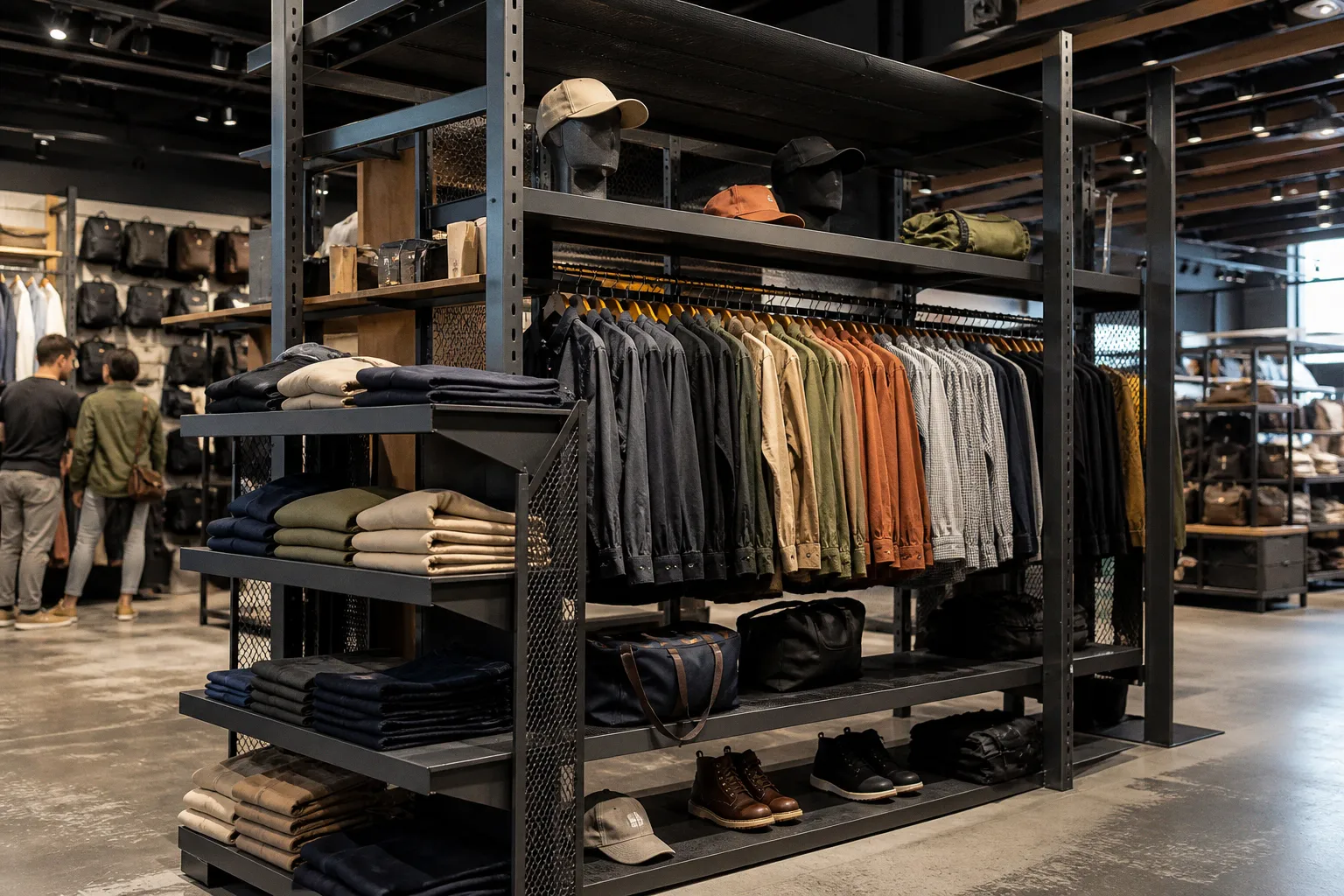
When a market posts growth and resilience simultaneously, the installed fixture base absorbs two opposing forces at once — new SKU density on existing gondolas, and category rebalancing that pulls some departments out and pushes others in. Both are load and finish problems before they are merchandising problems.
Cross-market load profiles from the same data window
Adjacent reports place the Canadian headline in a mixed field. Retail Asia, citing the Singapore Department of Statistics, puts June retail sales at $4.2 billion, up 4% year-on-year and 1% month-on-month on a seasonally adjusted basis; online transactions reached 16.4% of the total, up from 15.3% in May. That 1.1-point shift inside a single month is the relevant number for the shelf engineer — more online share means fewer in-store SKUs carried at higher per-SKU velocity, which raises point-load on brackets and concentrates the load distribution along the gondola run instead of spreading it.
Within the same Singapore release, the category split dictates fixture specification. Recreational goods rose 11.4% year-on-year, watches and jewellery 10.5%, computer and telecommunications equipment 9.8% — the last with nearly 65% of sales conducted online. Department-store sales fell 9.5%; wearing apparel and footwear fell 1.7%. The contraction is concentrated in the categories that physically depend on the highest densities of garment-on-hanger and slatwall hardware.
CryptoRank reports Eurozone retail sales unexpectedly dipped 0.3% in June. Retail Sector reports eBay lifted its full-year outlook on luxury, collectibles, and resale categories. Resale and luxury channels run on different steel from legacy department stores: lighter-gauge wall systems, tempered-glass display cases, modular cube shelving, lower point-loads per square foot.
What to verify before the next re-spec
1. Bracket gauge by category. A 1.1-point online share shift in one month (Singapore, May to June) is enough to invalidate the original shelf-loading table. Re-rate rather than assume. Computer and telecommunications stock faces very different in-store velocity at ~65% online than the 12.2% online share reported for supermarket and hypermarket categories, or the 35.2% reported for furniture and household equipment. Each implies a distinct linear-kilogram-per-meter figure.
2. Coating selection for reconfigured apparel space. Where apparel and footwear floorspace contracts (Singapore, –1.7%), the freed square meters are commonly reallocated to beauty, services, or food and beverage. Each of those calls for non-porous finishes and corrosion-resistant coatings that the original apparel spec did not require. Epoxy-polyester powder coat over zinc-plated substrate, or full stainless substitution in wet zones, should be specified before handover, not after.
3. Resale and luxury channel geometry. eBay's raised outlook on resale and collectibles implies continued expansion of secondary-market retail floorspace. That geometry favors modular wall systems over fixed gondolas, and tempered-glass display over open shelving. Spec the modular system first; reconfiguration cost drops with the floor plate and the steel can be redeployed rather than scrapped.
The Canadian column's claim of "resilience" is, for the engineer, a claim that the installed base can absorb category rotation without structural or finish failure. The Singapore and Eurozone data suggests the rotation is running faster than the coating warranty on most legacy installations. Treat the next floorplan revision as a structural re-spec, not a merchandising refresh.