Matte black garment racks: the oil and scratch trap
Matte black powder-coated garment racks occupy a defined failure zone in commercial retail.
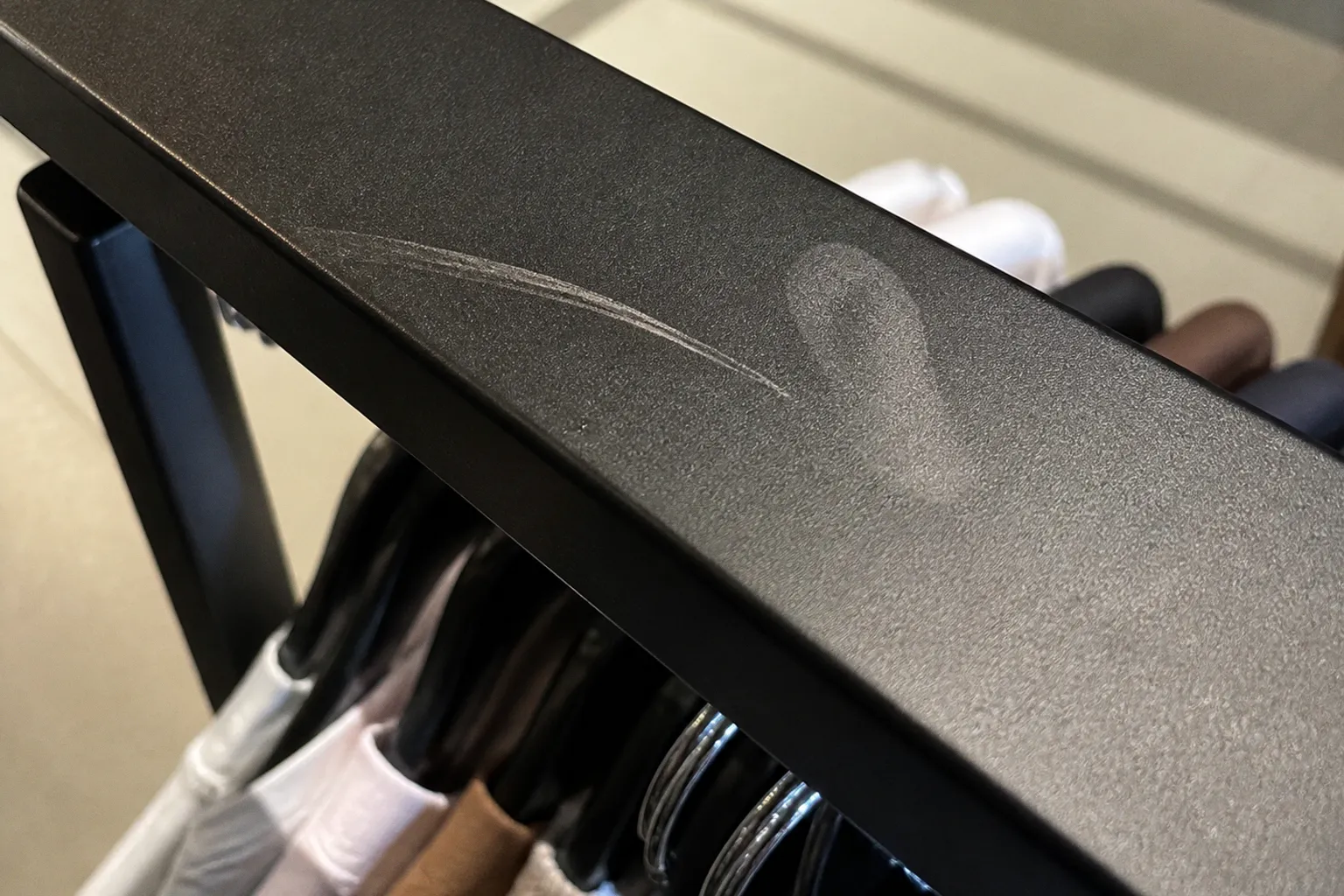
The 25 mm steel tube frame on a standard heavy-duty rolling unit — rated for 100 kg to 150 kg of hanging load and adjustable from 1440 mm to 1900 mm in height — provides strong corrosion protection for the underlying steel while the finish surface remains vulnerable to visible marking from routine handling. Skin oils deposited by staff and customers mark smooth matte films on contact. Hanger friction along the top rail initiates wear patterns that read as damage even when the substrate beneath is intact. The structural problem is not load-bearing. The structural problem is surface.
This is why the question of matte black garment rack scratch resistance cannot be answered by looking at the frame alone. The relevant variables are the coating chemistry, the texture of the cured film, the material used on the hanger rail, and the way the rack is cleaned between periods of heavy contact.
The powder coating layer: what it solves and what it does not
Electrostatic powder coating deposits an epoxy-polyester film on cold-rolled steel tube and sheet stock. Dry powder is sprayed electrostatically onto a grounded substrate and then heat-cured at approximately 180 °C to 200 °C, allowing the particles to flow and the polymer chains to cross-link. Final film thickness on commercial garment rack frames typically lands between 60 μm and 80 μm.
The cured film bonds to the steel substrate and seals it against atmospheric corrosion, humidity cycling, and incidental chemical contact. It also gives the manufacturer a consistent way to control color and gloss across a large batch of frames. In a retail environment, that matters: a rack is not only a structural object but part of the visual system around the merchandise.
What the film does well:
- It protects the underlying steel from ordinary indoor humidity and incidental moisture.
- It tolerates light impacts and occasional contact better than an unprotected steel surface.
- It provides a uniform black finish across tubes, brackets, feet, and welded joints.
- It resists many neutral-pH cleaning agents when those agents are used correctly.
- It conceals minor variation in the steel substrate better than a thin, highly reflective finish.
What the film does not do is shed skin oil.
The matte variant of the same broad coating family has a deliberately modified surface at the micro level. Light scattering from this micro-roughness produces the flat, low-gloss appearance that defines matte black. The trade-off is that the surface is less optically forgiving when it is contaminated by oil. A smooth matte film can show a handprint more clearly than a textured matte film because the mark changes the way light is reflected across a relatively continuous surface.
Skin lipids — primarily sebum — wet the finish when a hand touches the tube or rail. The oil does not need to damage the polymer to become visible. It only needs to alter the local reflectivity of the coating. A clean matte surface scatters light evenly. An oily handprint creates a patch with a different refractive behavior, so the outline becomes visible under directional retail lighting.
The practical result is often mistaken for a scratch. A dark smear on a matte black rack may be a deposit sitting on top of the coating, not a breach in the film. A genuine scratch has a different profile: it interrupts the surface, may expose a lighter underlayer or bare steel, and usually follows a line or impact path rather than the broad shape of a palm or fingertip.
Smooth matte black is a fingerprint collector. Textured matte black is a fingerprint concealer. The difference is measured in surface topography, not in color.
This is the central engineering tension in matte black retail hardware. The surface feature that produces the matte appearance can also make routine contamination more visible. The finish has not necessarily failed mechanically; it has failed as an optical surface under contact.
Why smooth matte finishes show wear so quickly
A smooth matte coating is attractive because it sits between two familiar extremes. It is less reflective than gloss black and usually looks more refined than a heavily textured industrial finish. Under controlled showroom lighting, it gives the rack a dense, architectural appearance. Under repeated handling, however, it offers little texture to break up the outline of a fingerprint or a narrow abrasion.
The distinction between contamination and abrasion is important during inspection:
- Oil marks are usually broad, soft-edged, and darker or slightly shinier than the surrounding coating. They often disappear after proper cleaning.
- Transfer marks may contain dye, adhesive, rubber, or plastic residue from hangers and packaging. They can require a second cleaning pass but do not necessarily indicate coating damage.
- Polishing or burnishing appears as a narrow change in sheen where hangers repeatedly slide over the same section of rail.
- Scratches and chips interrupt the film itself. Their edges may feel rough to a fingertip, and exposed steel can begin to oxidize if moisture reaches the breach.
- Chalking or delamination affects the coating more broadly. The surface may become powdery, uneven, or visibly detached, often after chemical abuse, prolonged weather exposure, or poor pretreatment before coating.
This classification prevents a common maintenance mistake: using aggressive solvent or abrasive pads to remove a mark that was only a removable oil deposit. The cleaning attempt then creates the permanent defect that the original mark did not represent.
The finish also interacts with lighting. A rack beneath a narrow LED spotlight can show rail burnishing that would be almost invisible under diffuse ambient light. Conversely, a textured coating can hide small scratches in general viewing but reveal them when light strikes the peaks and valleys from the side. Visual performance is therefore not independent of the retail environment. The same matte black garment rack may appear well maintained in a stockroom and visibly marked in a fitting-room corridor.
Textured vs. smooth: engineering surface grip and scratch concealment
Manufacturers respond to the contamination problem by engineering the surface texture itself. Three finish variants commonly appear in commercial garment rack specifications:
| Finish variant | Surface character | Fingerprint visibility | Scratch concealment | Typical use |
|---|---|---|---|---|
| Smooth matte | Fine, relatively continuous low-gloss film | High | Low | Controlled displays and low-contact areas |
| Sandy or micro-textured matte | Fine granular texture | Moderate to low | Moderate to high | Customer-facing racks and general retail floors |
| Wrinkle finish | Pronounced peaks-and-valleys pattern | Low | High | High-contact retail, storage, and industrial settings |
The exact roughness depends on the powder formulation, curing cycle, substrate preparation, and manufacturer’s texture specification. The values sometimes quoted for roughness should not be treated as universal performance limits: two finishes described as “matte” can behave very differently under the hand and under a hanger hook.
Smooth matte delivers the cleanest visual appearance when untouched but performs worst under visible contact stress. A sandy or micro-textured finish breaks up the reflection from oil deposits and makes narrow abrasions less visually continuous. It does not make the coating impossible to scratch. It changes the way the scratch is seen.
The wrinkle finish works through a more pronounced topographical pattern. Instead of relying on a nearly uniform low-gloss surface, it creates visible peaks and valleys that interrupt reflections. A fingerprint may still be present, but its outline is less likely to read as a single, high-contrast palm mark. Small scuffs are also distributed across the pattern rather than presented as a clean line on a flat field.
That visual advantage comes with trade-offs. Texture can collect dust, lint, and residue in its valleys. If the pattern is deep, a quick dry wipe may remove the loose material from the peaks while leaving contamination in the recesses. Textured finishes therefore conceal maintenance needs; they do not eliminate them. A rack can look acceptable from a distance while carrying a substantial deposit of fibers and oil in the surface geometry.
For commercial installations with high customer contact — boutique retail, fitting rooms, front-of-house displays, and areas where shoppers move hangers continuously — textured or wrinkle finishes generally provide a longer acceptable visual interval than smooth matte. The relevant interval is not the time until the coating is technically damaged. It is the time until marks become apparent to a casual observer at retail viewing distance, approximately 1 m to 2 m away.
In a busy fitting room, smooth matte may show hand marks and rail burnishing within the same trading period. A textured equivalent can remain visually controlled for longer because it scatters and interrupts the reflection from those deposits. The difference depends on lighting, hanger material, staff cleaning discipline, and how often customers handle the rail, but the direction is consistent: texture improves concealment.
For back-of-house storage and warehouse racking, smooth matte is more defensible. Contact is limited mainly to staff hands, the browsing intensity is lower, and the visual standard is different. The finish still marks; it simply matters less when the audience is a stockroom team rather than a paying customer.
Where the rail meets the hanger: chrome as a friction solution
The top rail takes concentrated and repeated stress. Hangers slide along it during stocking, customer browsing, and seasonal resets. A standard heavy-duty unit may offer 1290 mm to 1890 mm of extendable rail width, depending on the installed configuration. The exact length changes, but the mechanical problem remains the same: a relatively small contact area receives repeated sliding movement throughout the day.
Powder coating on this rail surface eventually shows the effect. The cured epoxy-polyester film can tolerate incidental contact, but it is not designed to function as a dedicated sliding bearing surface. Steel wire hanger hooks, molded plastic hangers, metal clips, and dust particles trapped between the two surfaces can abrade the coating. The wear pattern usually develops along the most-used section of the rail, often where staff initially concentrate stock and where customers browse most actively.
Once the coating is breached, the issue changes from appearance to protection. Bare or undercut steel is more vulnerable to moisture and corrosion, particularly in humid storage areas or where cleaning residue remains at the contact line. Even before corrosion appears, a polished strip on a matte black rail can make the rack look worn.
The engineering response is to separate the jobs of the frame and the rail: use a matte powder-coated frame for the visual identity and corrosion protection of the stationary structure, then specify a harder, smoother rail surface for repeated hanger movement.
Chrome plating requires a more precise distinction than the usual sales shorthand suggests. Decorative chrome is not simply a soft version of chrome, and it should not be assigned a universal low hardness range. It is still a chromium layer, commonly applied as part of a multilayer decorative plating system, often over nickel. Its main distinction from hard chrome is usually the plating architecture, intended thickness, and appearance rather than a simple category-wide hardness number.
Hard chrome is an engineered wear-resistant deposit applied for functional service. It is generally specified with greater attention to deposit thickness, dimensional build, substrate preparation, and resistance to repeated sliding or abrasive contact. Decorative chrome is usually much thinner and is optimized for a bright, attractive surface over the underlying plating system. It may provide useful durability in a garment rack application, but its suitability depends on the actual specification rather than the word “chrome” alone.
For a commercial rack, the relevant questions are therefore:
- Is the rail decorative chrome over a suitable plated or metal substrate, or is it merely a polished appearance layer?
- What plating thickness and substrate preparation does the manufacturer specify?
- Is the rail intended for repeated hanger sliding, or only for occasional display contact?
- Are the rail ends, welds, and cut edges protected against premature flaking or corrosion?
- Does the supplier provide a wear or service specification for the installed use?
A functional chrome rail can offer a smoother and more wear-tolerant contact surface than a powder-coated rail. But the benefit comes from the complete plating system and the rail design, not from assigning an unsupported hardness figure to every chrome finish.
This hybrid configuration — matte frame, plated rail — is a deliberate division of labor. The frame carries the visual identity and protects the stationary steel components. The rail carries concentrated contact stress and uses a surface system selected for movement.
The rail is not a decorative afterthought. It is the working interface between the rack and every hanger placed on it.
Lower-cost units often use powder-coated rails and accept the resulting wear pattern as part of the replacement cycle. That choice can be reasonable for temporary displays, fixed-hook presentations, or low-traffic back-of-house storage. Higher-traffic installations — department stores, busy boutiques, and fast-fashion retail — have more reason to specify a plated or otherwise wear-oriented rail because the highest-stress component is also the component customers see and touch most often.
Plated rails are not maintenance-free. They accumulate grime, adhesive residue from price tags, dye transfer, and surface deposits from hands. They benefit from periodic cleaning with a neutral-pH wipe and inspection for pitting, lifting, or flaking at the plating edge. The distinction from a powder-coated rail is not zero maintenance. It is that the rail surface is better suited to repeated sliding contact and does not rely on the powder film alone to absorb that movement.
Anti-fingerprint coatings: transparent surface chemistry
A further option above the base powder coating is a transparent oleophobic thin film, often marketed as an AF or anti-fingerprint coating. These films may use fluoropolymer- or silicone-based chemistry and are applied over the finished surface before being cured. Their thickness can be extremely small, sometimes measured in nanometers, so the treatment generally does not change the color or overall appearance of the rack.
The intended mechanism is a reduction in surface energy. Skin oils wet a treated surface less completely, so a handprint transfers with less visual contrast and is easier to remove. The treatment does not make the powder coating harder in the same way as a thicker protective layer, nor does it turn a powder-coated rail into a wear-resistant bearing surface. Its primary job is contamination management.
Performance under commercial conditions depends on the product and the operating environment:
- Oil deposits are less likely to spread into a high-contrast smear.
- Light fingerprints may be removable with a dry or lightly damp microfiber cloth.
- The interval between visible wipe-downs can increase, especially on vertical customer-contact surfaces.
- Repeated hanger sliding, abrasive dust, and aggressive scrubbing can wear the treatment away.
- Service life depends on contact frequency, cleaning chemistry, and the specific film applied.
- Reapplication usually requires controlled preparation that is difficult to perform on a busy retail floor.
AF coatings are not standard on entry-level commercial garment racks. They appear more often on premium units or on installations where the operator has explicitly valued lower visible contamination and reduced cleaning labor. The treatment is invisible, so specification must be confirmed in the manufacturer’s datasheet or finish schedule. A black frame that looks unusually resistant to fingerprints is not proof that an anti-fingerprint film has been applied.
There is also a limit to what oleophobic treatment can accomplish. It can reduce the severity of a fingerprint, but it cannot prevent a hanger hook from cutting or burnishing the coating. It can make an oil deposit easier to remove, but it cannot compensate for an abrasive cleaner that changes the film itself. Operators should treat AF as a maintenance aid, not as a substitute for selecting the correct rail material and texture.
The most effective application is often on customer-contact tubes, push handles, or other surfaces touched by hands but not subjected to continuous sliding. On the rail, the coating may provide a short-term visual benefit, but the mechanical demand remains the dominant design consideration.
Maintenance protocols under commercial traffic
Even with a textured finish, a suitable rail, and an AF coating, matte black garment racks require scheduled maintenance. The protocol should reflect contact intensity rather than follow a universal calendar detached from use.
High-traffic retail floors
1. Remove loose dust and fibers daily. Use a clean, soft microfiber cloth on customer-contact surfaces. This prevents lint and fine abrasive particles from becoming a third body between hangers and the rail.
2. Clean visible oil deposits before they accumulate. A lightly damp microfiber is often sufficient for fresh fingerprints. Do not press hard or polish the surface aggressively; pressure can spread oil into the texture and create a larger sheen change.
3. Use a compatible neutral cleaner for routine weekly cleaning. If the coating and supplier instructions permit it, a 70% isopropyl alcohol solution can remove accumulated sebum from compatible powder-coated surfaces. Test the procedure on an inconspicuous area first, particularly where the rack has a specialty texture, AF film, or plated rail.
4. Inspect the rail monthly, or more often where hanger movement is intense. Look for a continuous polished strip, exposed substrate, pitting, flaking at edges, and changes in the alignment or stability of the rail itself. A visual change in gloss is an early warning even when corrosion is not yet visible.
5. Distribute hanger movement when the display allows it. Rotate displayed stock or change the arrangement at planned intervals so that the same short rail segment does not receive every sliding contact event. Stock rotation cannot eliminate wear, but it can prevent one concentrated track from becoming the first failure point.
6. Separate cleaning tools by task. A cloth used on dusty floors or oily packaging can transfer abrasive grit back onto the rack. Use a clean microfiber for the visible finish and a separate tool for wheels, feet, and floor-contact components.
Back-of-house and storage applications
Back-of-house racks usually require less frequent cosmetic attention, but they should not be ignored. A monthly dry wipe-down and periodic damp cleaning are reasonable starting points for low-contact storage. Rail and frame integrity should be inspected at least annually, with additional checks in humid environments or wherever the rack is moved frequently.
The stockroom is also where impact damage tends to occur. Racks are pushed against shelving, door frames, pallets, and other fixtures. A small chip on a customer-facing rail may be cosmetic; the same chip in a humid stockroom can become a corrosion point. Record or repair such defects before they spread under the coating.
Cleaning agents to avoid
Avoid abrasive compounds, scouring pads, solvent-based degreasers, bleach in concentrations above 5%, and cleaners with pH below 4 or above 10 unless the manufacturer has specifically approved them. These products can attack the epoxy-polyester film, strip an oleophobic treatment, stain a plated rail, or accelerate chalking and delamination.
The damage is cumulative. A single unsuitable wipe may leave no obvious mark, but repeated exposure can produce gloss shift, softening, discoloration, or a powdery surface. Once the coating begins to chalk, its texture changes and the matte character can shift toward an uneven semi-gloss. That irregular sheen often looks worse than either a clean matte finish or an intentionally reflective one.
Do not use metal scrapers to remove adhesive from a rail. Start with a compatible cleaner and a soft cloth, then escalate only according to the finish supplier’s instructions. On plated surfaces, a scratch through the visible layer can be more difficult to repair cleanly than a removable adhesive mark is to remove patiently.
Environmental factors matter as well. Coastal or persistently humid locations see faster corrosion at any film breach, including pinholes, impact chips, and abrasion lines. Elevated moisture accelerates corrosion wherever the protective system has been compromised by hanger movement, impact damage, or a manufacturing defect.
Inspection frequency should therefore be calibrated to humidity, cleaning practice, movement frequency, and the age of the installation. A rack in a dry, climate-controlled showroom does not experience the same risk as one stored near an open loading door. The finish specification and the maintenance schedule should acknowledge that difference.
The structural recommendation
For commercial garment rack specification, the decision is not simply matte black versus another color. It is a choice of surface system for a defined contact environment.
1. Specify sandy or wrinkle matte black rather than smooth matte for customer-contact installations. The textured finish usually conceals fingerprints and minor scuffs more effectively, extending the period during which the rack presents a controlled appearance. It still needs cleaning, and deeper textures may retain dust, but it is more forgiving under retail traffic.
2. Specify a rail intended for repeated hanger sliding. A powder-coated rail can be acceptable for fixed-hook displays, temporary installations, or low-traffic storage. Where hangers move continuously, a suitable plated or otherwise wear-oriented rail is the more rational specification. If the supplier offers chrome, confirm whether the product is decorative plating or a functional wear-oriented system and review the actual construction details rather than relying on the label alone.
3. Use AF oleophobic treatment where visible contamination and cleaning labor are significant concerns. It can reduce the contrast of fingerprints and make routine wipe-downs easier, particularly on hand-contact surfaces. It does not replace a textured finish, and it does not protect a rail from mechanical abrasion.
4. Avoid smooth matte black within arm’s reach of sustained customer traffic unless the maintenance plan is explicit. Smooth matte can look excellent when clean and controlled, but it has little tolerance for repeated hand contact, oily deposits, and concentrated hanger movement. If the finish is chosen for its visual character, the operator must accept the cleaning burden that comes with it.
The matte black garment rack is a defensible commercial specification when the surface engineering matches the operating environment. It becomes a maintenance liability when a smooth finish is selected by default for a high-contact location and the rail is expected to absorb sliding wear it was never designed to handle.
The solution is not to avoid matte black. It is to separate appearance from contact mechanics: use texture where fingerprints and scratches must be concealed, use a properly specified rail where hangers must slide, and use anti-fingerprint chemistry as a maintenance aid rather than a promise of immunity. In retail, the finish is part of the operating system. A rack that keeps its surface legible under real traffic is doing more than looking good; it is reducing the number of times staff must intervene to make the display look intentional again.