Chrome racks in humid stores: rust prevention guide
Decorative chrome plating on a commercial garment rack is easy to overestimate. It looks substantial because it reflects light so cleanly, but the visible finish is only a very thin surface layer over nickel and steel.
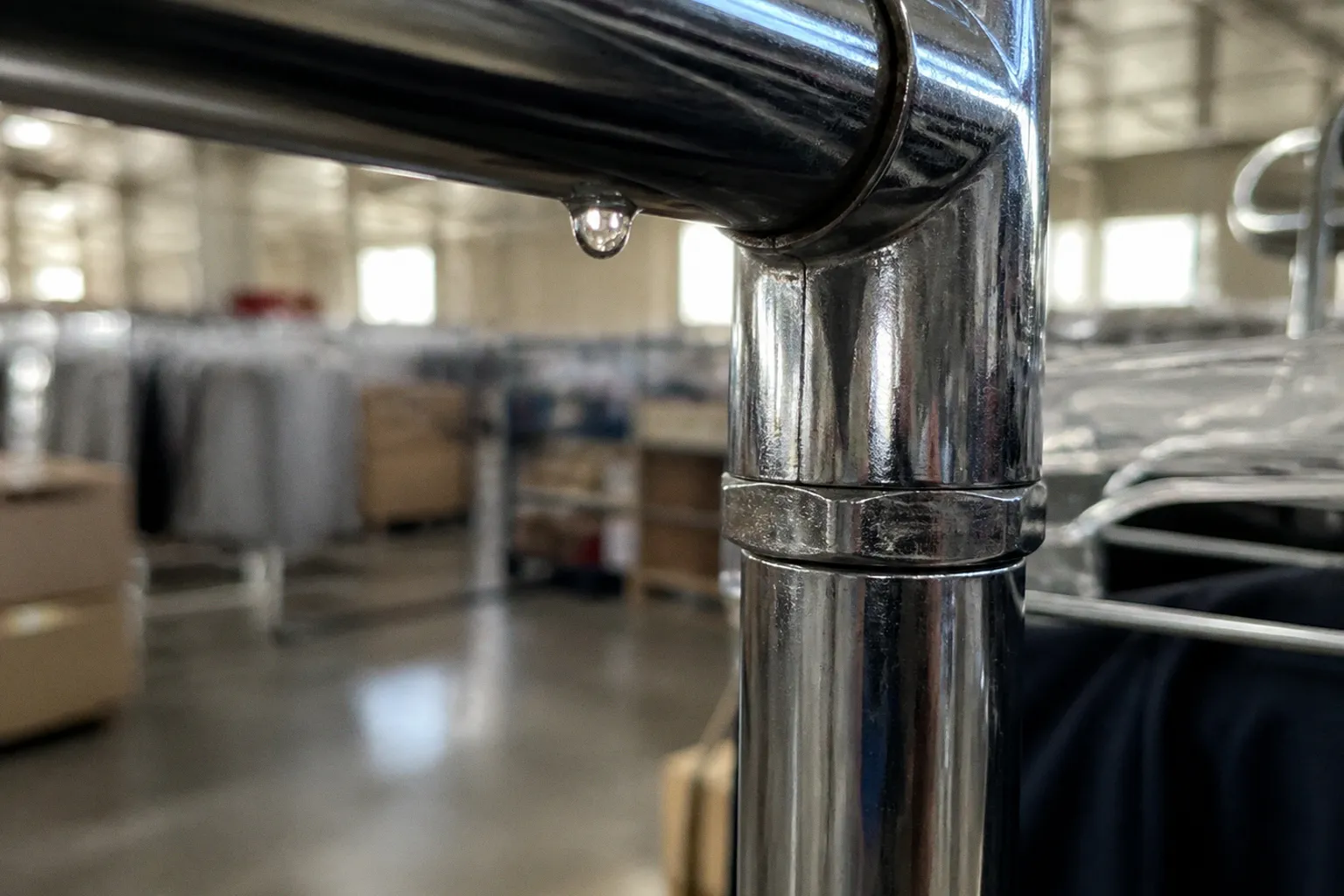
That layer can protect the rack effectively in the right environment. It cannot compensate for constant moisture, salt residue, condensation, or repeated abrasion at the points where hangers and hands make contact.
That distinction matters in any store with open doors, weak ventilation, damp stockrooms, or a location near the coast. A rack may look perfectly sound from a few feet away while corrosion is already developing around a scratch, a weld, a threaded joint, or the lower rail closest to a wet floor. By the time orange staining appears on a garment, the damage has usually been working underneath the visible finish for some time.
I've spent enough years around retail display hardware to know that rust on a chrome rack rarely begins in the middle of an untouched tube. It starts where the protective system has been interrupted: a scuff, a pinhole, a chipped edge, a poorly protected cut end, or a place where water remains trapped. In a humid store, maintenance is not about making a rack look polished for another afternoon. It is about slowing the corrosion process before it reaches the steel beneath the plating.
This is the practical problem behind chrome garment rack rust in high humidity: what the finish can withstand, what can be repaired without damaging it further, and when a different material becomes the more sensible choice.
The vulnerability of decorative chrome in retail environments
Before protecting a chrome garment rack, it helps to understand what the word "chrome" actually describes. Most commercial chrome racks are not made from solid chromium. They are generally steel components finished with an electroplated system: a steel substrate, an underlying nickel layer, and a much thinner decorative chromium surface.
The chrome provides the bright, reflective appearance associated with retail displays. It also contributes hardness and resistance to everyday oxidation. The nickel layer helps create a smooth, continuous surface and supports the decorative finish. The steel gives the rack its structure and load-bearing strength.
The visible chrome layer is usually measured in micrometers rather than millimeters. A commonly cited decorative layer of around 12.7 micrometers is far thinner than a human hair and much thinner than a sheet of ordinary copy paper. Exact thickness varies with the product, the plating process, and the intended use. The useful point is not the number itself. It is the scale: decorative chrome is a finish, not a thick structural shell.
That is why a rack can be strong enough to carry a full display while remaining vulnerable at the surface. The strength of the tube and the durability of its finish are separate questions.
The finish is exposed to several kinds of retail abuse at once:
- Wire hangers scrape across the same sections of rail repeatedly.
- Customers pull garments sideways instead of lifting them clear of the bar.
- Lower rails receive splash from mops, floor cleaners, wet shoes, and umbrellas.
- Hands leave oils and salts on curved ends and frequently touched sections.
- Displays are moved, assembled, and reconfigured, creating fresh chips around joints and fasteners.
- Metal accessories, price fixtures, and rough hanger hooks can create narrow scratches that are difficult to see.
A scratch does not have to look dramatic to matter. A narrow breach in the chrome can expose the nickel beneath it. If moisture remains in that area, the nickel may begin to dull or develop a pale haze before the steel underneath produces the familiar orange discoloration. Once the substrate is involved, corrosion can spread beneath the surrounding plating. The visible spot may therefore be smaller than the area that has already lost adhesion.
Where damage usually starts
The most useful inspection is not a general glance at the rack. It is a slow examination of the places where wear and moisture overlap.
Look closely at:
- The underside of lower rails, where water and cleaning residue are least likely to be wiped away.
- Curved end sections, which customers often use as handles.
- Welds, joints, and telescoping sections, where the finish may be uneven.
- Threaded connectors and exposed fasteners.
- Tube openings or cut ends that were not fully capped.
- Areas pressed against a damp wall or placed directly over a concrete floor.
- Any location where the rack rubs against another display or storage fixture.
A bright orange spot in the center of a clean, undamaged rail may be a simple surface contaminant. Orange bleeding around a scratch, seam, or edge is more concerning because it suggests that moisture has reached the underlying metal.
Decorative chrome is not armor. It is a thin protective finish, and it usually fails first where abrasion and standing moisture meet.
The practical implication is straightforward: do not wait for a rack to look seriously rusty before inspecting it. Early haze, cloudy patches, small black pinholes, and roughness that catches a cloth are easier to manage than lifted plating and deep pits.
Why humidity triggers oxidation beneath the plating
Chrome is often described as corrosion-resistant, and that is true in a limited sense. Chromium can form a very thin passive oxide layer that slows further reaction with the environment. But a retail rack is not a block of pure chromium sitting untouched on a shelf. It is a plated assembly with seams, edges, pores, mechanical wear, and a reactive steel substrate.
Humidity becomes a problem when moisture can remain at the surface long enough to enter one of those weak points. High relative humidity does not need to produce visible droplets immediately. A damp atmosphere can keep a contaminated or scratched surface wet at a microscopic level, especially in poorly ventilated corners, stockrooms, and areas with little air movement.
The risk increases when humidity is combined with:
- Salt carried in from coastal air, swimwear, or perspiration.
- Cleaning chemicals left behind after mopping.
- Dust and lint that hold moisture against the rail.
- Condensation on metal near exterior walls, doors, or air-conditioning outlets.
- Repeated wetting and drying, which concentrates dissolved minerals.
- Tight placement that prevents air from circulating around the rack.
Once moisture enters a defect, the plating system can begin to corrode in stages. A small opening may expose the nickel layer first. The area can turn dull, gray, or whitish before the steel is visibly affected. If the defect remains wet, corrosion can eventually reach the steel substrate and produce orange rust. The corrosion products take up more space than the original iron, which can lift adjacent plating and create a larger blister or flake.
This is why polishing the orange spot alone may not solve the problem. The rust is a symptom of a breach in the finish, not merely a stain sitting on top of an otherwise untouched surface.
The evaporation problem
Many store teams know to wipe a wet rack eventually. The timing matters more than they expect.
When a droplet evaporates, minerals and cleaning residues can remain concentrated around its edge. A rack that is left to air-dry after a splash may therefore be left with a narrow ring of contamination exactly where the moisture was most persistent. Repeated cycles create visible water spots, but the less visible effect is the gradual attack on scratches and pores in the plating.
Mop water is particularly troublesome because it may contain detergent, disinfectant, soil, and salts picked up from the floor. A dripping umbrella, wet swimwear, or condensation from a refrigeration unit can create the same problem on a smaller scale.
The response does not need to be elaborate. Remove the moisture with a clean microfiber cloth, rinse away residues when appropriate, and dry the surface rather than allowing the water to disappear on its own. If the rack has been exposed to salt or a strong cleaning solution, plain water followed by drying is usually safer than applying another aggressive chemical.
Humidity is a room problem as well as a rack problem
A rack does not experience the store's average humidity evenly. The air beside a damp concrete wall, in a crowded stockroom, or behind a display can be much less favorable than the air in the middle of the sales floor.
Cardboard cartons, fabric inventory, floor coverings, and packed shelving can all slow air movement. A rack placed tightly against an exterior wall may be exposed to condensation even when the room feels comfortable. The lower section can remain damp after cleaning long after the upper rail appears dry.
A basic hygrometer is useful because it replaces assumptions with a record of actual conditions. Take readings in more than one location if the store has a damp stockroom, a basement area, a fitting-room corridor, or large doors that remain open. The goal is not to chase a perfect number. It is to identify the places and times when moisture is consistently high enough to keep surfaces damp.
Safe removal techniques for surface rust and pitting
Once rust appears, the first decision is whether it is sitting on top of the finish or has damaged the metal beneath it. That distinction determines whether careful cleaning is appropriate or whether the component should be repaired or replaced.
Surface contamination may look like a light orange film, a small stain, or mineral haze that does not change the shape of the tube. Deeper corrosion often produces roughness, pinholes, bubbling, dark edges, or a patch where the chrome is lifting. Run a clean cloth lightly over the area. If it catches, inspect the spot under good light rather than immediately reaching for a stronger abrasive.
The common mistake is to treat chrome like bare steel. A coarse pad, wire brush, or aggressive abrasive may remove the rust, but it can also remove sound plating around it. That creates a larger exposed area and leaves a rough surface that traps moisture. The rack may look cleaner for the moment while becoming more vulnerable afterward.
A cautious process for light surface rust
For a small area of superficial rust, use a controlled process:
1. Remove garments and accessories from the rack so no rust particles or cleaning residue reach the merchandise.
2. Wash the area with mild detergent and clean water.
3. Rinse away the detergent and dry the metal completely.
4. Apply a light lubricant or a product intended for metal detailing.
5. Use only an extremely fine abrasive, such as 0000-grade steel wool, and work with minimal pressure.
6. Follow the curve of the tube with short, light passes rather than scrubbing aggressively in circles.
7. Wipe the residue away with a clean microfiber cloth.
8. Inspect the surface again before deciding whether another pass is necessary.
The lubricant is important because it helps carry loosened particles away instead of allowing them to grind into the finish. It is not a substitute for judgment. If the area continues to shed orange material, if the plating looks cloudy around the spot, or if a pit remains after cleaning, stop polishing.
Some maintenance teams prefer a soft cloth and a mild chrome-safe cleaner for very light haze. That can be appropriate when the issue is mineral residue rather than active rust. Read the product instructions and test it on an inconspicuous section first. A product that is safe for automotive chrome is not automatically suitable for every plated retail fixture, particularly if the rack has an existing wax, polymer, painted component, or plastic trim.
Vinegar and mineral deposits
A diluted solution of distilled white vinegar and water can help loosen light mineral deposits when applied briefly with a soft cloth. It should not be treated as a universal rust remover. Acidic cleaners can affect damaged plating and may leave a residue if they are not rinsed away.
If using a mild acidic solution, keep the contact time short, avoid soaking joints and tube openings, rinse with clean water, and dry immediately. Do not combine it with bleach or other cleaning chemicals. If the surface becomes dull, sticky, or discolored, discontinue the treatment.
When pitting means the finish is finished
Pitting is not just a cosmetic variation in the surface. It indicates that corrosion has removed material from the substrate or has undermined the plating. Polishing can smooth the edges of a shallow defect, but it cannot recreate missing steel or restore a continuous factory finish.
A component with deep pits, loose flakes, spreading bubbles, or rust that returns quickly after cleaning should be isolated from garments. Rust particles can transfer to light-colored clothing, and a rough edge can snag fabric or cut a hand. Depending on the rack's construction, the sensible solution may be replacement of a rail, end piece, connector, or complete frame rather than repeated surface treatment.
Professional re-plating is technically possible for suitable metal components, but it involves disassembly, stripping, surface preparation, and quality control. For modular retail hardware, replacing the affected component is often simpler. The right choice depends on the rack's design, the availability of matching parts, and whether the underlying structure remains sound.
Moisture control and protective sealant strategies
Cleaning rust without correcting the moisture pattern only resets the clock. The rack will return to the same condition if it continues to receive condensation, salt, or wet cleaning residue in the same places.
Start with the room. Make sure air can circulate around the rack, particularly behind displays and along exterior walls. Avoid placing metal fixtures directly against surfaces that show condensation or dampness. If the floor remains wet after cleaning, adjust the cleaning process rather than accepting the rack's lower rail as a permanent splash zone.
Dehumidification and ventilation
A dehumidifier can help when the store's humidity is consistently high, but it needs to be selected and positioned for the actual space. An undersized unit may run continuously without changing the conditions around the displays. A unit that drains poorly can introduce another source of standing water.
Ventilation is especially important in crowded stockrooms. Leave enough clearance around shelving and displays for air to move. Do not block exhaust points with cartons, and do not assume that a fan alone removes moisture; a fan can redistribute damp air without lowering its moisture content. The combination of ventilation, air movement, and appropriate dehumidification is more useful than any single device used in isolation.
Door management also matters. A shop that keeps doors open during damp weather may bring in far more moisture than the HVAC system can remove. Staff do not need a complicated protocol, but they should know when condensation is likely and which displays require a wipe-down.
Barrier placement
Small layout changes can prevent repeated exposure:
- Move racks away from sweating walls and areas beneath leaking or condensing equipment.
- Keep lower rails clear of direct splash from mops and cleaning buckets.
- Use suitable feet or caps where the rack meets a damp floor, provided they do not trap water inside the tube.
- Avoid storing wet garments, umbrellas, or swimwear directly over unprotected chrome.
- Leave a practical air gap behind displays instead of pressing them tightly against walls.
- Inspect the underside of the rack, not only the customer-facing surfaces.
A barrier should not create a concealed pocket where moisture can collect. Rubber pads, plastic feet, and protective films can help in some layouts, but they need inspection too. If water is trapped beneath a pad, the apparent protection becomes a corrosion accelerator.
Sealants: useful, but not magic
A clean, intact chrome surface can benefit from a protective sealant. Automotive waxes and synthetic polymer products designed for metal or chrome can create a water-shedding film that reduces direct contact between the finish and atmospheric moisture. They are maintenance aids, not permanent repairs.
Carnauba wax is simple to apply and easy to renew. A synthetic polymer sealant may last longer under handling, but it still needs a clean surface, correct application, and adequate curing time. Follow the product directions and test it on a hidden section before treating an entire fixture.
Do not seal over active rust, loose plating, or trapped moisture. The surface must be cleaned and dried first. Otherwise, the coating can hold contamination against the metal and make the later repair more difficult.
Furniture polish containing silicone can leave residues that complicate future refinishing. Oils such as olive oil are poor long-term protectants because they can become sticky, collect dust, and degrade. Products containing bleach or strong ammonia are also unsuitable for routine care of plated surfaces. When in doubt, use a mild cleaner, dry the rack, and choose a product explicitly intended for the finish.
The reapplication schedule should follow the store's conditions rather than a universal calendar. A rack exposed to salt air, frequent handling, and condensation may need attention much sooner than one in a dry, climate-controlled sales floor. Inspect the finish whenever the rack is deep-cleaned. If water no longer beads or the surface begins to feel dry and grabby, the protective film may need renewal.
A chrome rack usually fails where moisture sits longest and the finish is thinnest. Change those two conditions first; polishing comes after.
Cleaning protocols to avoid stripping protective layers
The safest cleaning routine is not the strongest one. It is the routine that removes sweat, dust, salt, and residue without repeatedly attacking the plating or the sealant protecting it.
For ordinary cleaning, use mild detergent diluted in warm water, a soft microfiber cloth, and a second cloth for drying. Apply the solution to the cloth rather than flooding the rack. Work in sections so that the surface does not remain wet while staff move on to another task.
The basic sequence is:
1. Remove dust and lint with a dry microfiber cloth.
2. Clean one section with mild detergent and water.
3. Rinse away detergent residue with a separate damp cloth.
4. Dry the section immediately.
5. Check joints, undersides, and lower rails before moving to the next area.
6. Reapply a compatible protective product only after the surface is fully clean and dry.
Avoid abrasive powders, scouring pads, coarse steel wool, and wire brushes. They can create scratches that are almost invisible under store lighting but become corrosion sites later. Do not use bleach or ammonia-based products as routine chrome cleaners. Strong disinfectants may also be unsuitable, especially if they are allowed to dry on the surface.
If the store requires a specific disinfectant for operational reasons, check its compatibility with chrome plating and follow the required dilution and contact time. Do not assume that a chemical safe for a floor, countertop, or stainless-steel sink is safe for decorative chrome over steel.
High-touch and high-splash areas
Not every part of a rack needs the same attention. Curved ends and hand-level sections collect oils and salts. Lower rails collect splash and dust. Tube joints hold residue in narrow gaps. These areas should be inspected more often than an upper bar that is rarely touched.
In coastal, poolside, or fitness-related retail, salt deserves special attention. Salt crystals can attract and retain moisture on the surface, allowing a small amount of atmospheric dampness to remain in contact with the finish. A wipe with clean water followed by thorough drying is usually more useful than repeatedly applying a stronger cleaner.
After mopping, staff should check displays near the floor. After a humid day with doors open, inspect metal near entrances and fitting rooms. If condensation forms on a rack, remove it promptly and look for the reason it formed. A wipe solves the immediate problem; moving the rack or improving air circulation may solve the recurring one.
Seasonal deep cleaning
A useful deep-cleaning window is any period when merchandise is already off the rack, such as after inventory changes or before a major display reset. Clean the rack section by section, inspect the finish under direct light, and pay particular attention to fasteners and tube ends.
Do not use the deep-cleaning occasion to experiment with an aggressive polish across every surface. Test new products in a hidden area. If one component has pitting or flaking, remove it from service rather than spreading abrasive residue across the rest of the frame.
Chrome plating vs stainless steel retail: when the material choice changes
The question usually comes after a store has repeated the same rust repair several times: should the next rack simply be stainless steel? Sometimes that is the correct answer. Sometimes the store is trying to solve a humidity problem with a more expensive fixture.
Decorative chrome and stainless steel behave differently because they protect themselves differently. Chrome relies on the integrity of a thin plated system. Stainless steel relies on the properties of the alloy and the formation of its own passive surface film. Stainless steel is not immune to staining or corrosion, particularly in the presence of chlorides, trapped moisture, poor fabrication, or contaminated cleaning tools. It is simply less dependent on an uninterrupted decorative coating.
| Factor | Decorative chrome on steel | 304 stainless steel | 316 stainless steel |
|---|---|---|---|
| Main vulnerability | Scratches, exposed substrate, trapped moisture | Chlorides, contamination, poor cleaning, crevices | Severe chloride exposure and neglected crevices can still cause problems |
| Appearance | Bright and mirror-like | Often brushed or satin, though polished finishes are available | Similar finish options to 304 |
| Maintenance | Frequent drying and finish care in damp spaces | Routine cleaning and drying; inspect welds and joints | Similar routine, with greater resistance to chloride-rich conditions |
| Typical fit | Dry or controlled indoor retail | General indoor retail with moderate humidity | Coastal, poolside, spa-adjacent, or chloride-exposed settings |
| Main purchasing question | Can the store protect the plating? | Is the environment suitable for 304? | Is the additional exposure severe enough to justify 316? |
Chrome remains attractive in controlled retail spaces because it is bright, familiar, and often economical. It can also suit stores where the display hardware is changed frequently and the environment is kept dry. The problem begins when the store's operating conditions repeatedly overwhelm the maintenance routine.
304 stainless steel is a reasonable step up for many indoor applications, but it should not be treated as a guarantee against every kind of corrosion. A brushed stainless rack may also show fingerprints, water spots, and surface contamination. Clean it with the grain where there is a directional finish, use non-contaminating tools, and avoid leaving salt or chemical residue in joints.
316 stainless steel contains alloying additions that improve resistance in chloride-heavy environments. That makes it relevant to coastal stores, poolside retail, and spaces where salt exposure is a regular part of the operation. It is not automatically necessary for every humid shop. A warm, damp inland store with clean air and good ventilation may have a different problem from an open-front swimwear store exposed to salt and wet merchandise.
Other materials deserve consideration as well. Powder-coated steel can perform well when the coating remains intact and damaged edges are repaired promptly. Aluminum avoids some forms of ferrous rust but can still stain, pit, or corrode under unfavorable conditions. Polymer or marine-oriented display systems may be useful where water exposure is persistent, though their appearance, stiffness, load capacity, and long-term wear need to match the retail application.
The correct comparison is not simply the purchase price of one rack against another. Consider the environment, the maintenance staff's actual capacity, the cost of downtime, the availability of replacement components, and the risk of damaged garments. A material that requires less daily attention may justify its higher initial cost in one store and be unnecessary in another.
The reality check before you buy or replace
Before purchasing a rust-treatment kit or replacing an entire display system, inspect the existing racks as working equipment rather than as isolated pieces of furniture.
Start by measuring the environment. A basic hygrometer can reveal whether the problem is concentrated near a doorway, stockroom, basement, exterior wall, or floor-level display. Record conditions at different times instead of relying on how the room feels. Humidity that seems harmless during a short visit may remain high overnight or rise sharply when doors stay open.
Then inspect the rack's wear pattern. If corrosion appears only on lower rails after mopping, the cleaning process and layout may be the main causes. If it appears around every joint and fastener, the construction and finish may be poorly suited to the room. If it occurs wherever hangers drag, consider changing hanger design, reducing metal-on-metal contact, or selecting a finish intended for heavier abrasion.
Check the substrate before deciding that a cosmetic repair is enough:
- Light haze or mineral spotting may respond to gentle cleaning.
- A small superficial stain may be treatable if the surrounding plating is intact.
- Roughness, pinholes, and bubbling require closer inspection.
- Flaking plating, deep pits, and recurring orange bleed usually indicate a component-level repair or replacement.
- Any sharp edge or rough area near garments should be removed from service immediately.
Think about the rack as a system. A polished rail will not solve water collecting inside an uncapped tube. A sealant will not stop a display from sweating against a damp wall. A dehumidifier will not repair plating that has already detached. The remedy has to match the failure point.
When comparing chrome with stainless steel, ask the supplier specific questions about the substrate, plating system, finish thickness, exposed cut ends, weld treatment, replacement parts, and intended environment. "Chrome" is not a complete specification, and "stainless" is not a complete performance guarantee. The construction details often matter as much as the label.
Finally, be honest about maintenance capacity. If staff cannot reliably dry displays after wet cleaning or inspect lower rails during routine work, choose a material and layout that tolerate that reality better. A technically excellent maintenance plan that no one follows is not a maintenance plan.
Chrome garment rack rust in high humidity is not mysterious, and it is not always a manufacturing defect. It is usually the result of a thin finish being exposed to moisture, contamination, and abrasion at the same time. The useful response is equally practical: identify where water remains, remove surface contamination without enlarging the damage, protect intact plating, and replace compromised components before corrosion reaches the merchandise.
Chrome can remain a good retail choice when the room is controlled and the care routine is realistic. In a persistently damp or salt-heavy environment, stainless steel, powder-coated steel, aluminum, or polymer alternatives may make more sense. The right decision is not the one with the brightest finish on delivery day. It is the one that still looks sound after the store's actual air, floors, cleaning routine, and customer traffic have had their turn.