Mirror black display racks: scratching and cleaning traps
Mirror black finish garment rack scratching is usually not a coating failure in the first instance. It is a surface-management failure. The reflective black layer may be only 0.1–3 µm thick, with many architectural PVD runs occupying approximately 0.3–2 µm.
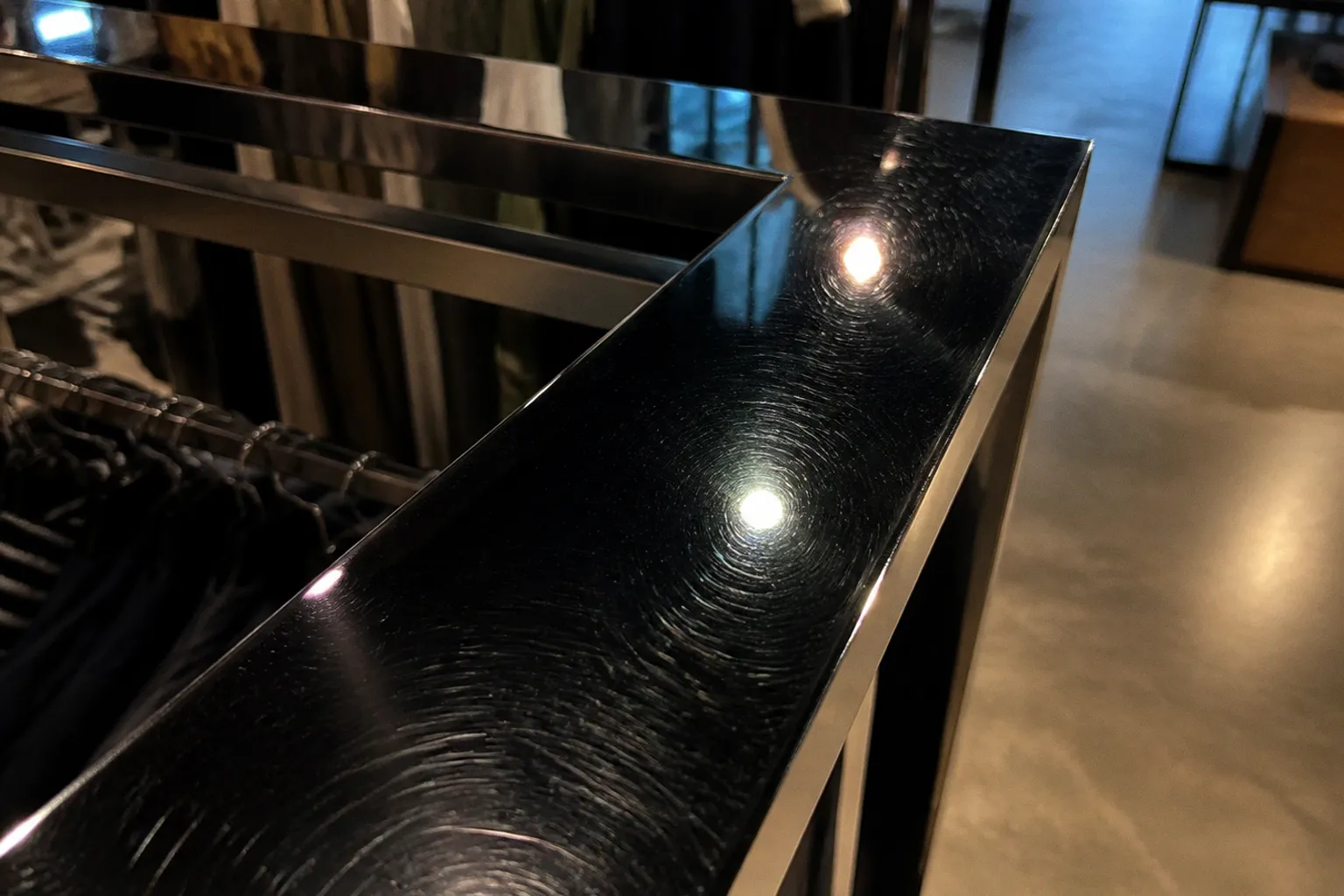
A metal hanger, abrasive towel, or contaminated cleaning cloth can therefore damage the visible finish without significantly affecting the rack’s steel tube or structural frame.
The substrate is equally important. Mirror black PVD is commonly applied over stainless steel polished to a Super Mirror No. 8 finish, with surface roughness averaging below Ra 0.05 µm. This produces the optical reflection. It does not create a thick sacrificial shell. Once a scratch penetrates the decorative layer and reaches the substrate, the exposed metal becomes an entry point for moisture and corrosion. Routine polishing cannot reconstruct the removed coating.
The science of a mirror black finish: coating thickness and substrate integrity
“Mirror black” describes an optical result, not one universal manufacturing process. Commercial display racks may achieve the appearance through PVD, electroplating, high-gloss paint systems, or combinations of polishing and tinted transparent layers. The maintenance limits depend on the complete stack:
- base metal;
- surface preparation and polishing;
- intermediate nickel or other plated layers, where used;
- black decorative layer;
- clear protective layer, where specified;
- tube joints, welds, end caps, and concealed seams.
PVD, or physical vapor deposition, is performed in a vacuum chamber. The metal substrate is cleaned, heated or otherwise prepared, and exposed to vaporized coating material. The resulting film is thin and tightly bonded when the substrate preparation is controlled. The process can produce a uniform black reflective finish on stainless steel and selected other metals.
The optical quality comes from two sources. The first is the substrate geometry. A polished tube must have a continuous, low-roughness surface before coating. The second is the coating itself, which modifies the reflected light and gives the metal its black appearance. A rough or contaminated substrate cannot be converted into a true mirror by depositing a dark film over it.
This distinction matters during procurement. A rack can be structurally adequate and still have a poor visible finish because the coating was applied over insufficiently polished tubing. Conversely, a rack can have a high-quality optical surface but remain vulnerable to hanger abrasion because the decorative layer is thin.
The material stack should be documented by the manufacturer. The useful questions are specific:
- Is the visible finish PVD, electroplating, powder coating, wet paint, or an unspecified “black chrome” system?
- What is the substrate: stainless steel, mild steel, aluminum, or plated steel?
- Is the tube polished before coating?
- Are welds and tube ends treated to the same standard as the straight sections?
- Is the finish applied before assembly or after welding?
- Are replacement components available in the same batch and finish?
- Has the manufacturer specified a cleaning chemistry or prohibited substances?
“Black chrome” is not a sufficient technical description. Chrome plating normally refers to a chromium-containing plated surface, but commercial terminology is not always consistent. Some suppliers use the term for a dark plated finish, others for a PVD appearance, and others for a painted or powder-coated surface. The cleaning response can differ substantially between these systems.
A mirror black rack is a thin-surface optical system mounted on a structural frame. The frame may tolerate abuse that the finish cannot.
Why mirror black polish display racks scratch under normal retail use
The most common mechanical damage does not come from a single severe impact. It comes from repeated low-force contact. Garment hangers slide across the horizontal rail. Hooks rotate under load. A hanger with a rough weld, burr, damaged coating, or trapped grit acts as a cutting tool.
The visible result depends on the contact geometry. A rounded plastic hanger distributes force over a larger area. A steel hook creates a narrow contact line. A small particle of silica, metal, or hardened dirt between the hook and the rack can create a three-body abrasion event. The particle moves across the coating while the hanger supplies the normal force.
High-gloss finishes expose this damage more clearly than brushed or textured surfaces. On a brushed brass finish, the grain can mask isolated directional marks. On a mirror black surface, a shallow scratch interrupts the reflected field and appears as a high-contrast line. The structural depth of the scratch may be small, but the optical defect is immediate.
The following contact conditions are particularly damaging:
1. Bare metal hangers. Steel hooks and cast-metal accessories can abrade the coating, especially at the rail’s upper surface where hangers are moved repeatedly.
2. Hanger burrs. A burr at the hook opening concentrates force on a small point. It can score the finish in a single pass.
3. Mixed hardware. Moving a rack between departments while leaving hangers on the rail increases sliding contact and impact at joints.
4. Contaminated rails. Dust and grit transform a soft cloth or hanger into an abrasive assembly.
5. Overcrowded garments. Dense garment loading forces staff to drag several hangers at once rather than lifting and repositioning them.
6. Unprotected transport. Wrapping coated tubes directly against rough cardboard, metal edges, or contaminated plastic can produce rub marks before installation.
7. Poorly finished joints. Couplers, weld zones, and tube seams can create local projections that contact hangers or cleaning tools.
The practical response is not to claim that a coating is scratch-proof. No such assumption is justified without a defined abrasion test and a documented result for the exact product. The available facts do not establish a universal Mohs hardness, pencil hardness, or multi-year hanger-friction rating for every commercial black mirror rack.
A supplier’s phrase such as “scratch resistant” should therefore be treated as incomplete. Resistance to what load, what abrasive, what number of cycles, and under what cleaning conditions? Without those parameters, the phrase has limited engineering value.
Chemical hazards: why cleaning agents dull black chrome rack finishes
Mechanical abrasion is only one damage route. Chemical attack can change the appearance without leaving a conventional scratch. Ammonia, bleach, and high-acidity cleaners such as unbuffered vinegar may degrade mirror finishes. The visible effects include cloudy films, gray discoloration, localized dulling, and attack at edges or defects.
The chemistry becomes more difficult at joints. Spraying a cleaner directly onto an assembled garment rack allows liquid to run into couplers, tube seams, weld crevices, threaded interfaces, and end-cap gaps. The liquid may remain trapped after the visible surface appears dry. In plated or coated steel assemblies, retained moisture and chemicals can initiate internal corrosion. Later, the corrosion product may bleed out from the joint and stain the exterior.
This is why direct spraying is a poor maintenance method for mirror black display racks. The spray pattern is difficult to control, and aerosolized droplets enter areas that cannot be wiped or inspected. A cloth application gives the operator control over the amount of liquid and the contact location.
Use a neutral cleaning system:
- warm water;
- a small amount of mild soap with neutral pH;
- a clean, soft, non-abrasive cloth;
- a second cloth for drying.
Avoid steel wool, scouring sponges, paper towels, terry cloth towels, and other materials that can carry abrasive particles or produce micro-scratches. Paper products are not automatically safe because they feel soft. Their fibers, embedded mineral particles, and interaction with dust can mark a high-gloss surface.
Do not use ammonia-based glass cleaner merely because the rack looks like glass. The reflective appearance does not make the coating chemically equivalent to a glass panel. Do not use bleach to remove fingerprints or disinfect a rail unless the finish manufacturer has expressly approved that chemistry for the exact coating system. Do not use concentrated or unbuffered vinegar as a general-purpose cleaner.
A neutral soap solution is not a repair agent. It removes surface contamination. It does not restore gloss lost through abrasion, remove corrosion that has penetrated the coating, or rebuild a missing PVD layer.
A controlled maintenance procedure for black display racks
Maintenance should reduce contact energy, abrasive contamination, and liquid retention. The sequence is simple, but deviations create most of the avoidable damage.
1. Remove garments and loose hardware
Do not clean around hanging garments. Remove hangers, signage hooks, shelf accessories, and detachable brackets from the rail. Sliding hardware during cleaning creates the same abrasion mechanism that damages the rack during merchandising.
Inspect hanger hooks at this stage. Reject pieces with burrs, sharp plating defects, exposed steel edges, or rough welds. A rack with a controlled surface can still be damaged by defective accessories.
2. Remove dry particles without dragging them
Loose dust should be lifted away with a clean, soft cloth or a suitable non-abrasive method. Do not press a dry towel against a visibly dirty rail and rub along its length. Dry particles can act as cutting media.
The direction of wiping is less important than the condition of the cloth and the pressure applied. A contaminated cloth is not made safe by folding it. Once a cloth has collected grit, replace it or launder it under a process that removes the particles.
3. Apply cleaner to the cloth, not to the rack
Prepare a diluted neutral soap solution. Dampen the cloth. Do not saturate it. The cloth should carry enough liquid to lift fingerprints and residues without creating runoff.
Work in short sections. This limits the amount of liquid near joints and makes it possible to inspect the surface before moving to the next area.
4. Wipe with low pressure
High pressure does not improve cleaning performance when the contaminant is a fingerprint or light dust. It increases the force between the cloth, the contamination, and the coating. Use a light pass. If a mark remains, reapply the neutral solution rather than increasing pressure immediately.
Never attempt to remove a fixed mark with metal polish, polishing compound, abrasive paste, or a scouring pad unless the coating supplier has issued a specific repair procedure. Conventional metal polishes are designed to alter or remove surface material. That is incompatible with a decorative layer measured in micrometres.
5. Remove residue and dry all joints
Use a second clean cloth to remove soap residue. Dry the rail, fittings, welds, seams, and end caps. Examine joint areas for retained liquid. The purpose is not cosmetic. Moisture trapped inside an assembly can produce corrosion that later emerges as staining or coating lift.
For larger installations, maintenance staff should record recurring staining at the same joints. Repeated bleed-out indicates a construction or sealing problem rather than a cleaning problem.
6. Reinstall hangers without sliding them
Place hangers onto the rail. Do not drag a group of hangers from one end to the other. Lift and position them individually or in small groups. This reduces repeated abrasion and limits the force applied to the coating.
Where operationally possible, use hangers with smooth polymer contact surfaces. This does not make the finish immune to damage. It reduces the probability of direct metal-to-coating contact and removes sharp hook edges from the wear system.
Cleaning method comparison
| Method | Surface effect | Joint and corrosion risk | Use on mirror black finish |
|---|---|---|---|
| Neutral soap and warm water on a soft cloth | Removes fingerprints and light residues with low chemical aggression | Low when the cloth is damp, not saturated | Suitable for routine cleaning |
| Water applied directly by spray bottle | Can remove light soil | Liquid can enter seams, couplers, and tube ends | Avoid on assembled hardware |
| Ammonia-based glass cleaner | May leave cloudy or dull areas on sensitive coatings | Can remain in joints and attack damaged edges | Do not use unless specifically approved |
| Bleach solution | Can chemically degrade decorative layers and discolor the surface | High risk at seams and exposed substrate | Not a general maintenance cleaner |
| Unbuffered vinegar or acidic cleaner | Can produce dulling or localized chemical attack | Elevated risk where coating is thin or damaged | Avoid |
| Paper towel or terry cloth | Can create micro-scratches and retain abrasive particles | Low chemical risk, high abrasion risk | Avoid |
| Steel wool or scouring sponge | Removes material mechanically and dulls reflection | Can expose raw substrate and create rust entry points | Prohibited for routine care |
| Metal polish or abrasive compound | May remove or alter the decorative finish | Can expose the substrate and complicate later repair | Not a restoration method |
Fingerprint resistance is a separate property
Fingerprint resistant metal finishes are often discussed as if they solve maintenance. They do not necessarily do so. Fingerprints are a contamination problem caused by oils, salts, and transferred skin residue. Scratch resistance is a mechanical property. Chemical resistance is another property. Corrosion resistance is related but not identical.
A finish can reduce the visibility of fingerprints while remaining vulnerable to hanger abrasion. A surface can resist mild soap but react poorly to alkaline, acidic, or chlorinated products. A stainless steel substrate can resist corrosion better than mild steel while still carrying a decorative layer that is easily marked when breached.
The procurement specification should separate these requirements:
- optical reflectivity and color uniformity;
- resistance to dry abrasion;
- resistance to wet abrasion;
- resistance to cleaning chemicals;
- adhesion of the coating to the substrate;
- corrosion behavior after coating damage;
- repair or replacement procedure;
- acceptable variation between production batches.
If the rack is installed in a high-contact retail environment, fingerprint visibility should not be the main selection criterion. The rail will still require cleaning. The more relevant question is whether staff can clean it using a neutral solution without creating progressive micro-scratching.
Surface damage: what can and cannot be repaired
Not every visible mark has the same cause. A removable film, transferred metal, dried detergent, and actual coating loss can appear similar under ordinary lighting. Diagnosis should begin with controlled cleaning, not aggressive polishing.
A safe inspection sequence is:
1. Photograph the defect under consistent light.
2. Clean the area using neutral soap, warm water, and a soft cloth.
3. Dry the area completely.
4. Inspect from several angles without rubbing.
5. Compare the mark with nearby reflections.
6. Check whether the defect continues through a joint, edge, or contact zone.
7. Determine whether the mark is residue, a surface scratch, coating loss, or corrosion staining.
A superficial deposit may disappear during cleaning. A micro-scratch will remain but may be visible only at a specific angle. A deep scratch may show a different color because the underlying layer or raw substrate is exposed.
Deep scratches through a thin PVD or plated black coating are permanent for practical maintenance purposes. They cannot be buffed back to a mirror finish with ordinary metal polish. Buffing removes surrounding material and changes the geometry of the reflective surface. It may enlarge the dull area, create a visible halo, or expose more substrate.
The exposed substrate also changes the corrosion condition. Once raw steel is in contact with ambient moisture and oxygen, the defect becomes more than an optical problem. Rust can begin at the scratch and spread beneath the adjacent coating. The rate depends on the substrate, humidity, contaminants, and coating adhesion, but the initial breach cannot be reversed by routine cleaning.
Localized repair is possible only through a controlled refinishing process suited to the original system. That may require stripping, repolishing, re-plating, or reapplying PVD under production conditions. A field-applied black paint or marker can conceal the color difference temporarily, but it does not reproduce the reflectivity, thickness control, adhesion, or corrosion protection of the original finish.
For installed retail systems, replacement of the affected tube or component is often more predictable than improvised polishing. The decision depends on whether the manufacturer can supply a matched part and whether batch variation is acceptable.
If a scratch reaches the substrate, the maintenance problem has ended and the materials problem has started.
Selecting the finish for the operating environment
Mirror black is appropriate where reflective contrast is part of the display specification and staff can control handling. It is less forgiving in installations with constant hanger movement, uncontrolled accessory changes, abrasive dust, or frequent cleaning by multiple teams using different chemicals.
The selection should follow the dominant failure mechanism:
- High hanger contact: specify smooth hangers, controlled spacing, and a finish with documented abrasion data.
- Frequent cleaning: obtain an approved neutral cleaning procedure before purchase.
- Dust and grit: establish dry-particle removal practices and prohibit aggressive wiping.
- Humid or chemically active environments: prioritize substrate and edge protection, sealed joints, and corrosion behavior after coating damage.
- Frequent reconfiguration: protect rails during transport and replace rather than drag hardware across coated surfaces.
- High visibility under directional lighting: inspect sample tubes under the actual store lighting, because minor scratches become more visible in reflected light.
A polished stainless steel rack without a black coating may tolerate some maintenance errors more predictably because it does not depend on a thin black decorative layer for its visual result. That does not make polished stainless steel immune to scratching. It means that the damage mechanism and repair options differ.
Powder-coated steel is another separate system. Its coating is generally thicker than a decorative PVD layer, but the finish is not equivalent to a mirror polish. Powder coating can chip at edges and impact points. It may offer a different balance between abrasion visibility, chemical resistance, and repairability. The correct comparison is not “which finish looks better.” It is which material stack remains serviceable under the actual contact and cleaning cycle.
A specification that prevents avoidable damage
A purchase order for black display racks should not stop at “mirror black finish.” That phrase leaves the critical variables undefined. The specification should identify the substrate, process, surface preparation, and maintenance limits.
At minimum, request:
- substrate grade and nominal tube dimensions;
- coating process, such as PVD or electroplating;
- stated coating thickness range where available;
- substrate roughness or polishing grade;
- treatment of welds, joints, tube ends, and cut edges;
- approved pH range for cleaners;
- prohibited chemicals and cleaning tools;
- abrasion or adhesion test data, if available;
- sample approval under retail lighting;
- packaging method for transport;
- replacement-part availability;
- warranty exclusions relating to hanger abrasion and chemical cleaning.
Do not convert an unavailable test value into a general performance claim. The research does not establish a universal long-term comparison between mirror black electroplating and mirror black PVD under daily retail hanger friction. A supplier may have internal data, but it must be requested for the exact finish, substrate, and production process.
The same discipline applies to load-bearing claims. Decorative finish and structural capacity are separate specifications. A mirror black garment rack still needs a defined tube section, connection design, weld quality, base stability, and working load. A visually intact coating does not prove structural adequacy. A structurally sound rack does not prove coating durability.
Definitive recommendation
For light to moderate garment handling in a controlled retail environment, select mirror black PVD only when the supplier identifies the substrate and provides a written neutral-cleaning procedure. Use soft, non-abrasive cloths. Apply liquid to the cloth. Keep chemicals out of joints. Remove hangers before cleaning. Never drag metal hardware along the rail.
For high-contact installations with frequent hanger movement, abrasive dust, or inconsistent maintenance staff, specify a finish based on documented abrasion and chemical-resistance data rather than appearance terminology. If no test information is available, treat the black mirror layer as damage-sensitive.
The rule is direct: low contact and controlled cleaning permit a mirror black finish; repeated metal abrasion and uncontrolled chemistry require a different material strategy. The structural frame may carry the load, but the coating determines how quickly the rack becomes a visible maintenance liability.