DeJa Vu Museum tickets: entry route and visitor storage guide
1,000 square meters of interactive exhibition. Two floors. One timed-entry threshold. The arithmetic of visiting the DeJa Vu Museum in Berlin is a queuing problem before it is a cultural one.
Visitors who treat the timed-entry format as a casual ticket purchase — arriving without a confirmed slot, carrying equipment that will be rejected at the door, or underestimating the 45–60 minute circuit — waste the window. The data points that matter are concrete: floor area, daily operating window, locker capacity, prohibited items, accessibility constraints. This guide sets them out as a sequence of operational constraints, not as a tourist narrative.

DeJa Vu Museum
Prices checked on August 17, 2026 · current price on the partner page.
Official website — dejavumuseum.de
Prices are indicative and may change — confirm the price and availability on the partner page.
Partner link — GetYourGuide ticketsThe single timed-entry door is the load-bearing wall of the visit. Everything upstream — slot selection, transit timing, locker deposit — feeds into it. Everything downstream — gallery pacing, photo stops, circuit duration — flows out from it. Treat the threshold as the fixed point of the day.
The timed-entry framework and 1,000 m² routing
The DeJa Vu Museum uses a single timed-entry ticket format. There is no tiered pricing structure, no VIP upgrade, no fast-track surcharge. One standard admission ticket grants access to all exhibition zones for a single one-time entry. Visitors select a start time, arrive at that time, and pass through a single threshold into the 1,000 m² circuit.
Single-entry ticket structure
The ticket format is binary: one slot, one entry, one continuous circuit. Visitors do not choose zones at the booking stage; the slot is the entry moment, and all exhibition zones are open during the visit. Re-entry after exit is not part of the standard format. The visit terminates when the visitor leaves the final gallery.
Children aged 0 to 2 enter free of charge. Visitors above that threshold require a paid timed-entry ticket.
Routing and self-guided circuit
The exhibition is distributed across two floors and includes mirror mazes, the Abyss floor, the Starroom, and approximately 60 hidden-image paintings by artist Oleg Shupliak. Routing is self-guided; no tour leader directs movement. Visitors choose their own pace through the room sequence, moving from zone to zone at will within the open layout.
A timed entry is not a ticket upgrade — it is a capacity valve on a 1,000 m², two-floor footprint.
The timed-entry format exists to control instantaneous occupancy inside the fixed 1,000 m². Without a slot system, arrivals would bunch at the door during peak hours and exceed the safe density the mirror corridors and Abyss floor can handle. The format converts a continuous flow problem into a discrete one — visitors enter at staggered intervals, traverse the circuit, and exit before the next wave builds at the threshold.
Practical implications:
- A confirmed time slot locks the entry moment. Late arrivals may forfeit the slot depending on door-side enforcement.
- Once inside, visitors move through the circuit at their own pace. Average duration sits at 45–60 minutes.
- Re-entry is not part of the standard format. The visit is a single continuous run.
- All exhibition zones are included in the standard ticket. No zone requires a separate fee.
Operating schedule and the 45–60 minute window
The museum operates daily from 10:00 AM to 8:00 PM. There is no weekly closure day — Monday through Sunday run on the identical 10-hour window. Visitors do not need to verify weekday against weekend; the schedule is uniform.
Schedule exceptions
Two annual exceptions apply:
- January 1: closed for the day.
- December 31: reduced hours. Visitors on these dates should confirm the cut-off time before travel.
Outside these two dates, the 10:00 AM to 8:00 PM window is the operational ceiling. The precise last-entry cutoff is not published; visitors booking late-afternoon slots should confirm at the time of purchase.
Location and transit overhead
The address is Rochstraße 14c, 10178 Berlin, in the Mitte district near Alexanderplatz. From Alexanderplatz, the walk is 5 to 7 minutes on foot. Visitors arriving by U-Bahn, tram, or S-Bahn should add transfer time and platform-walking time separately from the museum visit duration. A 7-minute walk plus a 5-minute platform exit plus a 3-minute locker deposit equals roughly 15 minutes of pre-visit overhead — that overhead sits outside the 45–60 minute circuit time and must be budgeted independently.
| Operational parameter | Specification |
|---|---|
| Exhibition area | ~1,000 m² |
| Floors | 2 |
| Daily operating hours | 10:00 AM – 8:00 PM |
| Operating days | Monday through Sunday (uniform) |
| Annual closure | January 1 |
| Reduced hours | December 31 |
| Average visit duration | 45–60 minutes |
| Address | Rochstraße 14c, 10178 Berlin |
| Distance from Alexanderplatz | 5–7 minutes on foot |
| Ticket format | Single timed entry, all zones |
| Children 0–2 | Free admission |
| Re-entry | Not permitted under standard format |
The 45–60 minute window is an average, not a guarantee. Visitors who stop to photograph each of the approximately 60 hidden-image paintings, navigate the mirror maze at reduced speed, or revisit the Starroom for a second look will exceed it. The average is a floor; the ceiling depends on visitor pace. Slots booked back-to-back with dinner reservations or transit connections carry risk if the circuit runs long.
On-site lockers and the bag storage system
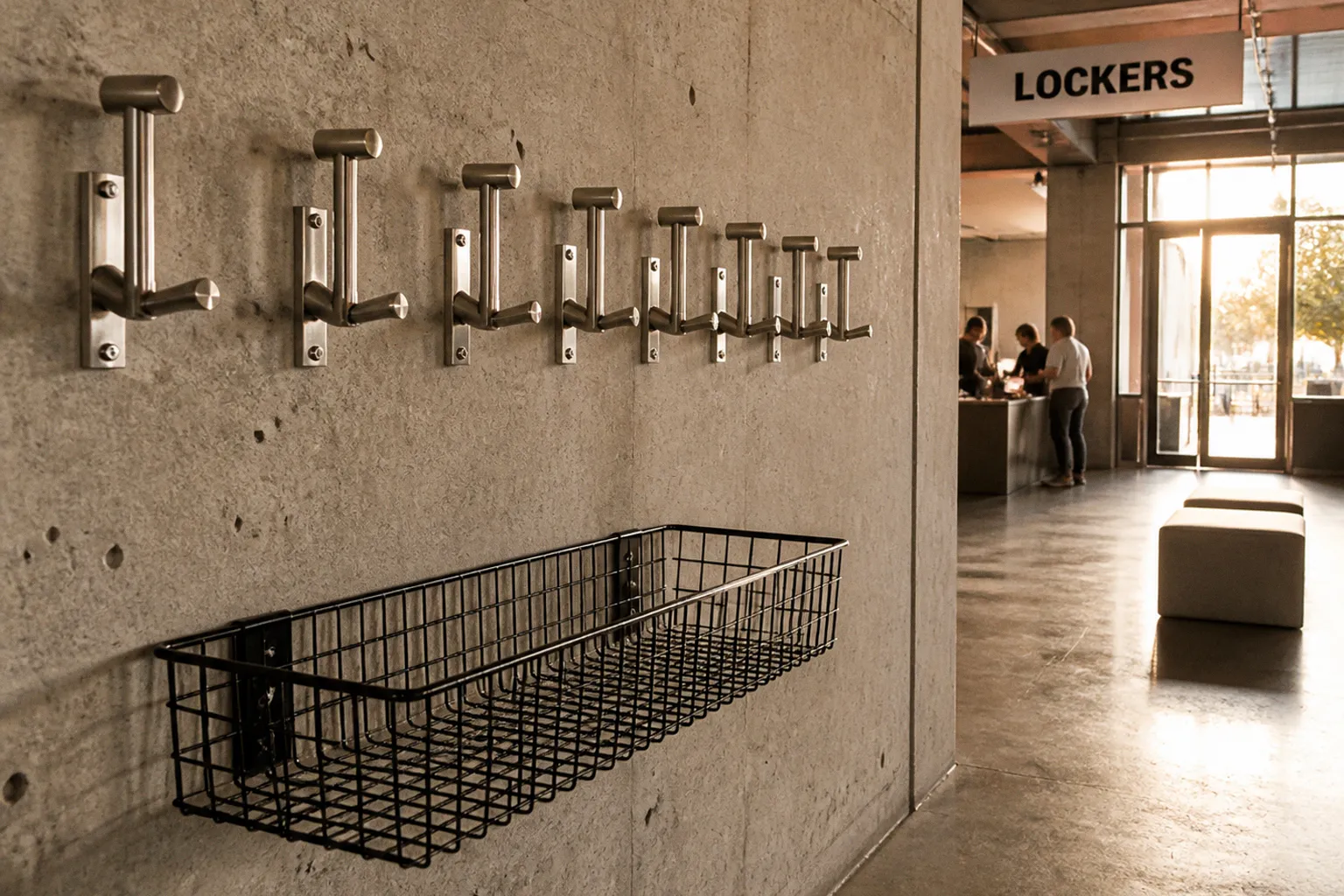
The museum provides on-site lockers for jackets, personal bags, and luggage. Visitors deposit belongings before entering the exhibition route. This is not optional equipment; it is the standard clearing mechanism for the circuit.
The locker system functions as the primary filter between street-level carry and gallery-level movement. The exhibition zones are interactive — visitors walk through mirror corridors, traverse the Abyss floor, move through the Starroom — and unsecured bags compromise both the visitor experience and the safety of others in confined passageways. The bag policy is structural, not cosmetic.
Mandatory storage threshold
The bag policy is enforced at the entry threshold. Visitors carrying backpacks, oversized day bags, or luggage cases are redirected to the locker area before they enter the circuit. Small handbags and pockets-only items typically pass through without redirection, but the boundary is enforced at the door and not negotiable inside.
Locker capacity and limitations
Lockers are sized for standard personal items: jackets, day bags, small luggage. Specific compartment dimensions and weight limits are not published. Visitors with atypical loads — professional camera bodies, large suitcases, or equipment cases — should confirm capacity at the venue before relying on the locker system.
The mechanism used to secure each compartment — coin deposit, digital lock, or token — is not specified in published venue information. Visitors should expect to carry either euro coins or a venue-issued token; confirm at the front desk on arrival.
The locker is not a closet. It is a clearing stage for the circuit.
Photography equipment and prohibited items
Personal photography and video recording are permitted inside the exhibition. Visitors are explicitly encouraged to capture the illusion environments — the mirror mazes, the Abyss floor, the Starroom, and the Shupliak paintings are designed with photo capture in mind.
Equipment restrictions
The permission is bounded by equipment class:
- Tripods are prohibited.
- Professional camera equipment is prohibited.
- Drones are prohibited.
The prohibition applies inside the exhibit rooms. Hand-held cameras and phones operate without restriction. The boundary is between amateur and professional gear, and between ground-level and elevated shooting platforms. Monopods and selfie sticks fall in an unclear zone — assume prohibited unless confirmed otherwise at the entry threshold.
Food, drink, and chewing gum
Additional prohibited items inside the exhibition areas:
- Food.
- Drinks.
- Chewing gum.
The food and drink prohibition covers the gallery circuit. Items must be consumed or discarded before entering. The constraint is structural as much as hygienic: liquid spills on the Abyss floor or inside mirror mazes create slip hazards that venue staff cannot remediate mid-visit. Solid food debris creates the same problem inside the confined corridors. The prohibition is a maintenance protocol expressed as a rule.
Chewing gum is banned specifically because it cannot be removed cleanly from carpeted or textured floor surfaces that exist in some installation zones.
| Permitted | Prohibited |
|---|---|
| Hand-held photo and video | Tripods, professional gear, drones |
| Personal phones | Selfie sticks and monopods (assumed prohibited) |
| Stored jackets and bags (in lockers) | Food, drinks, chewing gum |
| Standard luggage (in lockers) | Oversized equipment carried into galleries |
Accessibility constraints and structural limitations
The venue is not wheelchair accessible. This is a structural constraint, not a service gap or a temporary limitation. The two-floor layout, the mirror maze passages, the Abyss floor, and the Starroom configuration do not accommodate wheelchair routing. Visitors with mobility impairments should verify access arrangements with the venue before purchasing tickets — the published position is that wheelchair access is not available.
The museum may not be suitable for visitors with photosensitive epilepsy. The illusion environments use lighting transitions, strobe-like effects, and high-contrast visual patterns that can trigger seizures in susceptible individuals. The warning is published in the venue regulations; visitors with the condition should treat it as a hard exclusion rather than a discretionary caution.
Children aged 0 to 2 enter free of charge. The 45–60 minute circuit is the adult-paced average; families with young children should plan for longer duration, slower pace through the mirror mazes, and possible early exit if the child is overstimulated.
The maximum visitor capacity enforced per hour is not published. The timed-entry format controls instantaneous load on the two-floor circuit, but the precise cap is internal to venue operations. Visitors booking peak slots — weekend afternoons, public holidays, school-break periods — should expect tighter queuing at the entry threshold even with a confirmed time slot. Buffer the slot by 15 minutes upstream and downstream.
Operational checklist and final recommendation
The visit resolves to a sequence of constraints. Treat them in this order:
1. Confirm the timed-entry slot. Build the day's schedule around it, not around adjacent reservations.
2. Reduce carried items to phone, wallet, keys. Everything else routes to the locker.
3. Verify camera gear: phone or hand-held only. Tripods and professional bodies stay home.
4. Confirm fitness for the two-floor circuit. Wheelchair users and photosensitive-epilepsy visitors should confirm access before booking.
5. Plan for 45–60 minutes inside, plus 10–15 minutes for locker deposit and retrieval.
The DeJa Vu Museum is a fixed-footprint interactive venue with a single-entry, timed-access format. Visitors who arrive at the correct slot, with cleared pockets and compliant camera gear, complete the circuit within the published window. Visitors who treat the timed entry as flexible, arrive with full backpacks, or attempt to bring tripods into the mirror maze lose time at the threshold and at the locker bank. Operate within the published constraints and the visit runs on schedule.
Practical info
Currency: EUR
Driving: on the right
Emergency number: 112