Stainless steel racks: is grade 201 enough for retail?
I've been on enough install jobs to know that "stainless steel" means almost nothing at the point of sale. Walk into a supply showroom, ask about a garment rack, and you'll get a shiny tube with a price tag and a shrug about the grade.
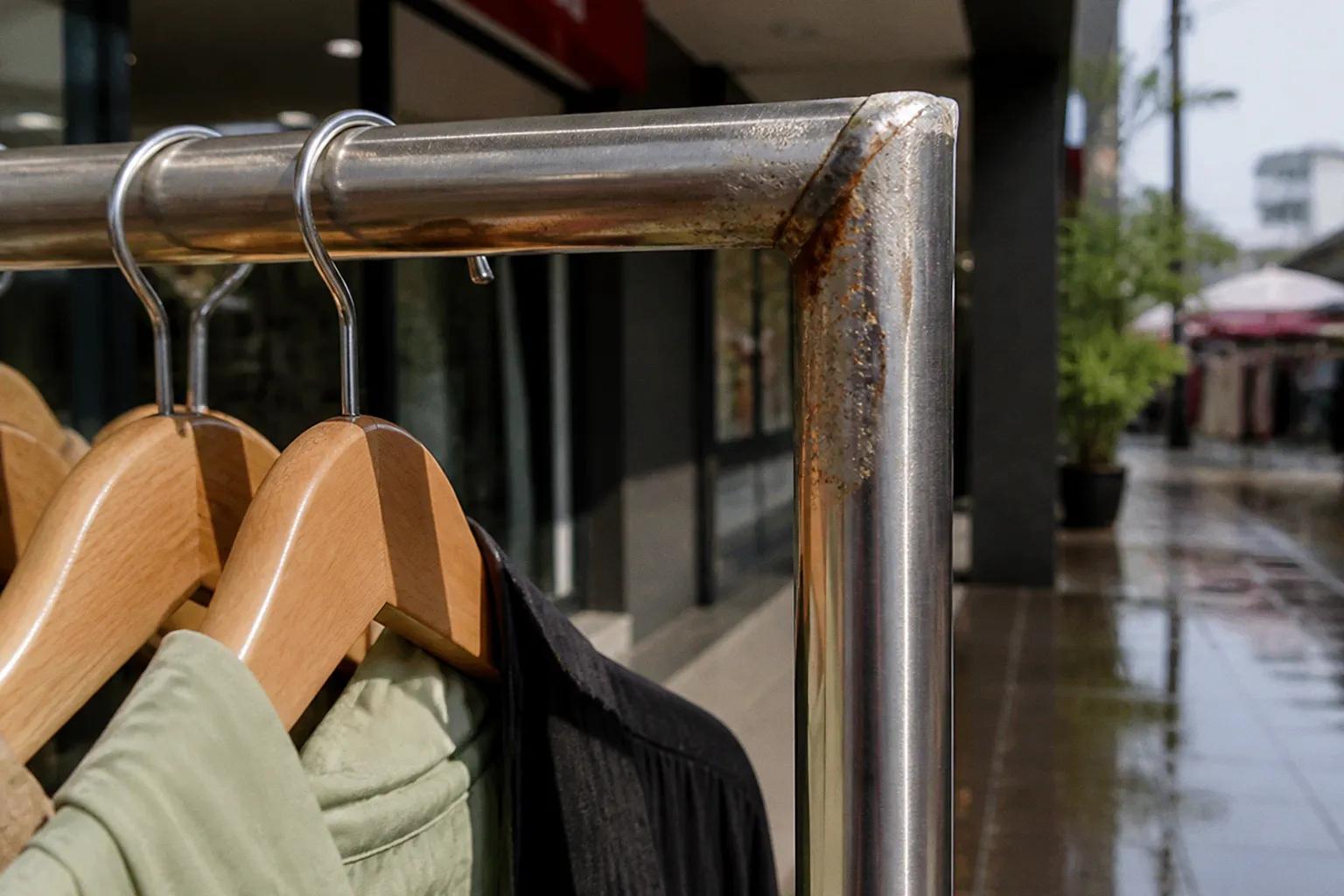
The difference between Grade 304 and Grade 201 isn't academic — it's the difference between a fixture that lasts a decade and one that develops orange freckles within a season. Let me walk you through what actually matters when you're choosing metal for a retail display, and why the cheaper option quietly costs more than anyone admits.
Compare car rental deals in United Kingdom
See available offersPartner link — DiscoverCars comparisonThe Chemistry of Strength: Why Grade 201 Outperforms in Rigidity
Here's the part nobody talks about: Grade 201 is stronger than Grade 304. Not "about the same," not "comparable" — measurably stronger on every mechanical benchmark that matters for a load-bearing rack.
Grade 304 stainless is the alloy most people picture when they hear "stainless steel." It's roughly 18% to 20% chromium and 8% to 10.5% nickel, with the balance mostly iron. That combination delivers excellent corrosion resistance, but nickel costs real money — which is why metallurgists in the 1950s started tinkering with a cheaper recipe.
Grade 201 swaps a big chunk of that nickel for manganese (5.5% to 7.5%) and a touch of nitrogen. The result is an alloy that is mechanically harder and tougher. Minimum tensile strength on Grade 201 clocks in at 655 MPa versus 515 MPa for Grade 304. Yield strength sits around 310 MPa for 201, roughly 45% higher than 304's 215 MPa. Both alloys maintain similar elongation figures — around 40% — so 201 achieves its higher strength without becoming brittle.
In practical terms, that means a Grade 201 tube won't bend or sag as easily under a heavy winter coat display. For a freestanding garment rack holding 30 kilograms of wool overhanging the base footprint, that extra rigidity is genuinely useful. I've replaced enough bowed 304 crossbars in mid-tier boutiques to respect the upgrade. The 201's rigidity also pays off in modular systems where verticality matters — tall tower racks that need to stay straight under asymmetric loading, or wall-mounted brackets bearing the weight of heavy denim collections without deflecting at the joint.
Grade 201 is not a downgrade in strength — it's a deliberate trade where manufacturers swapped corrosion resistance for cheaper, tougher metal.
Corrosion Resistance and the Chromium–Nickel Trade-Off
Now the bill comes due. All that extra rigidity comes from manganese and nitrogen, neither of which does much to fight rust.
Chromium is the element responsible for the passive oxide layer on any stainless steel — that thin, self-healing film of chromium oxide that re-forms the moment the surface is scratched. Both 304 and 201 carry enough chromium to form this layer (18–20% in 304 versus 16–18% in 201), so the film exists on both alloys. The difference lies in how well it holds up. Nickel in 304 stabilises the austenitic crystal structure, which promotes a more uniform, resilient passive film that recovers quickly from surface damage. It also significantly improves resistance to acidic and chloride-rich environments — exactly the conditions that attack retail fixtures hardest.
In Grade 201, the manganese–nitrogen substitution for nickel changes the picture. The passive layer tends to be less consistent, and manganese-rich inclusions in the microstructure can act as initiation sites for pitting corrosion. The alloy still qualifies as "stainless," but it reaches its limits much sooner once conditions deviate from dry and clean.
The test numbers aren't subtle. In accelerated salt-spray testing (ASTM B117), Grade 201 typically shows visible corrosion spots well before Grade 304 under identical conditions — often within the first 72 hours of exposure to mild acids or sustained humidity. Run the same test on Grade 304 and you're waiting many times longer for comparable degradation. That gap is what you're actually buying when you pay the 304 premium.
In a dry, climate-controlled retail floor — think an indoor shopping-mall store with consistent HVAC — Grade 201 will hold its finish for years. No problem. But step outside that controlled envelope and the math flips. A coastal boutique within a kilometre of saltwater air, a store near a loading dock where forklifts kick up road salt, a fitting-room area where steam from a garment steamer cycles through daily — these are the environments where 201 starts costing you. The rust doesn't creep up on you either. It blooms, often around the welds first, then creeps along the polish lines.
Chromium builds the passive film that keeps stainless steel stainless — nickel makes that film robust enough to survive the real world.
Visual Differences: Assessing Surface Finish and Aesthetic Quality
If you put a polished 304 tube next to a polished 201 tube under retail lighting, you'll see it. The 201 reads darker, hazier, slightly muddy. The 304 has that clean, bright, almost-white reflectivity that boutiques and flagship stores pay a premium to showcase. The manganese content in 201 dampens the surface brilliance — it's not a defect, it's the alloy showing through the polish.
For most apparel merchandising, that visual difference matters. A mirror-black or brushed-brass finish over a 201 substrate reads as "dull premium" rather than "premium premium." If your store leans on chrome plating or polished-metal accents as part of the brand language, 304 gives you the canvas the finish was designed for. 201 gives you a slightly muted version that works fine for back-of-house or warehouse display, less so for a front-of-house fixture where the metal itself is part of the merchandising story.
One further consideration: over time, the visual gap between the two grades tends to widen. Grade 304 holds surface finishes more uniformly; 201 is more prone to gradual darkening, haze, and — in plated or coated finishes — uneven wear that can eventually let the substrate show through. The timeline for that degradation varies enormously depending on coating quality, cleaning regimen, handling frequency, and environmental conditions, so no single number applies universally. What's consistent is the direction: 304 ages more gracefully.
| Surface Parameter | Grade 304 | Grade 201 |
|---|---|---|
| Chromium content | 18–20% | 16–18% |
| Nickel content | 8–10.5% | 3.5–5.5% |
| Manganese content | ≤2% | 5.5–7.5% |
| Reflectivity (polished) | Bright, white, mirror-like | Darker, hazier, matte-leaning |
| Brushed/satin appearance | Clean, uniform grain | Slightly muddier grain |
| Finish consistency over time | Holds surface treatments evenly | More prone to uneven wear and haze |
The "looks identical under showroom lights" claim is the most common piece of marketing fiction in this category. It holds for about ten minutes. After a season of merchandising, dust, and customer contact, the difference becomes obvious — and the difference is always in 201's favour on price and against it on appearance.
Long-Term Cost Analysis: Upfront Savings vs. Replacement Cycles
The 20% to 40% upfront savings on Grade 201 is real. I've seen procurement teams light up when a quote comes in 30% under budget on a 200-rack rollout. That number, though, ignores the second replacement cycle.
In a corrosive or humid environment, 201 has a service life measured in months rather than years before visible pitting and rust staining start undermining the fixture. Grade 304 in the same conditions runs 8 to 10 years or longer. Do the math on a chain of 15 stores refreshing fixtures every two years versus every decade, and the 201 "savings" evaporate into labour, disposal, and brand-image costs fast.
For dry indoor retail, the lifespan comparison narrows considerably — both grades will outlast a typical 5-year lease cycle without much fuss. That's where the upfront savings genuinely land in your pocket. The question is whether your store environment stays "dry indoor" for the life of the rack, or whether it gradually becomes something else: humidity from a new espresso bar next door, a relocated fitting room near a restroom, seasonal condensation from a poorly insulated storefront, a cleaning contractor who switches to acidic descalers.
A retrofit project that looked cheap at quotation often turns into the most expensive fixture line item in the operating budget by year three. The 201 rack doesn't fail dramatically — it just slowly stops looking like the spec sheet.
Environmental Suitability: Matching Metal Grades to Store Conditions
Here's the decision framework I walk clients through. It's less about "best metal" and more about "honest match."
Grade 304 is the right call for:
- Coastal locations within 1 km of the ocean
- Stores with washdown cleaning protocols or steam sanitisation
- High-humidity environments (pool clubs, spa retail, tropical climates)
- Outdoor displays, even semi-covered ones
- Anywhere road salt, de-icing chemicals, or industrial airborne contaminants reach
- Flagship or high-end retail where the metal finish is integral to brand identity
Grade 201 works for:
- Dry, climate-controlled indoor retail with stable HVAC
- Back-of-house stockrooms and warehouse garment storage
- Pop-up or short-term displays where the deployment window is under two years
- Budget-conscious rollouts where the display is replaced on a planned refresh cycle regardless
- Secondary fixtures, internal structures, or areas where the metal is concealed behind panels or fabric
If your store sits somewhere between those two columns — say, an urban boutique in a city with humid summers but no coastal exposure — the safer pick is still 304. The cost differential per rack is modest at unit scale, and it removes the "is this the season it starts rusting?" anxiety that 201 owners quietly live with. The clearance you lose from buying the premium alloy once is roughly the clearance you lose every two years chasing rust patches on the cheaper alternative.
Reality Check Before You Buy
Before you sign the purchase order, walk through this list:
- Demand the grade in writing. "Stainless steel" is not a specification. The supplier should specify 304 or 201 by name, ideally with a mill certificate confirming composition.
- Test the finish. Ask for a side-by-side polished sample under your actual retail lighting — not showroom fluorescents. The visual difference between 304 and 201 is obvious once you know what to look for.
- Audit your environment honestly. Humidity, cleaning chemicals, coastal air, HVAC consistency — these determine whether 201's cost advantage survives contact with reality. Factor in how the space might change over a five-year lease, not just how it looks today.
- Calculate lifecycle, not unit cost. A 30% saving that forces a replacement at month 20 isn't a saving — it's a lease on someone else's scrap metal.
- Check the joining method. Welds and crimps on 201 corrode faster than the parent metal. Stainless hardware on a 201 tube is a weak link worth scrutinising before sign-off.
- Plan for finish degradation. Even in dry indoor retail, 201 darkens and hazes faster than 304. If brand presentation matters over the long term, 304 ages more gracefully.
The honest answer to the question in the headline: Grade 201 is enough for retail if your retail is dry, climate-controlled, and not too bothered by a slightly muted finish that gradually deepens. For anything else, the strength advantage 201 offers doesn't offset the corrosion risk. You end up paying for rigidity you didn't need and replacing fixtures you shouldn't have had to.